
Corruption is a Key Priority, But Types of Corruption Differ in Relevance
Corruption consistently ranks as a top-five issue for Americans, nationally and even higher in the battleground. Americans want Congress and the President to focus on inflation and the cost of living (60%), jobs and the economy (46%), healthcare (42%), Social Security and Medicare (37%) and corruption in government (32%).
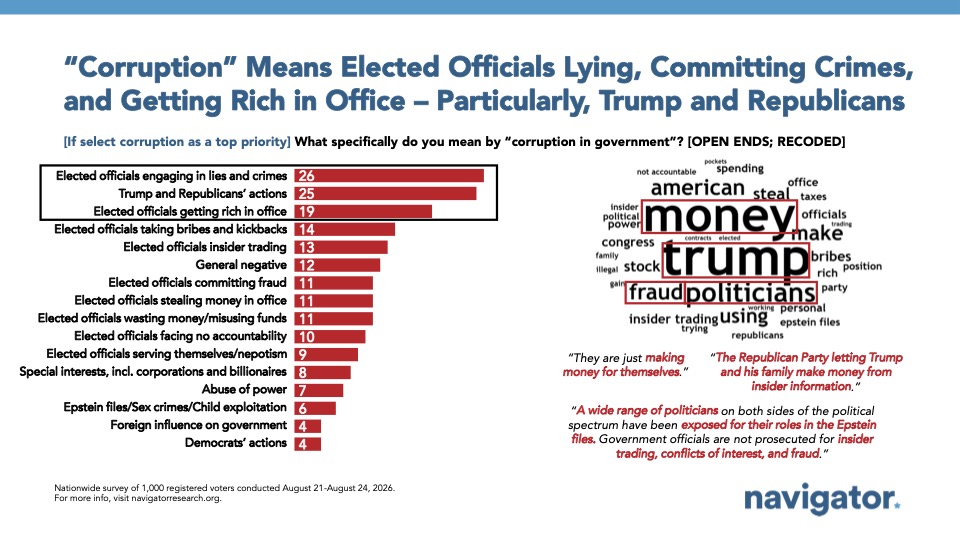
Despite corruption in government being a top issue Americans want the president and Congress to work on, not all corruption is created equal. Americans who rank corruption as a key priority think of corruption as a range of different definitions: elected officials engaging in lies and crimes (26%), Trump and Republicans’ actions (25%) and elected officials getting rich in office (19%).
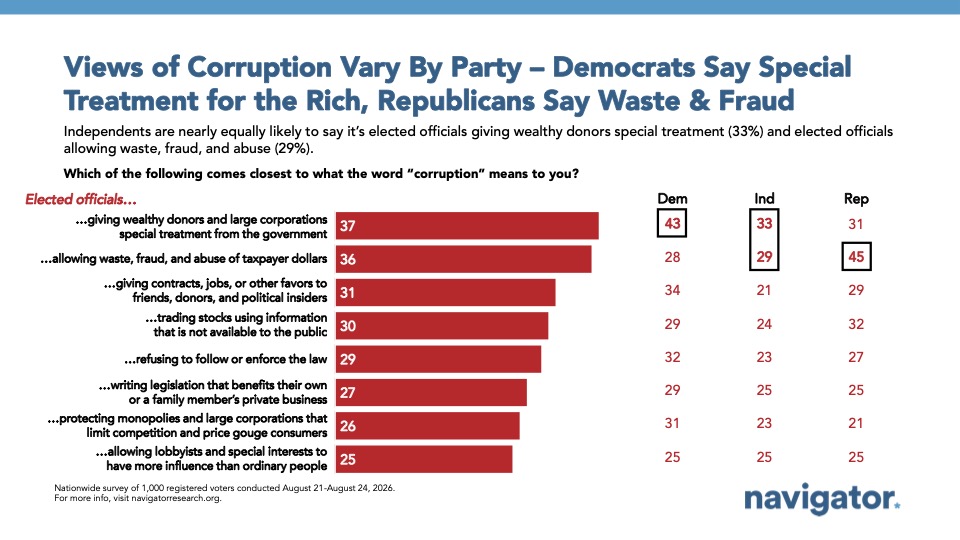
Democrats (43%) are much more likely to identify elected officials giving wealthy donors and large corporations special treatment from the government, while Republicans (45%) identify allowing waste, fraud, and abuse of taxpayer dollars as corruption. Independents are more split amongst the two, with 33% identifying corruption as special treatment for the rich, while 29% identify it as waste and fraud.
While views on corruption differ by party, a majority of Americans (88%) say many to nearly all elected officials are corrupt. Independents (40%) are especially likely to say “nearly all” are corrupt, compared to 32% of Democrats and 31% of Republicans.
Most See President Trump and Republicans as More Corrupt
No matter how Americans define it, most see President Trump and Republicans as more corrupt. A majority of Americans (60%) say Trump is bringing more corruption to Washington, 20-points higher than those who say he’s fixing it. In February of 2025, this difference was only two points (51% bringing corruption to Washington – 49% fixing it). Nearly all Democrats (92%) share this view, as well as strong majorities of Trump regretters (72%) and independents (71%).
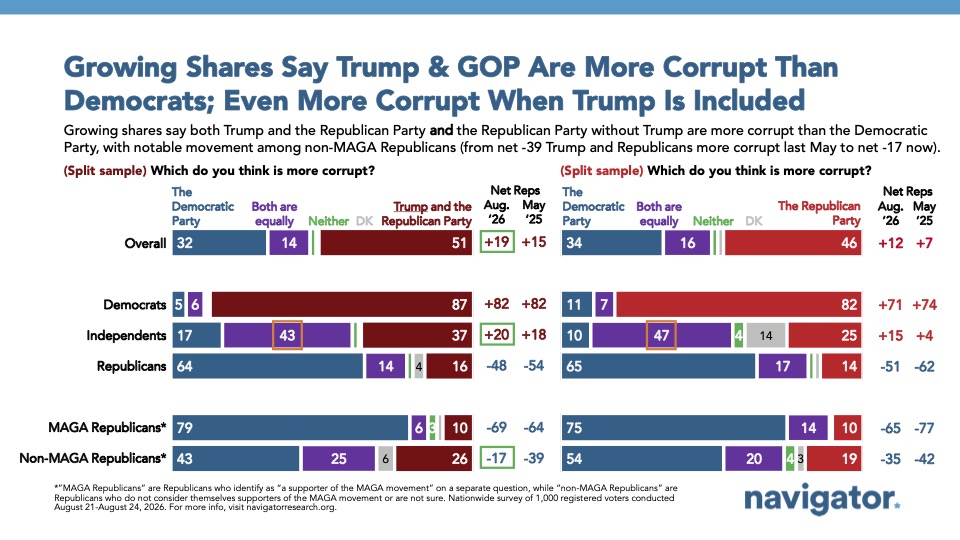
When asked which party they deem to be more corrupt, Americans say the Republican Party by 12 points (46% Republican Party is more corrupt – 34% Democratic Party is more corrupt). Adding President Trump to the choice only widens the gap (51% – Trump and the Republican Party is more corrupt – 32% Democratic Party is more corrupt).
- Black (71%) and Latino (65%) Americans feel especially strongly that Trump and the Republican Party is more corrupt, compared to white (46%) Americans.
Americans consistently report Republicans as being more likely to engage in a range of corrupt acts, from giving wealthy donors special treatment to protecting monopolies to price gouge Americans.
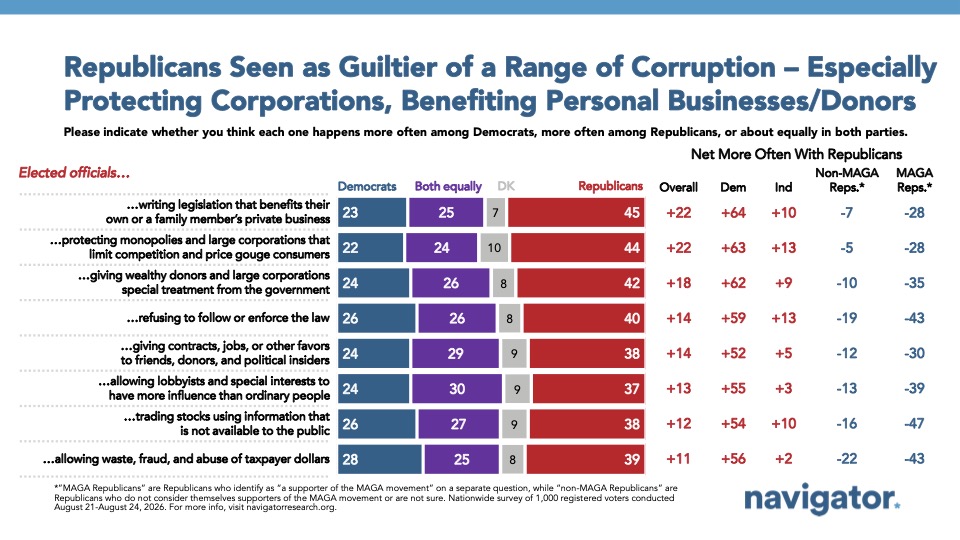
Despite Americans viewing Republicans as more likely to be corrupt, this does not mean they trust Democrats to handle corruption. Americans are split on who they trust to take on corruption, with about one-third (35%) saying they trust the Democratic Party, one-third (33%) putting their trust in the Republican Party and another third (32%) reluctant to trust either party or don’t know.
The Political System, Presidency, and Congress Seen as Most Broken and Needing Major Changes
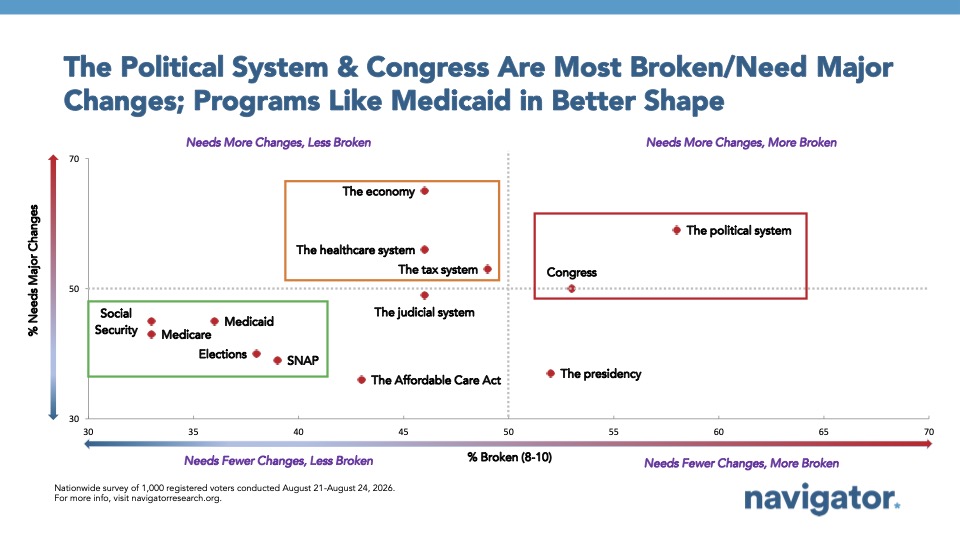
When asked about a variety of U.S. systems, programs, and institutions, Americans ranked the political system (58% broken), Congress (53% broken) and the presidency (52% broken), as the most broken.
A majority (59%) believe the political system needs major changes, and nearly one-in-five (17%) believe it needs to be torn down completely. Younger Americans ages 18-34 are more likely to say the political system is broken (65%), compared to older Americans (35-54, 55% broken – 55 and older, 56% broken). Three-quarters (74%) believe the economy needs either major changes or to be torn down completely, and sentiment shared especially strongly by independents (57% needs major change).
The political system and Congress are viewed as both the most broken and in need of change, while the economy and healthcare are viewed as less broken, but still deeply in need of change. Notably, basic needs programs like Social Security, Medicare, Medicaid, and SNAP are seen as among the least broken programs and in need of fewer changes. The same can be said about our election system.