Earlier this month, Americans gave Democrats the biggest majority in Congress in half a century. Navigator polled 3,000 midterm voters (compared to our normal samples of 1,000 registered voters) across the country to learn more about why they cast their ballots and what they’re looking for in their elected leaders. This report is the second in a series of findings from this survey.
Inflation and Cost of Living Was Top of Mind for 2026 Midterm Voters, Followed by Jobs and the Economy and Healthcare
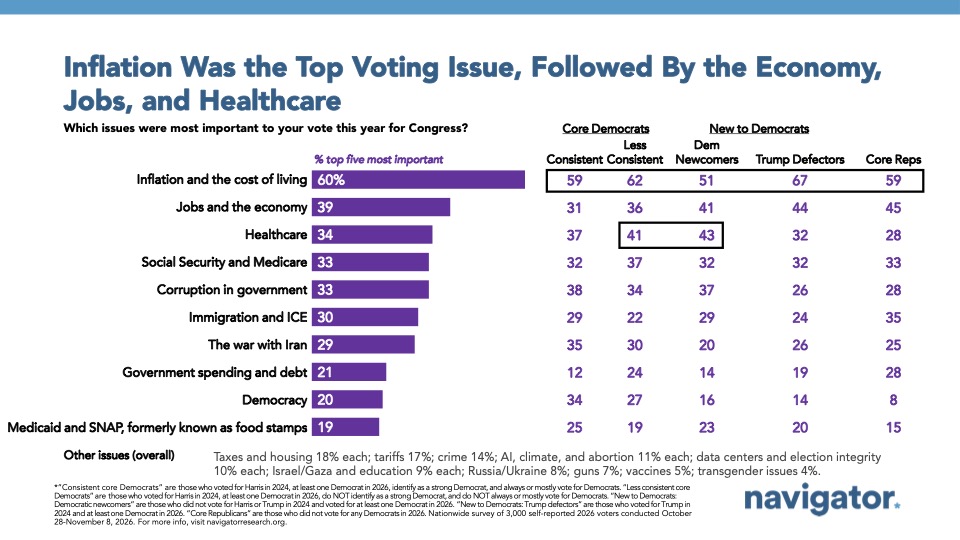
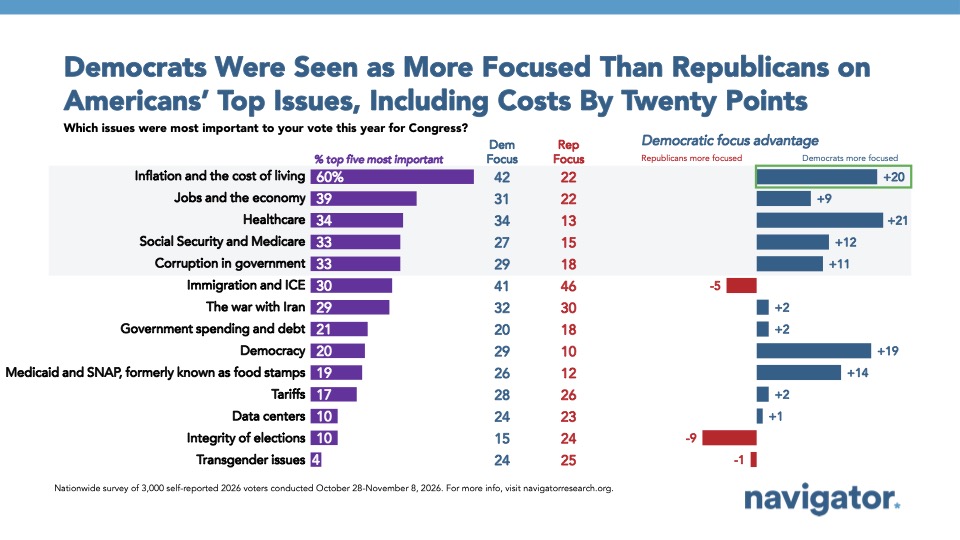
When asked to pick the top five most important issues affecting their vote for Congress, 60% of voters said inflation and the cost of living. Over a third (39%) of midterm voters also cited jobs and the economy within their top five, while about a third said healthcare (34%), Social Security and Medicare (33%), corruption in government (33%), and immigration and ICE (30%).
- Younger voters were more likely to vote based on jobs and the economy; 47% ranked it as a top five issue compared to just 27% of those over 65.
- 43% of Democratic newcomers – those who voted for neither Harris nor Trump in 2024 and voted for at least one Democrat in 2026 – had healthcare as a top-five issue, nearly 10 points higher than voters overall.
- 67% of Trump defectors – those who voted for Trump in 2024 and voted for at least one Democrat in 2026 – cited inflation and the cost of living as a top-five issue.
- Over two-thirds (68%) of independents rated inflation and the cost of living as a top-five issue.
When asked what issues motivated votes against a candidate, inflation and the cost of living also topped the list (37%), followed by immigration and ICE (33%) and corruption in government (28%). All three of these issues have been deeply tied to President Trump’s actions during his first two years in office.
Trump holds a 78% disapproval rating on his handling of inflation and the cost of living, and 59% of Americans disapprove of Trump’s handling of immigration. One Texas mom Trump regretter from a Navigator focus group earlier this fall said, “I feel like ICE was definitely the wrong way of going about a lot of things.” Corruption has also ranked as a top-five issue for Americans nationally, and most (60%) say Trump is bringing more corruption to Washington rather than fixing it.
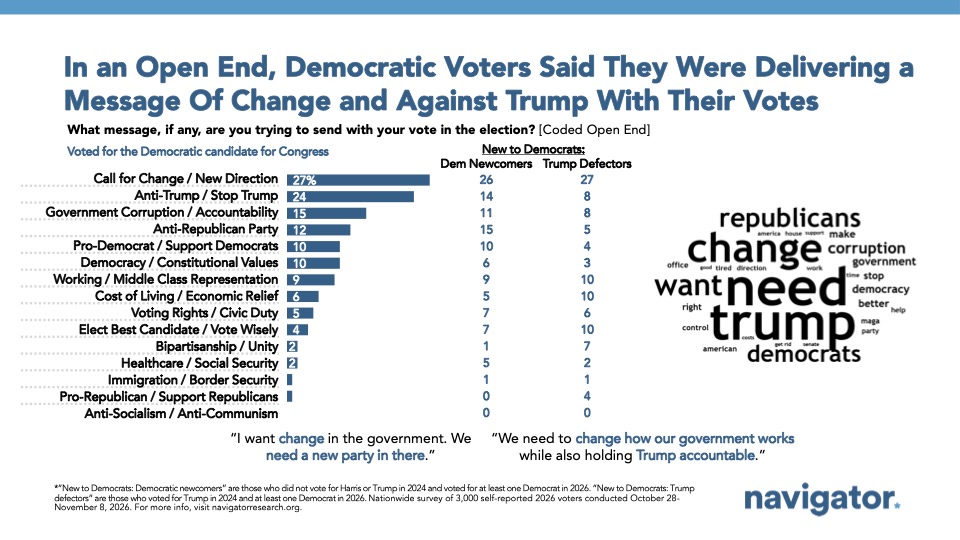
When asked what message voters were trying to send with their vote, 27% called for change and 24% were anti-Trump.
Americans Saw Democrats Focused on Their Priorities and Republicans Focused Elsewhere
Voters saw Democrats as more focused on the top issues they prioritized. By 20 points, Democrats were seen as more focused than Republicans on inflation and the cost of living. Democrats also held strong leads over Republicans on jobs and the economy (+9 points), healthcare (+21 points), corruption in government (+11 points), and Social Security and Medicare (+12 points), all top issues for voters. New Democratic voters saw Democrats as especially focused on healthcare (+26 points).
On the contrary, despite inflation and cost of living being the top issue, Republicans were seen as focusing on immigration and ICE (46%), the war with Iran (30%), and tariffs (26%), which Americans see as directly raising their costs. Although 25% saw Republicans as fixating on transgender issues throughout this cycle, only 13% cited it as an important reason for their vote.
Americans Supported Democrats Over Republicans for Economic Reasons, to Protect Medicare and Social Security, and as a Rejection of Trump
Voters backed Democrats for economic reasons. By 30 or nearly 30 points, Americans saw the issues of costs, tariffs, and healthcare, as more of a reason to support Democrats. This margin is even wider in many cases for Democratic newcomers and Trump defectors.
- Democratic newcomers saw the issues of tariffs, grocery costs, and inflation as more of a reason to support Democrats by over 80 points.
- Trump defectors saw the issues of Medicaid, grocery costs, and gas and diesel costs as more of a reason to support Democrats by over 40 points,
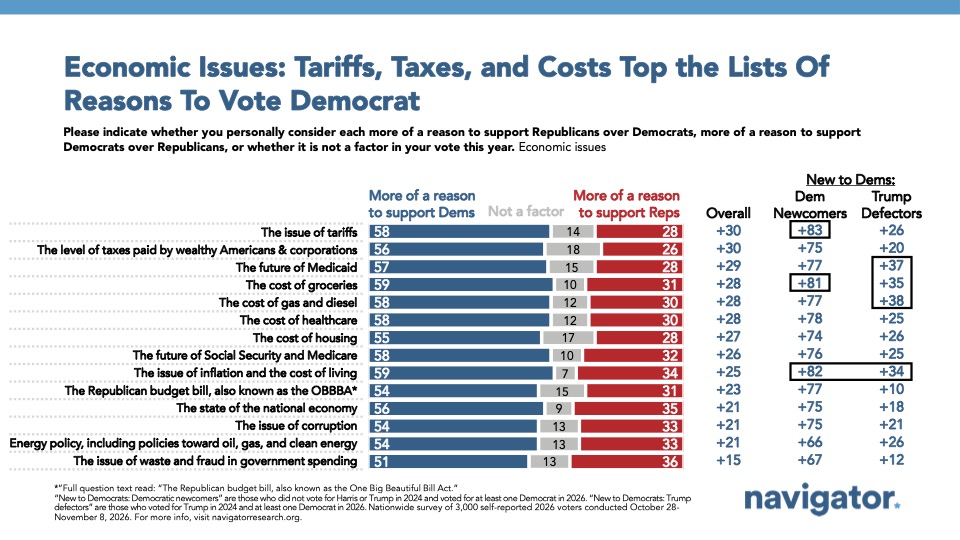
Nearly all (93%) of those who voted for House Democrats cited inflation and the cost of living as a reason to do so. Additionally, those who disapprove of Trump were more likely to cite economic reasons to support Democrats (83% inflation and the cost of living, 82% cost of groceries, 82% cost of gas/diesel, 82% tariffs).
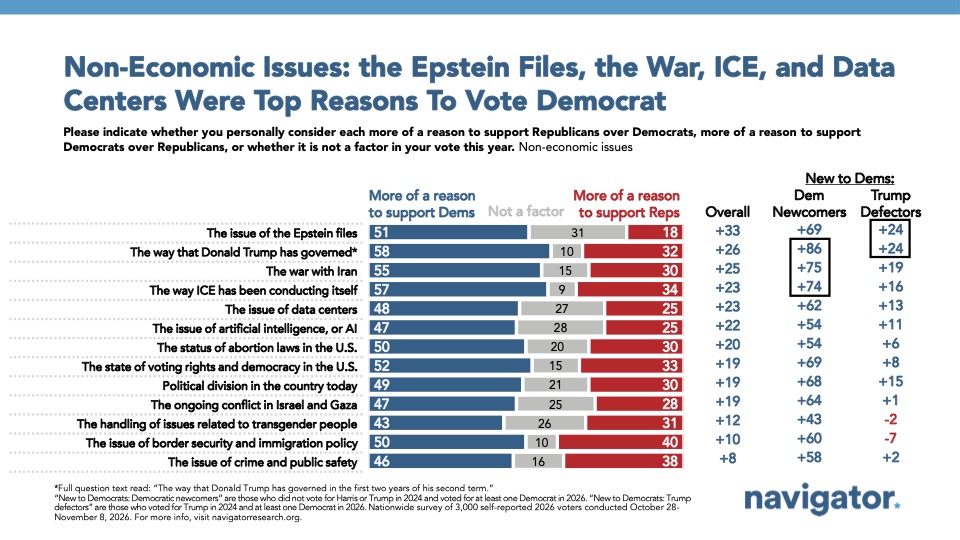
Americans also supported Democrats as a rejection of Trump. Over half (58%) say they supported Democrats because of the way that Donald Trump has governed in the first two years of his second term, 57% cited the ICE’s conduct, 54% cited corruption, and 51% cited the Epstein files.
- Democratic newcomers were especially moved by the way Trump has governed (+86 points support Democrats), the Iran war (+75 points support Democrats), and ICE (+74 points support Democrats).
- Trump defectors were especially moved by the Epstein files (+24 points support Democrats) and the way Trump has governed (+24 points support Democrats).
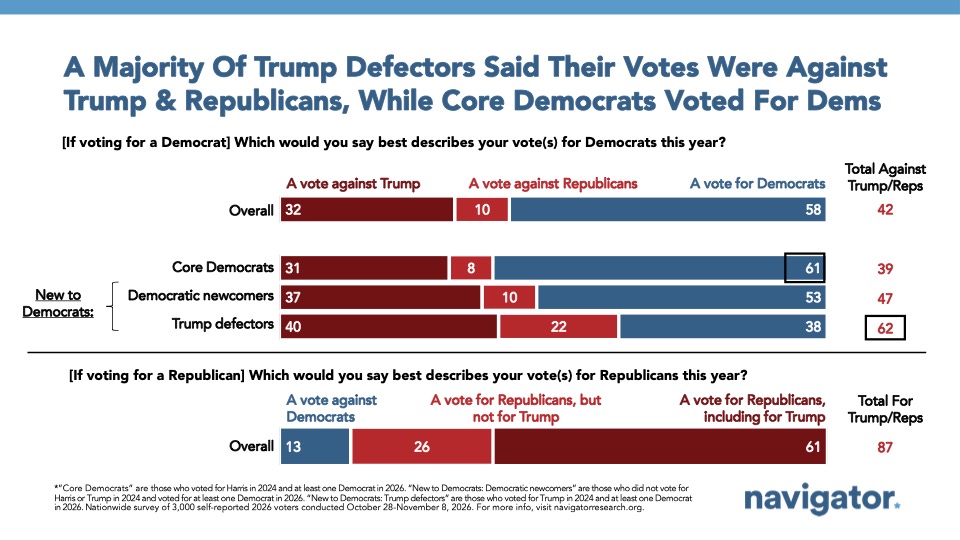
Of those who voted for a Democrat, 58% described it as an affirmative vote for Democrats, but nearly one-third described it as a vote against Trump (32%) or against Republicans (10%). Nearly two-thirds (61%) of Republican women described their vote for Democrats as a vote against Trump, as well as 51% of Republicans and 48% of 2024 Trump voters.
Of groups who most affirmatively supported Democrats:
- 64% of Latino women saw their vote as an affirmative vote for Democrats, compared to 51% of Latino men. This was the most pronounced gender gap Navigator saw within racial groups.
- 70% of Black Americans saw their vote as an affirmative vote for Democrats, compared to 63% of AAPI Americans, 59% of Latino Americans, and 54% of white Americans.
- 68% of Gen Z saw their vote as an affirmative vote for Democrats, compared to 62% of Millenials, 56% of Gen X, and 55% of baby boomers.
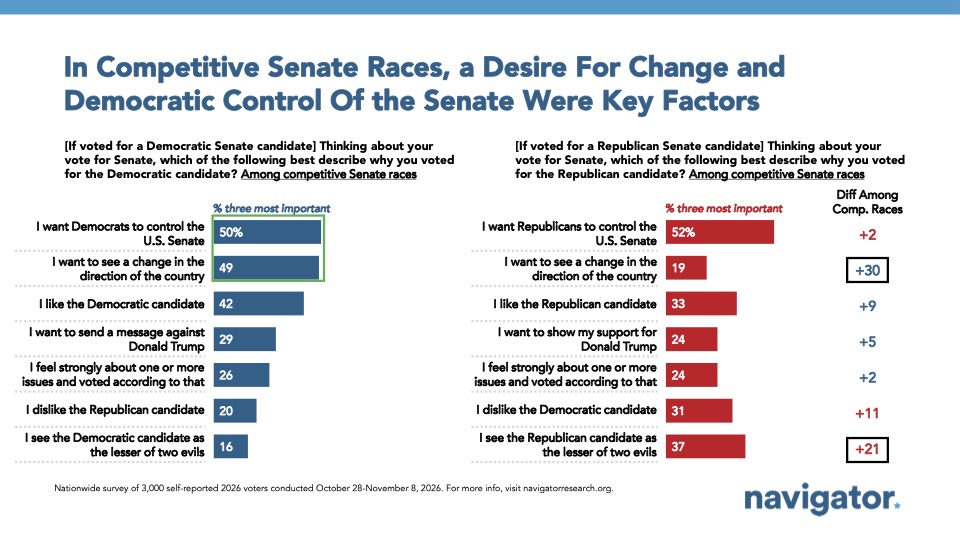
In competitive Senate races, Americans voted for the Democratic candidate because they wanted to see Democratic control (50%) and change (49%). Competitive Democratic Senate voters were more likely to say they liked their party’s candidate (42%) compared to Republican Senate voters (33%). Competitive Republican Senate voters were also more likely to say that they saw their party’s candidate as the lesser of two evils (37%) compared to Democratic Senate voters (16%).