

Americans Feel Corruption in Their Pocketbooks and Want Elected Officials To Address It
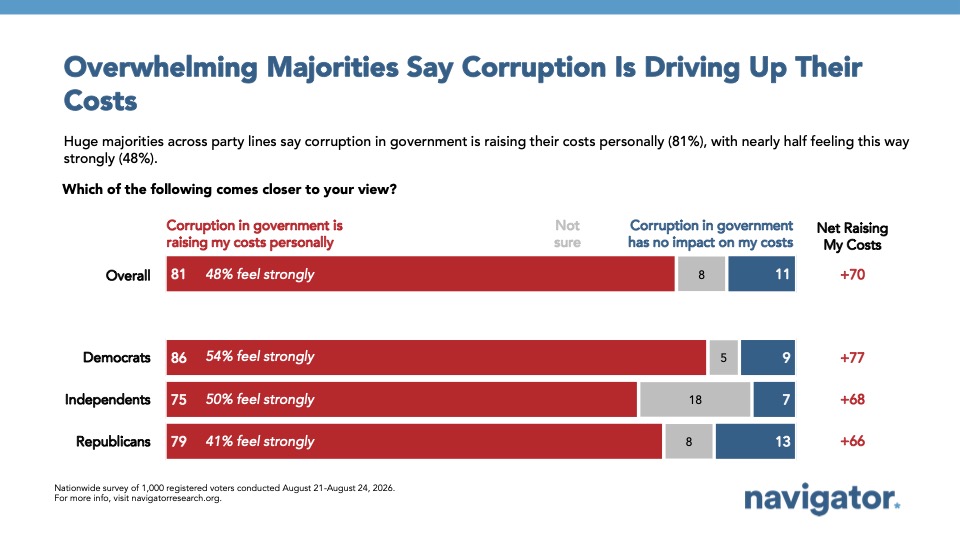
Corruption isn’t just an abstract political issue for Americans, it’s a pocketbook one. Four-in-five Americans (81%) see corruption in government as raising costs, and nearly half (48%) feel this way strongly. Non-MAGA Republicans (82%) and independents (75%) are especially likely to say this is the case.
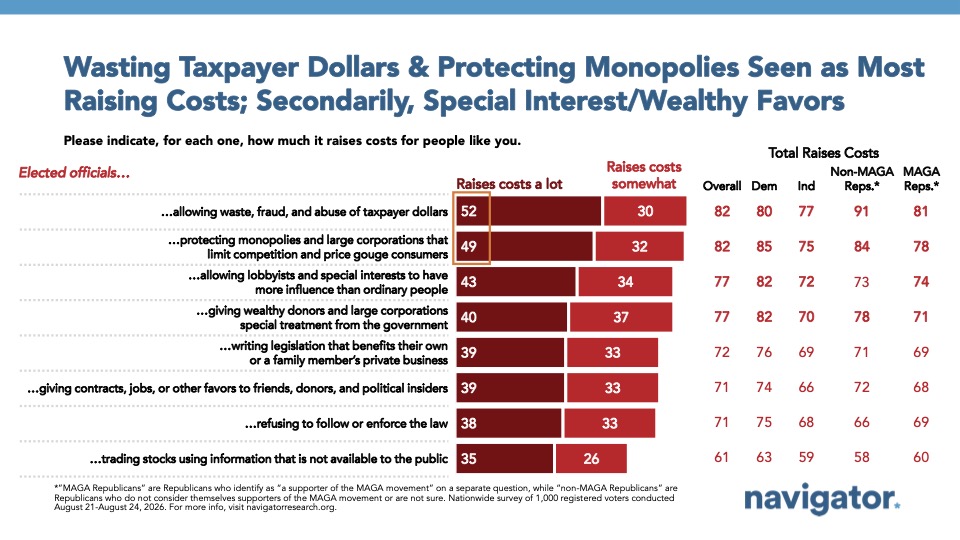
When asked to name the culprits behind these rising costs, most Americans point to elected officials allowing waste, fraud, and abuse of taxpayer dollars (82% raises costs, including 52% raises costs a lot) and protecting monopolies and large corporations that price gouge consumers (82% raises cost, including 49% raises costs a lot).
Cracking Down on Unfair Price Gouging and Prosecuting Corporate Fraud Are Seen As Most Effective Ways To Address Corruption and Lower Costs
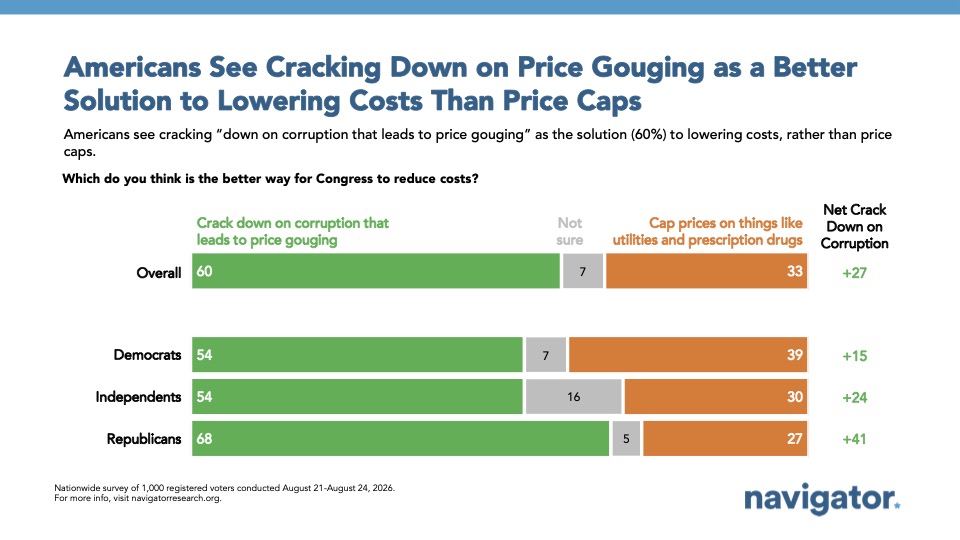
When it comes to solutions, Americans have a clear preference. Three-in-five (60%) agree cracking down on price gouging is the best way to reduce costs, compared to only one-in-three (33%) who say capping prices of things like utilities and prescription drugs is the best solution. Independents (net +24 points) and Republicans (net +41 points) feel especially strongly about cracking down on corruption in comparison to capping prices. Notably, nearly one-in-five (16%) independents have yet to make up their mind.
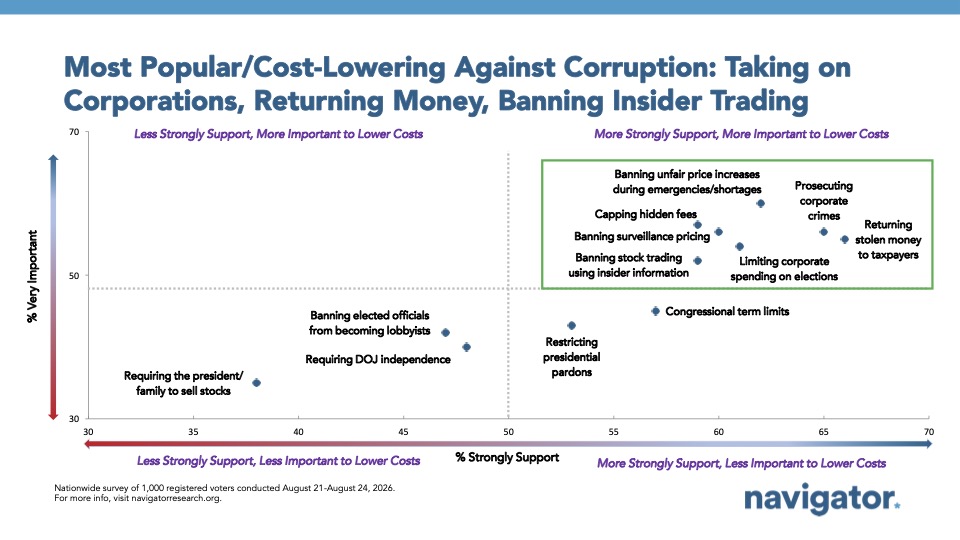
Americans want accountability and relief. The top three measures to address corruption – recovering and returning stolen money to taxpayers (66% strongly support), prosecuting corporate wage theft (65% strongly support), and banning companies from unfairly raising costs (62% strongly support) – reflect a desire to hold bad actors accountable. But there is also strong support for measures that would directly lower costs, including banning unfair price hikes during emergencies or shortages (60% very important), capping hidden fees (57% very important), prosecuting corporations for fraud (56% very important), and banning the use of personal data to charge consumers differently (56% very important).
Americans View Trump and His Family, Billionaires, and Corporations As the Most Corrupt
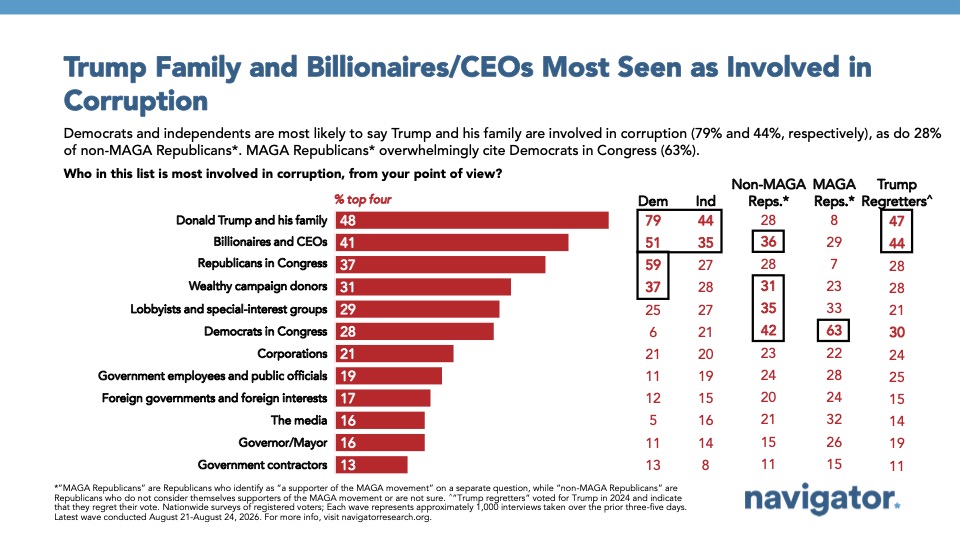
President Trump and his family (48%) are viewed as the most corrupt when stacked against billionaires, CEOs, lobbyists, and other political officials. While Democrats overwhelmingly share this view (79%), it is also shared by nearly half (47%) of Trump regretters and a third (34%) of independents and non-MAGA Republicans. Communities of color (60%) also view Trump as the most corrupt, compared to less than half (42%) of white Americans.
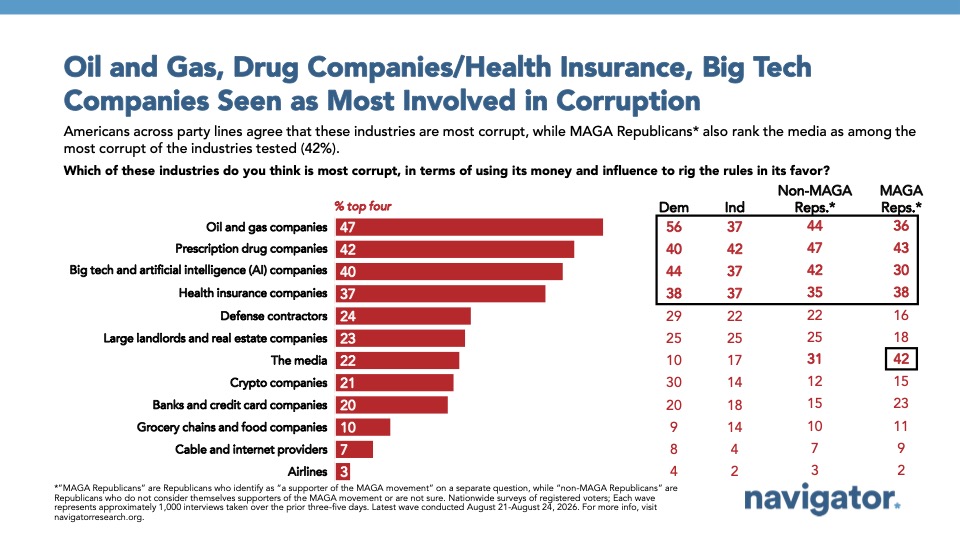
Americans name oil and gas companies (47%), prescription drug companies (42%), big tech and AI companies (40%), and health insurance companies (37%) as the most corrupt industries. But there are partisan divisions around which corporations are the most corrupt. Democrats (56%) are more likely to name oil and gas companies, a villain also most salient amongst Trump regretters (47%). Republicans (45%) and independents (42%) are more likely to call out the prescription drug industry. Media stands out as its own flashpoint with MAGA Republicans (42%) in particular calling the industry corrupt, compared to 31% of non-MAGA Republicans and just 17% of independents.
Most Convincing Argument To Address Corruption Connects to Costs and Emphasizes No One is Above the Law
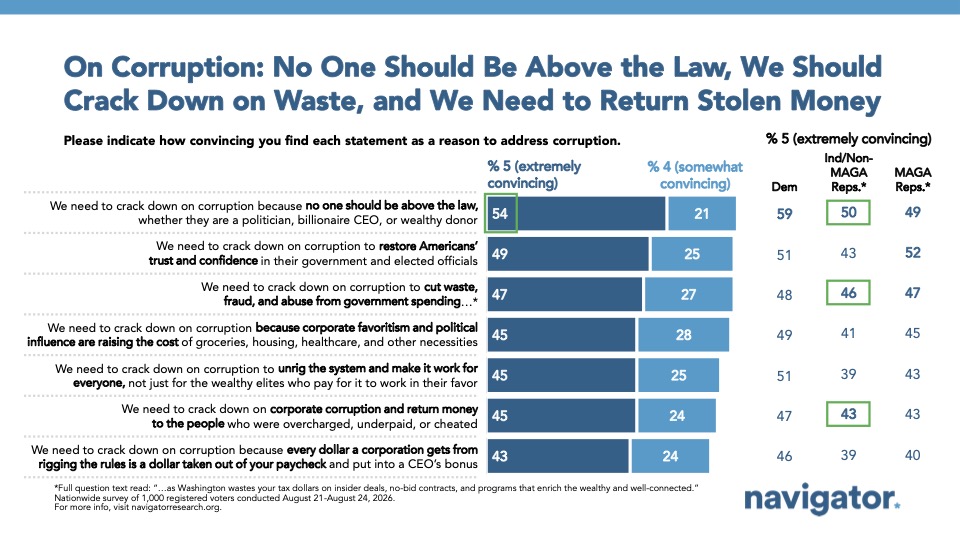
The most convincing argument for addressing corruption emphasizes that whether they are a politician, billionaire CEO, or wealthy donor – no one is above the law. Three-in-four found this statement to be convincing, including 54% who found it to be extremely convincing. Americans across demographics agreed, but it was especially salient for women (57% extremely convincing), Americans over 55 (63% extremely convincing), non-MAGA Republicans (55% extremely convincing). Independents and non-MAGA Republicans found this messaging to be the most convincing (50% extremely convincing) among the tested messages.
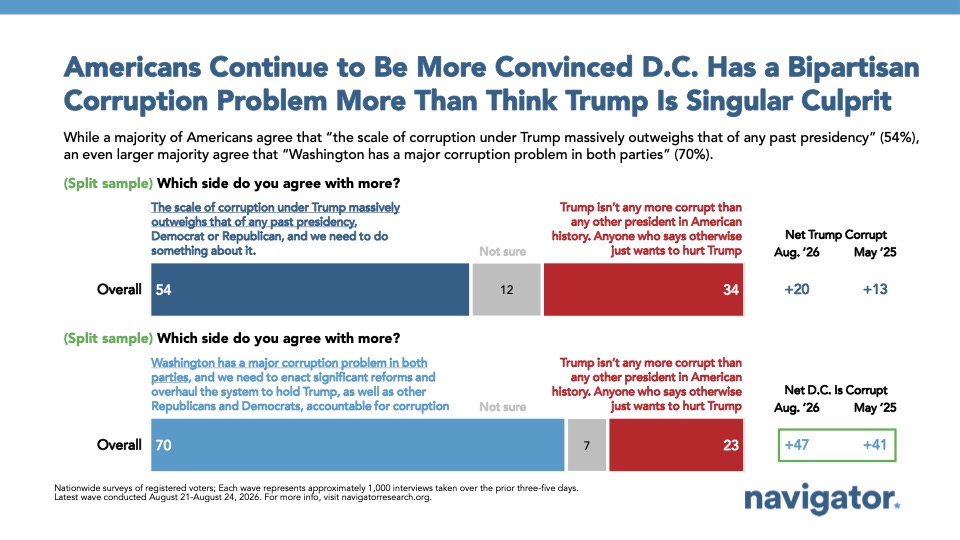
Americans are also convinced Washington’s corruption problem is bipartisan, so any effective message should acknowledge this reality. By 20 points, more feel corruption under Trump outweighs past presidencies (54% Trump is more corrupt – 34% Trump isn’t more corrupt than anyone else). However, by nearly 50 points, Americans feel Washington has a major corruption problem in both parties (70% both sides are corrupt – 23% Trump isn’t more corrupt than anyone else).
Messaging Framework When Advocating for Action To Address Corruption
- Cost of living is top of mind for Americans, and rampant corruption is making it worse. Anti-corruption messaging and policies that address both in tandem are winners.
- Acknowledge the status quo in Washington is broken, don’t try to defend it.
- Focus on the point that no one is above the law. Use messaging like: Corruption is raising everyday costs – we need to crack down on corruption because no one should be above the law, whether they are a politician, billionaire CEO, or wealthy donor.
- Pick an effective villain, such as the large corporations Americans already believe are screwing everyone over.
- Name a solution that focuses on accountability and actually lowering costs. Americans overwhelmingly agree cracking down on corporate price gouging is the most effective way to lower costs and address corruption. Other popular actions include:
- Returning stolen money to taxpayers.
- Banning insider trading in government.
- Taking on big corporations with a range of actions: prosecuting corporate crimes, banning unfair price hikes, limiting corporate spending on elections, and banning surveillance pricing.