
Americans Remain Opposed to the War with Iran
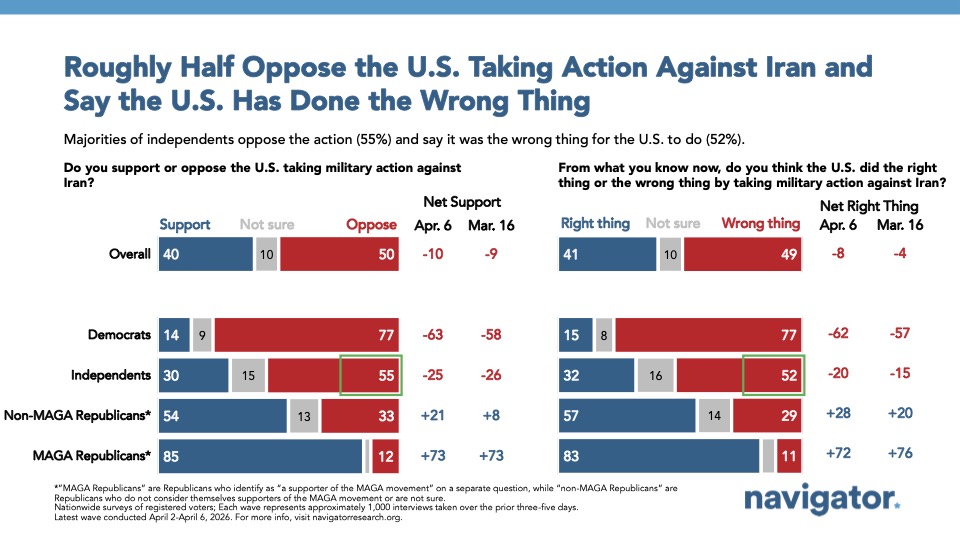
Over one month into the conflict, Americans oppose the war with Iran by 10 points (40% support – 50% oppose). This is roughly the same as in March, when support for the war was underwater by nine points (40% support – 49% oppose).
More Americans think the U.S. did the wrong thing by taking military action against Iran than think it was the right thing to do (41% right thing – 49% wrong thing). This eight-point gap is slightly wider than what it was in March when 43% viewed military action as the right thing and 47% viewed it as the wrong thing.
Plurality Say the Iran War Makes Their Families and Communities Less Safe
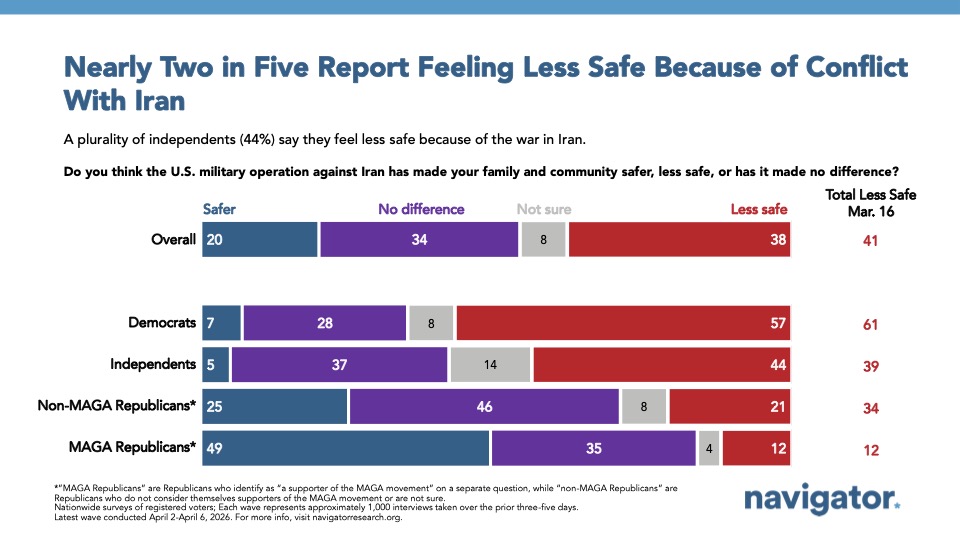
President Trump claims the Iran War “is necessary for the safety of America.” Many Americans disagree. A plurality of nearly four-in-10 say the war is making their family and community less safe (38%). Just over one-third say the war has made no difference to their safety (34%), while only one-in-five believe the war is making their community safer (20%).
Democrats and independents are especially likely to say the war is making them less safe.Only 5% of independents say the war has made their family and community safer, while 7% of Democrats say the same. Likewise, 44% of independents and 57% of Democrats say the war has made them less safe – gaps of 39 and 50 points, respectively. Republicans are more likely to say the war has made their communities safer than less safe (37% safer – 16% less safe), though a plurality (40%) say it has made no difference.
Americans Across Parties are Deeply Concerned About the Potential for Prolonged Conflict with Iran
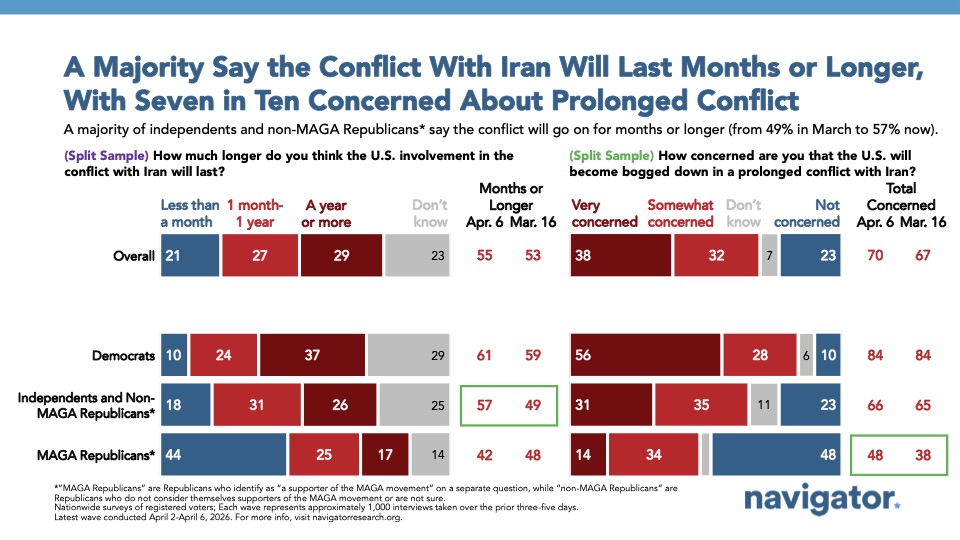
As President Trump has consistently shifted the timeline for the war in Iran, seven-in-10 Americans say they are concerned the U.S. will become bogged down in a prolonged conflict with Iran, compared to just 23% who are not. Concern persists across partisanship, as majorities of Democrats (84%), independents (75%), and Republicans (54%) all say they are concerned about a prolonged conflict with Iran. Concern has risen since March, when the gap between those concerned and those not was 41 points, compared to 47 points today.
- While MAGA Republicans report more confidence in President Trump’s handling of the war on a variety of indicators, concern over a potential prolonged conflict is evenly split (Net 0; 48% concerned – 48% not concerned).
When asked how long they expect the war with Iran will last, Americans tend to aim high. Over half believe the war will last a month or longer (56%), including nearly three-in-10 who think the war will continue on for a year or longer (29%). Still, about a quarter of Americans say they “don’t know” about the duration (24%). Just about one-in-five think the war will be over in less than a month (21%).
Americans See President Trump Lacking Clear Goals for War in Iran
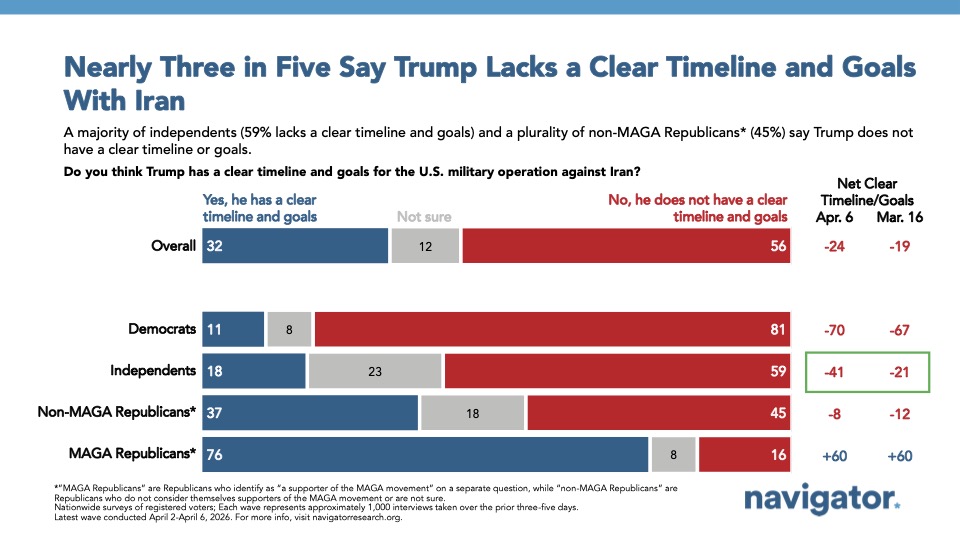
Despite President Trump’s recent efforts to make his case for the war, Americans remain unconvinced he has a clear timeline and goals. Over half say the president does not have a clear timeline and goals for the war with Iran (56%), while just one-in-three (34%) say he does. Confidence that the president has a clear timeline and goals in Iran is driven largely by MAGA Republicans, with 76% thinking he does and only 16% thinking he does not.
Americans Describe U.S. Involvement in Iran as Expensive, Unnecessary, and Dangerous
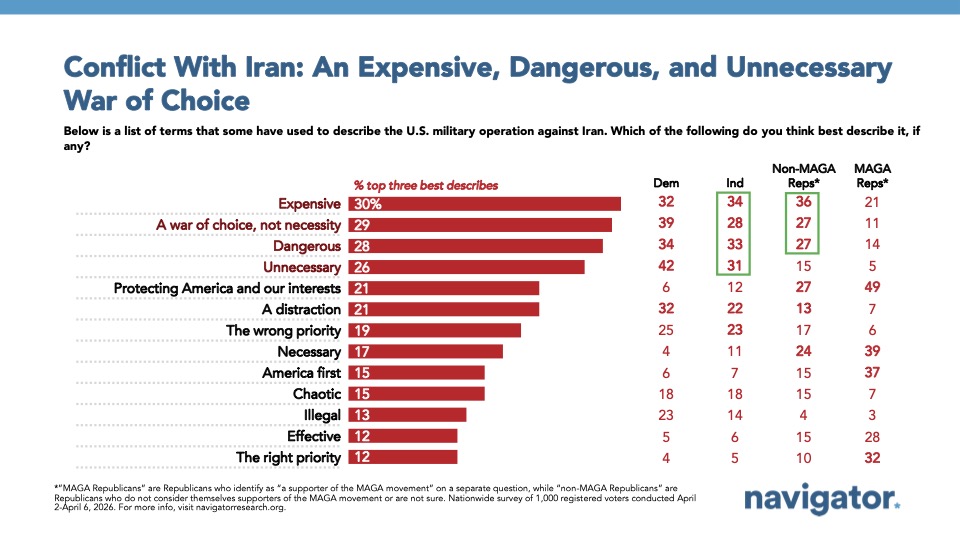
When asked to select up to three terms that best describe U.S. involvement in Iran,Americans are most likely to describe the war as “expensive,” (30%) “a war of choice, not necessity,” (29%) “dangerous,” (28%) and “unnecessary” (26%).
Americans Oppose Congress Providing $200 Billion for the War – Cuts to Health Care Make It a Non-Starter
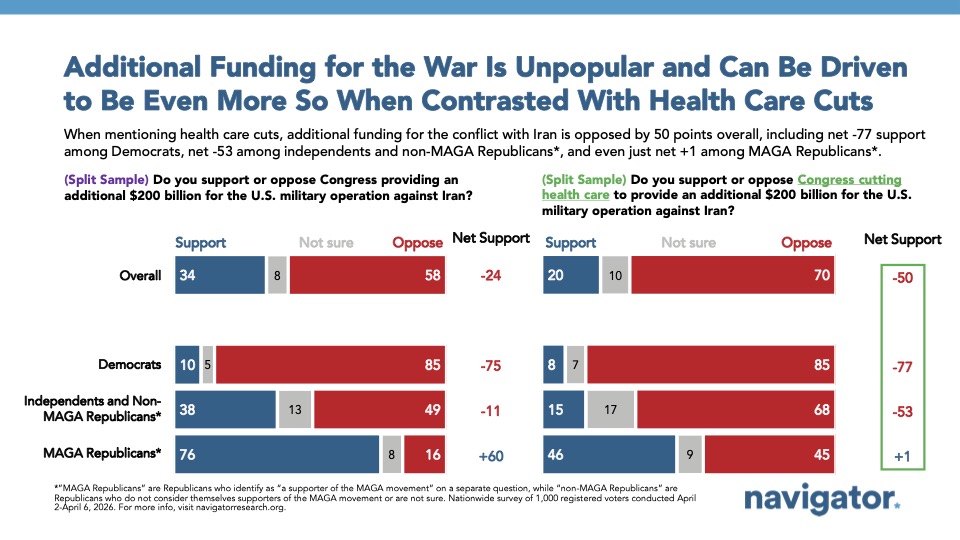
On its own, support for Congress providing $200 billion in additional funding for the war is underwater by a net -24 points (34% support – 58% oppose). When adding the context that $200 billion for a foreign war could come with cuts to health care spendingat home, net support drops to -50 (20% support – 70% oppose).
Americans Do Not Want Boots on the Ground in Iran
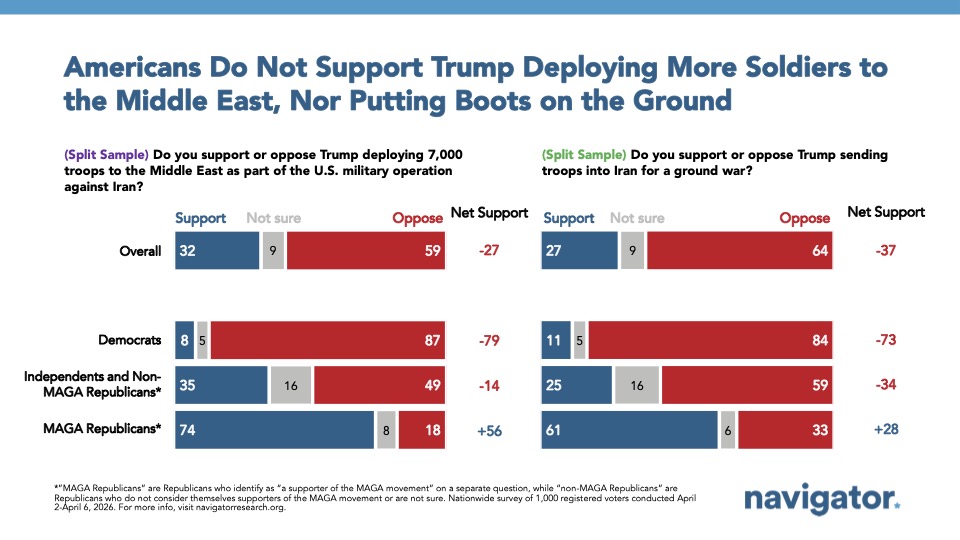
By a 37-point margin, Americans oppose President Trump sending U.S. troops to fight a ground war in Iran (27% support – 64% oppose). Once again, Democrats and independents are relatively aligned: 84% of Democrats and 71% of independents oppose sending in troops for a ground war. Republicans are more supportive than not, as 48% say they support sending troops into Iran, while 41% are opposed.
- MAGA and Non-MAGA Republicans are split on this question. Among non-MAGA Republicans, net support for a ground war in Iran is underwater by a net -19 points, while MAGA Republicans support sending troops into Iran by a net +28 points.
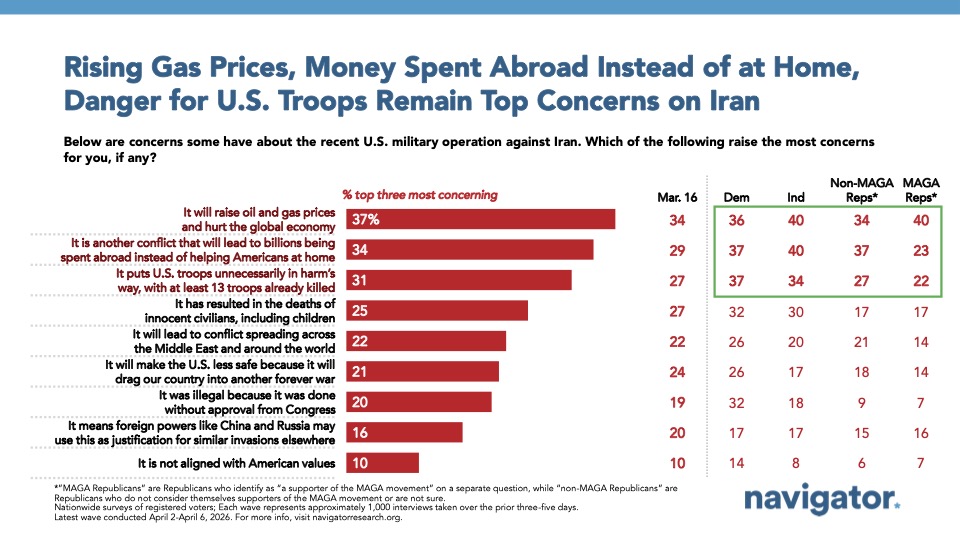
Americans are Most Concerned the Iran War Will Hurt the Economy, and put U.S. Troops and Innocent Civilians in Harm’s Way
When asked to select their top three concerns with the war, Americans point first to economic concerns, and then to endangering the lives of U.S. troops and innocent civilians.
Recommendations:
- Connect the war in Iran to the costs back home. Americans are feeling this war in their wallets through increased gas prices, and they’re opposed to spending more money on it, especially if it means further cuts to health care.
- Highlight the mismatch in priorities: Americans want their government focused on lowering the cost of living and other issues at home – this war does the opposite.
- Many Americans are already defining the war as expensive, unnecessary, and dangerous – don’t fight that framing, use it. Messaging that mirrors how the public already thinks is more persuasive than trying to introduce new language or arguments. For example, a focus on illegality is far less compelling than a focus on costs.
- Make clear this costly war could drag on – and Americans don’t want that. Americans aren’t buying the administration’s timelines, and their concern about a prolonged conflict is very real.