
Battleground Constituents View Tech Companies of All Stripes, and Their CEOs, Negatively
Battleground voters are deeply unfavorable toward technology companies. This includes AI companies (65% unfavorable), “Big Tech” (66% unfavorably), and social media companies (76% unfavorable). Social media companies have the lowest net favorable rating of the three (-65 net favorable, 17% favorable – 76% unfavorable).
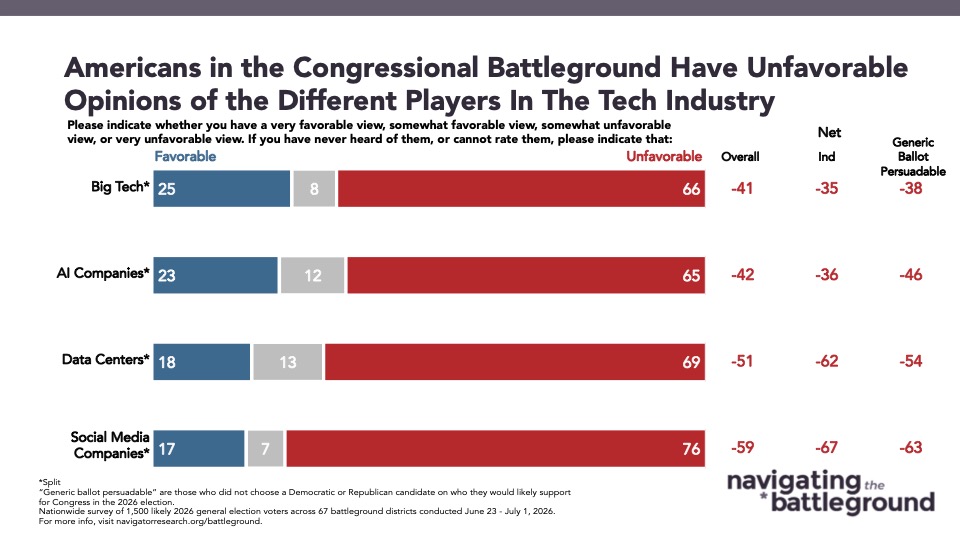
Most Republicans view all of these more negatively than positively, but their disdain for social media companies is highest (77% unfavorable). Majorities of independents view all of the aforementioned groups unfavorably, but 21% say they are unable to rate AI companies.
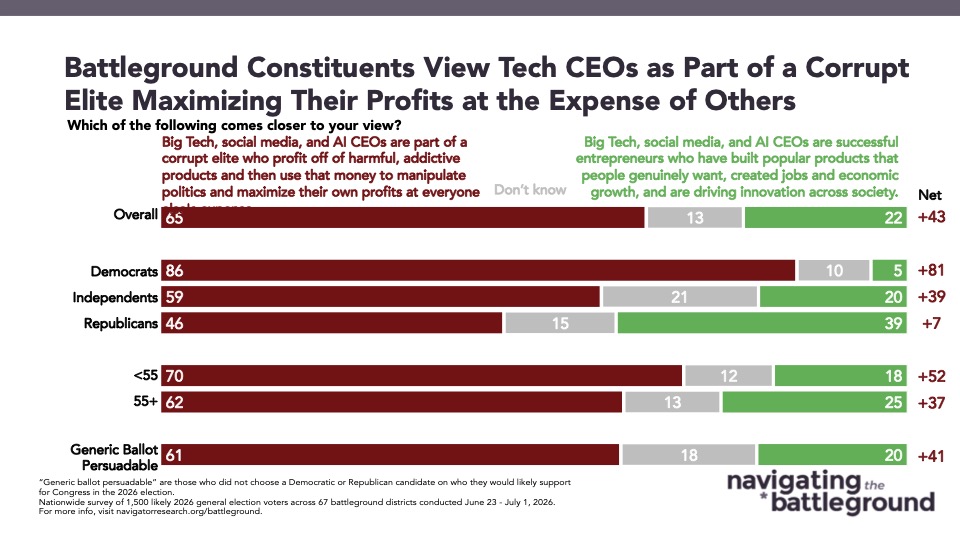
Nearly two-thirds of Americans in the battleground (65%) agree with the following statement:
- Big Tech, social media, and AI CEOs are part of a corrupt elite who profit off of harmful, addictive products and then use that money to manipulate politics and maximize their own profits at everyone else’s expense.
Compared to just 22% who agree with a statement characterizing these CEOs as “successful entrepreneurs who have built popular products that people genuinely want, created jobs and economic growth, and are driving innovation across society.”
Americans in the Battleground View Data Centers Unfavorably and Doubt They Are Creating Long-Standing Jobs
Nearly seven-in-10 battleground constituents view data centers unfavorably (69%), including 43% who are “very unfavorable” towards them. Even a majority of Republicans (53%) view data centers unfavorably.
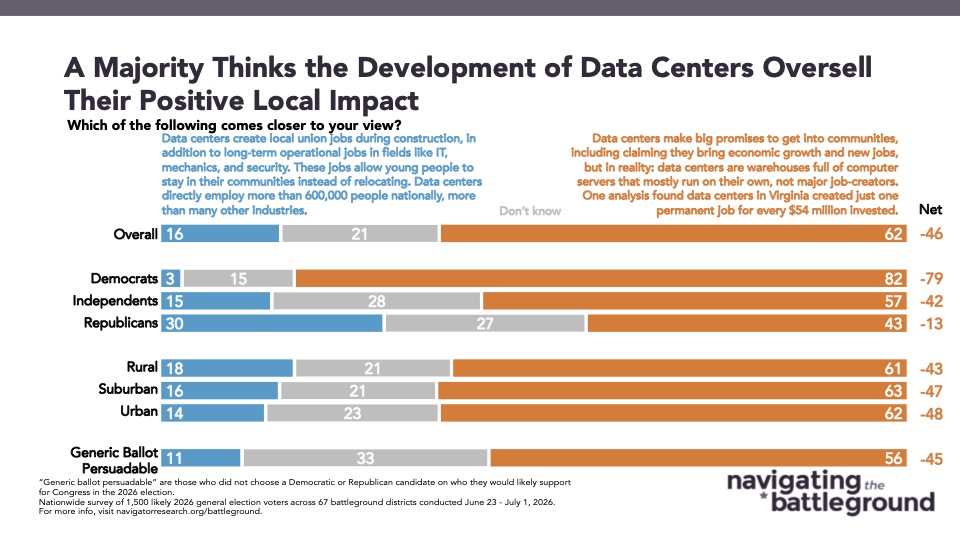
More than six-in-10 (62%) agree with the following statement:
- Data centers make big promises to get into communities, including claiming they bring economic growth and new jobs, but in reality: data centers are warehouses full of computer servers that mostly run on their own, not major job-creators. One analysis found data centers in Virginia created just one permanent job for every $54 million invested.
This is compared to just 22% who agree with a contrasting statement. While more Republicans and independents agree with the negative statement on data centers over the positive one, 27% of Republicans and 28% of independents don’t know, signaling that data centers are ill-defined to them.
Americans in the Battleground Want Lawmakers to Rein in Technology Companies, But Think They Have A Lot of Influence in D.C.
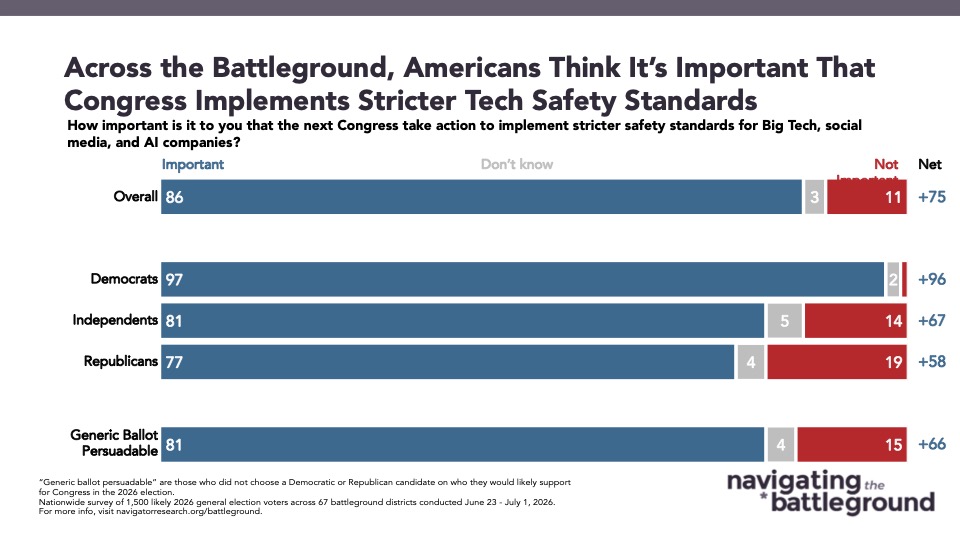
86% of Americans in the battleground say it’s important for the next Congress to take action to strengthen safety standards for Big Tech, social media, and AI companies, including 62% who say it’s extremely important. This notion crosses party lines: more than three-quarters of Democrats, Republicans, and independents say it’s important the next Congress prioritize reining in tech.
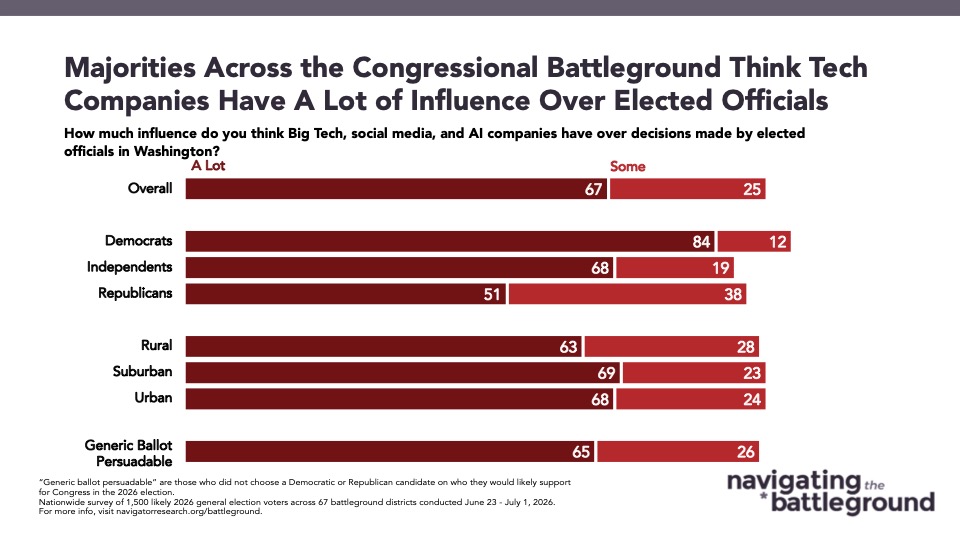
At the same time, more than two-thirds (67%) of Americans in the battleground say that technology companies have a lot of influence over decisions made by leaders in Washington.
A Majority Are Concerned by Actions President Trump and Republicans in Congress Took Favoring Big Tech
A majority (54%) say they have concerns when given the following information:
- President Trump and Republicans in Congress took millions from tech, social media, and AI companies and then supported efforts to remove AI and other laws to protect millions of Americans online.
This includes 43% who say the statement raises “very serious concerns.”
The Strongest Messages Against Technology Companies Invoke Harms to Children and Rising Costs
At least 60% found each of the statements we tested on technology companies “very concerning.” However, the most concerning were the ones that invoked harms to children and rising costs.
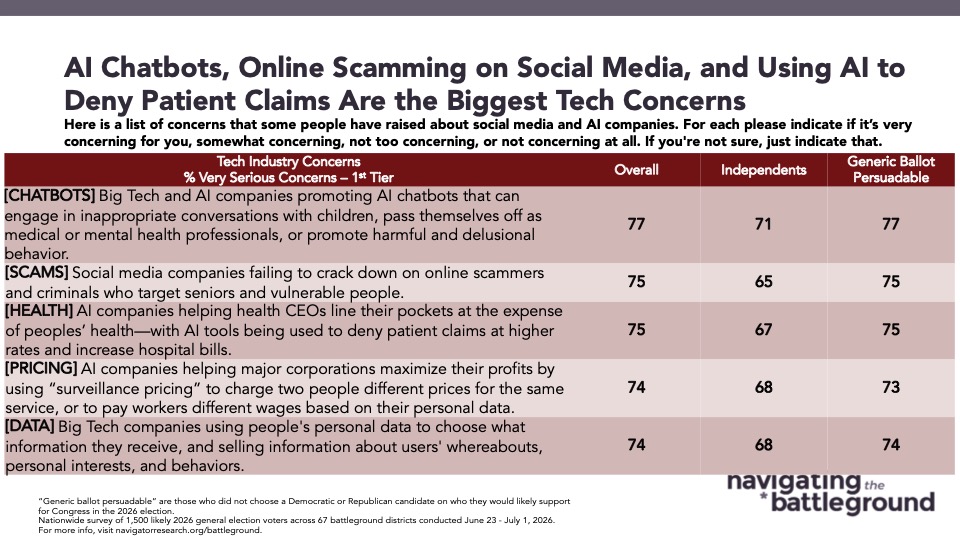
While still successful, a message invoking potential job losses due to AI was the weakest-performing.
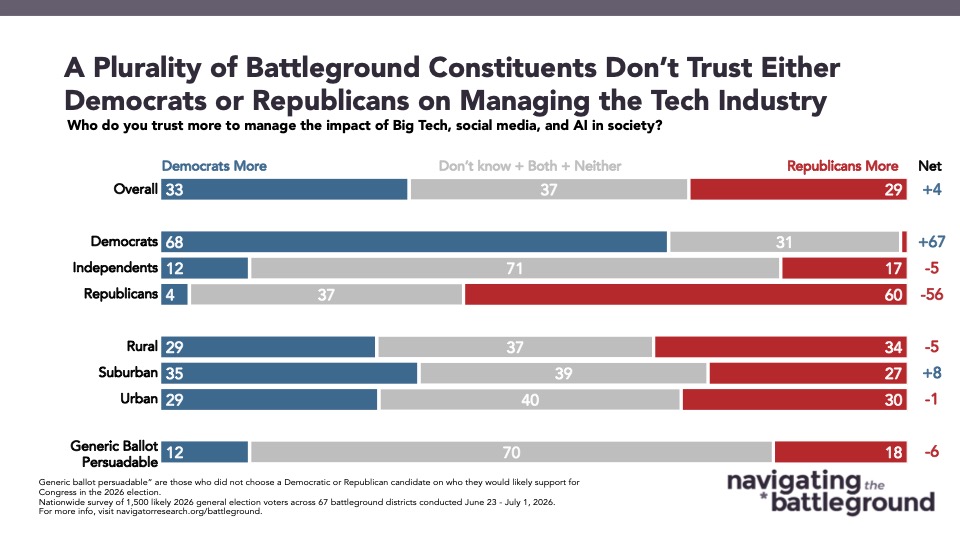
Nearly a Third Don’t Trust Either Party to Manage the Impact of Big Tech, Social Media, and AI
Battleground constituents are divided on who they trust to manage the impact of Big Tech, social media, and AI. 33% say Democrats, 29% say Republicans, and 32% say neither (a combination of 5% say they don’t know or both). More than three-in-five independents (62%) say they trust neither party on the issue.