
Four in Five Americans Support Legislation Protecting Access to Contraception

June 11, 2024
Maryann Cousens

Polling data on contraception in the United States and which rights are seen as at risk and should remain legal. We also look at how Americans would view elected officials who support taking away the rights to access contraception.

Poll: Access to Contraception in the U.S.

This Navigator Research report contains polling data on the latest perceptions of abortion and contraception in the United States and which rights are seen as at risk and should remain legal. We also look at how Americans would view elected officials who support taking away the rights to access contraception and abortion.

Four in five support specific legislation that would protect access to contraception.


Despite Senate Republicans blocking legislation that would protect access to contraception, overwhelming majorities across partisanship support this kind of legislation. 81 percent of Americans, including 90 percent of Democrats, 75 percent of Republicans, and 70 percent of independents, support legislation “protecting access to contraception, including condoms, IUDs, birth control pills, and emergency contraception pills,” while only 11 percent are opposed to such legislation. Critically, four in five Americans who are unfavorable to both President Biden and former President Trump support legislation that would protect access to contraception (83 percent). 

  • Three in four Americans who identify as MAGA Republicans support legislation that would protect access to contraception, including condoms, IUDs, birth control pills, and emergency contraception (75 percent).
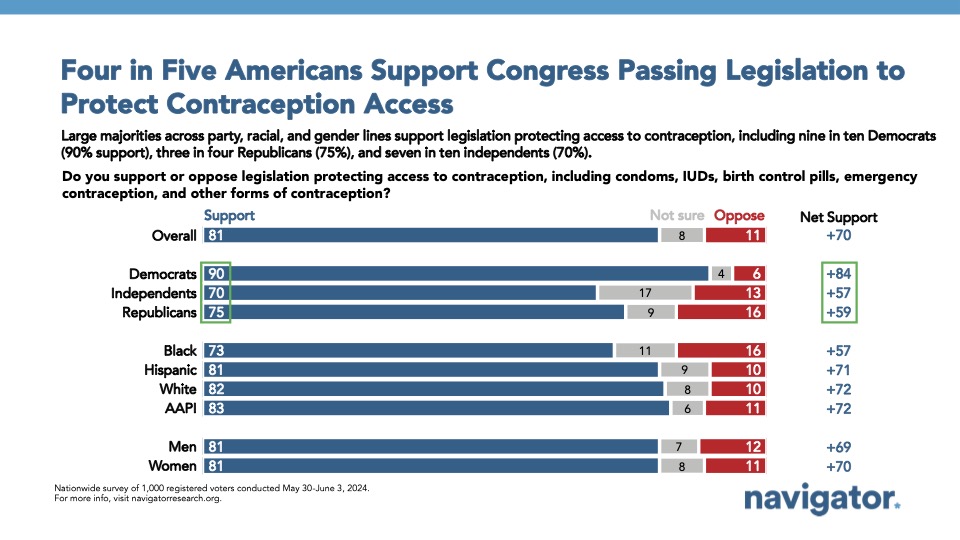
Bar graph of polling data from Navigator Research. Title: Four in Five Americans Support Congress Passing Legislation to Protect Contraception Access

Contraception is widely popular, however, more Americans believe it should be legal when framed as “birth control.”


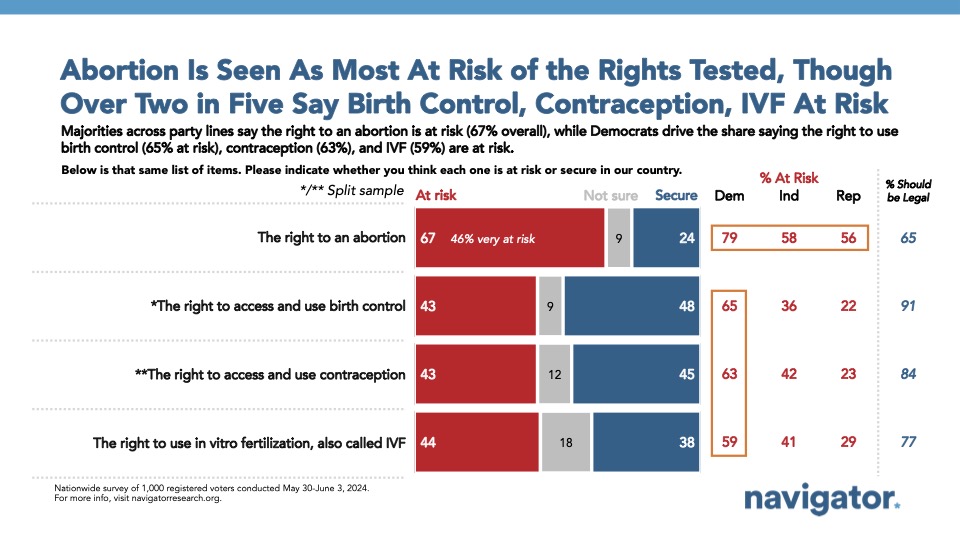
Vast majorities of Americans believe that contraception, in vitro fertilization (IVF), and abortion should all be legal. Nine in ten Americans believe birth control should be legal (91 percent), including 93 percent of Democrats, 90 percent of Republicans, and 85 percent of independents. Similarly, nearly four in five believe IVF should be legal (77 percent), and two in three believe abortion should be legal (65 percent). That being said, Americans are most likely to believe the right to an abortion is at risk in the United States (67 percent), while a smaller plurality believes the right to IVF is at risk (net -6; 38 percent secure – 44 percent at risk). The right to access and use birth control is viewed as more secure, with pluralities by a narrow margin believing the right is not at risk (net +5; 48 percent secure – 43 percent at risk). 

  • A plurality of Americans under the age of 35 believe the right to access and use birth control is at risk (48 percent at risk – 43 percent secure). Seven in ten younger Americans also believe the right to an abortion is at risk (71 percent). 
  • While both are overwhelmingly popular, Americans say they believe “birth control” should be legal (91 percent, including 73 percent who feel this way strongly) by 7 points more than they believe “contraception” should be legal (84 percent, including 69 percent who feel this way strongly).
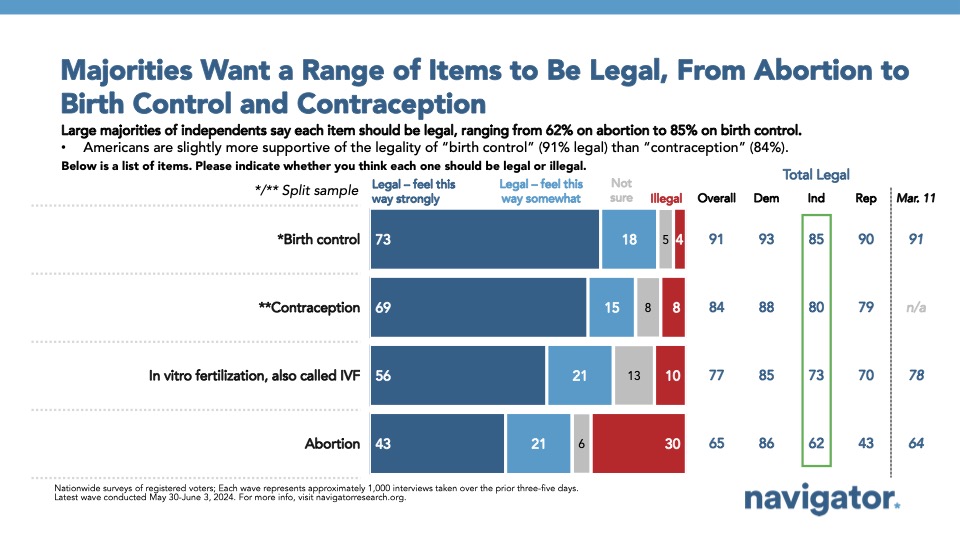
Bar graph of polling data from Navigator Research. Title: Majorities Want a Range of Items to Be Legal, From Abortion to Birth Control and Contraception
Bar graph of polling data from Navigator Research. Title: Abortion Is Seen As Most At Risk of the Rights Tested, Though Over Two in Five Say Birth Control, Contraception, IVF At Risk

A majority of Americans could not support an elected official who supports banning abortion, IVF, or contraception.


Three in four Americans say they could not support an elected official who supports banning contraception (76 percent), including 86 percent of Democrats, 72 percent of independents, and 68 percent of Republicans. By 50 points, Americans say they could not support an elected official who supports banning IVF from being available for family planning (67 percent could not support – 17 percent could support), nor an elected official who supports a national abortion ban by 37 points (63 percent could not support – 26 percent could support). 

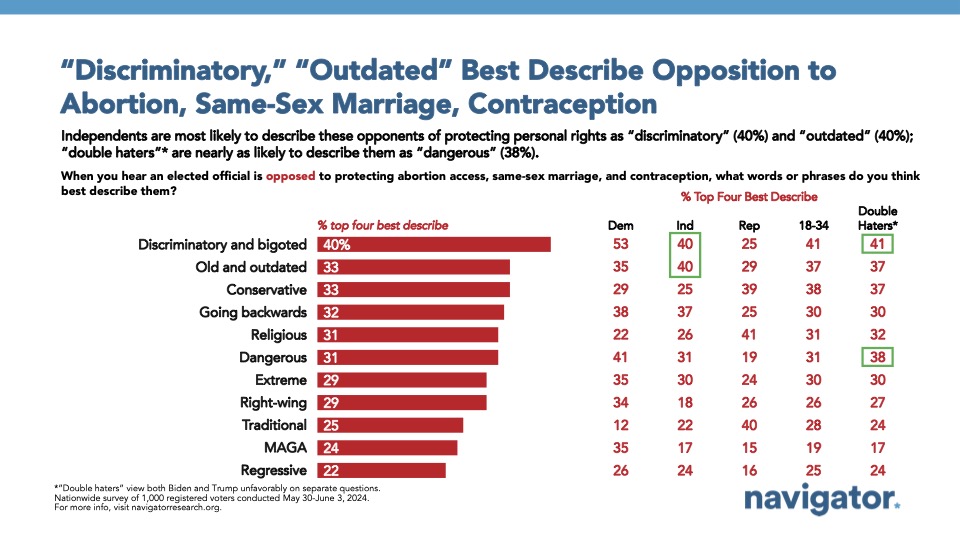
  • When prompted to rank words or phrases that best describe an elected official who is opposed to protecting abortion access, same-sex marriage, and contraception, “discriminatory and bigoted” is the most frequently listed (40 percent), followed by “old and outdated” (33 percent).
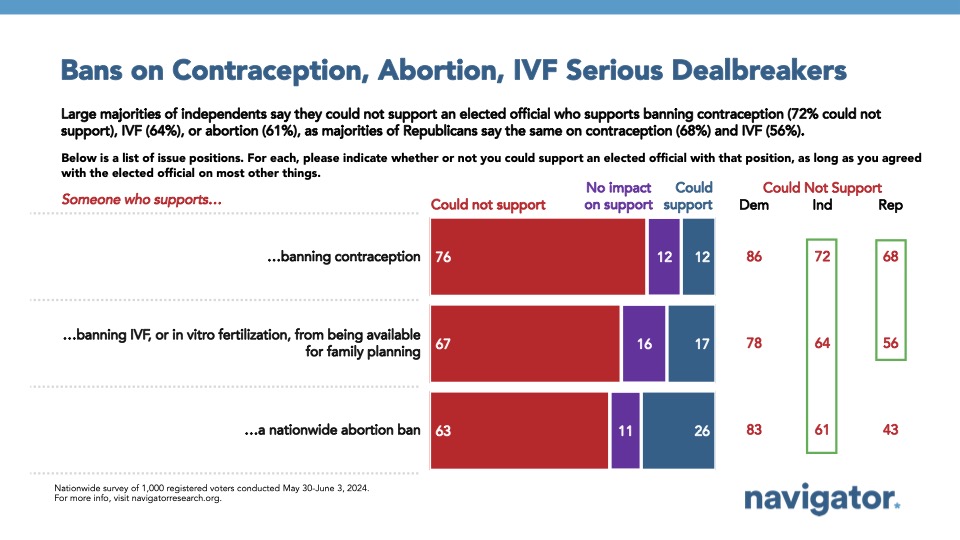
Bar graph of polling data from Navigator Research. Title: Bans on Contraception, Abortion, IVF Serious Dealbreakers
Bar graph of polling data from Navigator Research. Title: “Discriminatory,” “Outdated” Best Describe Opposition to Abortion, Same-Sex Marriage, Contraception
October 7, 2026

Five Key Trends We’re Seeing: Trump Grows More Toxic as Regret Peaks and Americans’ Priorities Go Unanswered 

This Navigator Research report covers trends throughout President Trump's second term.

Melissa Toufanian, Julie Alderman Boudreau, & Tina Tang
October 1, 2026

Rising Grocery Prices Are Getting Harder For Americans To Digest

This Navigator Research report covers rising grocery prices and cost of living.

Tina Tang, Avery Smedley, and Abigail Xu
September 28, 2026

What the Flock? Americans Are Not On Board With Flock Cameras

This Navigator Research report covers how Americans view Flock cameras and surveillance.

Avery Smedley and Tina Tang
September 24, 2026

Food for Thought: Americans Are Concerned About What’s On Their Plate

This Navigator Research report covers how Americans are viewing recent food safety issues that have dominated headlines and how they have changed what they eat because of it.

Tina Tang
Download
Toplines
Share

About The Study

Global Strategy Group conducted a public opinion survey among a sample of 1,000 registered voters from May 30-June 3, 2024. 100 additional interviews were conducted among Hispanic voters. 75 additional interviews were conducted among Asian American and Pacific Islander voters. 100 additional interviews were conducted among African American voters. 105 additional interviews were conducted among independent voters. 200 additional interviews were conducted among voters ages 18-34. The survey was conducted online, recruiting respondents from an opt-in online panel vendor. Respondents were verified against a voter file and special care was taken to ensure the demographic composition of our sample matched that of the national registered voter population across a variety of demographic variables. The margin of error for the full sample at the 95 percent level of confidence is +/- 3.1 percentage points. The margin for error for subgroups varies and is higher.

Related Posts

READ MORE
October 07, 2026

Five Key Trends We’re Seeing: Trump Grows More Toxic as Regret Peaks and Americans’ Priorities Go Unanswered 

This Navigator Research report covers trends throughout President Trump's second term.

Melissa Toufanian, Julie Alderman Boudreau, & Tina Tang
October 01, 2026

Rising Grocery Prices Are Getting Harder For Americans To Digest

This Navigator Research report covers rising grocery prices and cost of living.

Tina Tang, Avery Smedley, and Abigail Xu
September 28, 2026

What the Flock? Americans Are Not On Board With Flock Cameras

This Navigator Research report covers how Americans view Flock cameras and surveillance.

Avery Smedley and Tina Tang
September 24, 2026

Food for Thought: Americans Are Concerned About What’s On Their Plate

This Navigator Research report covers how Americans are viewing recent food safety issues that have dominated headlines and how they have changed what they eat because of it.

Tina Tang