

Overview
Americans believe fraud exists in a wide range of government-run programs, and blame varies from benefit recipients to the president to members of Congress. An effective strategy to address fraud should not deny this reality, but focus on the impact GOP policies will have not on combatting fraud, but on hurting everyday families.
The bottom line: While Americans are worried about both fraud and budget cuts, when forced to choose they are far more worried about cuts. Denying, dismissing, or minimizing fraud works against us.
Background
Allegations of fraud have been a main line of attack from Republican lawmakers, increasingly framing the focus on misuse of public funds in Democratic-led states. Cases in Minnesota have repeatedly been cited as evidence of systemic failures by Democratic governors, intending to make fraud appear endemic in blue states. Additionally, the Trump administration recently announced the “National Fraud Enforcement Division” to “zealously investigate and prosecute” fraud, while using allegations as justification to cut millions in funding for health care in states.
What The Data Is Showing
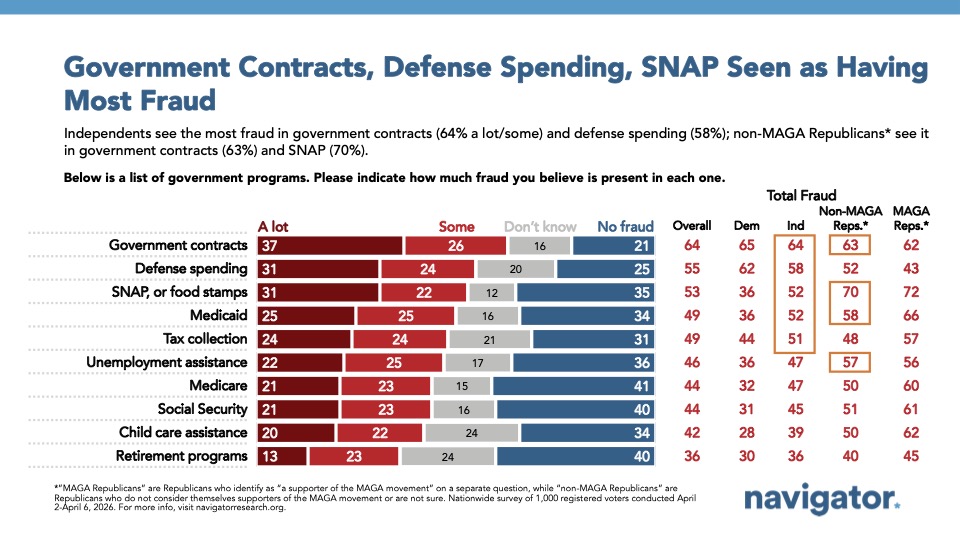
Contrary to the GOP narrative, Americans don’t see benefit programs as the biggest source of waste and fraud, they see government contracts as the top source. A majority believe fraud exists in government contracts (64% fraud – 21% no fraud) and defense spending (55% fraud – 25% no fraud), over SNAP (53% fraud – 35% no fraud) and Medicaid (49% fraud – 34% no fraud). Additionally notable as Americans are concerned about fraud in defense spending, they are also overwhelmingly opposed to Congress providing $200 billion in additional funding for the war in Iran.
Americans are divided on who bears responsibility for fraud in government programs – 39% blame program recipients, while 38% point to President Trump and his administration. That split, however, breaks sharply along partisan lines. While blaming people on government programs for fraud is driven more heavily by older Americans, Republicans, and white men, in order to meet Americans where they are in our communications, we cannot build a winning message by first refuting what people feel is reality. Effective communication acknowledges the real concerns people have, then moves quickly to what’s actually at stake: who gets hurt by the policy response, and how.
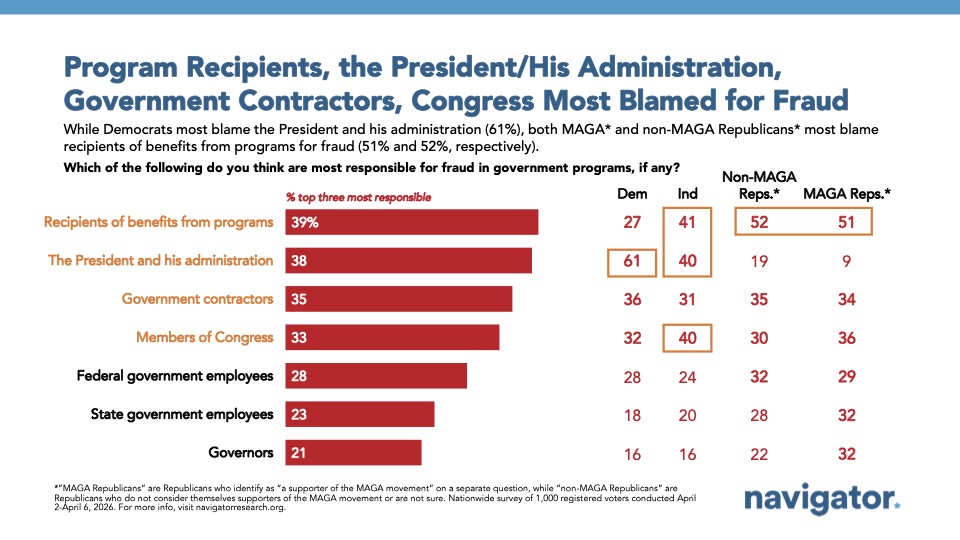
Notably, state officials and governors are least blamed for fraud in government programs, and could be effective messengers in this fight.
While Americans are concerned about fraud in government programs, they do not believe the answer is in cuts to basic needs families depend on. Context matters; people don’t believe it is possible to cut fraud without kicking people off of health care. From Navigator’s June 2025 survey, fielded shortly before the passage of the Republican budget known as the One Big Beautiful Bill Act, a majority of Americans (51%), including a plurality of independents (46%), believed it would be impossible to cut “waste, fraud, and abuse” without kicking people off of Medicaid.
Americans are overwhelmingly concerned about cuts to benefit programs like health care, and while the best messages should not deny the reality that fraud exists, a successful counter message takes accountability, and more importantly, addresses impact.
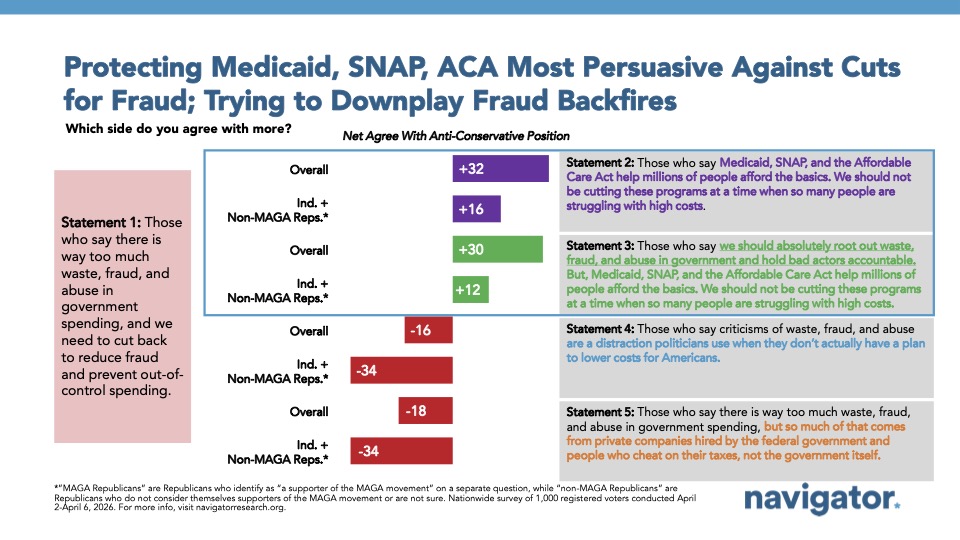
By more than +30 points, and double digits for independents and non-MAGA Republicans, Americans agree that the need to cut spending and reduce fraud is nota justification for cutting programs which help millions afford the basics at a time when people are already struggling with high costs. While Americans may believe fraud exists in government contracts, the more effective message to counter the attack centers on the impact of cutting programs people rely on.
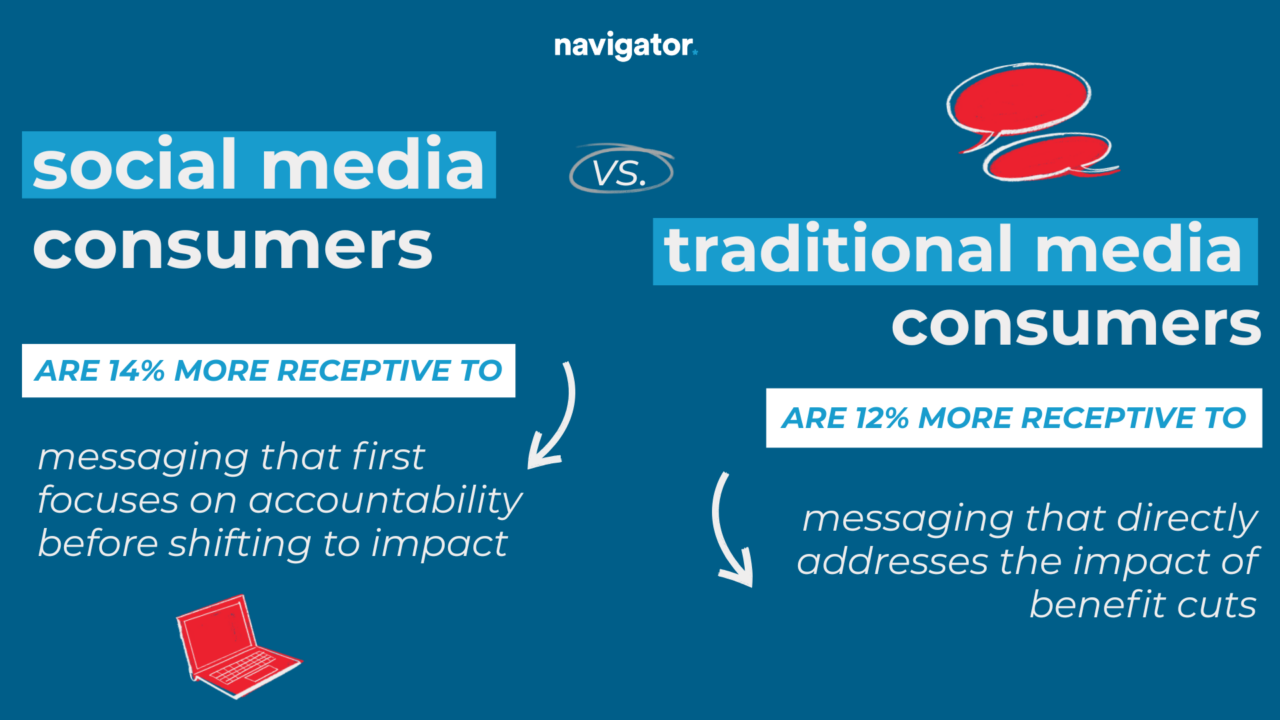
Medium and platform specific messaging will also be crucial to effectively neutralize bad faith attacks on fraud. Traditional media consumers (ie., local news, online news, radio) are more likely than social media consumers to blame recipients for fraud in benefits programs, but are more receptive to messaging that directly addresses the impact of benefit cuts, while social media consumers are more receptive to messaging that first focuses on accountability before shifting to impact.
Americans recognize fraud is a real issue, but are more concerned with the harm done by cuts to benefit programs than prioritizing rooting out fraud. A winning message acknowledges reality and focuses on what voters already intuitively know—that cutting health care and access to food will harm kids and families, and is not a viable solution to address fraud.