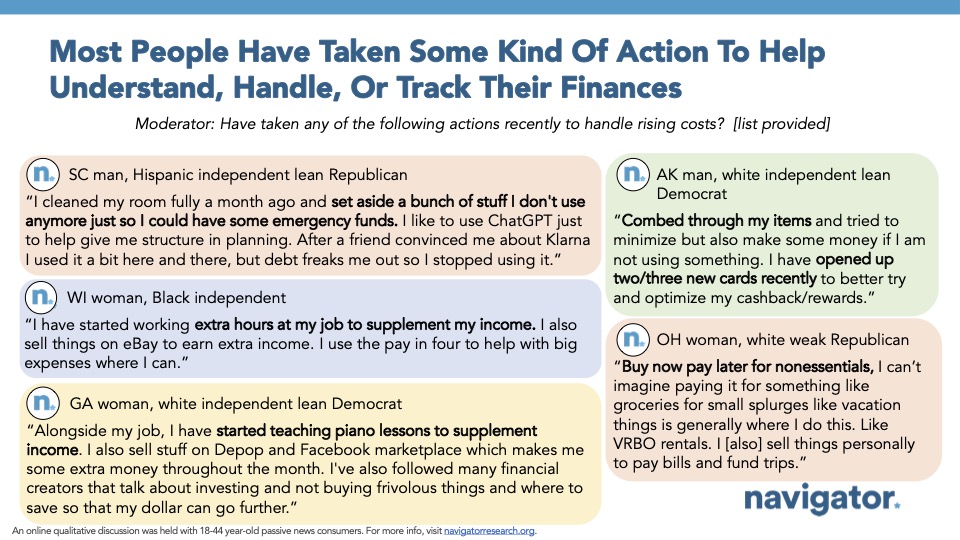
Last month, Navigator conducted qual boards with passive news consumers. Qual boards are a private online forum where participants log on and answer a series of questions. These qual boards focused on passive news consumers, or those who say news comes to them rather than seeking it out. Over a three-day period, participants answered a series of questions on politics, news consumption, and AI use.
Participants Are Skeptical of Traditional Media and Spending More Time on Social Media
When asked what “the media” means to them, participants naturally mention more traditional media outlets like Fox, CNN, ABC, NBC, and CBS. Yet some also brought up social media. But no matter where they get the news, participants mentioned bias in coverage.
- “It’s hard relying on news whether it’s traditional and social media because they seem to be [biased]. Resources like [Ground] are the best in my opinion when seeking out accurate news information.” – GA man, weak Democrat
- “Big name news companies, anyone with giant money backing.” – TX woman, weak Republican
Participants say they spend “anywhere from less than an hour on a busy day” to up to seven hours a day on social media. While most say they primarily use it to pass the time or connect with friends and family, many say they use it as a news source.
- “I use Social Media to stay up to date on current events, do research or find hacks, DIYs, or new beauty products to try based on video reviews.” – NV woman, weak Democrat
- “I use social media as a news source mor[e] than anything.” – WI man, independent lean Republican
- “My main intention of being on social media is to follow up on local, national, and international current events, as well as listen to and watch videos of interest.” – GA woman, independent
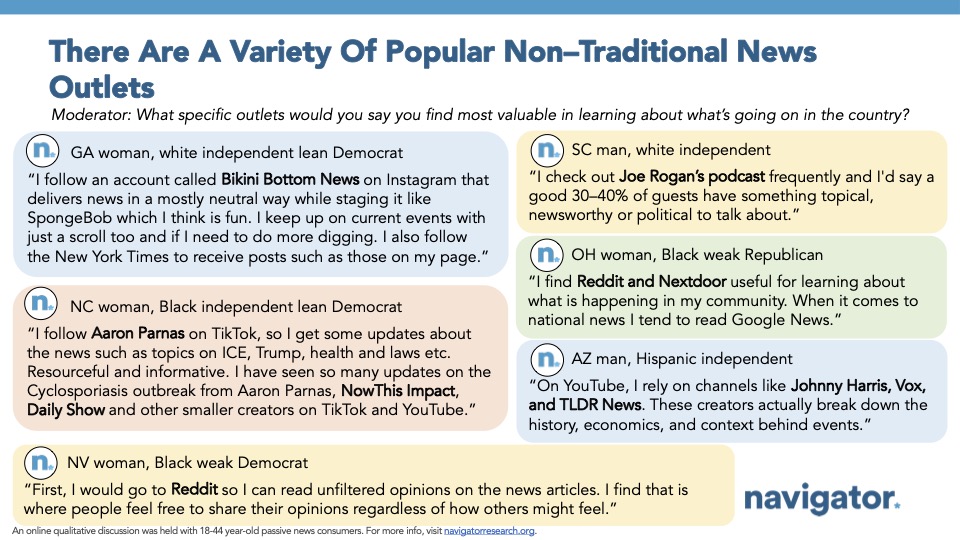
Many were able to name specific websites and creators they follow to understand what is going on in the country.
News Stories are Still Breaking Through to Passive News Consumers, But Many Say The Coverage They See Is Too Negative
Even without seeking the news out, many mainstream stories are breaking through to passive news consumers.
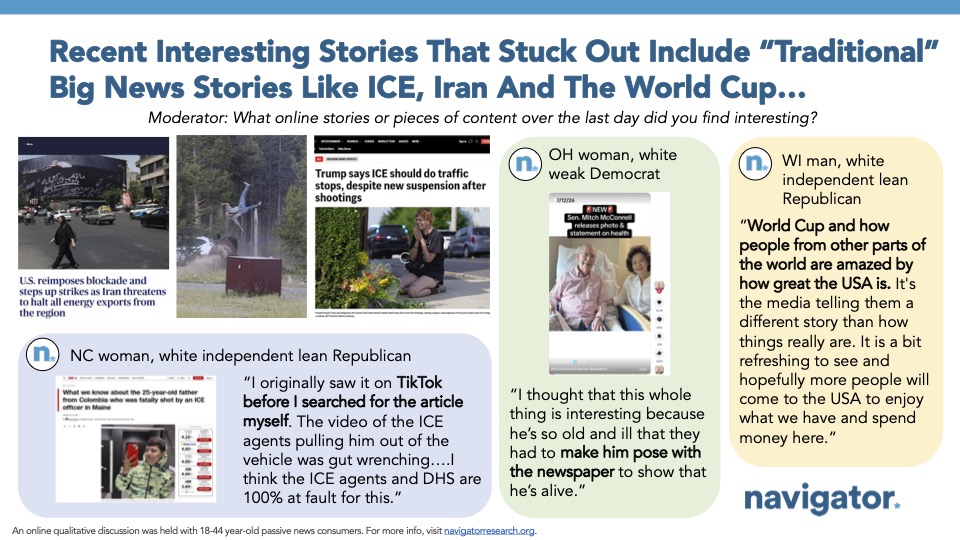
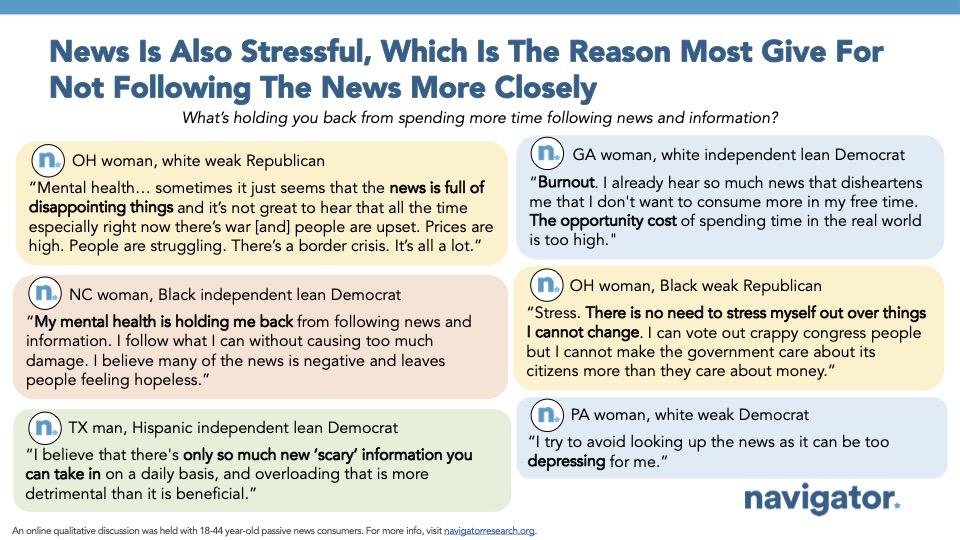
Several cited other stories that broke through that weren’t necessarily covered by mainstream news, like a conflict in Oregon over $200,000 in missing Legos. However, participants lamented that they don’t follow the news as closely because it is too negative.
People Responded Positively to Creator Videos That Presented Facts Directly and Negatively to Those That Appeared to Include Spin
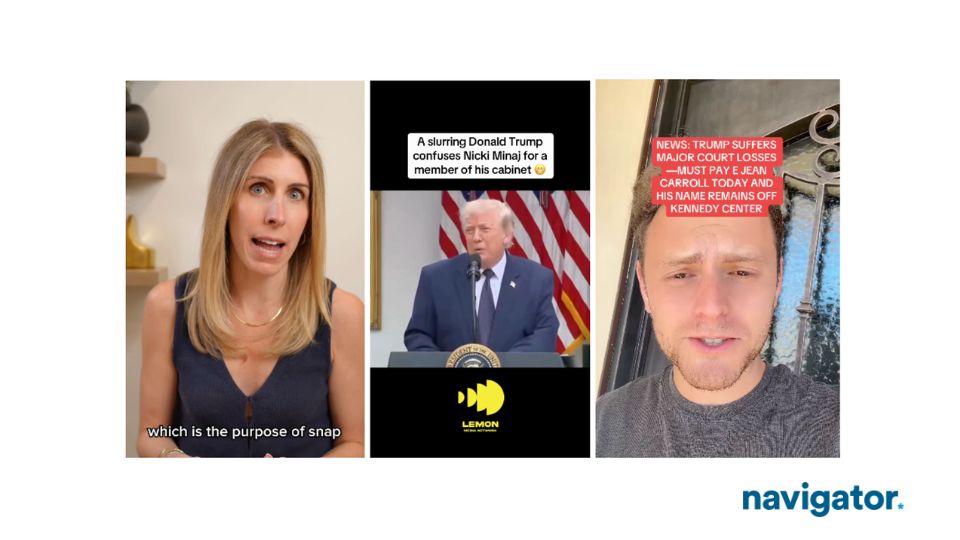
Participants were asked to respond to three videos of creators sharing the day’s news. Respondents were most positive about a video featuring a creator debunking talking points from Republicans in Congress on SNAP.
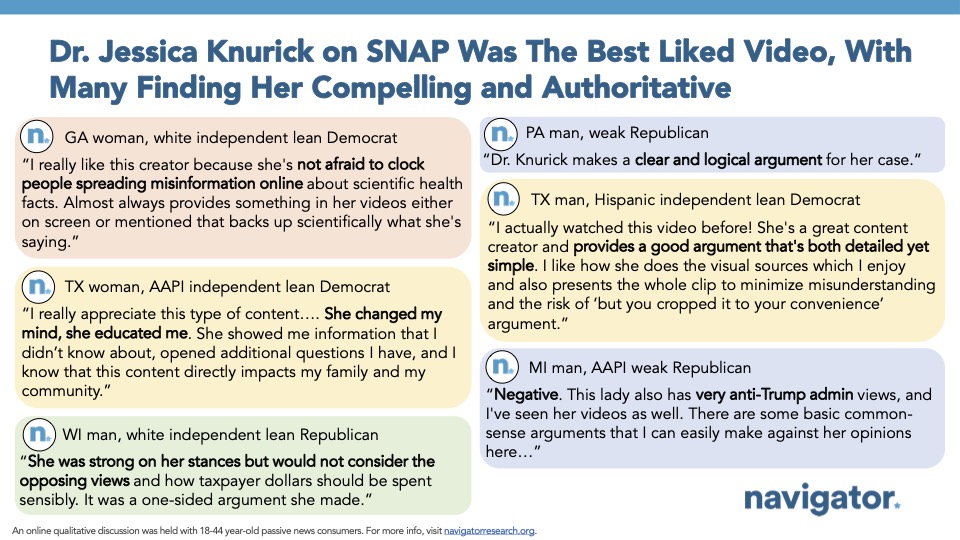
Two of the videos, one featuring a creator speaking directly to camera and another featuring a video of Trump with a negative caption, were viewed as biased, especially by those unfamiliar with the speaker.
- “It’s not helpful news and it’s just a clip taken pretty much out of context.” – PA woman, independent lean Democrat
- “I have no idea who that is or if what he says [is] credible or not. I’d definitely have to dive in to figure out more information. It’s not a very professional video, and when I see videos like this I tend to feel like they are more opinion pieces than factual news.” – TX woman, weak Republican
- “My first reaction is that I don’t know this man and he didn’t cite any sources for this information so while it may be interesting if true it is something that would require me to fact check it.” – OH woman, weak Republican
When asked what would make them trust a source more, some said they trust news more when they can cross-check it on other platforms or if the reporter comes off as someone without an agenda, while others cited corporate ownership as a form of bias.
- “People are allowed to have opinions of course, however when it is presented in a way to purposely divide people politically, it makes it untrustworthy. I’d trust some news sources more if they didn’t do that.” – PA woman, independent lean Democrat
- “If they reported the facts without bias.” – OH woman, weak Republican
- “I would trust a news source that was not owned by the bigger corporations.” – NC woman, independent lean Democrat
Participants Do Not Want to See Content from Elected Officials and Few Say an Elected Has Made Them Change Their Minds
When asked what type of content they wanted to spend more time reading, watching, or listening to, the vast majority listed “content for an elected official” last. Some say it sounds like campaigning and not truthful.
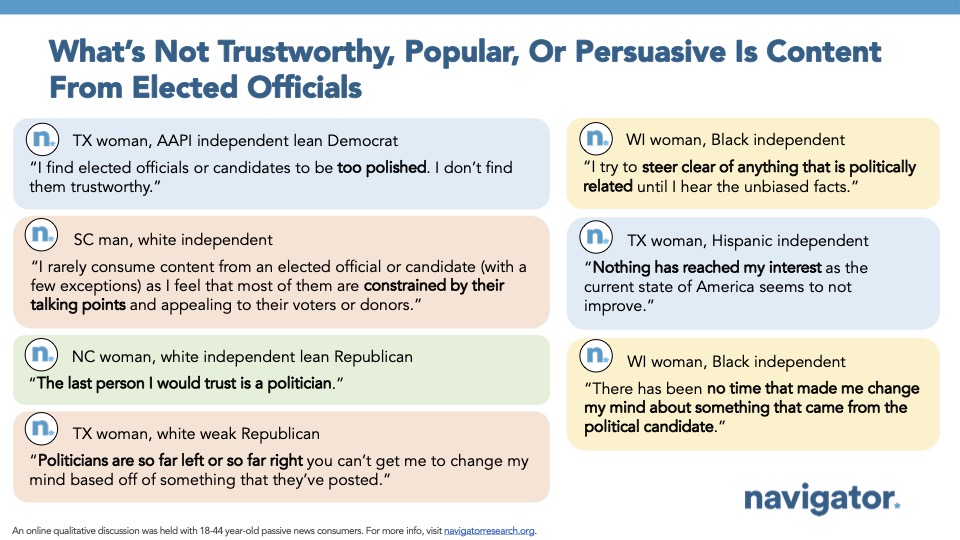
Only a handful could name a time when they heard from an elected official who made them change their mind.
- “Thomas Massie (R) kinda changed my mind about this as he goes against his party’s grain.” – OH woman, weak Democrat
- “When I heard Mamdani speak on raising taxes for the upper class. I’d always been on the fence about that because they did earn their share. However, when I saw what that extra money can do for the city and how the upper class doesn’t always pay their fair share, I fall now on the side that they should be proportionally contributing to society.” – GA woman, independent lean Democrat
- “James Talarico is the only one that so far stands out as a political figure that is interesting to me. He presents ideas that I agree with. He seems like a breath of fresh air. He seems like he cares about people and is easy to understand when he speaks. He communicates casually and straight to the point.” – TX woman, independent lean Democrat
Content is Driving Participants to Change Their Personal Habits, But Not Necessarily Take Political Action
Many described times when they made changes to their lives based on the content they’re seeing, but not necessarily inspiring them to take political action. Many of the changes they took were in health and wellness.
- “I see information on health and workouts all the time. I started eating high protein and fiber because of the info I saw online about its importance to physical health.” – GA woman, independent lean Democrat
- “I started drinking hot water with lemon and chia seeds every morning because of a Chinese medicine video I watched. I’ve lost 10 lbs since I started.” – NC woman, independent lean Republican
Participants Use AI and Worry About Others Getting Duped By AI Content
Many participants said they use AI, but are worried about the future.
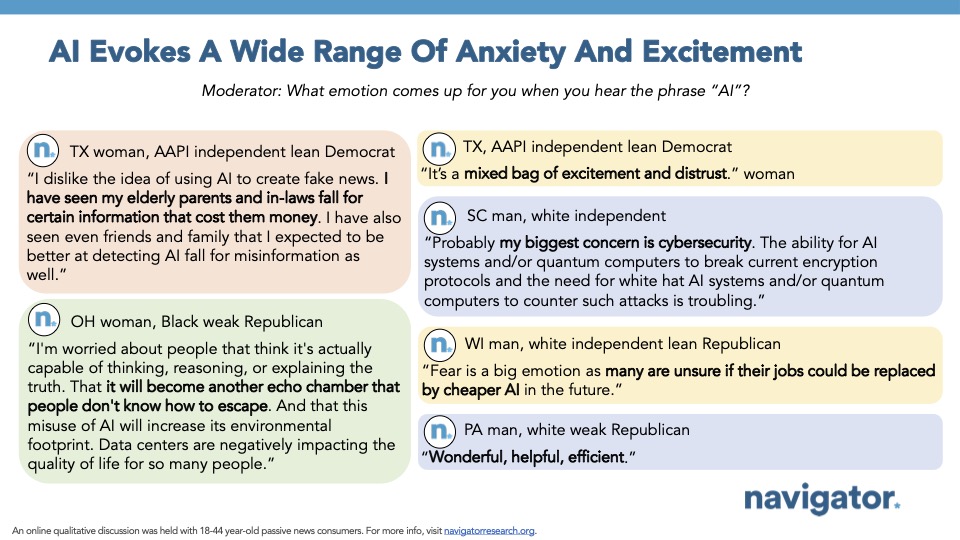
Many report using chatbots, like ChatGPT and Gemini. Some say they’ve used them for everything from health tips to organizing emails.
- “Asked AI some health related questions and tips on calorie counting because I am trying to lose weight. It’s definitely helpful, down 30lbs and counting so far.” – GA man, weak Democrat
- “I have used ChatGPT to help with organizing a work email. It was helpful but I needed to make it sound authentic.” – WI man, independent lean Republican
- “I used DeepSeek to get information on the current for sale sign on my neighbor’s house. I used Gemini to help me find keywords for job searches. I needed help on making burgers in the air fryer, so I asked Alexa about that. She even set an alarm for me. So, I would say yes, It was helpful.” – NC woman, independent lean Democrat
When it comes to concerns, some cite job security, the impact of data centers, and people becoming dependent on it.
Participants Are Frustrated With the State of the Country and Overwhelmed By Rising Costs
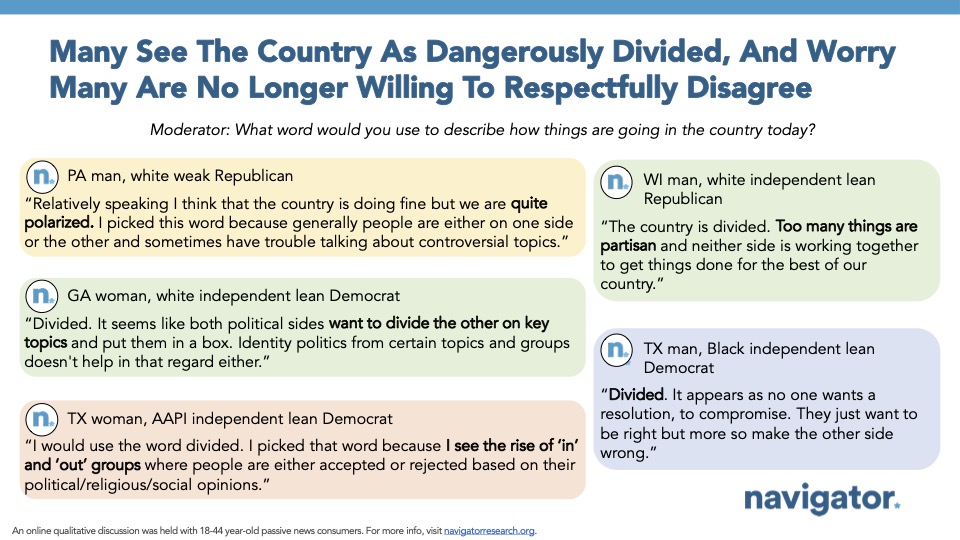
Participants use words like “annoying,” “divided,” and “chaotic” to describe the state of the country today. To explain their answers, many cited the political state of the country, with some pointing specifically to the Trump administration.
Rising costs are the top concern for participants, with many pointing to gas, food, and energy costs. Participants say that in order to keep up with rising costs, they’ve taken on debt, used buy now, pay later platforms, and sold personal items.