Government Shutdown: A Guide for Advocates
This Navigator Research report contains polling data on Americans’ latest perceptions of a possible government shutdown in the fall, including awareness of a potential shutdown, as well as messaging guidance on the most convincing reasons to avoid a shutdown.
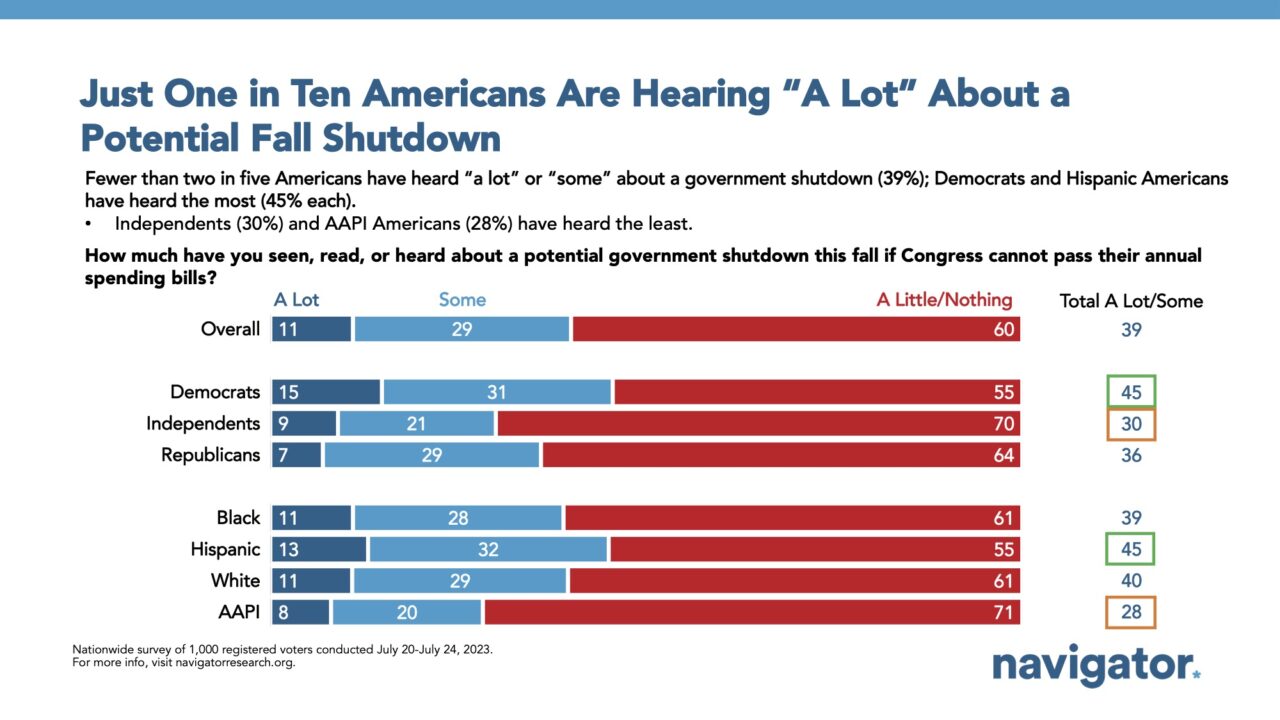
Just one in ten Americans say they have heard “a lot” about a potential government shutdown this fall.
Two in five Americans have seen, read, or heard at least “some” news about a potential government shutdown this fall (39 percent); only one in ten report hearing “a lot” about this potential government shutdown (11 percent), including just 15 percent of Democrats, 9 percent of independents, and 7 percent of Republicans.
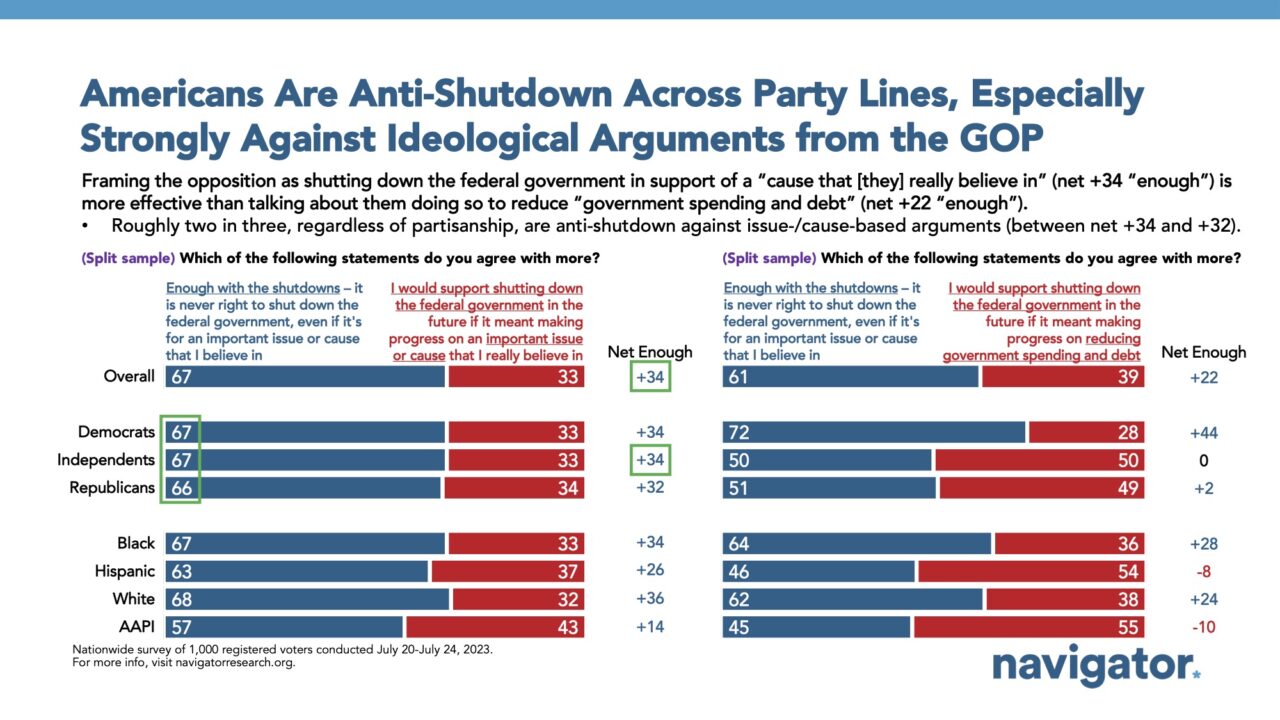
Two in three Americans agree that it’s never right to shut down the federal government, with even greater opposition when Republicans are doing it to push their ideological demands.
In a split-sample test, a progressive argument against government shutdowns won against two different conservative arguments in favor of a shutdown by at least 20 points in each case. When a potential government shutdown was framed as the result for Republicans trying to “make progress on an important issue or cause that I really believe in,” net opposition was 34 points compared to a narrower net 22 points when framing a potential shutdown as “if it meant making progress on reducing government spending and debt.”
- The argument that “enough with the shutdowns – it is never right to shut down the federal government, even if it’s for an important issue or a cause that I believe” beats the following pro-shutdown argument by 34 points: “I would support shutting down the federal government in the future if it meant making progress on an important issue or cause that I really believe in” (67 percent against shutdown – 33 percent in favor of a shutdown). This includes two in three across partisanship who agree the government should not shut down for ideological progress (67 percent of Democrats, 67 percent of independents, and 66 percent of Republicans).
- In a second back-and-forth, three in five agree the government should not shut down when pit against the following argument: “I would support shutting down the federal government in the future if it meant making progress on reducing government spending and debt” (61 percent against shutdown – 39 percent in favor of a shutdown).
- Americans over the age of 65 oppose government shutdowns, with nearly four in five agreeing that it is never right to shut down the government by at least a net of 40 points against both arguments.
The most effective argument against a government shutdown centers delaying payments like Social Security, Medicare, and veterans’ benefits.
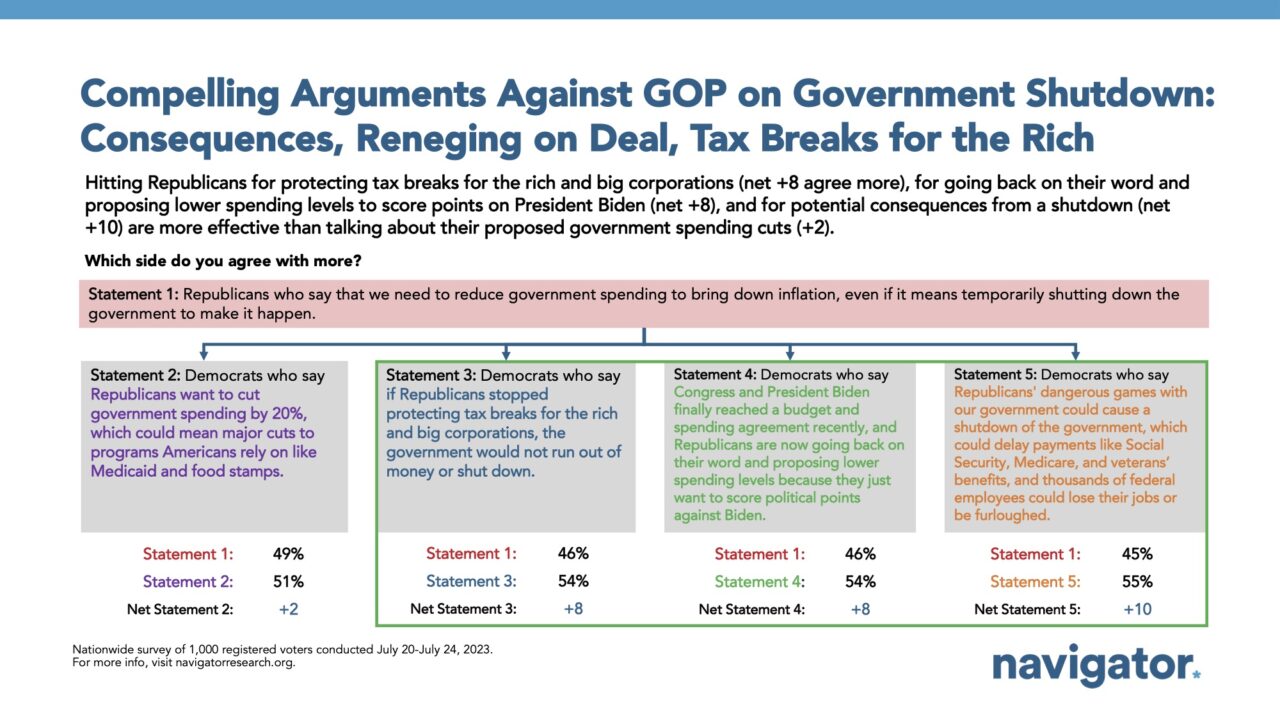
The most compelling arguments against Republicans’ rationale for shutting down the government include that they are playing games with Social Security, Medicare, and veterans benefits, as well as giving tax breaks to the wealthy that is forcing the government to run out of money. Against the Republican argument that to “we need to reduce government spending to bring down inflation, even if it means temporarily shutting down the government to make it happen,” the most compelling arguments are “Republicans’ dangerous games with our government could cause a shutdown of the government, which could delay payments like Social Security, Medicare, and veterans’ benefits, and thousands of federal employees could lose their jobs or be furloughed” (55 percent progressive argument – 45 percent conservative argument), and that “If Republicans stopped protecting tax breaks for the rich and big corporations, the government would not run out of money or shut down” (net +8; 54 percent progressive argument – 46 percent conservative argument).
- The best-testing message with independents focused on Republicans reneging on their agreement with Biden: “Congress and President Biden finally reached a budget and spending agreement recently, and Republicans are now going back on their word and proposing lower spending levels because they just want to score political points against Biden” (net +8; 54 percent progressive argument – 46 percent conservative argument; including 56 percent of independents – 44 percent conservative argument).
- An argument that emphasizes that Republicans want to cut government spending by 20 percent only draws even against the conservative argument (net +2; 51 percent progressive argument – 49 percent conservative argument).
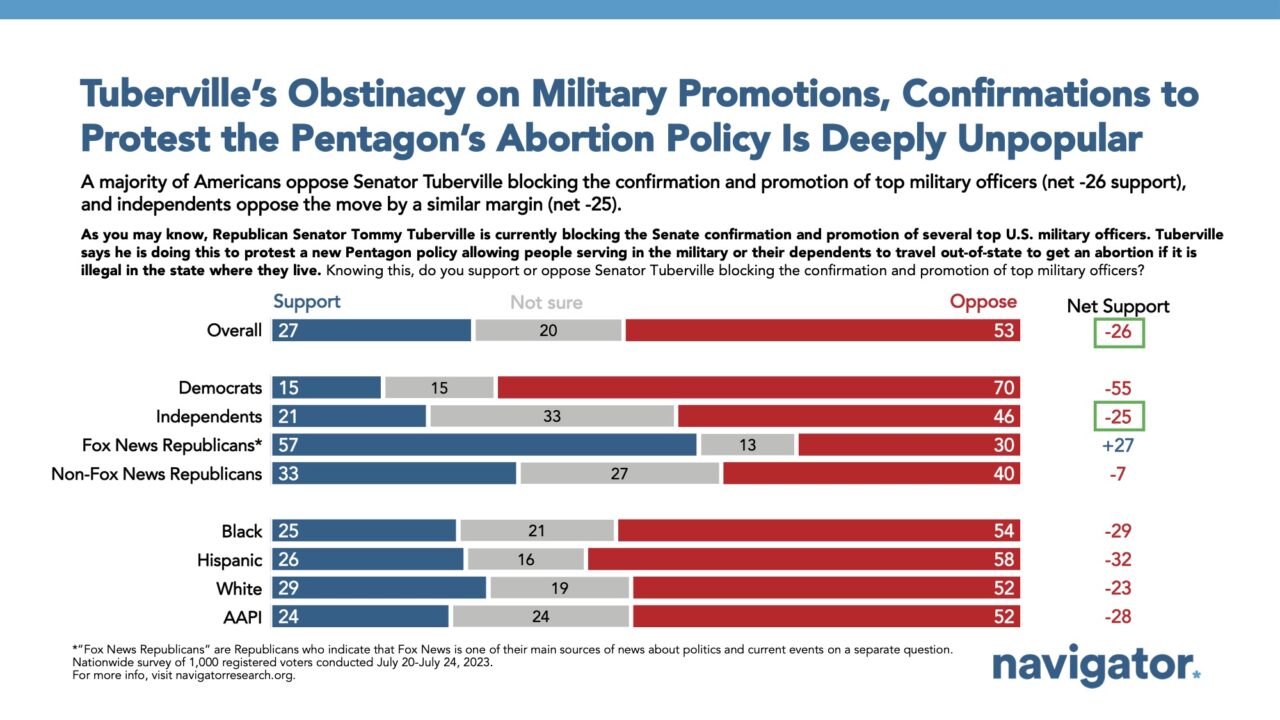
Bonus finding: A majority of Americans oppose Senator Tuberville’s blocking of promotions and confirmations of U.S. military officers in protest.
By a 26-point margin, Americans oppose the Republican Senator blocking the confirmation and promotion of several top U.S. military officers in order to protest a new Pentagon policy allowing those serving in the military or their dependents to travel out of state to receive an abortion (53 percent oppose – 27 percent support). Two in five Americans say they “strongly oppose” the Senator blocking these confirmations and promotions (39 percent). Opposition to the Senator’s actions is strongest among Democrats (net -55; 15 percent support – 70 percent oppose), followed by a plurality of independents (net +25; 46 percent oppose – 21 percent support), and more than one in three Republicans (net -7; 36 percent oppose – 43 percent support).
- Among Republicans, opposition is greater among those who do not watch Fox News (net -7; 33 percent support – 40 percent oppose), compared to those who do watch Fox News (net +27; 57 percent support – 30 percent oppose).
- Opposition to Senator Tuberville’s actions is also high among college-educated women (net +48; 63 percent oppose – 15 percent support) and Americans over the age of 65 (net +33; 60 percent oppose – 27 percent support).