
Why “Fight Back on Costs” Beats Warning About Voter Suppression

July 21, 2026
Melissa Toufanian

This Navigator Research report covers feelings on election security and protection efforts.

Big Takeaways:

Americans want their leaders to focus on tackling rising costs, but instead see President Trump and Republicans in Congress focused on immigration, foreign conflicts, and election integrity.

Leading with messaging on voter suppression tactics, including threats of deploying ICE or the National Guard at polling places, can actually backfire and demotivate some people from voting.

Effective messaging frames voting as a way to stand up to Trump and Republicans' broken promises to lower costs, their rampant corruption, and the weaponization of government.

Americans Care Most About Rising Costs, Inflation and Not the 2020 Election 

Since the start of Trump’s second term, Navigator has tracked what Americans from across the country want their elected leaders to focus on and what they actually think those in power are prioritizing. Americans want their leaders to focus on lowering inflation and the cost of living but instead see Trump and Republicans in Congress most focused on immigration, foreign conflicts, and election integrity.
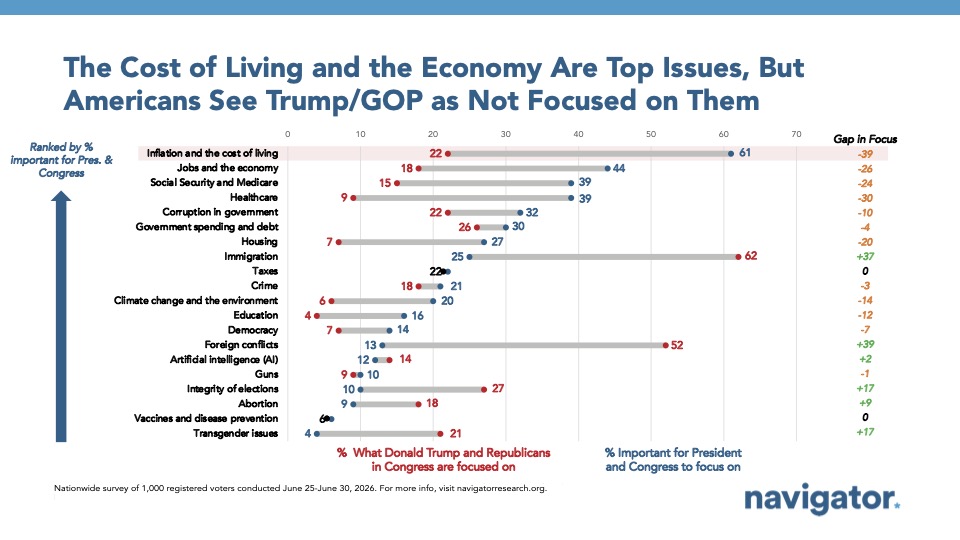
Graph from Navigator Research titled: The Cost of Living and the Economy are Top Issues, But Americans See Trump/GOP as Not Focused on Them

That disconnect was once again on display, when President Trump used a primetime White House address to revive debunked claims about vote tampering and foreign interference. Not only does Navigator’s data show that is not what Americans want their leaders in Washington to focus on, but additional Navigator Research data shows the vast majority of Americans believe their votes were counted correctly and fairly in the 2020 election. And when asked, even a majority of Republicans oppose Trump’s attempt to overturn the 2020 election.

But many Americans already distrust the political system and some worry their vote won’t count. In a recent survey of Democratic-leaning voters, fielded before Trump’s speech, about one-third (32%) admit they are not motivated to vote. Among this group, many think their vote doesn’t count (24%), and that the system is corrupt and rigged against them (19%).
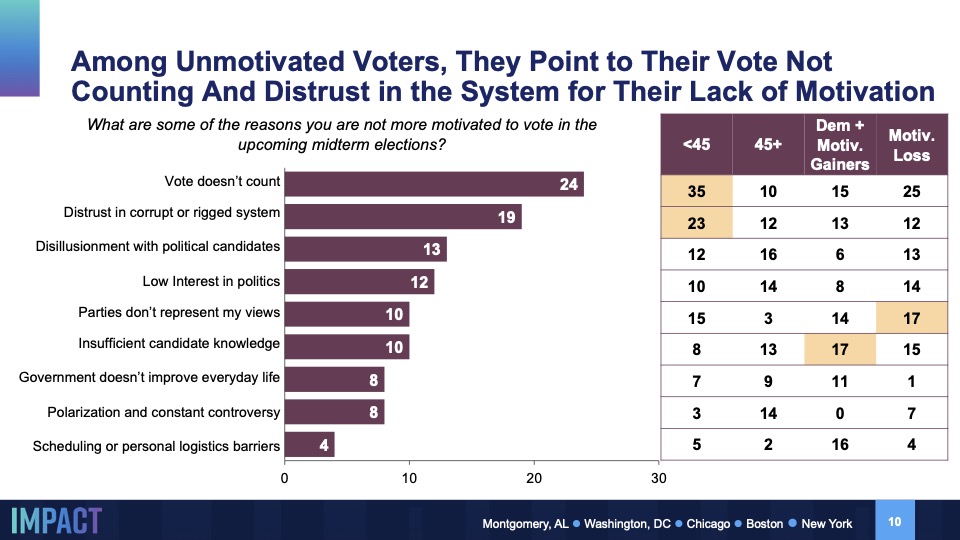
Graph from Navigator Research titled: Among Unmotivated Voters, They Point to Their Vote Not Counting And Distrust in the System for Their Lack of Motivation

Leaning into Trump’s Bogus Claims of Rigged Elections Can Backfire With Certain Audiences

Republican voter suppression tactics could be effective in discouraging some lower propensity Democratic voters to turn out in November. A significant portion of younger Black Americans (17%) say hearing about these voter suppression policies makes them less motivated to vote. About one-in-four Hispanic Americans over age 45 say it has no impact on their motivation to vote.
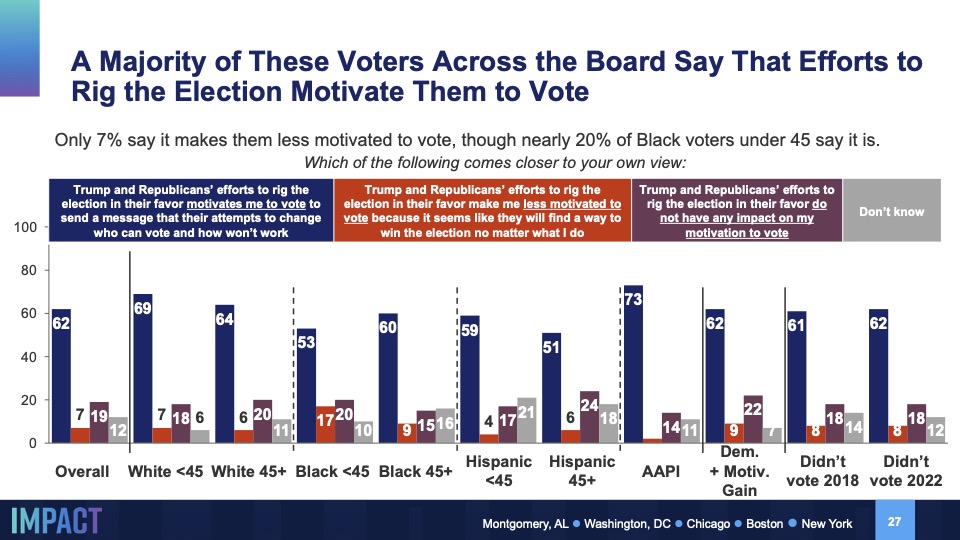
Graph from Navigator Research titled: A Majority of These Voters Across the Board Say That Efforts to Rig the Election Motivate Them to Vote

Among all the election security policies tested, deploying ICE agents to polling sites had the largest negative impact on vote motivation: 36% of respondents said this would make them “much less likely” to vote, including 33% of Hispanic American respondents. A ban on mail-in voting had a similar demotivating effect, with 27% of all respondents – and 35% of Hispanic Americans – saying it would make them much less likely to vote.
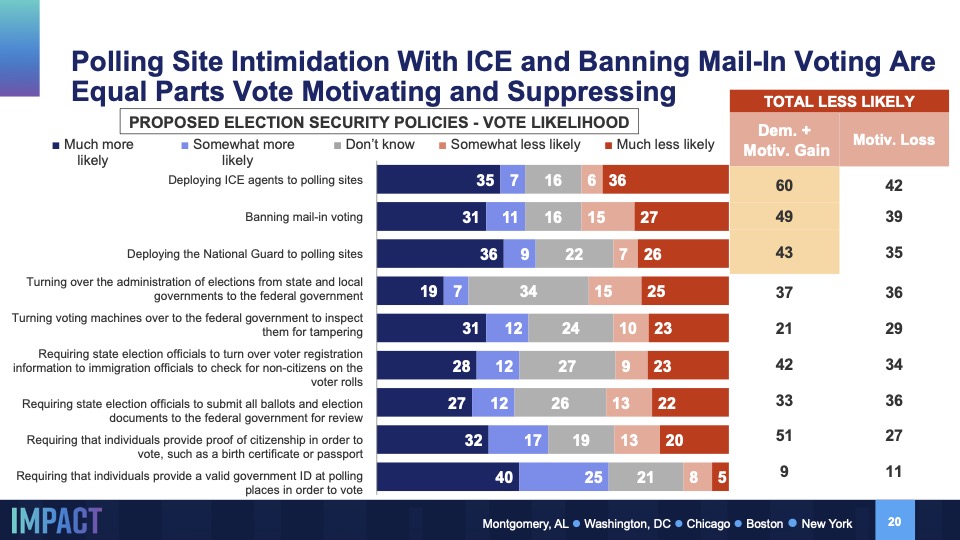
Graph from Navigator Research titled: Polling Site Intimidation With ICE and Banning Mail-In Voting Are Equal Parts Vote Motivating and Suppressing

Messaging on the wider harms caused by the Trump administration – rising costs, corruption, abuse of power – were all more effective at motivating respondents to vote than messages about Trump’s tampering with and rigging the election. The most effective messaging focuses on a call to action to vote out elected officials who aren’t tackling rising inflation or lowering costs while also reassuring Americans that our elections are safe and secure. 
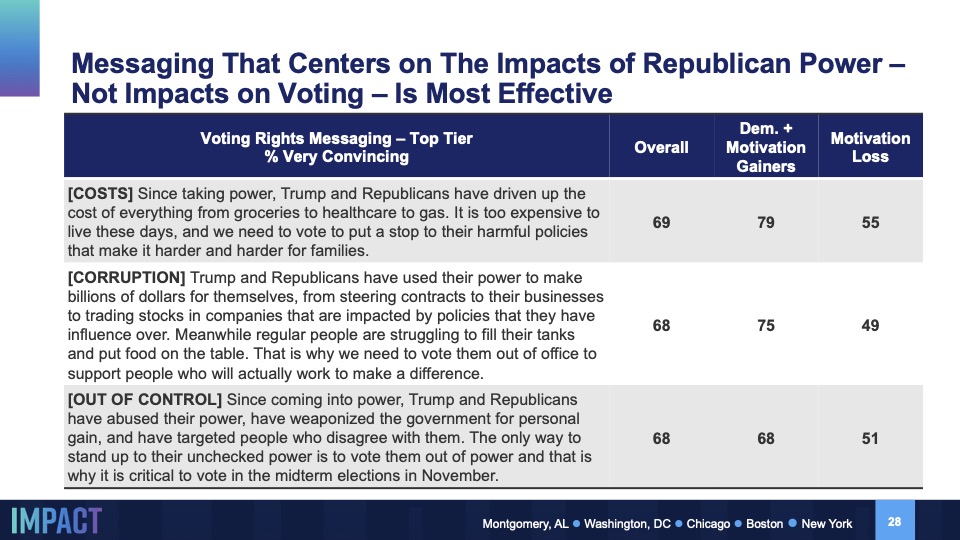
Slide from Navigator Research titled: Messaging That Centers on The Impacts of Republican Power – Not Impacts on Voting – Is Most Effective

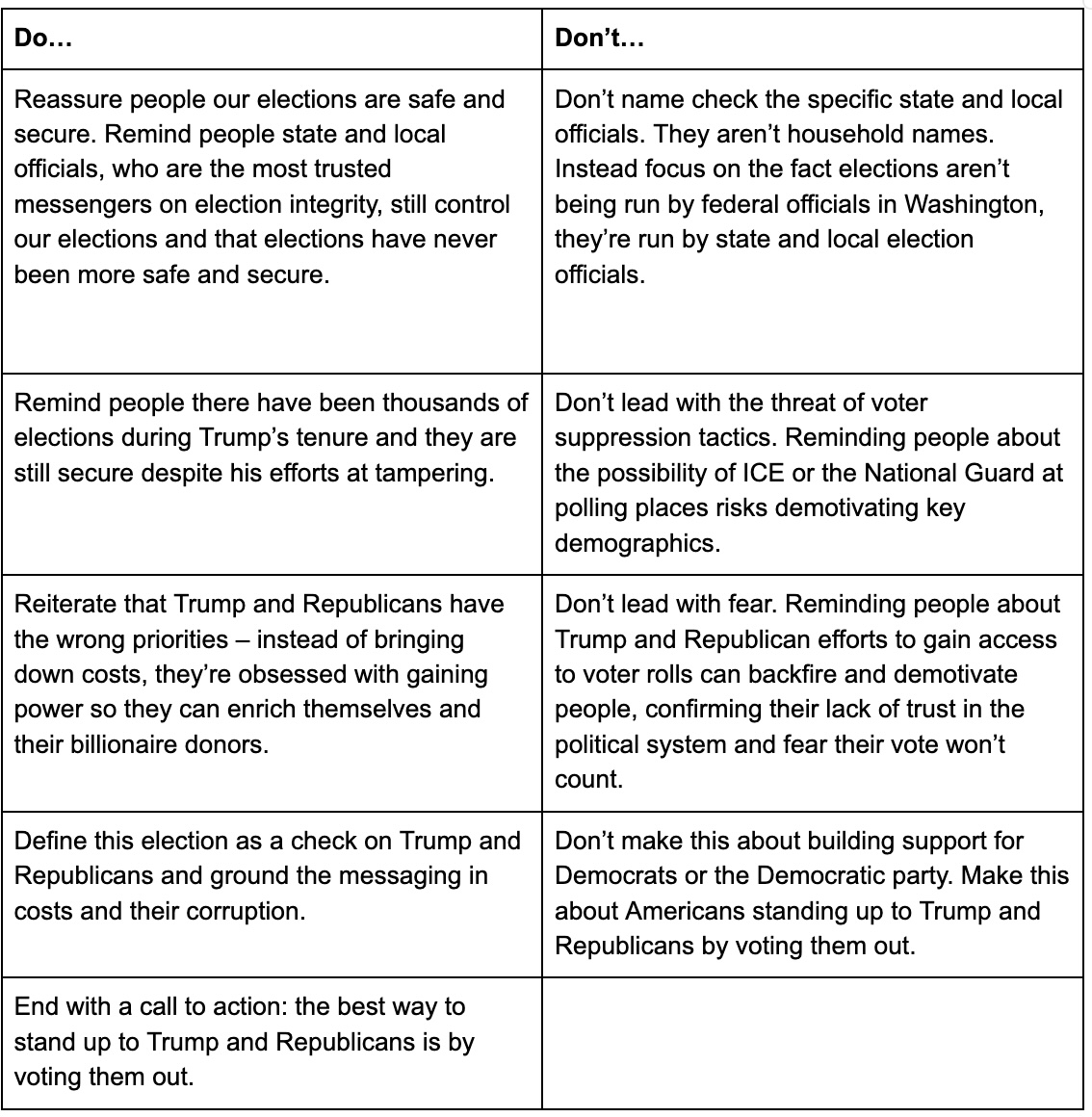
This messaging guidance outlines how to communicate about election interference without demotivating key Americans from voting.
Share

About The Study

Impact Research conducted public opinion surveys among a nationwide sample of 1,000 Democrat-leaning low-propensity voters from May 21 - June 4, 2026. The survey was conducted by text-to-web (100 percent). Respondents were verified against a voter file. The margin of error for the full sample at the 95 percent level of confidence is +/- 3.1 percentage points. The margin for error for subgroups varies and is higher.

Related Posts

READ MORE
September 16, 2026

What Iowans Want - Lower Prices & Clean Water

This Navigator report contains new research from a statewide survey in Iowa August 18 - 29 concerning views of leaders, issue priorities, and trust.

Everything is Bigger in Texas, Including Concern over Cost and Corruption

This Navigator Research report contains new research from statewide surveys conducted in Texas. This is part of our larger Expanding the Battleground series which also fielded in Iowa, Ohio, and Alaska.

September 11, 2026

Special Report: Americans in Key Battleground States Want Leaders Who Share Their Values

This Navigator Research report covers views of leaders, issue priorities, and trust.

Julie Alderman Boudreau

Americans are Concerned by AI, But Still Use It

This Navigator Research report covers survey and qualitative data on how Americans feel about artificial intelligence (AI) and how they’re using it, if at all.

Julie Alderman Boudreau