
Majorities Support Voting Rights Legislation and Filibuster Reform

January 18, 2022
Bryan Bennett

Majorities are more likely to support eliminating the filibuster if it stands in the way of passing voting rights or a new economic plan.

Key takeaways
  • Half of Americans have heard about the Freedom to Vote Act, and nearly two in three support it being passed.
  • Protecting the right to vote from the whims of either political party and state politicians is the most convincing reason to pass federal voting rights reforms.
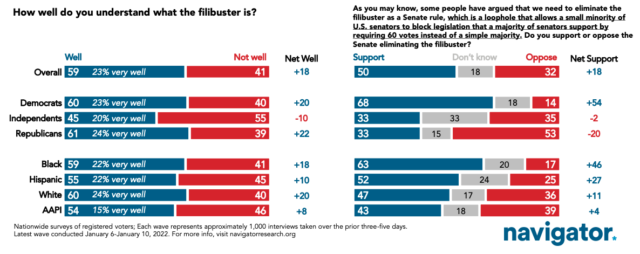
  • A growing share say they understand the filibuster and support eliminating it by a double-digit margin.

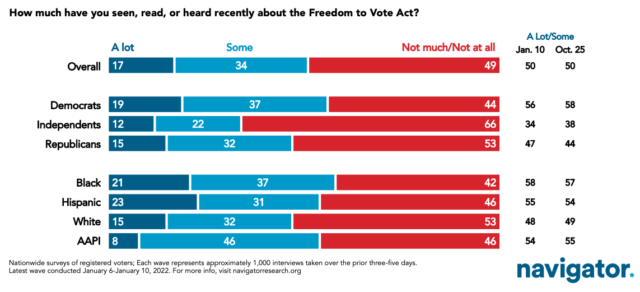
Half of Americans Have Heard About the Freedom to Vote Act

Independents are the least likely to have heard about the Freedom to Vote Act (34% “a lot” or “some”).
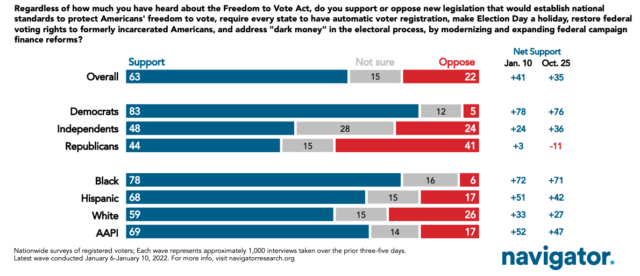
Three in Five Support Passage of the Freedom to Vote Act

There has been a 6-point increase in support for the Freedom to Vote Act since October (from net +35 to net +41).

  • Pluralities of independents (48%) and Republicans (44%) support the Freedom to Vote Act.
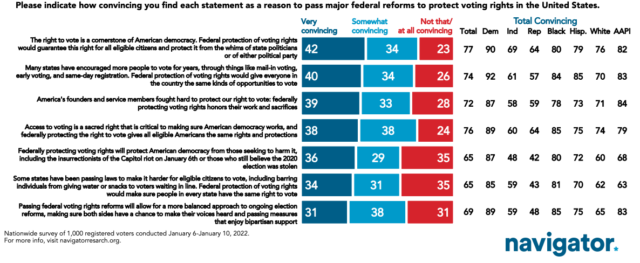
On Federal Voting Reforms, Protecting the Right to Vote from Political Whims of Either Party Is Most Convincing Argument

Among independents, the most convincing messaging focuses on protecting the right to vote from political whims of either party (69% convincing) and increasing access for all Americans to vote (61%).
A Majority Report Understanding the Filibuster, With Half Wanting to End It

Democrats (68%) are driving the share who support eliminating the filibuster, with 33% of independents and Republicans each supporting its abolition.
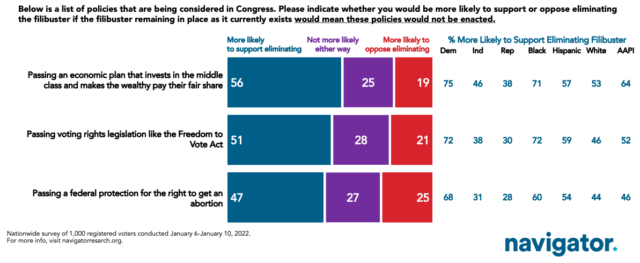
A Range of Progressive Policy Outcomes Make Americans More Likely to Support Eliminating the Filibuster

Nearly half of independents (46%) say they would be more likely to support eliminating the filibuster if it meant passing “an economic plan that invests in the middle class and makes the wealthy pay their fair share.”
Download
Toplines
Share

About The Study

This release features findings from national online surveys of 1,000 registered voters conducted January 6-10, 2022. Additional interviews were conducted among 101 Hispanic voters, 100 African American voters, 101 independents without a partisan lean, and 79 Asian American and Pacific Islander voters.

Related Posts

READ MORE

How White Christians Feel About America at 250

This Navigator Research report covers how white Christians feel about what it means to be an American, the rights and freedoms they value most, and how they view the country ahead of its 250th anniversary.

Julie Alderman Boudreau

Defining America For Immigrant Americans

This Navigator Research report covers research among first-generation immigrants and children of immigrants on what it means to be American, how they define the American dream, and how they see the future of the country as we approach our 250th.

Tina Tang
June 24, 2026

Four Years Post Roe Americans Still Support Abortion Rights

This Navigator Research Report covers perceptions of abortion rights four years after the Supreme Court overturned the constitutional right to abortion.

Julie Alderman Boudreau & Talya Hamberg

What the 250th Anniversary Means to Black and Latino Americans

This Navigator Research report covers Black and Latino Americans on perceptions of what it means to be American, how they define the American dream, and how they see the future of the country, ahead of the nation’s 250th celebration.

Maryann Cousens