
Poll: Views of Government Funding
This Navigator Research report contains polling data on the level of support for increasing funding for a variety of public programs including Social Security and Medicare, the Affordable Care Act, and nutrition assistance, as well as messaging guidance for communicating about increasing public investment against cutting spending on those programs.
Vast majorities support more investment in programs like Social Security and Medicare.
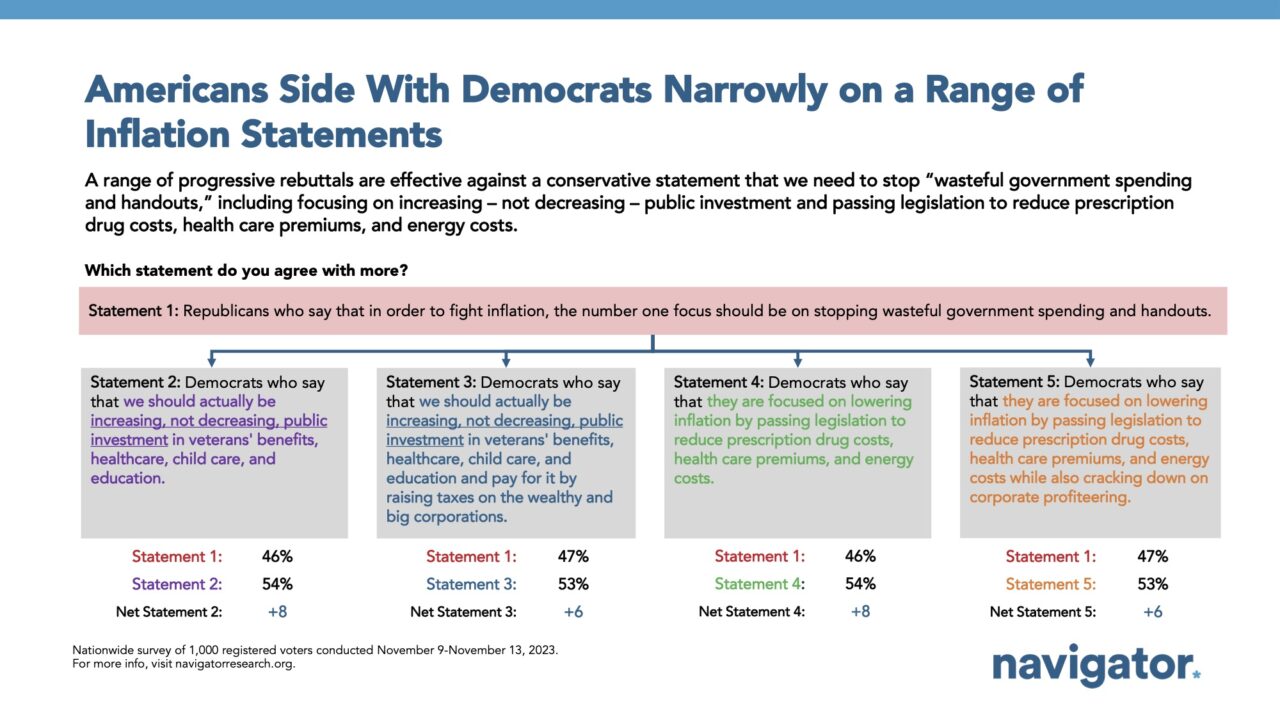
Large majorities of Americans not only oppose cuts to programs like Social Security and Medicare, nutrition assistance for vulnerable families, and Medicaid and the Affordable Care Act, but also overwhelmingly support investing more in them. This survey contained a split-sample experiment where half of respondents were asked about cutting spending for a variety of programs and the other half of respondents were asked about increasing funding in the same list of programs. The most widely opposed cuts include funding for retirement programs, like Social Security and Medicare (net -68; 13 percent support – 81 percent oppose), funding for nutrition assistance for children and vulnerable families (net -63; 15 percent support – 78 percent oppose), funding for K-12 public schools (net -61; 16 percent support – 77 percent oppose), and funding for health care, including Medicaid and the Affordable Care Act (net -54; 20 percent support – 74 percent oppose). When looking at these same programs and asking support for increasing investment in them, there is equal or even higher levels of support for additional funding, including increasing funding for retirement programs, like Social Security and Medicare (net +71; 82 percent support – 11 percent oppose), funding for nutrition assistance for children and vulnerable families (net +60; 76 percent support – 16 percent opposed), funding for health care, including Medicaid and the Affordable Care Act (net +59; 76 percent support – 17 percent oppose), and funding for K-12 public schools (net +54; 73 percent support – 19 percent oppose).
- Nearly three in four Americans also support increasing funding for housing assistance programs for low-income families (72 percent), funding for childcare programs (72 percent), and increasing IRS funding to crack down on wealthy tax cheats and big corporations (70 percent).
- Importantly, there was significantly stronger support for increasing funding in the IRS to crack down on wealthy tax cheats and big corporations (net +49; 70 percent support – 21 percent oppose) than there was opposition to cutting IRS funding (net -11; 40 percent support – 51 percent oppose).
Majorities agree with progressive arguments over conservative arguments on inflation and government spending.
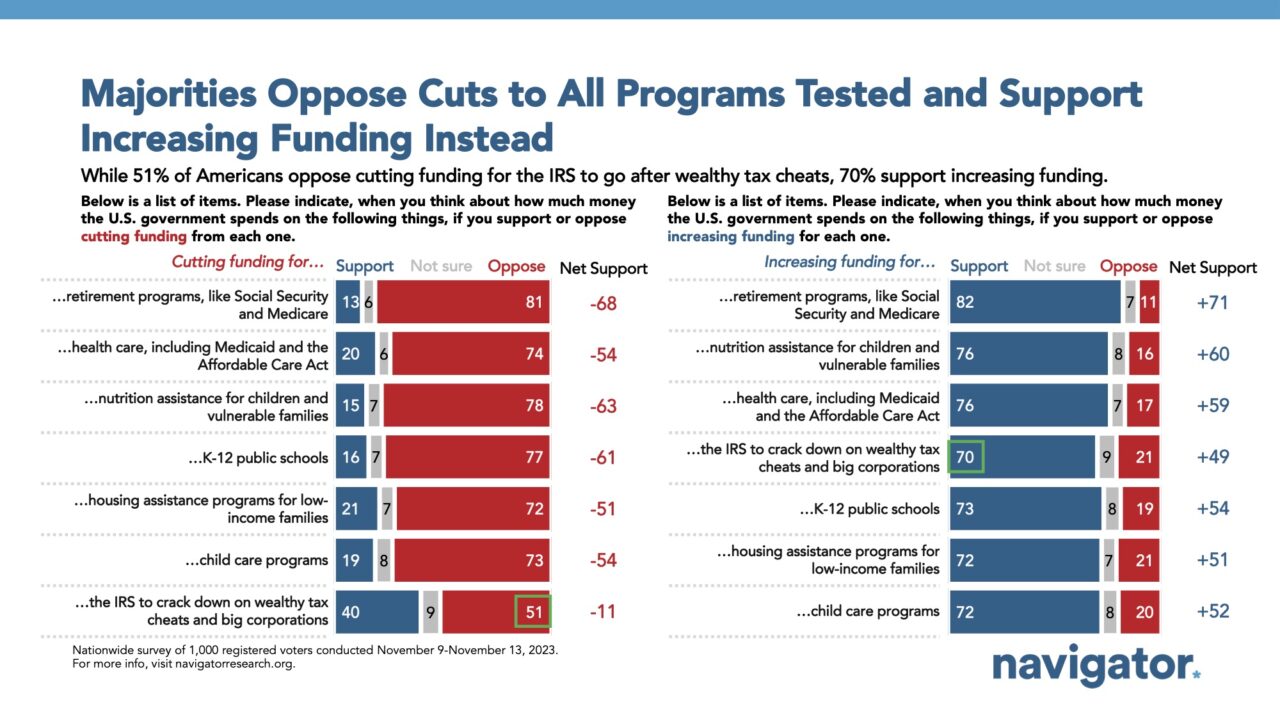
More Americans agree with progressive statements that the government should increase spending on public investment over conservative arguments that we need to focus on “stopping wasteful government spending and handouts.” When presenting the conservative argument that “in order to fight inflation, the number one focus should be on stopping wasteful government spending and hand-outs” against four progressive rebuttals, the conservative argument lost in each head-to-head test. One of the strongest progressive arguments centered on increasing public investment, including more agreeing with a statement that “we should be actually increasing, not decreasing public investment in veterans’ benefits, healthcare, child care, and education” (54 percent) over the conservative argument (46 percent). Navigator has consistently found that centering increased investments in programs that help lower costs for middle and working class families is an effective framing when talking about Americans’ deeply negative perceptions of the current economy.
- Another progressive argument that performed well against the conservative argument emphasized being “focused on lowering inflation by passing legislation to reduce prescription drug costs, health care premiums, and energy costs” (net +8; 54 percent progressive argument – 46 percent conservative argument).