Trump’s Approval Declines in the Battleground as Economic Pessimism Persists

July 3, 2025
Ian Smith

Polling report on the latest perceptions of President Trump and Congressional Democrats and Republicans in the House Battleground.

Poll: President Trump and Congressional Democrats and Republicans in the House Battleground

This Navigator Research report covers the latest perceptions of President Trump and Congressional Democrats and Republicans in the House Battleground.

The economy continues to lead as the top overall issue, with 41 percent of battleground constituents identifying either “inflation and the cost of living” or “jobs and the economy” as a priority.

In a newly added question, we tested “government corruption” as a top concern. It now ranks just behind threats to democracy and the economy — making it the third-most prioritized issue overall (28 percent).
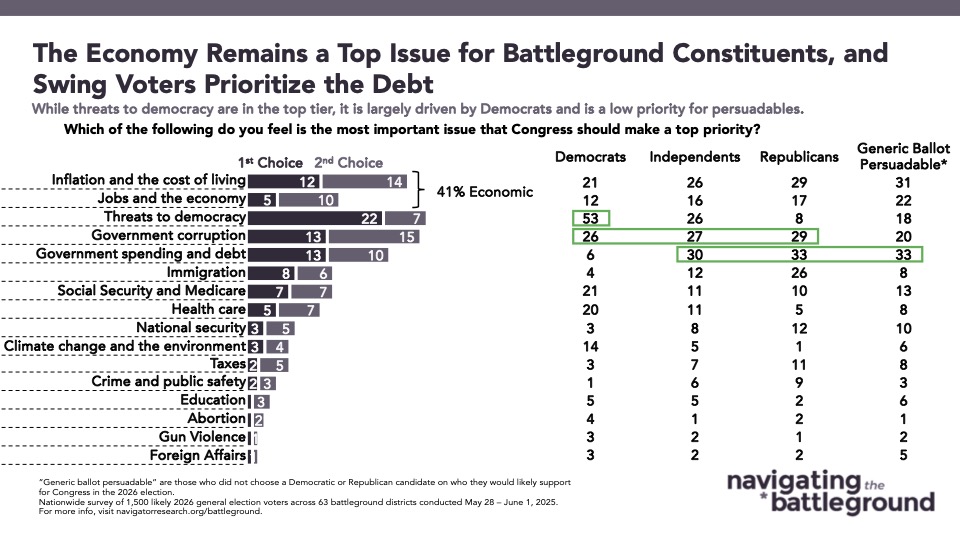
Bar graph of polling data from Navigator Research. Title: The Economy Remains a Top Issue for Battleground Constituents, and Swing Voters Prioritize the Debt

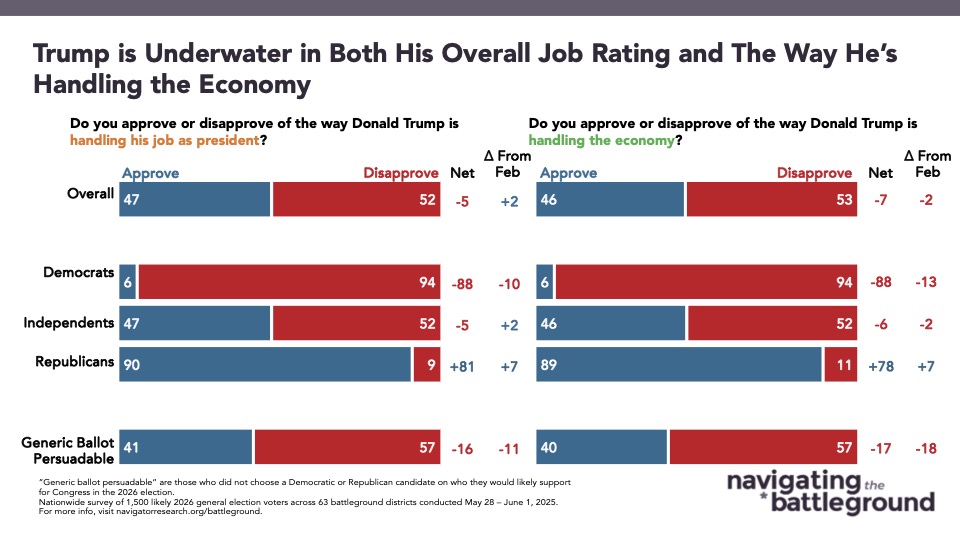
Trump’s standing has declined slightly among battleground constituents and persuadables — even in a sample that leans slightly more Republican than the national electorate. In February, his favorability was roughly even; today, he is four points underwater (48 percent favorable – 52 percent unfavorable). This decline mirrors his approval on the economy, which now sits seven points underwater (46 percent approve – 53 percent disapprove).
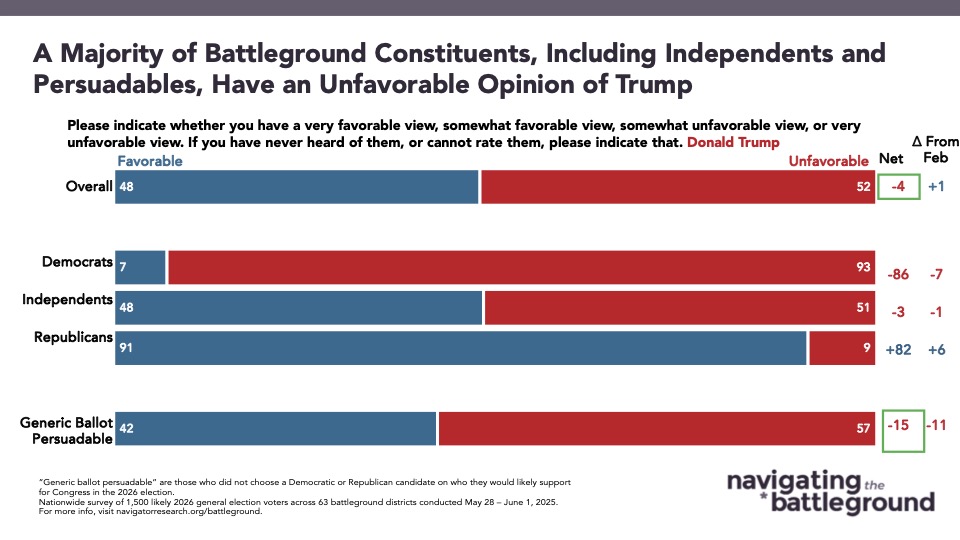
Bar graph of polling data from Navigator Research. Title: A Majority of Battleground Constituents, Including Independents and Persuadables, Have an Unfavorable Opinion of Trump
Bar graph of polling data from Navigator Research. Title: Trump is Underwater in Both His Overall Job Rating and The Way He’s Handling the Economy

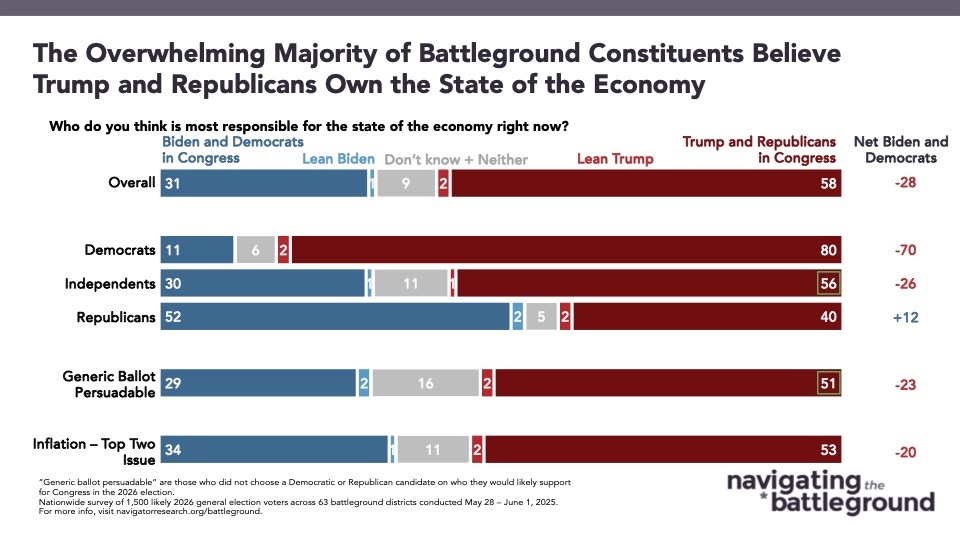
Perceptions of the economy remain bleak:

  • 61 percent of battleground Americans say the economy is doing “not so good” or “poor.”
  • 58 percent say Trump and Republicans in Congress are most responsible for the current state of the economy.
  • 26 percent list inflation as one of their top two concerns.
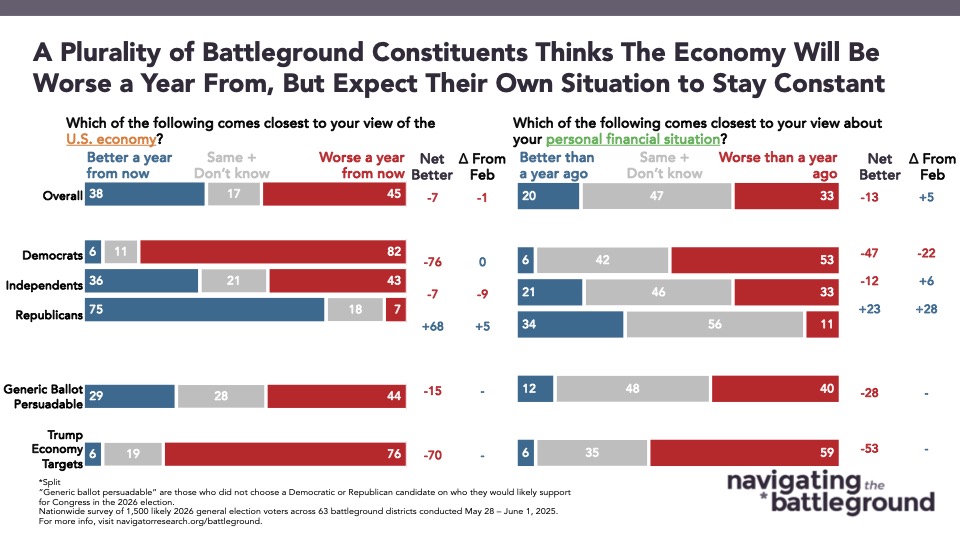
  • 33 percent say their personal financial situation is worse than it was a year ago.

There is little optimism about the economy looking forward:

  • 45 percent believe the economy will be worse a year from now.
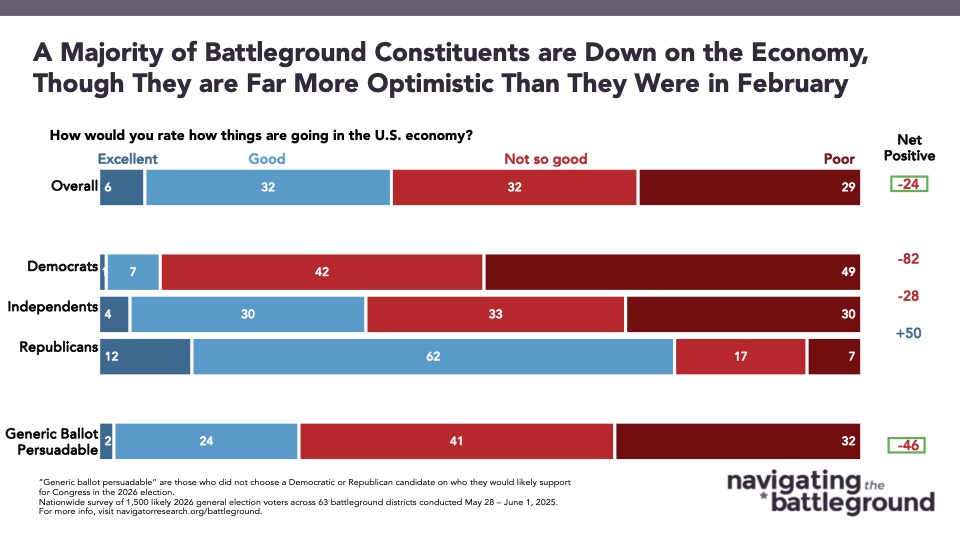
Bar graph of polling data from Navigator Research. Title: A Majority of Battleground Constituents are Down on the Economy, Though They are Far More Optimistic Than They Were in February
Bar graph of polling data from Navigator Research. Title: The Overwhelming Majority of Battleground Constituents Believe Trump and Republicans Own the State of the Economy
Bar graph of polling data from Navigator Research. Title: A Plurality of Battleground Constituents Thinks The Economy Will Be Worse a Year From, But Expect Their Own Situation to Stay Constant

Read More

October 3, 2025

Feeling the pressure of rising grocery costs Battleground voters lay the blame on Trump and Republicans in Congress

Polling report on perceptions of tariffs in the House battleground.

Ian Smith & Maryann Cousens
September 26, 2025

Americans in the Battleground Want Congress to Protect Health Care — Even If It Means Shutting Down the Government

Polling report on perceptions of a potential government shutdown, rising costs among House battleground constituents.

Ian Smith & Erica Seifert

Views of Democrats and Republicans in the House Battleground

Polling report on the latest perceptions of President Trump and Congressional Democrats and Republicans in the House Battleground.

Zoya Qadiri

Reactions to the Budget Bill in the House Battleground

Polling report on the perceptions of the budget bill recently passed by House Republicans.

Rachael Russell
Download
ToplinesGRAPH
Share

About The Study

This survey was conducted among a sample of 1,500 likely 2026 general election voters from May 28-June 1, 2025. The survey was conducted via text-to-web. Respondents were verified against a voter file and special care was taken to ensure the demographic composition of our sample matched that of the 63 congressional districts included in the sample across a variety of demographic variables (the full list of districts included in the sample can be found on slide 20 here). The margin of error for the full sample at the 95 percent level of confidence is +/- 2.5 percentage points.