Poll: Affordability
This Navigator Research report covers the latest views of the affordability crisis, including specific costs Americans say are increasing and how increased costs are impacting financial habits.
Shifting of Economic Perceptions and Priorities
Inflation and the cost of living has remained the top issue for Americans throughout 2025. Our most recent survey shows 57% believe the President and Congress should be focused on the issue, not far from its highest point at 62% in April. Health care has emerged through the year as an issue Americans want the government to focus on, starting at 33% in January and now reaching its highest point at 42%.
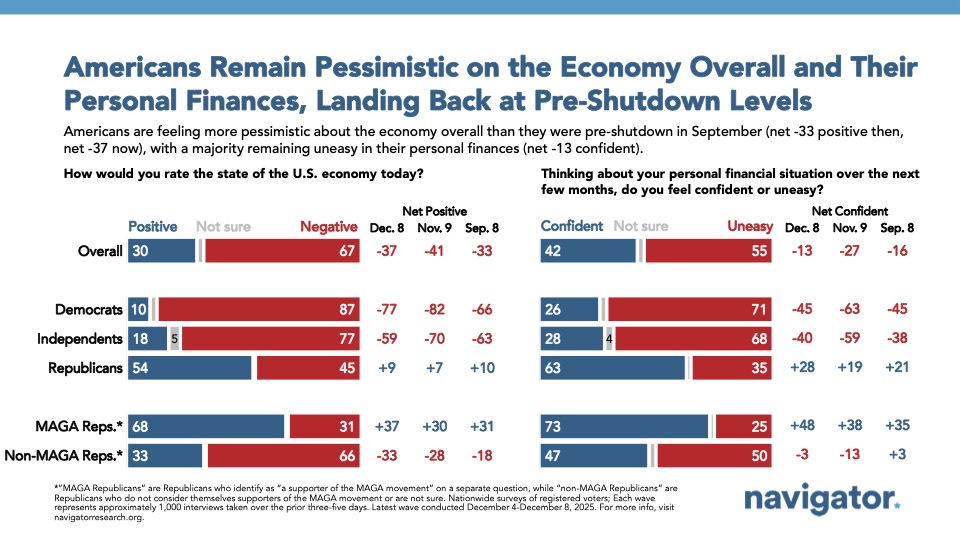
Perceptions of the economy have remained negative throughout the year, reaching their lowest point in April (77% negative), with two in three still rating the economy negatively today (67%). Similarly, Americans have expressed uneasiness regarding their personal financial situations throughout the year, with the greatest amount of stress in early November (63% uneasy – 36% confident) which has improved some over the past few weeks (55% uneasy – 42% confident).
Specific Pain-Points
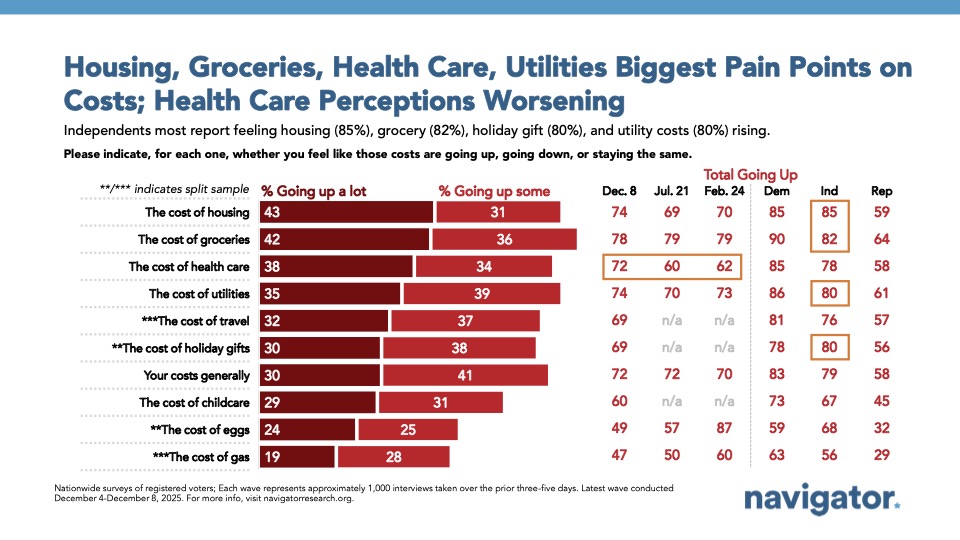
The cost of nearly everything is going up, and going up “a lot.” Over three in four say the cost of groceries is going up (78%), including 42% who say the cost is going up “a lot.” Similarly, 74% say the cost of housing is going up, with 43% saying it is going up “a lot.” The cost of utilities (74% going up, 35% going up a lot) and the cost of health care (72% going up, 38% going up a lot) are the next most significant cost pain points for Americans. While most cost assessments have remained steady throughout the year, Americans are 10-points more likely to say the cost of health care is on the rise than they were in February (62% in February – 72% now).
Renters and home-owners alike are feeling the effects of rising housing costs, though renters are the most likely, as 78% say the cost of housing is on the rise –compared to 70% of homeowners.
While several specific cost metrics vary between urban and rural areas, the cost of utilities is a concern across population density. 76% of urban Americans say the cost of utilities is going up, and 73% of rural Americans say the same.
Health Care Premiums
Half of Americans say their health care premiums are going up (50%), including 20% who say their premiums are going up “a lot.” This cost pressure is felt across party lines. Democrats are only somewhat more likely than Republicans to say their premiums are going up (56% of Democrats, 47% of independents, 44% of Republicans).
Financial Habits and Experiences
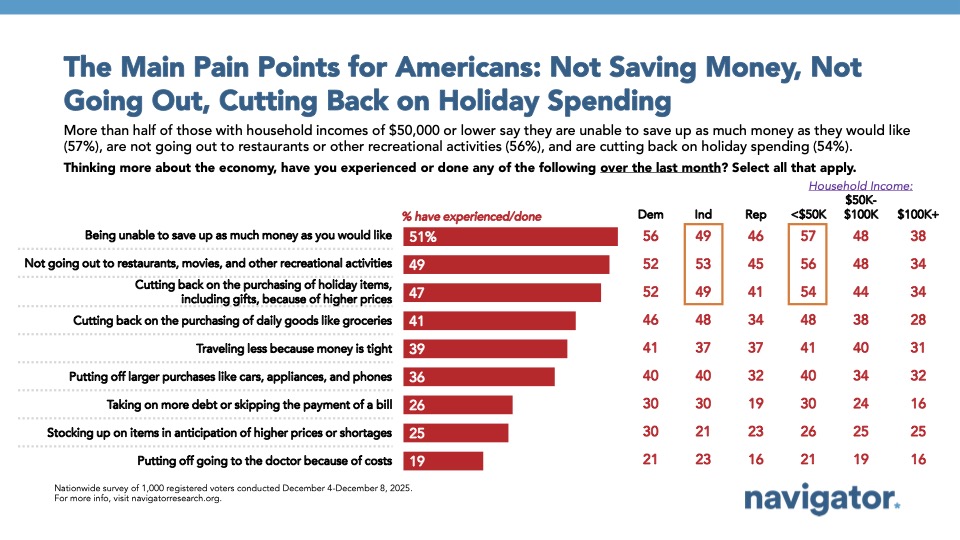
Most Americans report being unable to save up as much money as they would like (51%), and 49% say they have stopped going out to restaurants, movies, and doing other recreational activities. As the holiday season approaches, 47% say they have cut back on gift purchases due to higher prices.
A majority say they have carried a credit card balance in the past year, including 40% who say they have carried a balance in the past month. One in four Americans have used a “buy now, pay later” tool, such as Klarna, in the past year (26%), including 14% who have used one in the past month.
Millennials are significantly more likely than other generations to use a “buy now, pay later” tool such as Klarna or Afterpay. 43% of Millennials report using “buy now, pay later” in the past year, compared to 29% of Gen-Z, 25% of Gen-X, and 12% of Boomers.
Who’s to Blame?
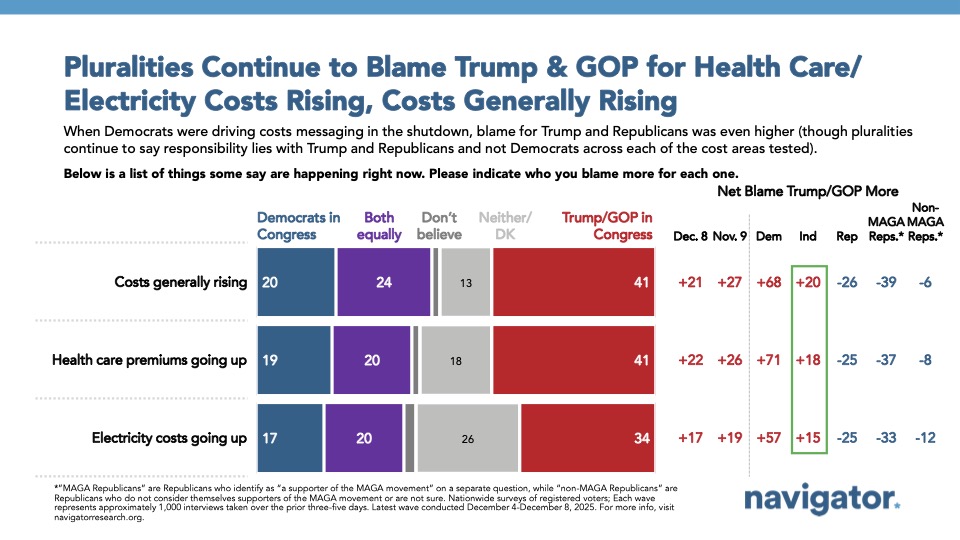
By a 21-point margin, Americans blame Trump and Republicans in Congress more than Democrats in Congress for rising costs. By a similar margin (net +22), Americans blame Trump and Congressional Republicans for health care premiums rising. Independents also blame Trump and Republicans more than Democrats for general costs rising, health care premiums rising, and the cost of electricity rising, but also say both parties are to blame.