
MAHA Message Guidance
Messaging guidance on the “Make America Healthy Again” (MAHA) movement.
The “Make America Healthy Again” (MAHA) movement blends common-sense health advice with fringe – and sometimes dangerous – ideas. Its leaders say they want to tackle America’s chronic disease crisis and improve wellness, but their proposals often reveal something else: a distrust of science and a readiness to exploit public frustration with the health care system. As Health and Human Services Secretary Robert F. Kennedy Jr. remakes the nation’s public health establishment, his agenda leans heavily on two emotional threads: fear of illness and anger at a system people feel is broken.
Navigator Research completed a study of public attitudes towards health and wellness, as well as perceptions of the MAHA movement and what progressive messages appeal most to those in the MAHA-curious cohort. (deck here).
Values
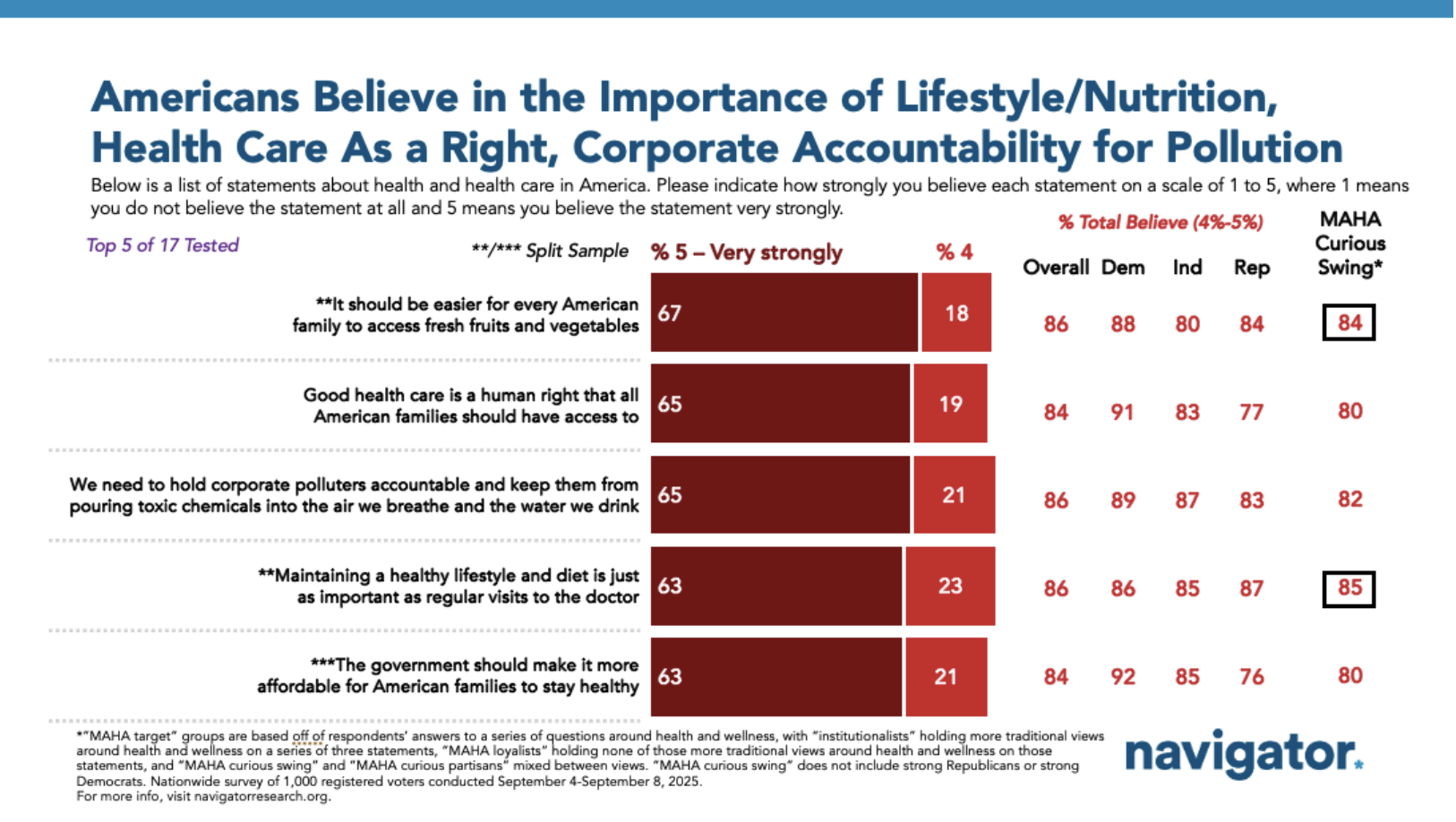
While Robert F. Kennedy may be divisive, an overwhelming majority of Americans across partisanship share common values about health and wellness:
- The government should make it more affordable for American families to stay healthy.
- Good health care is a human right that all American families should have access to.
- It should be easier for every American family to access fresh fruits and vegetables.
- Maintaining a healthy lifestyle and diet is just as important as regular visits to the doctor.
- We need to hold corporate polluters accountable and keep them from pouring toxic chemicals into the air we breathe and the water we drink.
Messaging to Meet the Moment
A message that addresses the faults in our health care system and focuses on cracking down on corporate interests persuades Democrats and independents, non-MAGA Republicans, and also “MAHA curious” persuadables.
Our health care system is broken, but the answer is not to cut medical research, take away healthy school meal options from kids, or limit vaccines. Instead we should be cracking down on special interest influence in our government and putting science and facts ahead of politics.
Message Path:
- Acknowledge the system is broken: Most Americans are not satisfied with, or confident in, the existing health care system.
- Point out that Republicans’ proposed solution is not right: Americans oppose cuts to medical research, taking away healthy school meals from kids, and ending all vaccine mandates.
- Provide an alternative: Cracking down on special interest influence in our government is particularly persuasive when talking about health and wellness in the country today.
- Lean into common sense consensus solutions: Americans overwhelmingly agree that healthcare should be a right and that government should make it more affordable for people to stay healthy.