

Poll: Media Consumption and Views on the Iran War
This Navigator Research report covers how Americans’ views on the war with Iran differs by their media habits.
Republicans Who Watch Fox News Report Greater Support for the Iran War Across a Variety of Metrics
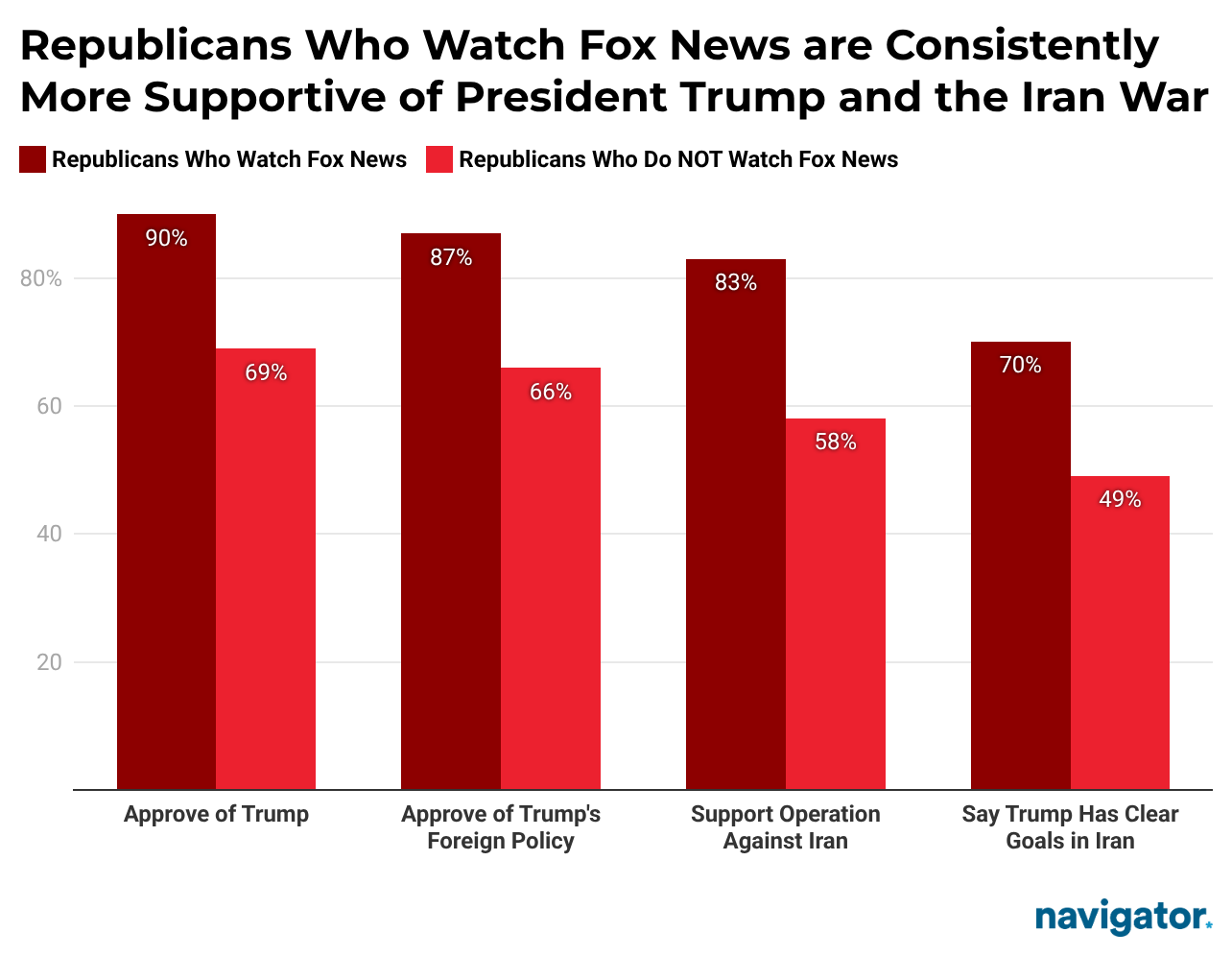
Americans are net negative on the war with Iran and Trump’s handling of foreign policy, but their attitudes are different depending on where they get their news. Nine-in-10 Republicans who say they watch Fox News approve of President Trump’s job in office, and 87% approve of his handling of foreign policy. Among Republicans who do not watch Fox News, just 69% approve of Trump’s job in office and 66% approve of his handling of foreign policy.
Republicans who report watching Fox News are 25 points more likely to support the war with Iran than Republicans who do not watch Fox News (83% support and 58% support, respectively).
- Republicans who watch Fox News are 21 points more likely than Republicans who do not to say they feel President Trump has a clear timeline and goals for the military operation in Iran (70% and 49%, respectively).
Republicans who watch Fox News are more likely to point to more positive reasons why President Trump decided to conduct military operations in Iran – 73% say a top three reason was that President Trump “felt Iran’s nuclear and missile programs posed an imminent threat,” compared to only 47% of Republicans who do not watch Fox News that say the same.
- Still, both groups share the same top three reasons they thought Trump conducted military operations against Iran: that he thought their missile program posed an imminent threat (73% Fox – 47% non-Fox), that he wants to liberate the Iranian people (66% Fox – 40% non-Fox), and that he wants regime change in Iran (55% Fox – 40% non-Fox).
Passive News Consumers Report Higher Opposition to Iran War, but Are Less Certain on Other Metrics
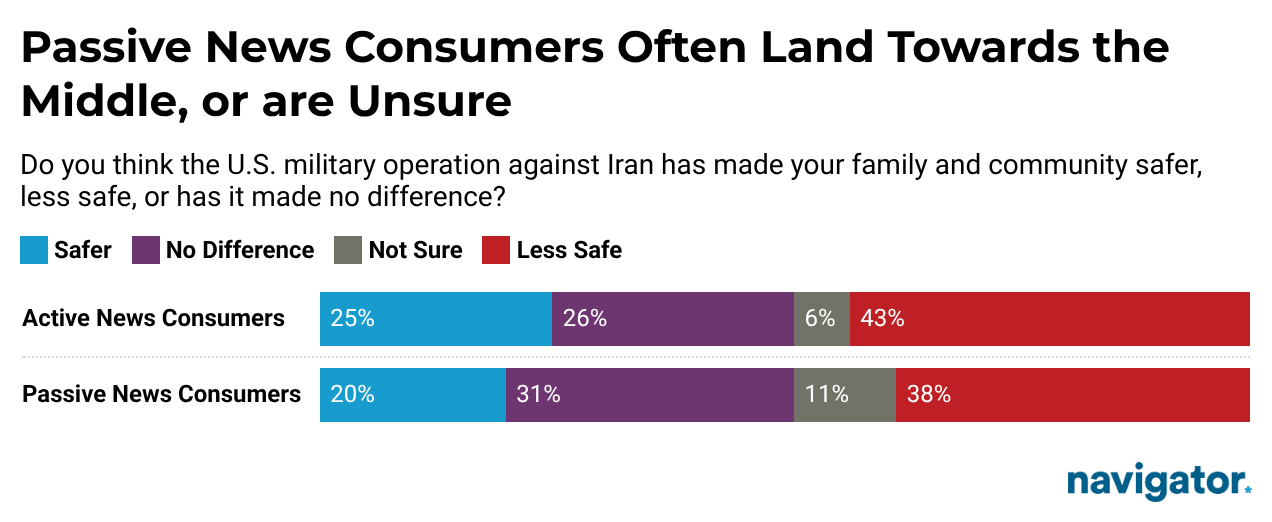
Passive news consumers (those who say the news comes to them) are more opposed to the war in Iran than active news consumers (those who say they seek out the news). By 15 points, passive news consumers say they oppose the war (35% support – 50% oppose), compared to active news consumers who oppose the war by 5 points (44% support – 49% oppose).
Conversely, passive news consumers report less concern the U.S. will end up in a prolonged conflict, though both groups are more concerned than not:
- More than two-thirds of active news consumers are concerned (70% concerned – 24% not concerned)
- Passive news consumers are 32 points more concerned than not (61% concerned – 29% not concerned).
Other questions on the war with Iran demonstrate more alignment between passive and active news consumers – although passive news consumers are more apt to say they are “not sure” or that they “don’t know.”
Support for the War with Iran Varies Between Viewers of Major Cable News Channels, as Do Views on Why President Trump Conducted the Operation
Americans who watch Fox News are far more supportive of the Iran war than those who watch CNN or MSNBC/MSNOW. While six-in-10 Americans who watch Fox News say they support the military operation in Iran, just 37% of both CNN and MSNBC/MSNOW viewers say the same.
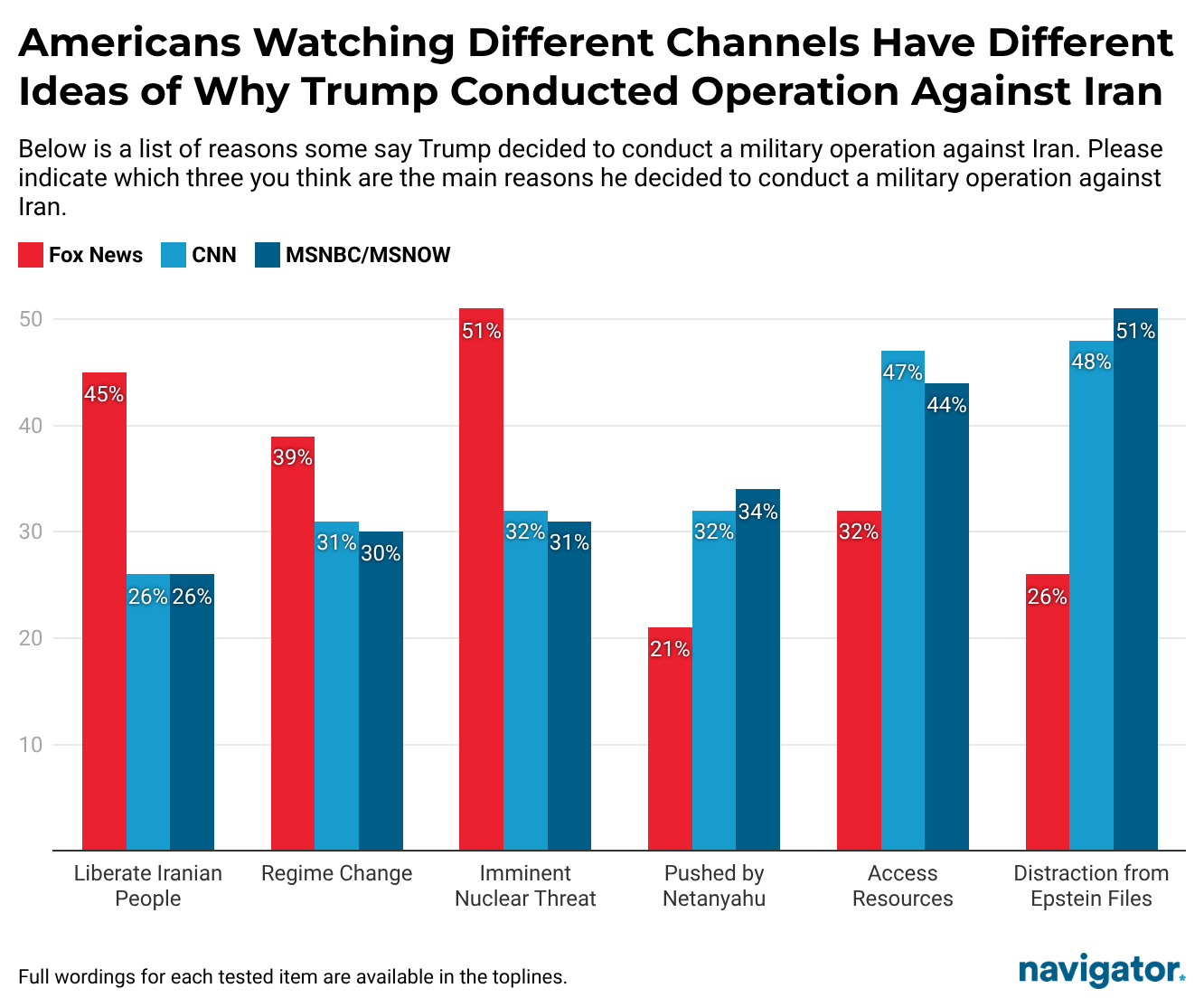
Fox News viewers and CNN and MSNBC/MSNOW viewers are also divided on why they think President Trump launched a war against Iran. While half of Fox News viewers say a top three reason for President Trump conducting the operation is that “he felt Iran’s nuclear and missile programs posed an imminent threat” (51%), just 32% of CNN viewers and 31% of MSNBC/MSNOW viewers say the same. Meanwhile, 48% of CNN viewers and 51% of MSNBC/MSNOW viewers say a top three reason for President Trump conducting the operation is that “he wants to use the conflict to distract from other issues, like the Epstein files,” while 26% of Fox News viewers say the same.
Americans on Different Social Media Platforms View the War Differently
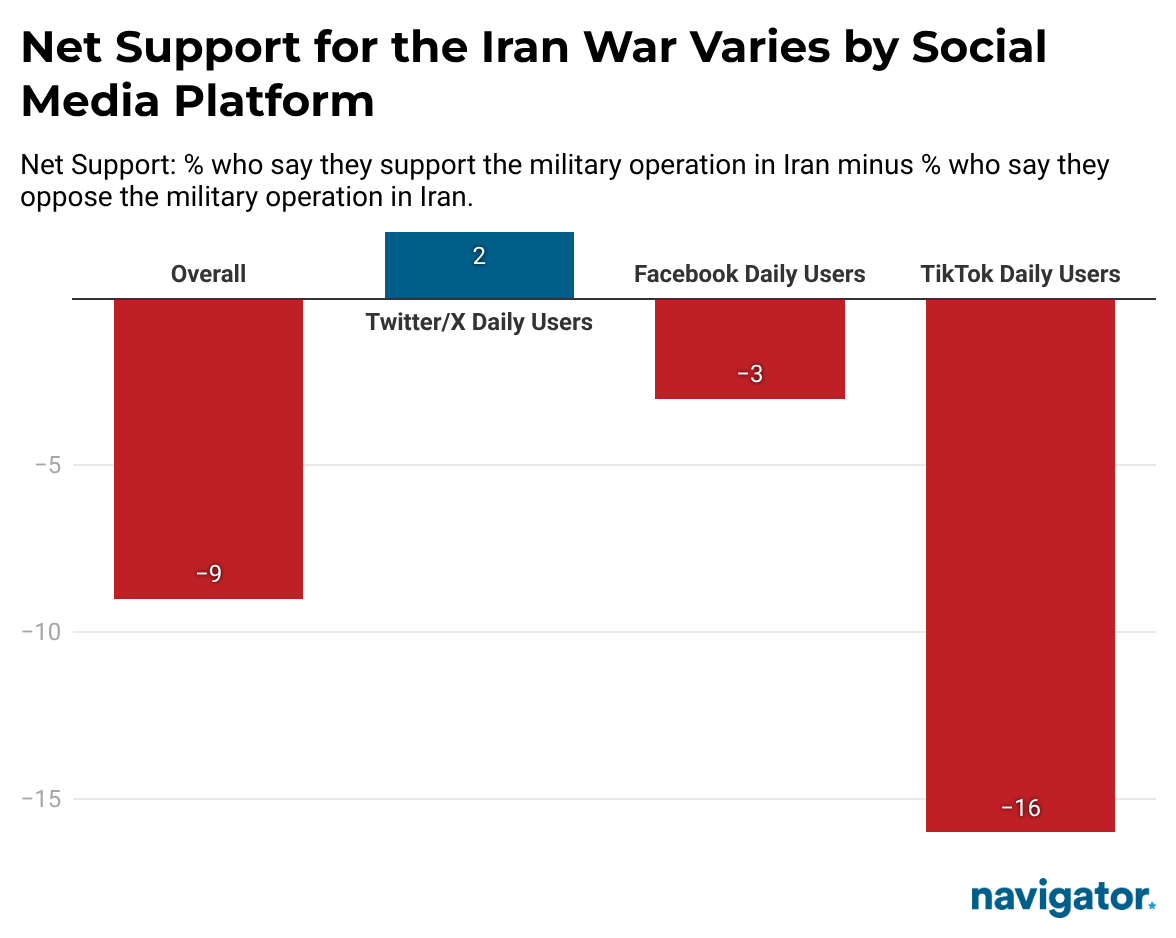
Americans on different social media platforms harbor differing views of the war. Americans who check Twitter/X daily support the U.S. military operation in Iran by two points (48% support – 46% oppose), while daily Facebook users are opposed by three points (43% support – 46% oppose). Daily TikTok users are far less supportive, opposing the war in Iran by 16 points (37% support – 53% oppose).
Americans on Twitter/X or TikTok tend to be younger, while Facebook is most popular among older Americans:
- Nearly 59% of daily TikTok users and 58% of daily Twitter/X users are ages 44 and under, while 59% of daily Facebook users are ages 45 and older.
Quick Takeaways
- Where and how Americans get their news is both shaped by their previous political views and how they understand events as they unfold – including the Iran War.
- Passive news consumers are a large group whose opinions are often unsettled. Reaching these people is critical for changing public opinion.
- While conversations in the political space often unfold on Twitter/X, Twitter users are already engaged – 73% of daily users are active news consumers, the highest portion on any platform – and increasingly steeped in right-wing content promoted by the site’s algorithms. Finding less engaged Americans on Facebook, Instagram, or TikTok may prove more useful when trying to influence public opinion.