

Message Guidance on Tariff SCOTUS Ruling

February 20, 2026
Navigator Research

Polling report covering the latest perceptions of tariffs, including the share of Americans who support Trump’s tariff plan and how tariffs are seen as impacting costs.

Big Takeaways:

Tariffs are 30 points underwater, and majorities oppose President Trump’s tariff plan.

Seven in ten believe tariffs are increasing the cost of things they buy.

Messages focusing on specific impacts of tariffs, and how tariffs will drive up costs, are most effective messages against Trump’s tariffs.

Poll: Tariffs

This Navigator Research report covers the latest perceptions of tariffs, including the share of Americans who support Trump’s tariff plan and how tariffs are seen as impacting costs.

Tariff Favorability and Support

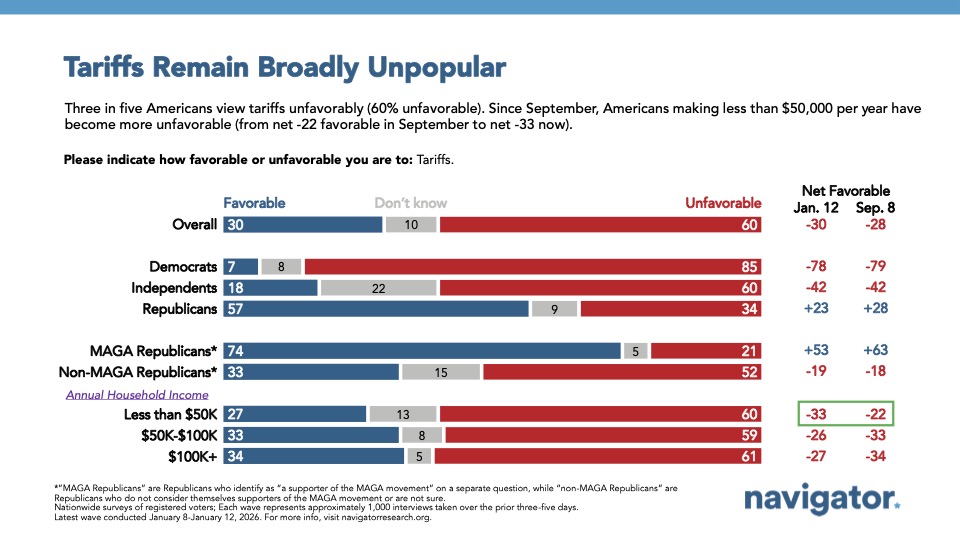
Tariffs remain overwhelmingly underwater, with 60% of Americans viewing them unfavorably and only 30% holding favorable views as of January.
Bar chart from Navigator Research, titled: Tariffs Remain Broadly Unpopular

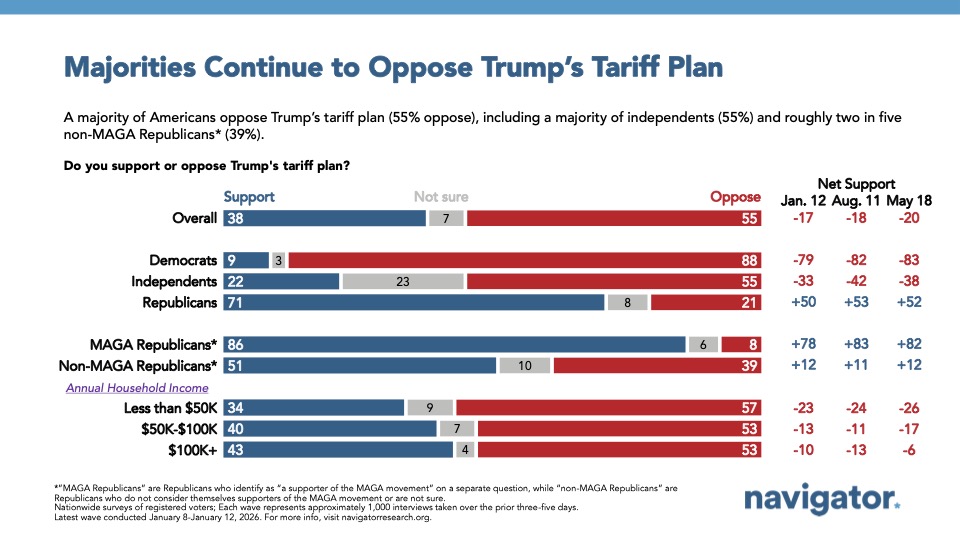
A similar margin opposes President Trump’s tariff plan, with 55% opposing and only 38% in support. Support for Trump’s tariff plan is largely partisan, opposed by 88% of Democrats, 55% of independents, and 21% of Republicans. Among Republicans though, there’s a split in support – with MAGA Republicans being 35 points more likely to support Trump’s tariff plan (86% MAGA – 51% non-MAGA).

  • Across income groups, Americans oppose Trump’s tariff plan, including among those who identify as “middle class” (43% support – 51% oppose).
  • Americans earning less than $50,000 a year have become 11 points more negative on Trump’s tariff plan since September, shifting from -22 in September to -33 in January.
Bar chart from Navigator Research, titled: Majorities Continue to Oppose Trump’s Tariff Plan

Tariffs and Costs

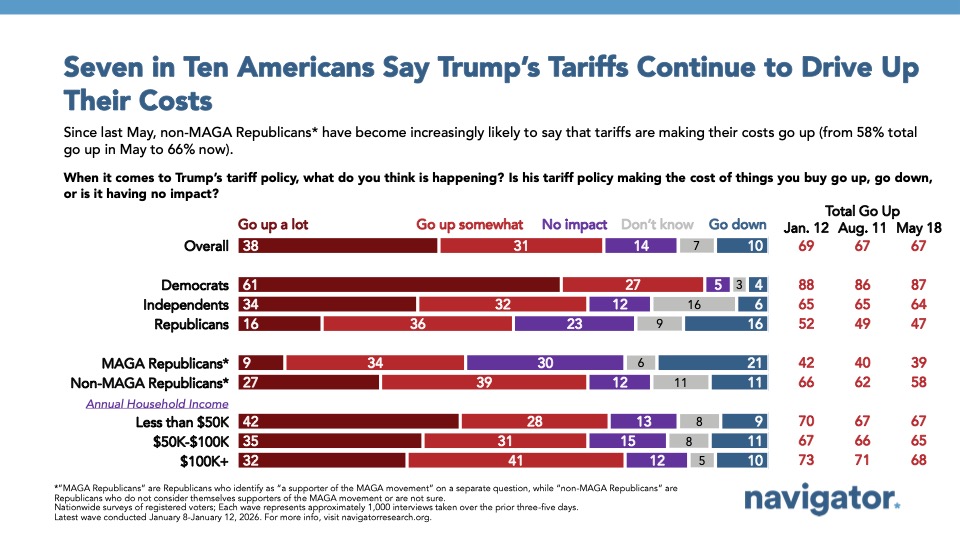
A majority across partisanship believe tariffs have led to an increase in their costs (69%), including 88% of Democrats, 65% of independents, and 52% of Republicans. Two-thirds of passive news consumers, those who say news comes to them, believe tariffs have increased their costs (66%), a similar share as active news consumers (71%). Only 10% of Americans say tariffs have made their costs go down.
Bar chart from Navigator Research, titled: Seven in Ten Americans Say Trump’s Tariffs Continue to Drive Up Their Costs

As Americans continue to believe their costs are increasing, majorities disapprove of President Trump’s handling of inflation and the cost of living (58% disapprove – 37% approve).

Message Guidance

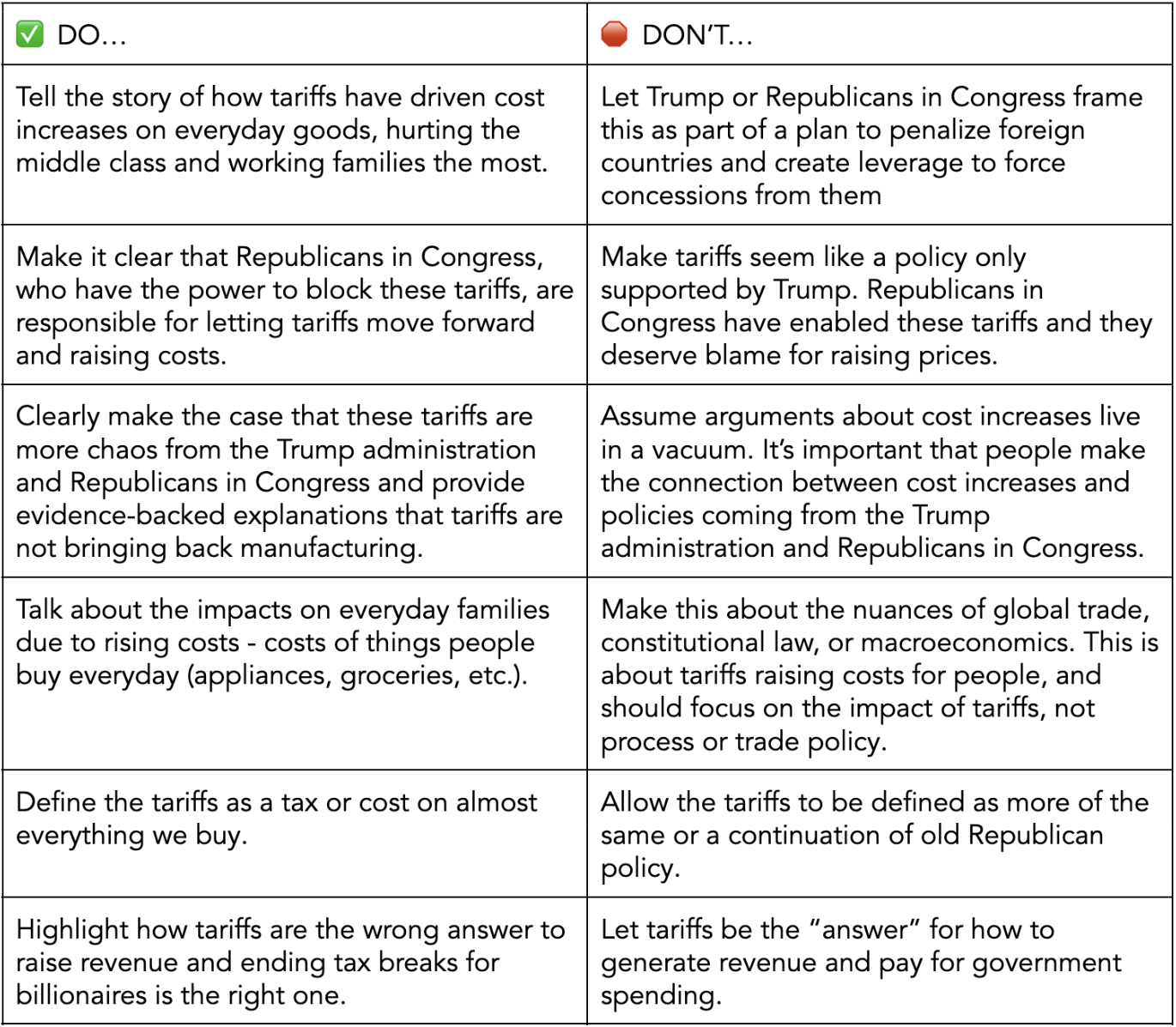
Despite the decision from the Supreme Court this morning, many of the Republican tariffs will continue. Additionally, it is likely that President Trump continues many of his tariffs in one way or another through a different mechanism. Even in the interim, it’s crucial to continue to tell the stories of how these tariffs, imposed by Trump and backed by Republicans in Congress, are raising costs for things people buy every day.

Here are some tips for how best to communicate on the negative impacts of tariffs:
Do's and Don't From Navigator Research

Read More

February 9, 2026

Do’s and Don’ts about Discussing ICE and Immigration

Do’s and Don’ts about Discussing ICE and Immigration

Navigator Research
February 5, 2026

All eyes are on ICE

This Navigator Research report covers Trump’s handling of immigration and mass deportations as well as messaging guidance on ICE.

Maryann Cousens
October 31, 2025

State of the Shutdown: Families are Paying the Price for GOP Chaos

Messaging guidance around the government shutdown.

Navigator Research
October 30, 2025

Government Shutdown Week 4: Message Guidance

Polling report on the latest messaging guidance regarding the government shutdown.

Rachael Russell, Ian Smith, Maryann Cousens & Camille Keene
Share

About The Study

Global Strategy Group conducted a public opinion survey among a sample of 1,000 registered voters from January 8-January 12, 2026. 100 additional interviews were conducted among Hispanic voters. 100 additional interviews were conducted among African American voters. 75 additional interviews were conducted among Asian American and Pacific Islander voters. 100 additional interviews were conducted among independent voters. The survey was conducted online, recruiting respondents from an opt-in online panel vendor. Respondents were verified against a voter file and special care was taken to ensure the demographic composition of our sample matched that of the national registered voter population across a variety of demographic variables. The margin of error for the full sample at the 95 percent level of confidence is +/- 3.1 percentage points. The margin of error for subgroups varies and is higher.