

Americans Overwhelmingly and Increasingly Want More Regulation of Artificial Intelligence
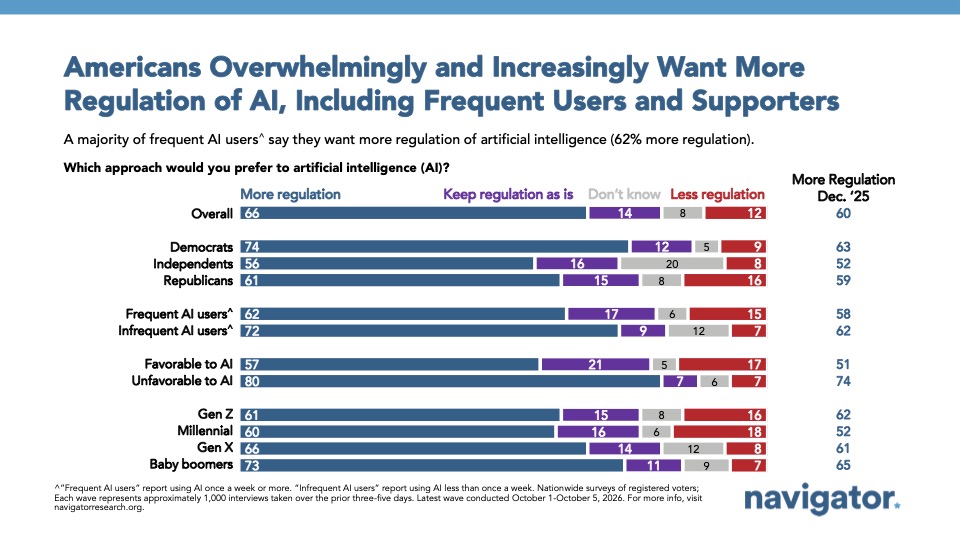
Two-thirds (66%) want more regulation of artificial intelligence (AI), up six points from December 2025. Only 12% want less. Support for increased regulation cuts across party lines with majorities of Democrats (74%), independents (56%), and Republicans (61%) all supportive, as well as majorities across generations and those who are frequent AI users (62% more regulation) and who love the technology (57% more regulation).
Americans Most Trust Independent Experts to Regulate AI
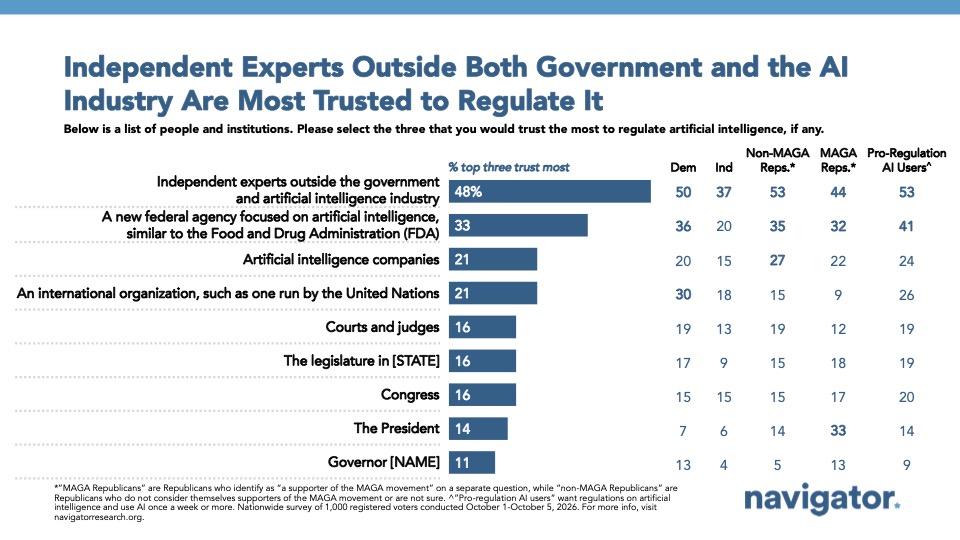
When asked to pick three entities they most trust to regulate AI, nearly half (48%) choose independent experts outside the government and artificial intelligence industry. A third (33%) choose a new federal agency focused on artificial intelligence, similar to the Food and Drug Administration. About one-in-five (21%) choose AI companies and the same amount (21%) say an international organization, such as one run by the United Nations. But slightly less than one-in-five (17%) don’t trust any of the people and institutions listed to regulate the technology.
AI Increasingly Seen as an Issue Americans Want the President and Congress to Prioritize
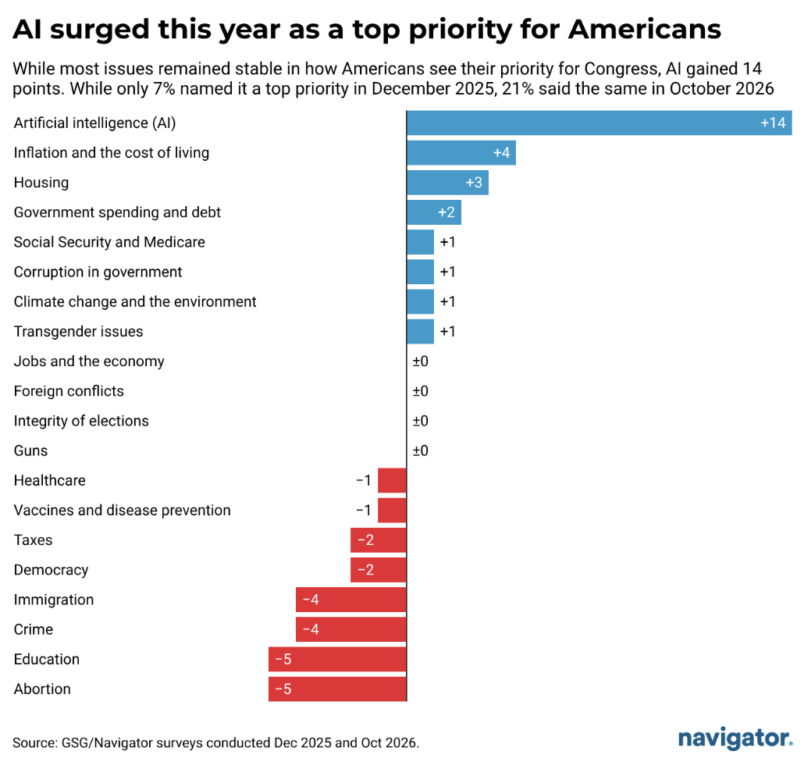
When asked to select the top five issues the president and Congress should focus on, AI saw the most significant growth of any issue tested this year. Only 7% selected AI within their top five issues back in December 2025, but that has tripled, reaching 21% earlier this month. The issue steadily gained as a priority throughout 2026, from 11% in August to 16% in September. 21% is on par with the number prioritizing crime and taxes. However, all of these issues lag far behind inflation and the cost of living (61%), jobs and the economy (44%), and healthcare (41%) in terms of priorities.
Americans Overall Are More Anxious Than Hopeful About AI
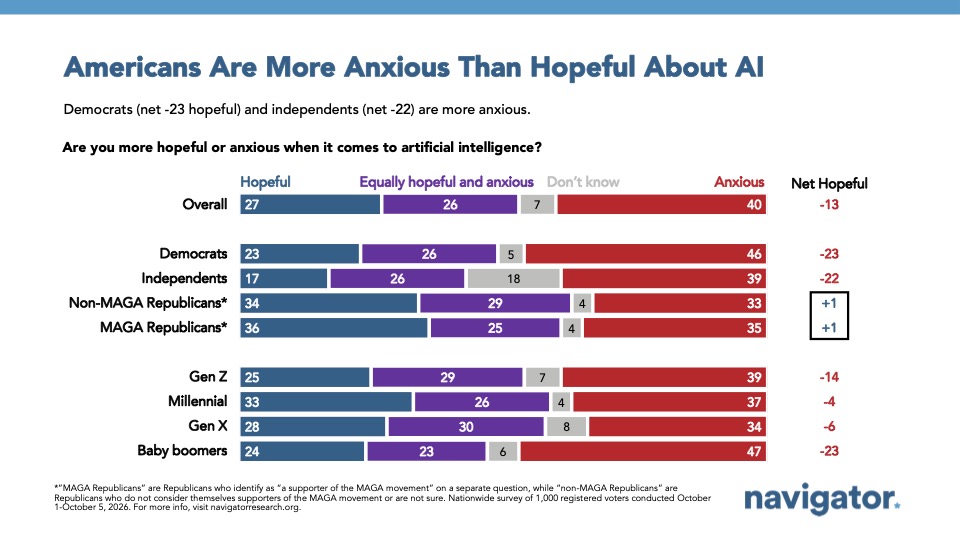
Two-in-five (40%) say they’re more anxious about AI than hopeful, while 27% say they’re more hopeful. 26% are equally hopeful and anxious. Democrats (46% anxious) and independents (39% anxious) are more anxious than Republicans (34% anxious).
Men are split (34% anxious – 35% hopeful) but women lean far more anxious (45% anxious – 21% hopeful). College-educated women are especially anxious about the technology (51% anxious – 19% hopeful) as are moms (46% anxious – 21% hopeful), more so than dads (29% anxious – 37% hopeful). Frequent users of AI are more hopeful (40% hopeful – 26% anxious), while infrequent users or those who have never used it are more anxious (11% hopeful – 58% anxious).
Economic anxiety, whether about their personal finances or the country’s economy, also influenced people’s hopefulness about AI. Economically anxious respondents, those who either felt uneasy about their personal finances or felt negatively about the status of the American economy, were less hopeful (23%) and more anxious (49%) about AI, while those with confidence in their personal finances or in the US economy were far more hopeful (44%) than anxious (29%).
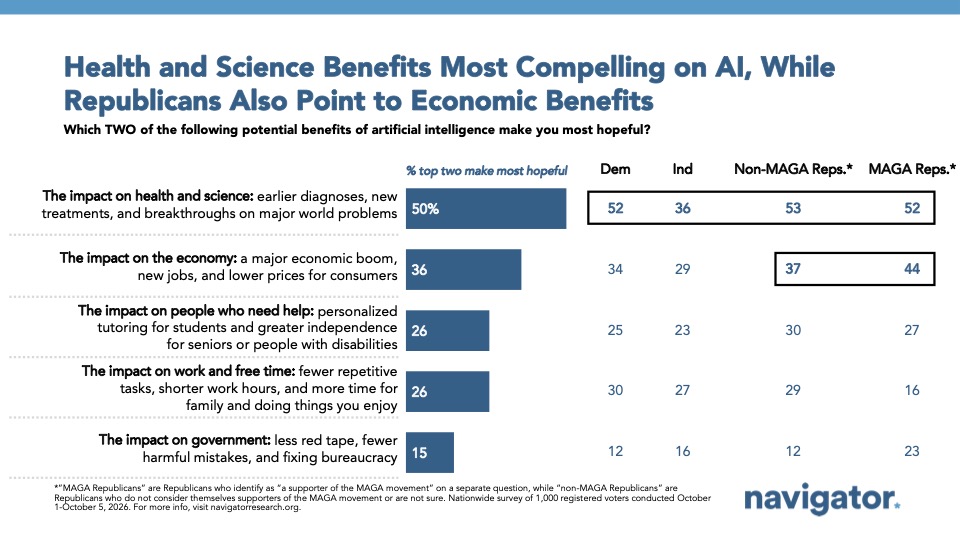
Americans Are Most Hopeful About AI’s Impacts on Health and Science
When asked to select the two things about AI that make them most hopeful, 50% choose the potential impact on health and science, with the possibility of earlier diagnoses, new treatments, and breakthroughs on major world problems. About a third (36%) choose the potential impact on the economy, with the possibility of a major economic boom, new jobs, and lower prices for consumers.
Americans Are Split on the Most Concerning Aspects of AI
When given a list of potential AI concerns, ranging from cyberattacks to job loss to higher energy costs, a majority of Americans are concerned by every possibility. But when asked to select their top two concerns, three issues rise to the top, though none garners more than half:
- The impact on safety and security: cyberattacks, scams, dangerous weapons, and AI threatening humanity (44% top two concerns).
- The impact on the economy: job losses, an AI stock market bubble, and a possible economic crash (35% concerned).
- The impact on society: fake content, dependence on AI, and students failing to develop needed skills (35% concerned).