
Poll: Trump and the Economy
This Navigator Research report contains polling on the latest perceptions of President Trump and his handling of the economy, including how Americans rate his handling of the cost of living, how Americans view the impact of Trump’s economic policies, and the greatest concerns about Trump’s first few months in office.
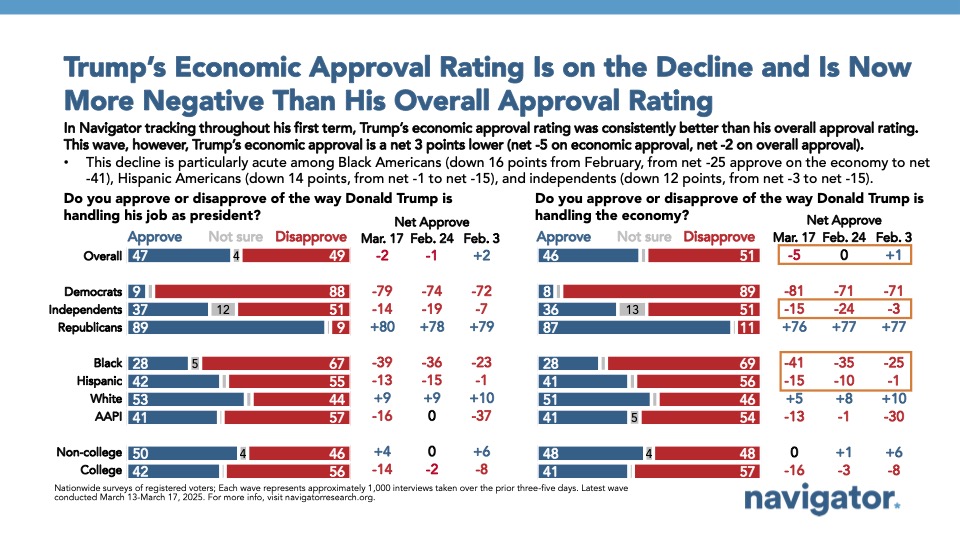
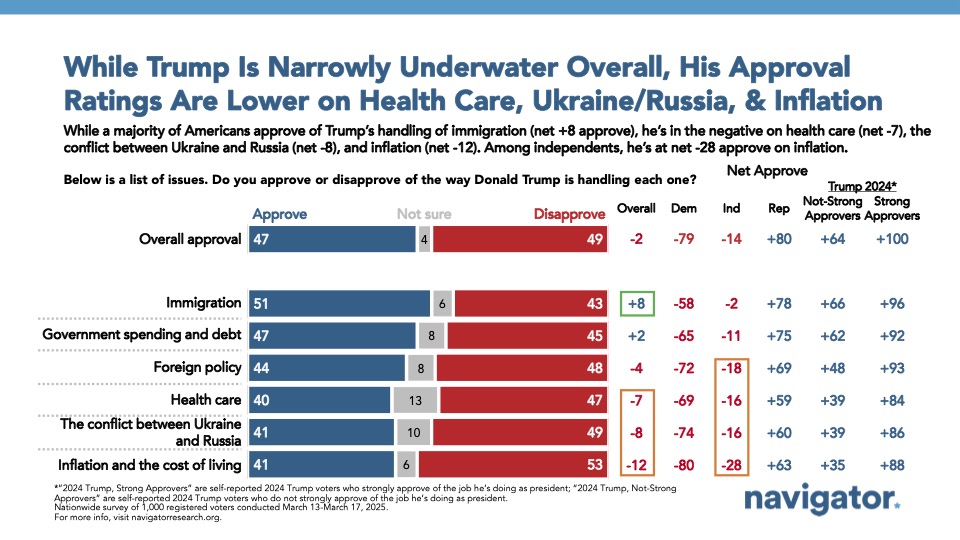
Approval of President Trump’s handling of his job as president and handling the economy are both underwater.
For the first time in Navigator’s tracking, President Trump’s economic approval rating (net -5; 46 percent approve – 51 percent disapprove) has fallen below his overall approval rating (net -2; 47 percent approve – 49 percent disapprove). Trump’s overall approval is underwater by 14 points among independents (37 percent approve – 51 percent disapprove) and his handling of the economy is underwater by 15 points (36 percent approve – 51 percent disapprove).
By an even greater margin, Americans disapprove of Trump’s handling of inflation and the cost of living by double digits.
53 percent of Americans disapprove of how Trump is handling inflation and the cost of living compared to just 41 percent who disapprove. Independents disapprove of Trump’s handling of inflation and the cost of living by a two-to-one margin (net -28; 28 percent approve – 56 percent disapprove).
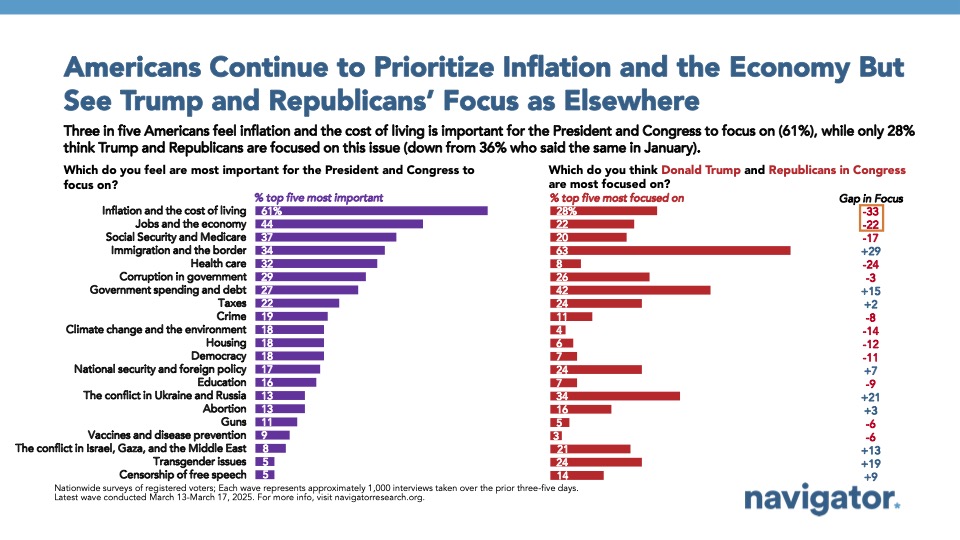
- 61 percent of Americans rank inflation and the cost of living in their top five most important issues for the President and Congress to be focused on, but just 28 percent believe inflation and the cost of living is a priority for President Trump and Congress.
- A majority of Americans approve of how Trump is handling immigration (net +8; 51 percent approve – 43 percent disapprove) and are roughly split on his handling of government spending and debt (net +2; 47 percent approve – 45 percent disapprove), though a plurality of independents disapprove (net -11; 37 percent approve – 48 percent disapprove).
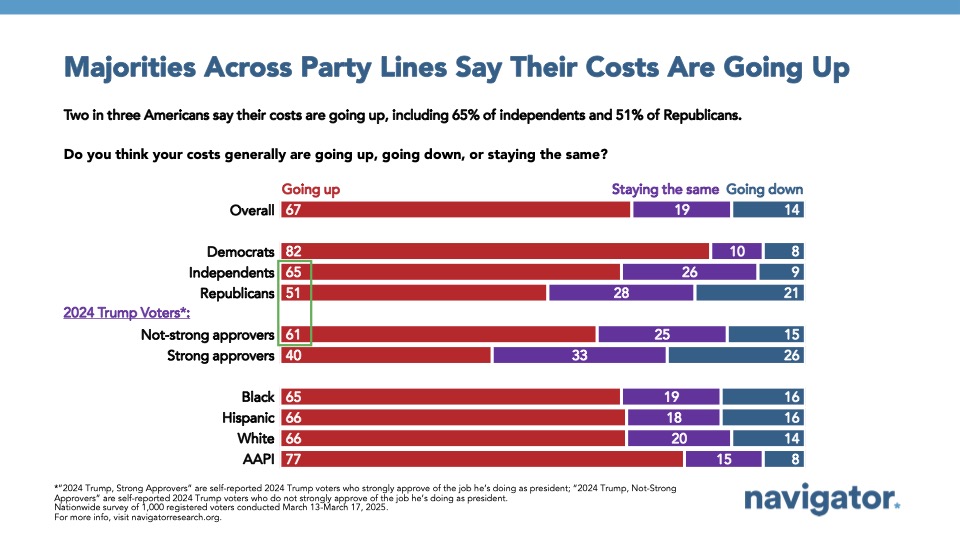
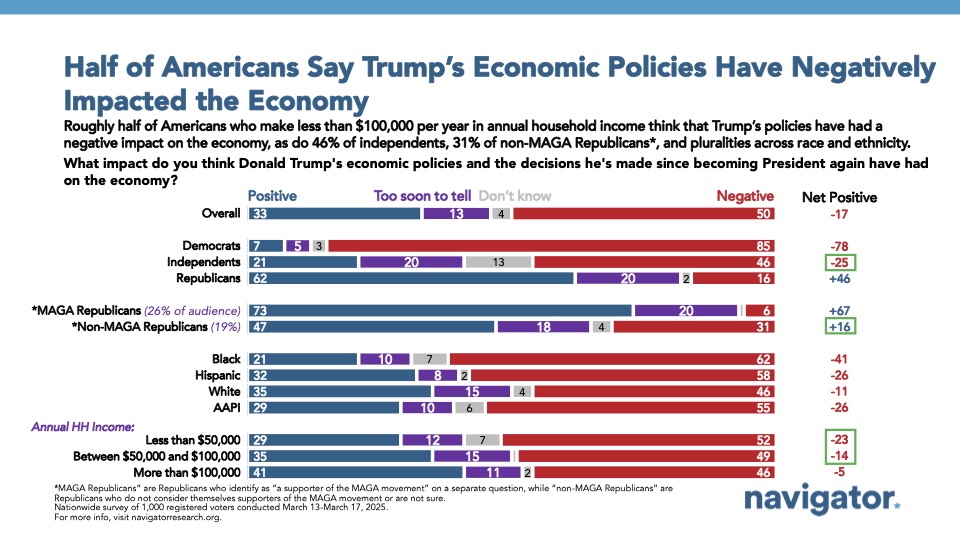
Half of Americans say Trump’s economic policies have had a negative impact on the economy as majorities across partisanship believe their costs are going up.
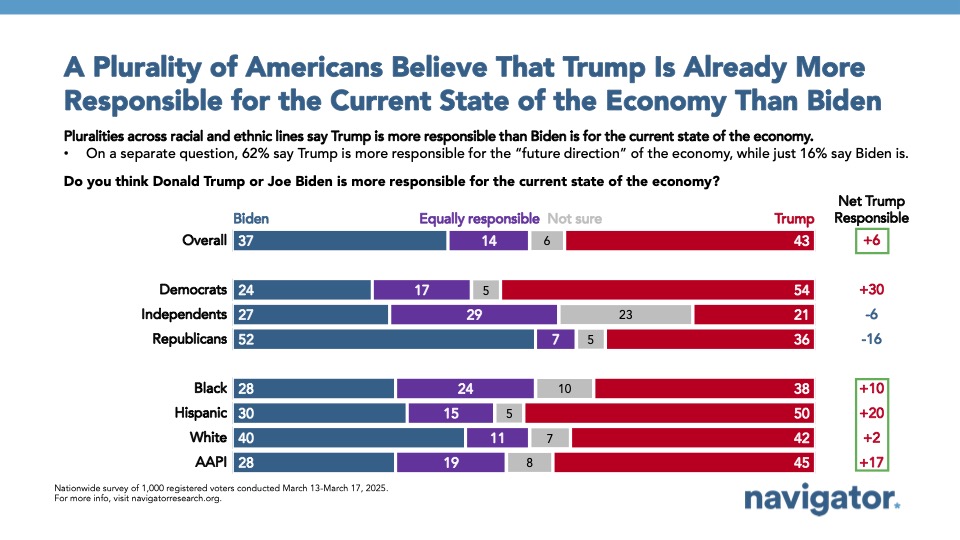
Two in three Americans believe their costs are going up (67 percent), including 82 percent of Democrats, 65 percent of independents, and 51 percent of Republicans. As costs continue to be seen as increasing, more Americans believe Trump’s economic policies have had a negative impact on the economy (net -17; 33 percent positive – 50 percent negative), including a plurality of independents (net -25; 21 percent positive – 46 percent negative). A narrow plurality of Americans believe Trump is responsible for the current state of the economy than former President Biden (net +6; 43 percent Trump more responsible – 37 percent Biden more responsible)
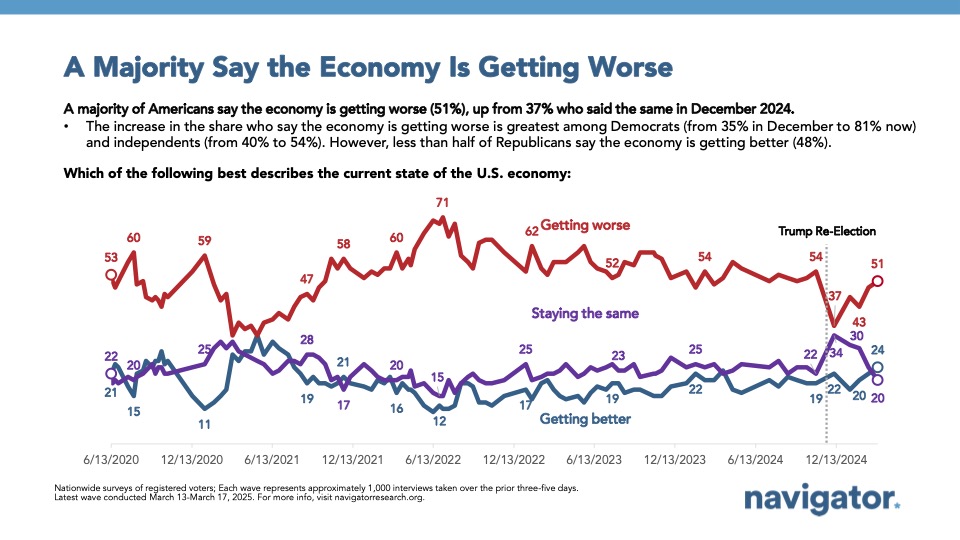
- A majority believe the economy is getting worse (51 percent), which has increased by 14 points since the first Navigator survey conducted after Trump’s re-election (37 percent).
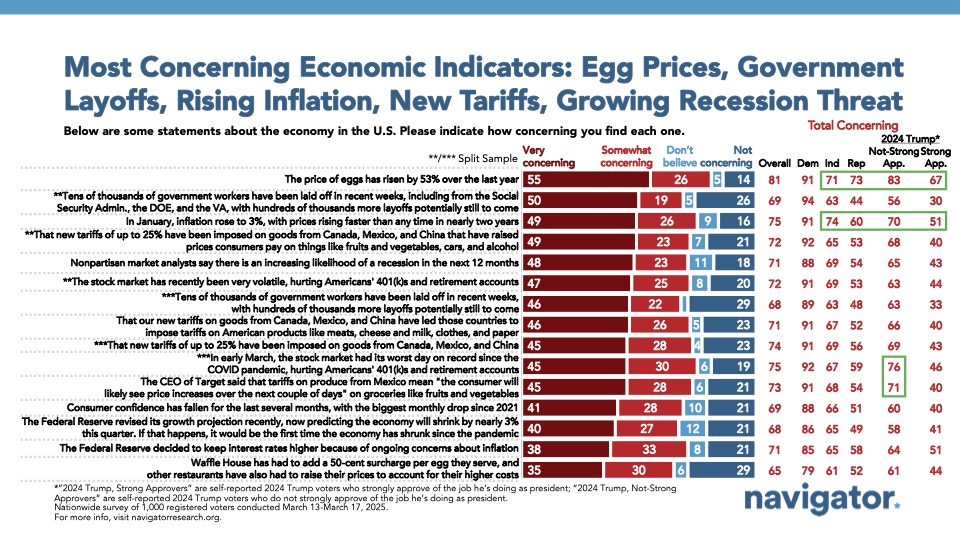
- The most concerning economic indicators include the price of eggs rising (81 percent concerning, including 55 percent finding this “very” concerning), tens of thousands of government workers being laid off (69 percent concerning, including 50 percent finding this “very” concerning), inflation rising (75 percent concerning, including 49 percent finding this “very” concerning), and new tariffs (72 percent concerning, including 49 percent finding this “very” concerning).
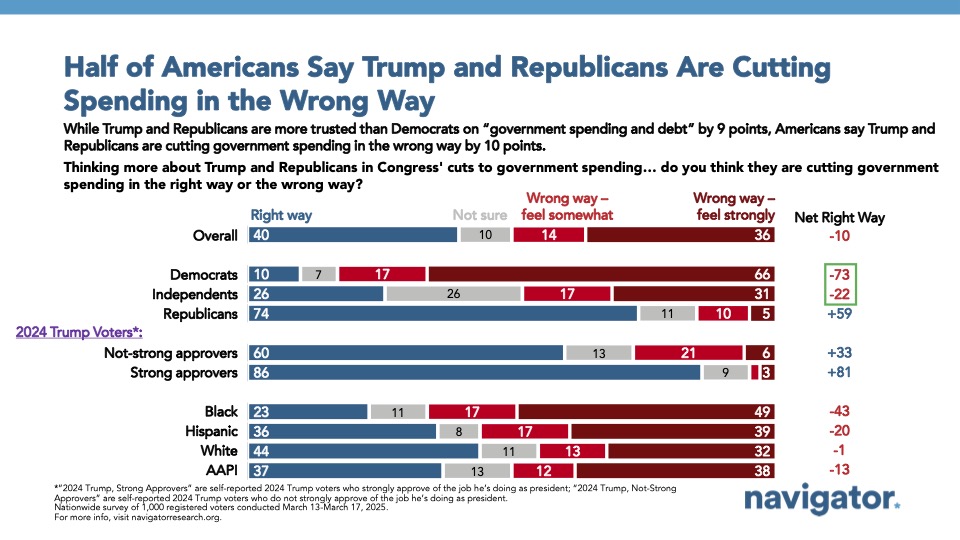
A plurality of Americans believe Trump and Republicans in Congress are cutting spending in the wrong way.
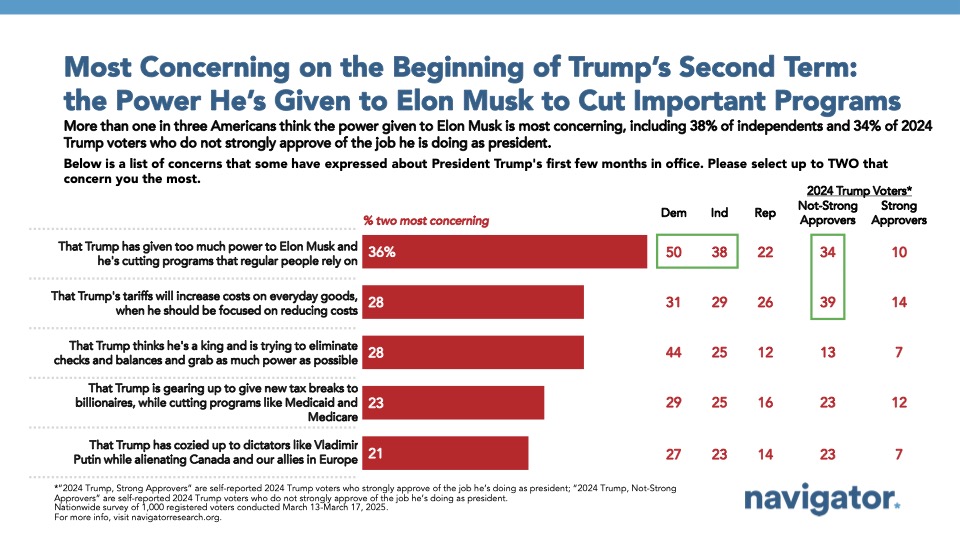
By 10 points, Americans believe Trump and Republicans are cutting spending the wrong way (50 percent) than the right way (40 percent). More than four in five Democrats believe Trump and Republicans are cutting spending the wrong way (net -73; 10 percent right way – 83 percent wrong way), as do nearly half of independents (net -22; 26 percent right way – 48 percent wrong way). Among a list of concerns about President Trump’s first few months in office, Americans are most concerned by Trump giving Elon Musk too much power to cut programs that regular people rely on, with 36 percent selecting it as one of their two biggest concerns.
- Elon Musk’s favorability continues to decline (net -17; 38 percent favorable – 55 percent unfavorable), falling by a net 11 points since the election (net -6; 42 percent favorable – 48 percent unfavorable). Musk’s net favorability has dropped 27 points among Black Americans (from net -24 to net -51) and by 29 points among Hispanic Americans (from net -1 to net -30).