Republicans on the Hook for Government Shutdown

September 17, 2025
Erica Seifert & Ian Smith

Polling report on perceptions of a potential government shutdown.

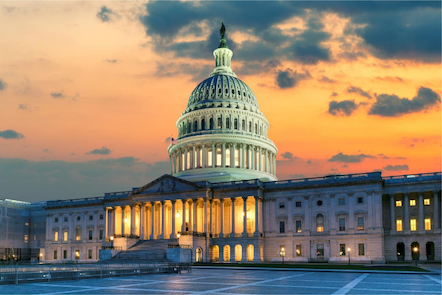
An image of the United States Capitol building at sunset

TODAY'S BIG TAKEAWAYS

Shutdown awareness remains low and lags well behind other recent news stories.

Americans are more likely to blame Trump and Republicans in the event of a shutdown.

Independents and Republicans have increased likelihood of blaming both sides.

Poll: Potential Government Shutdown

This Navigator Research report covers perceptions of a potential government shutdown.

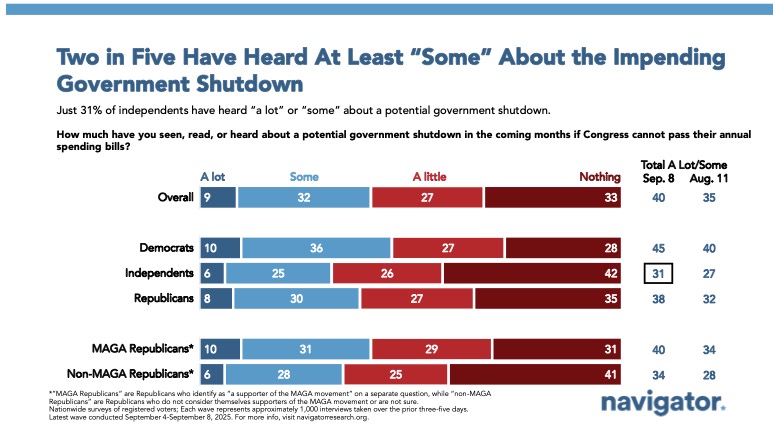
Awareness of a potential government shutdown is relatively low compared to other recent news stories. Just nine percent of Americans say they’ve seen, read, or heard “a lot” or about a possible shutdown, while 40 percent report having heard at least some. This lags well behind other news and events in our August Survey: 66 percent of Americans have heard about Trump and the congressional GOP’s Medicaid budget cuts, including 36 percent who have heard “a lot,” and 61 percent of Americans have heard about Texas redistricting.

Among active news consumers, awareness of a shutdown is noticeably higher. 48 percent have heard “a lot” or “some” about the shutdown, with just 11 percent hearing “a lot.” Passive news consumers are much less likely to have heard news about a potential shutdown, with only 28 percent hearing something, including only five percent who have heard “a lot.”
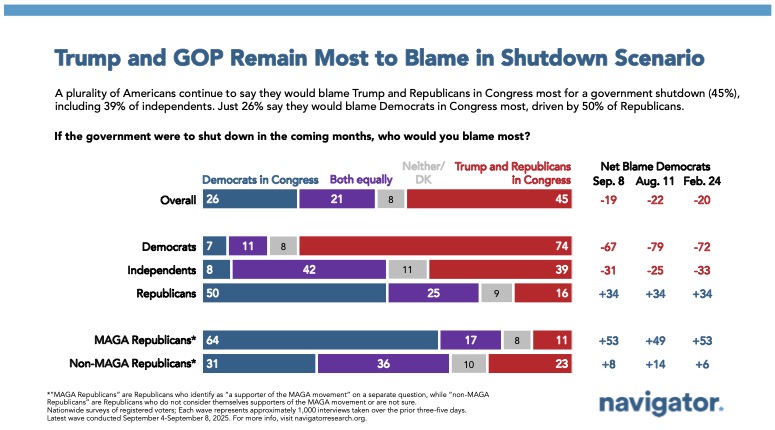
If the government were to shut down in October, Americans say they would be more likely to blame President Trump and Republicans in Congress than Democrats. 45 percent say they would blame Trump and Republicans, while 26 percent say they would blame Democrats in Congress. Another 21 percent would blame both sides equally. The American public’s perception of who should be blamed for a government shutdown has remained consistent since we began tracking in August, with virtually no movement.

Notably, in a break from what we usually see on highly partisan questions that name Trump and Republicans, 25 percent of Republicans say they would blame both sides equally, including 36 percent of non-MAGA Republicans. Independents are split: 42 percent say they would blame both parties equally, while 35 percent would blame Trump and Republicans in Congress.
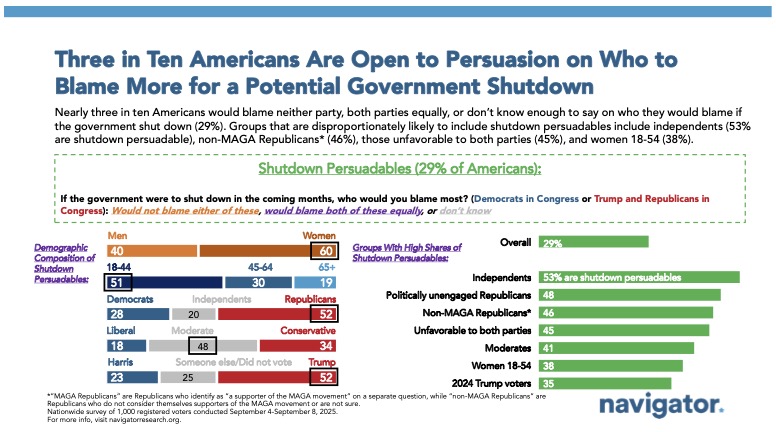
For more detailed messaging guidance on the shutdown see our updated shutdown memo here.

Read More

November 19, 2026

The Issues That Built the Blue Wave

This Navigator Research report covers the issues Americans prioritized as they headed to the polls in the midterm election.

Tina Tang
November 18, 2026

A Winning Democratic Focus Attracted New and Old Voters Alike

This Navigator Research report covers how voters felt about the two parties.

Avery Smedley & Tina Tang
November 17, 2026

The Receipts: Costs Drove the Blue Wave

This Navigator Research report covers the issues Americans prioritized as they headed to the polls and what motivated their vote.

Abigail Xu, Tina Tang, & Avery Smedley
November 12, 2026

Trump Disapproval and Regret Fueled the Blue Wave

Today’s report is the first in a series containing new data from an exit poll with 2026 midterm voters. This report covers how voters felt about President Trump, the economy, and other key figures.

Julie Alderman Boudreau
Download
ToplinesGRAPH
Share

About The Study

Global Strategy Group conducted a public opinion survey among a sample of 1,000 registered voters from September 4-September 8, 2025. 100 additional interviews were conducted among Hispanic voters. 100 additional interviews were conducted among African American voters. 75 additional interviews were conducted among Asian American and Pacific Islander voters. 100 additional interviews were conducted among independent voters. The survey was conducted online, recruiting respondents from an opt-in online panel vendor. Respondents were verified against a voter file and special care was taken to ensure the demographic composition of our sample matched that of the national registered voter population across a variety of
demographic variables. The margin of error for the full sample at the 95 percent level of confidence is +/- 3.1 percentage points. The margin of error for subgroups varies and is higher.

Related Posts

READ MORE
November 19, 2026

The Issues That Built the Blue Wave

This Navigator Research report covers the issues Americans prioritized as they headed to the polls in the midterm election.

Tina Tang
November 18, 2026

A Winning Democratic Focus Attracted New and Old Voters Alike

This Navigator Research report covers how voters felt about the two parties.

Avery Smedley & Tina Tang
November 17, 2026

The Receipts: Costs Drove the Blue Wave

This Navigator Research report covers the issues Americans prioritized as they headed to the polls and what motivated their vote.

Abigail Xu, Tina Tang, & Avery Smedley
November 12, 2026

Trump Disapproval and Regret Fueled the Blue Wave

Today’s report is the first in a series containing new data from an exit poll with 2026 midterm voters. This report covers how voters felt about President Trump, the economy, and other key figures.

Julie Alderman Boudreau