
Tariffs, Tax Cuts & Trouble for Republicans

March 5, 2026
Maryann Cousens

This Navigator Research report covers the latest perceptions of government leaders and their handling of the economy, including the costs battleground constituents see as increasing the most, and the power they believe Congress has to act to lower these costs.

Big Takeaways:

Economic approval ratings for Republicans in Congress have fallen sharply, dropping by double digits over the past year.

Americans in the battleground believe Congress has the power to lower costs, but see Trump and GOP tariffs and tax cuts for the ultra wealthy driving prices up.

Battleground Poll: Costs

This Navigator Research report covers the latest perceptions of government leaders and their handling of the economy, including the costs battleground constituents see as increasing the most, and the power they believe Congress has to act to lower these costs.

Approval of Congress’s Handling of the Economy

Americans in the battleground disapprove of their Republican incumbents’ handling of the economy by 16 points (31% approve – 47% disapprove), a steep decline from last February where Congressional Republican incumbents had an economic approval of net zero (36% approve – 36% disapprove). Named Congressional Democratic incumbents are 4 points underwater on their handling of the economy (35% approve – 39% disapprove) – consistent with their approval from last February (net -2; 34% approve – 36% disapprove).
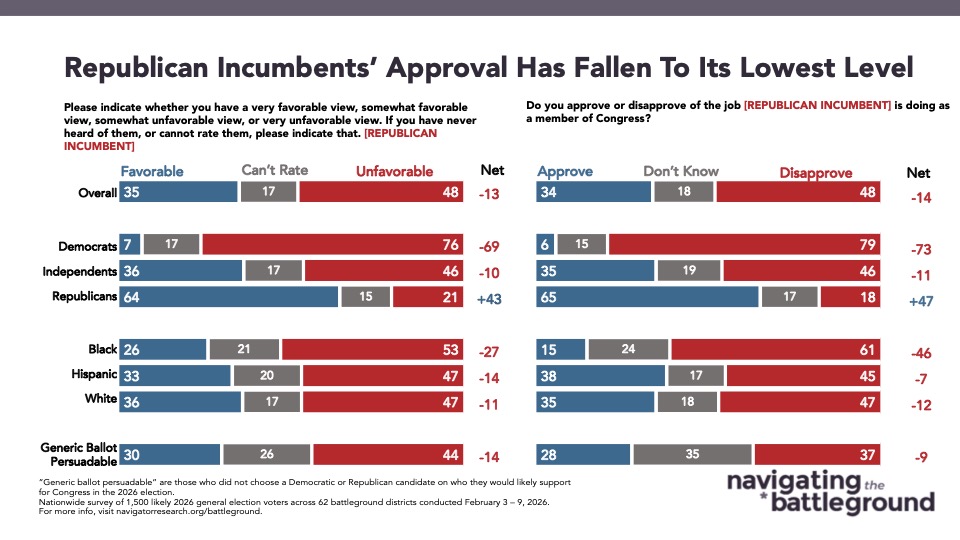
Bar graphs from Navigator Research titled: Republican Incumbents' Approval Has Fallen To Its Lowest Level

Costs

Three-in-four battleground constituents say their costs have gone up over the past year (75%), including 53% who say they have gone up “a lot.” Across parties costs are seen as going up, including among 98% of Democrats, 71% of independents, and 52% of Republicans.
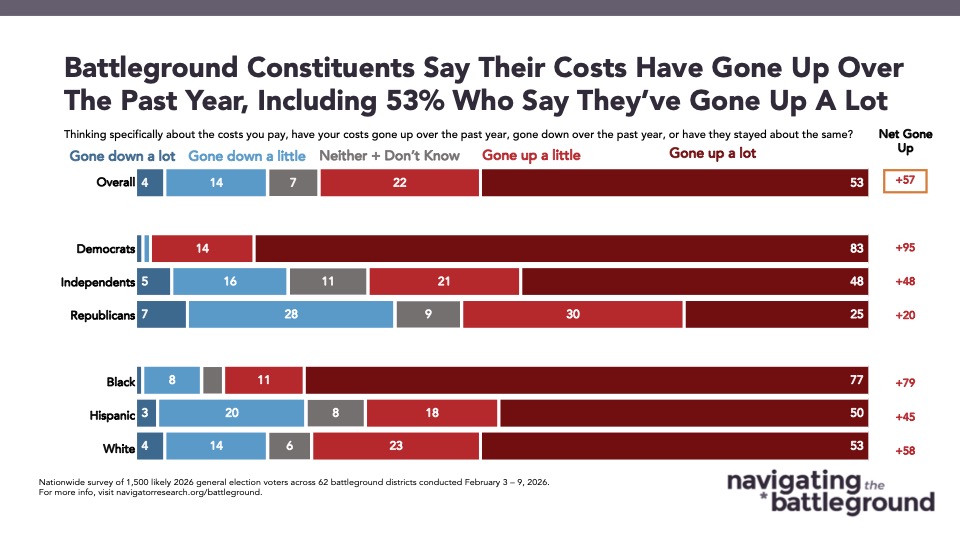
Bar graph from Navigator Research titled: Battleground Constituents Say Their Costs Have Gone Up Over The Past Year, Including 53% Who Say They’ve Gone Up A Lot

When citing the main reasons for costs increasing over the past year, 33% cite “tariffs” in an open-end response, with the second most popular answer being inflation (20%). Independents in the battleground are most likely to cite tariffs as the top reason costs are going up (27%).
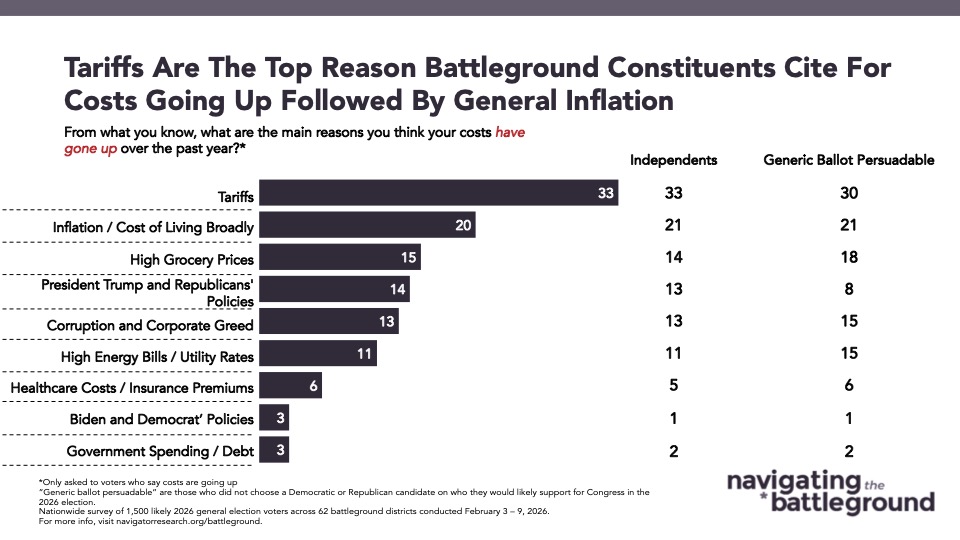
Bar graph from Navigator Research titled: Tariffs Are The Top Reason Battleground Constituents Cite For Costs Going Up Followed By General Inflation

Specific Costs: Groceries, Housing, Utilities, and Health Care

Overwhelming majorities say the cost of utilities (84%), health care (80%), groceries (77%), and housing (69%) have gone up. Though a cost that fewer experience, one-third say the cost of child care has increased (33%), including 25% who say it has increased “a lot.”
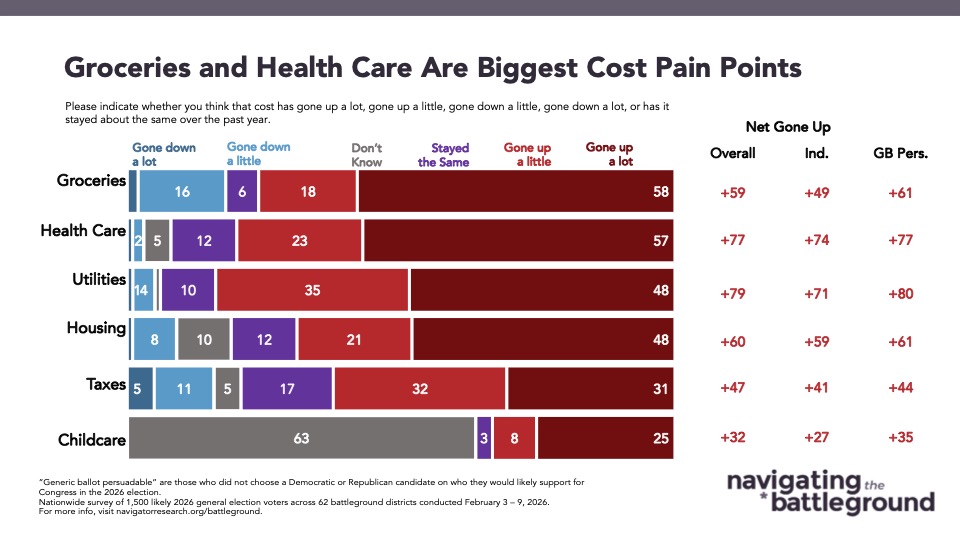
Bar graph from Navigator Research titled: Groceries and Health Care Are Biggest Cost Pain Points

When it comes to the power Congress has to lower these costs, 91% believe Congress has the power to lower health care costs, including 74% who say they have the power to lower the cost of health care “a great deal.” Overwhelming majorities also believe Congress has the power to lower costs related to utilities (85%), housing (79%), and groceries (79%).
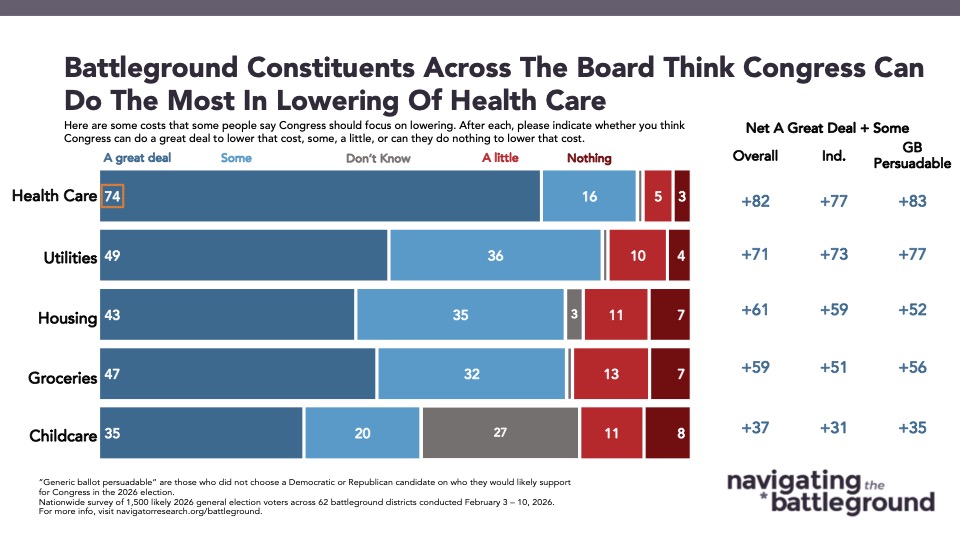
Bar graph from Navigator Research titled: Battleground Constituents Across The Board Think Congress Can Do The Most In Lowering Of Health Care

Congressional Republican Actions Leading to Costs Increasing

While battleground constituents believe Congress has the power to lower a range of costs – they see President Trump and Congressional Republicans as raising costs through a number of their policies. Nearly three-in-four Americans in the battleground believe Trump and Republicans in Congress imposing tariffs on imported items has led to costs going up (72%), including 53% who say tariffs have led to costs increasing “a lot.” Other Trump and Congressional Republican policies are also linked to higher costs, including ending tax credits for people and businesses who get their health insurance through the ACA marketplace (60%), passing a tax bill that benefits the ultra wealthy (54%), cutting funding for Medicaid (53%), and limiting the production of clean energy (51%).
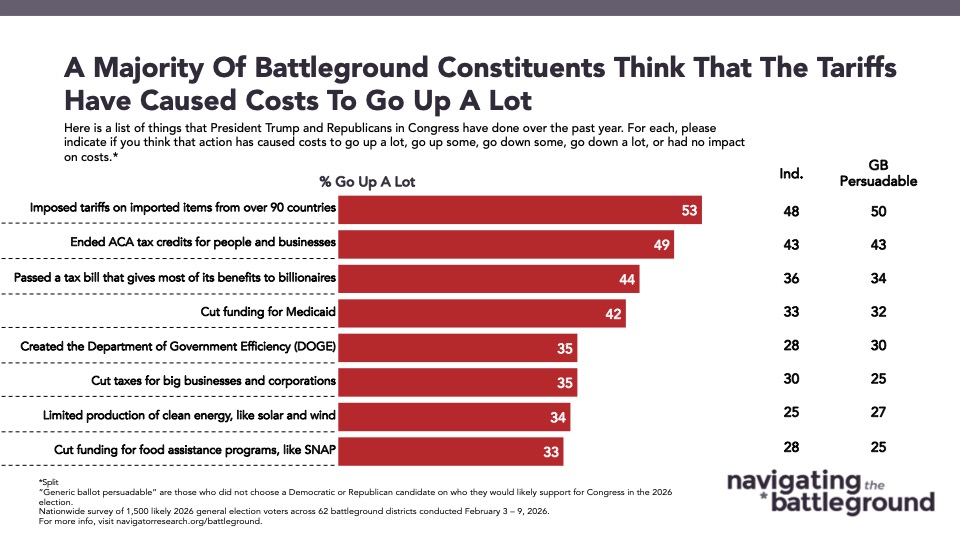
Bar graph from Navigator Research titled: A Majority Of Battleground Constituents Think That The Tariffs Have Caused Costs To Go Up A Lot

Stay tuned for more Navigating the Battleground reports focusing specifically on health care and utility costs.

Read More

February 23, 2026

State of the Battleground

Polling report on perceptions of government leaders, including which party is more trusted to handle the issues that matter most to Americans in the battleground, and who is seen as having the right priorities.

Maryann Cousens
October 3, 2025

Feeling the pressure of rising grocery costs Battleground voters lay the blame on Trump and Republicans in Congress

Polling report on perceptions of tariffs in the House battleground.

Ian Smith & Maryann Cousens
September 26, 2025

Americans in the Battleground Want Congress to Protect Health Care — Even If It Means Shutting Down the Government

Polling report on perceptions of a potential government shutdown, rising costs among House battleground constituents.

Ian Smith & Erica Seifert

Trump’s Approval Declines in the Battleground as Economic Pessimism Persists

Polling report on the latest perceptions of President Trump and Congressional Democrats and Republicans in the House Battleground.

Ian Smith
Share

About The Study

Impact Research conducted public opinion surveys among a sample of 1,500 likely 2026 general election voters from February 3-9, 2026. The survey was conducted by text-to-web (100 percent). Respondents were verified against a voter file and special care was taken to ensure the demographic composition of our sample matched that of the 62 congressional districts included in the sample across a variety of demographic variables. The margin of error for the full sample at the 95 percent level of confidence is +/- 2.5 percentage points. The margin for error for subgroups varies and is higher.