Most Are Confident In Both Past and Future Ballots Being Counted Fairly
Asked to look back at the 2020 presidential election, two-thirds of Americans agree that Joe Biden won legitimately (47% strongly agree, 20% somewhat agree). These numbers remain unchanged from 2024 (47% strongly agree, 19% somewhat agree). Only 21% strongly disagree and 13% somewhat disagree on the election outcome with the majority (79%) identifying as a MAGA Republican.
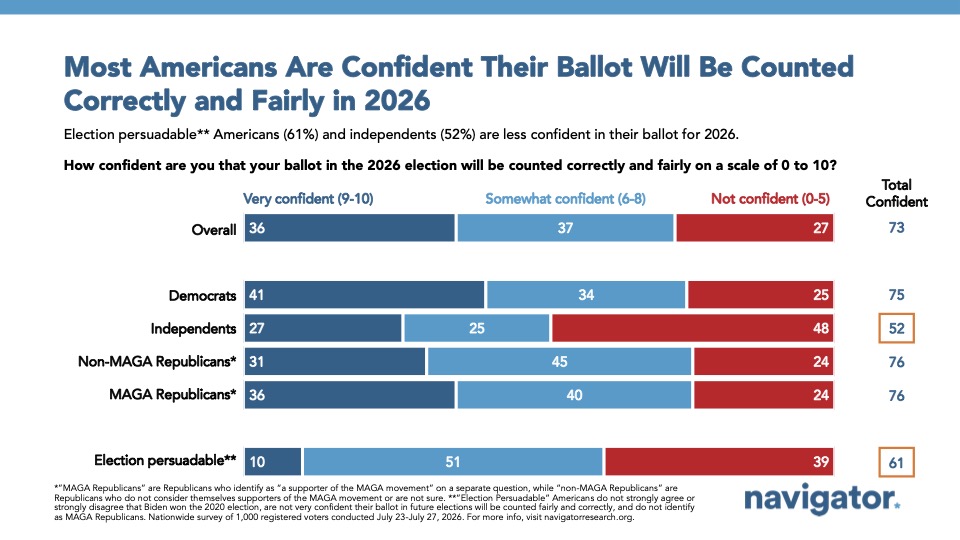
Looking back at the 2024 presidential election, three-in-four (74%) remain confident their ballot was counted correctly and fairly. And looking ahead, 76% are confident their ballot in future elections will be counted correctly and fairly.
But Americans are Divided on Election Integrity, Voter Fraud, and Voter Suppression
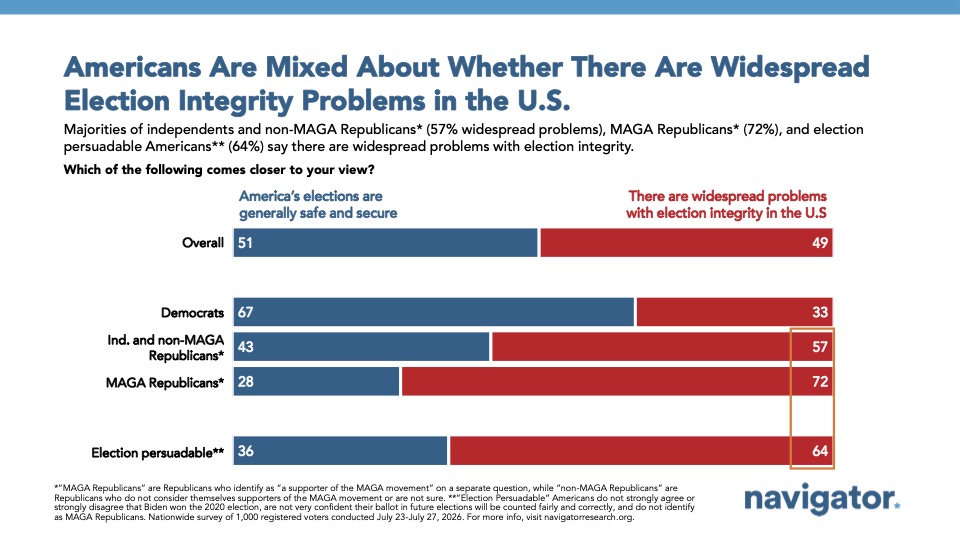
Americans are sharply divided on whether our elections are safe and secure. 51% view U.S. elections as generally safe and secure while 49% think there are widespread problems with election integrity. Partisanship drives the divide with 67% of Democrats and 41% of independents viewing elections as safe and secure while 64% of Republicans and 59% of independents see widespread problems with election integrity in the U.S.
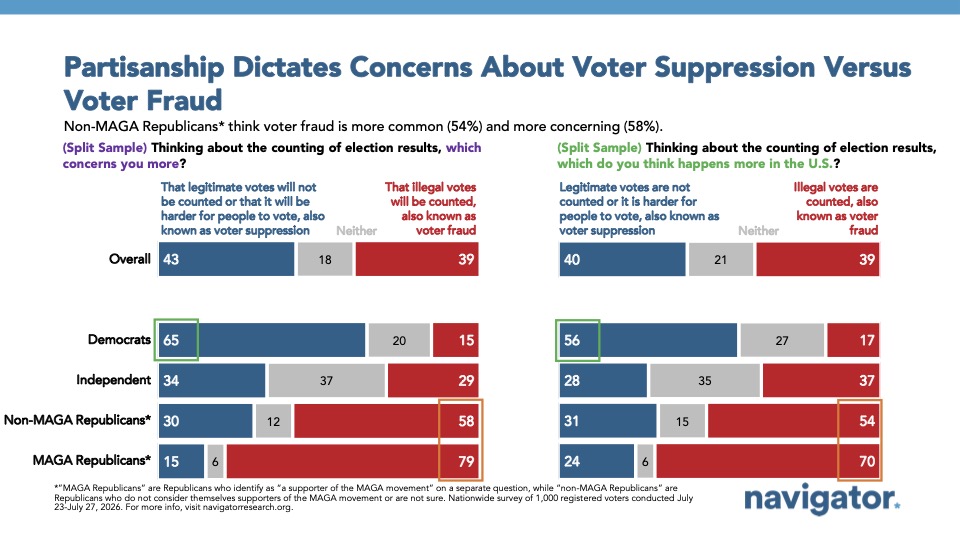
Another divide emerges over the existence of voter fraud and voter suppression: 40% say voter suppression is more common and 39% instead say the same of voter fraud. The partisan breakdown is again behind this divide with 56% of Democrats viewing voter suppression as more likely compared to 27% of Republicans and 28% of independents holding the same view. Two-thirds of Republicans (63%) see voter fraud as occurring more frequently along with 17% of Democrats and 37% of independents. It’s worth noting that 27% of Democrats are unsure about voter fraud versus voter suppression as are 23% of independents.
Americans are Most Concerned About ICE at Polls, Misinformation, Republican Meddling, and Legitimate Votes Not Being Counted
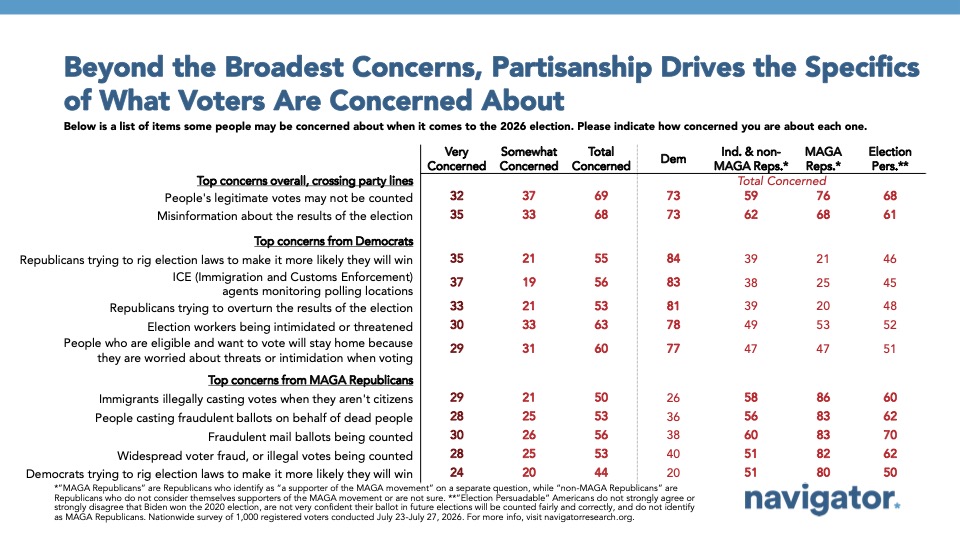
When it comes to the 2026 election, people are most concerned about Immigration and Customs Enforcement (ICE) agents monitoring polling locations (37% very concerned), legitimate votes not being counted (35% very concerned), and misinformation about the results of the election (35% very concerned).
Democrats Slightly More Trusted than Republicans to Prevent Voter Fraud, Hold Free and Fair Elections
39% trust Democrats to prevent voter fraud compared with 34% who trust Republicans. One-in-five don’t trust either party on this issue.
41% trust Democrats more and 31% trust Republicans more when it comes to holding free and fair elections. About one-in-five (22%) trust neither party.
Many Think it’s Likely Trump and Republicans in Congress Will Claim the Midterms are Fraudulent
Nearly three-in-four (72%) say it’s either “very likely” (42%) or “somewhat likely” (30%) that Trump and Republicans in Congress will claim that the 2026 election is fraudulent if they do not win a majority in Congress. Only half (50%) feel the same about Democrats in Congress.
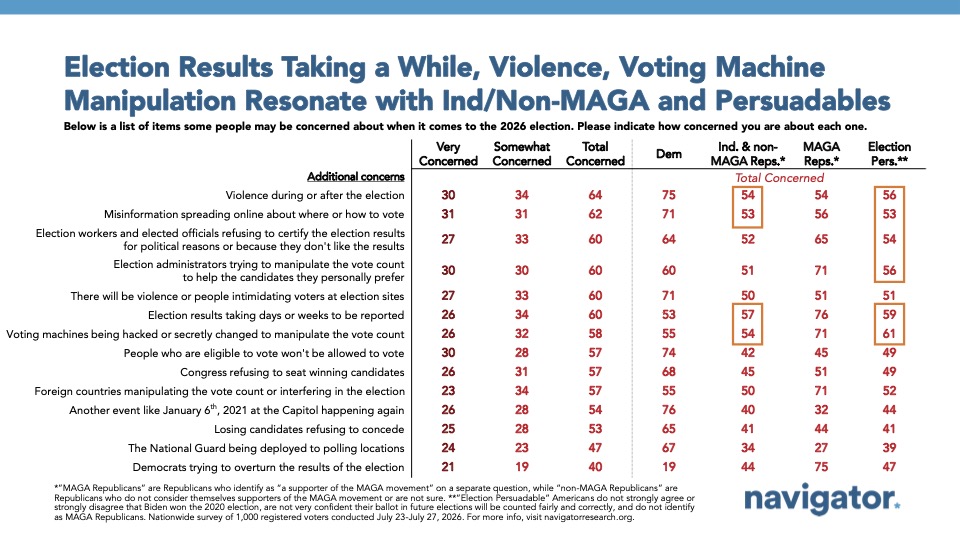
Americans overall are less concerned about foreign countries manipulating the vote count or interfering in the election (23% very concerned), and Democrats trying to rig election laws to make it more likely they will win (24% very concerned).
Even Trump’s Base Show Signs of Fatigue With His Commentary on the 2020 Election
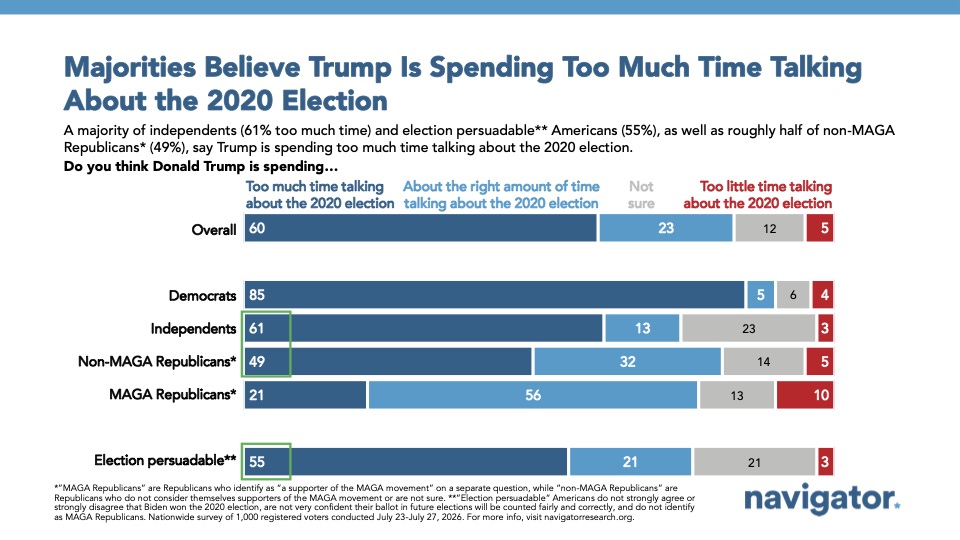
Six-in-10 Americans (60%) think President Trump is spending too much time talking about the 2020 election, including 61% of independents and 34% of Republicans. About one-in-four (23%) think he’s spending about the right amount of time talking about the 2020 election, including 13% of independents and 45% of Republicans. Only 5% think the president is spending too little time talking about the 2020 election.
Election Websites, Search Engines, Local News Most Popular Places to Find Voting Info
State or local election office websites (53%), a search engine like Google or Bing (37%), local news sources (36%), friends or family (32%), and news websites (23%) are the top five most popular sources for information on where, when or how to vote in an upcoming election. Younger Americans (ages 18-34) rely most on friends or family (45%), social media (39%), and a search engine (39%) while older Americans (ages 35-54) cite using their state or local election websites (44%), a search engine (39%), and local news sources (35%).
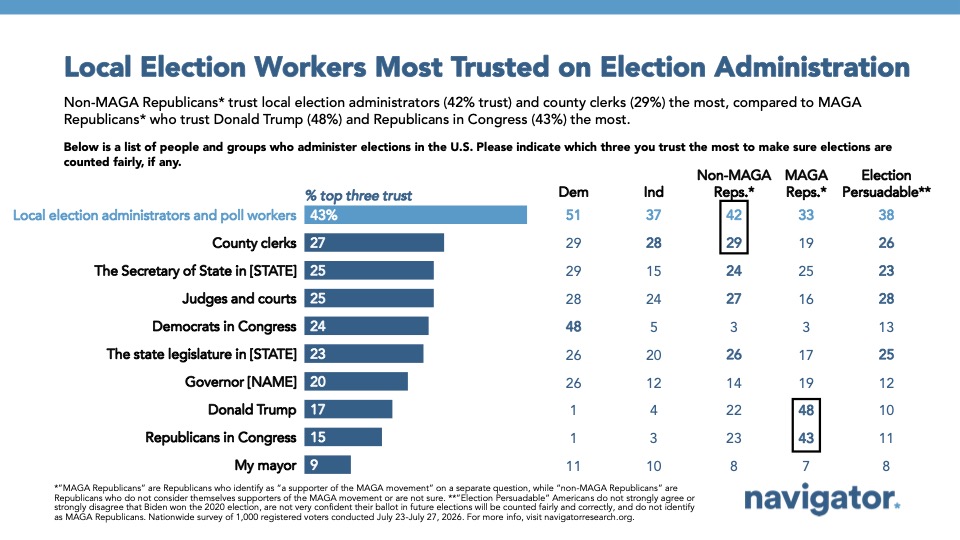
Local Election Workers Most Trusted on Election Administration
When it comes to who is most trusted to make sure elections are counted fairly, local leaders top the list: local election administrators and poll workers (43%), county clerks (27%), secretary of state (25%), judges and courts (25%). Democrats in Congress are more trusted (24%) than Republicans in Congress (15%).
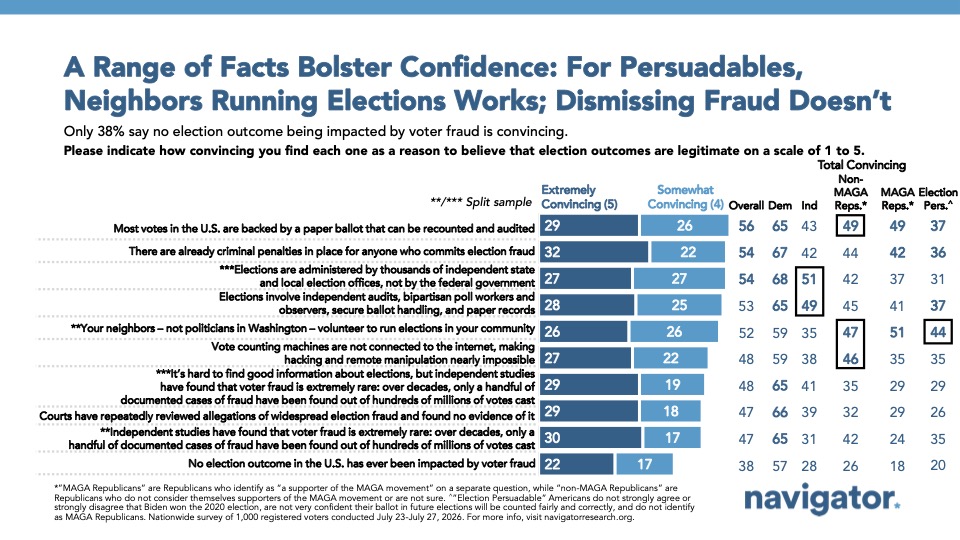
Highlighting Existing Election Systems, Penalties, and Election Workers Convinces Americans that Election Results are Legitimate
Facts about existing election systems, including the use of paper ballots (55% convincing) and existing criminal penalties (54% convincing) were most convincing to Americans that election outcomes are legitimate. Facts highlighting how elections are administered by state and local officials (54% convincing) and that neighbors, not D.C. lawmakers, run elections (52% convincing) are also convincing.
The least convincing fact is how voter fraud has never impacted an election outcome in the U.S. (38% convincing). Only 28% of independents and 26% of non-MAGA Republicans find this fact convincing.