
Navigator listened to non-voters to learn what they thought of this election, what kept them from voting, and what they expect from incoming lawmakers. While tallies are still coming in, only 49% of the voting-eligible population cast a ballot in the 2026 midterm elections, per the University of Florida Election Lab, a slight uptick from 2022 when just over 46% cast a ballot.
Non-Voters Were Aware of Political News and Races in Their States and Beyond
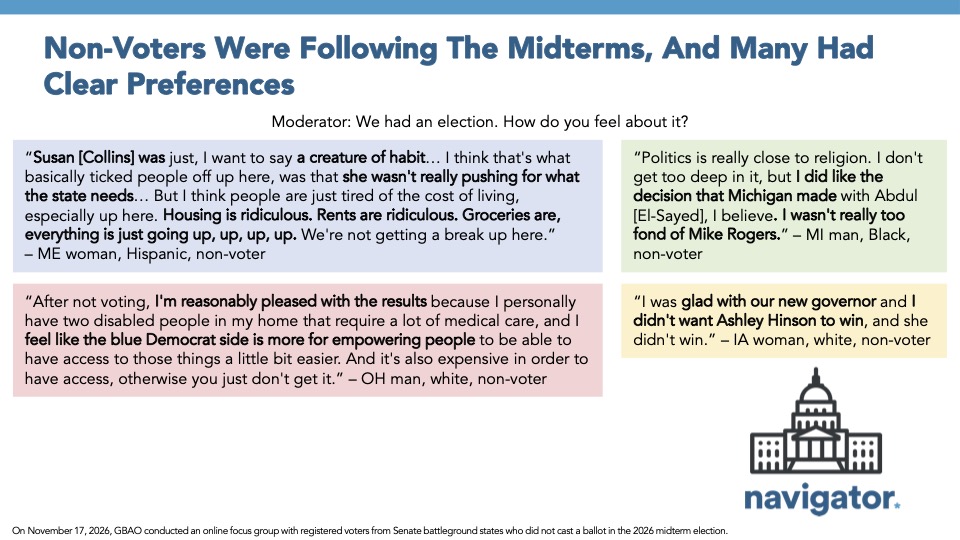
Even though these participants did not vote, they were still keeping up with political races and current events. Several knew candidates by name, and many had clear opinions.
In particular, the Texas Senate and gubernatorial races captured attention by Texans and non-Texans alike. Many were surprised by the outcome.
- “I mean the way Texas flipped completely to Democrat for the most part, I thought that was mind-blowing.” – ME woman, Hispanic, non-voter
- “With the rest of the country, I was just glad it went all blue, because I really think we needed a change. And I can’t believe Texas flipped. My daughter brought me the map and showed all a blue wave.” – IA woman, white, non-voter
- “I didn’t think it was going to happen! … It’s hope, it’s like, ‘Okay so we’re really voting.’” – TX man, Hispanic, non-voter
Work, Apathy, and Personal Conflicts Kept Them from Casting Their Votes
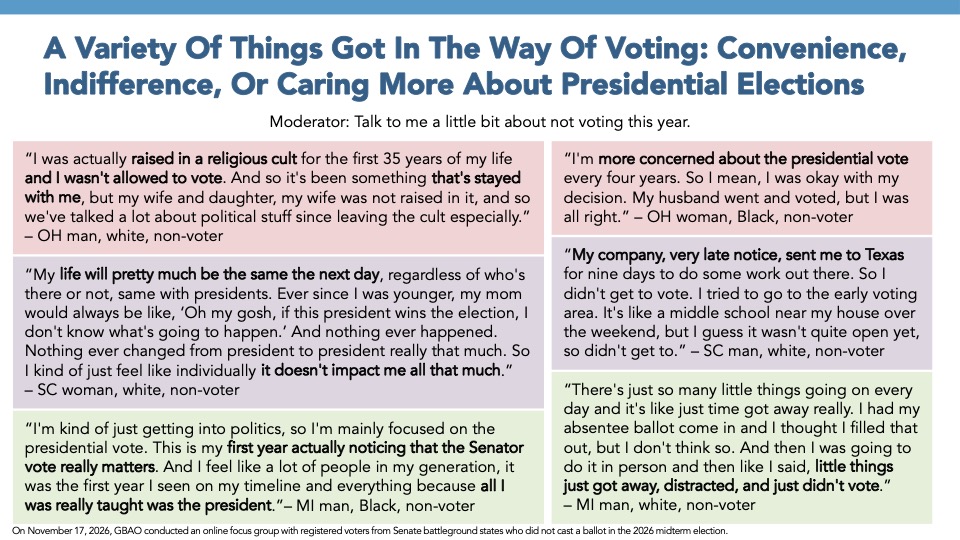
Non-voters did not participate in the election for a multitude of reasons. For some, life got busy or time escaped them. One participant did not vote because of their personal history with a cult.
Several Said They Didn’t Feel Like Their Vote, or Politics at All, Mattered to Them Personally
Some non-voters did not think that the election, or their individual vote, would have an impact on their lives. Instead, they wanted a return to normalcy and to get on with their lives. No matter who wins, I just got to go to work.” – SC man, white, non-voter
- “No matter who wins, I just got to go to work.” – SC man, white, non-voter
- “Everybody’s just bashing each other, and I was just over it. … I just wanted normal life to resume.” – OH woman, Black, non-voter
- “You’ll just go to work. My life will pretty much be the same the next day, regardless of who’s there or not, same with presidents. … I kind of just feel like individually, it doesn’t impact me all that much.” – SC woman, white, non-voter
One participant felt a lack of control.
- “I didn’t vote because, honestly, with Donald Trump winning twice in a row, I just thought it’s all a sham. It doesn’t matter who we vote for, they’re gonna do what they want to do. … The 1% of the rich people, whoever’s in power, they’re gonna do what they want regardless of who they put in as their puppet.” – IA woman, White, non-voter
Many Were Happy with the Results, But Some Regret Their Decision
Despite not voting, several expressed joy with the results across the country and in their specific states:
- “I did like the decision that Michigan made with [Sen-elect] Abdul [El-Sayed].” – MI man, Black, non-voter
- “This doctor, pediatrician who won [Sen-elect Annie Andrews]. And I’m happy about that. I think it’s good and a move forward for South Carolina.” – SC woman, white, non-voter
- “I was so happy to see our governor out, Kim Reynolds. I really wanted her gone, and I was very, very happy the Democrat won that.” – IA woman, white, non-voter
A few participants admitted they regret their not voting. One specifically said he wished he had voted to help Republicans fare better:
- “I regret not voting. I should have … I honestly thought [Republicans] would be more dominant.” – MI man, white, non-voter
Negative Campaigning and Lackluster Candidates Soured Non-Voters on the Political Process
Campaign tactics, particularly negative ads, were widely derided.
- “We got blasted with so many text messaging. It was getting to spam levels. I’m kind of glad that’s done.” – ME woman, Hispanic, non-voter
- “I was so completely over all of the commercials, all of the mail, all of the text messages. I just wanted it to completely stop” – OH woman, Black, non-voter
Negative ads were cited by several, especially participants in Ohio, who called out Republican gubernatorial candidate Vivek Ramaswamy for airing an ad featuring Gov.-elect Amy Acton’s mom. One called the ad “dirt-slinging.”
Several also criticized the choices on their ballots and said there was no candidate who convinced them to cast a ballot in either direction:
- “Unfortunately, I wasn’t in love with either of our candidates, Darline Graham, who was doing the job without being elected is always weird, and Dr. Annie Andrews, I just knew nothing about her. I’d never heard of her.” – SC man, white, non-voter
Non-Voters Want Lawmakers to Tackle Costs and Healthcare, But Many Anticipate Political Gridlock
Non-voters said they hope new lawmakers will take on rising costs.
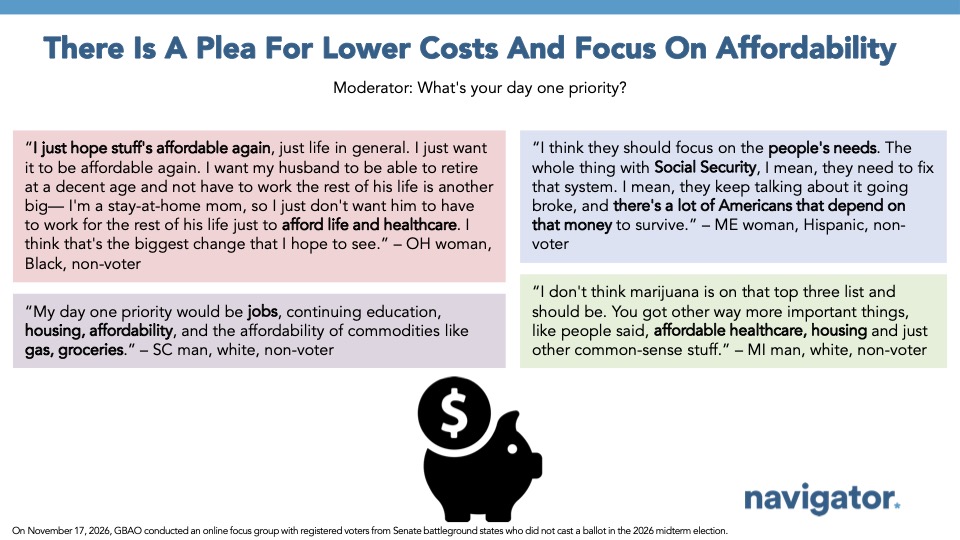
Many expect Democrats to take up healthcare in general and Medicare, particularly, while several thought Democrats would first pursue marijuana legalization and reproductive rights. Whatever their priorities, many said that they expect gridlock to reign as Trump has promised to veto legislation passed by Democrats in Congress.
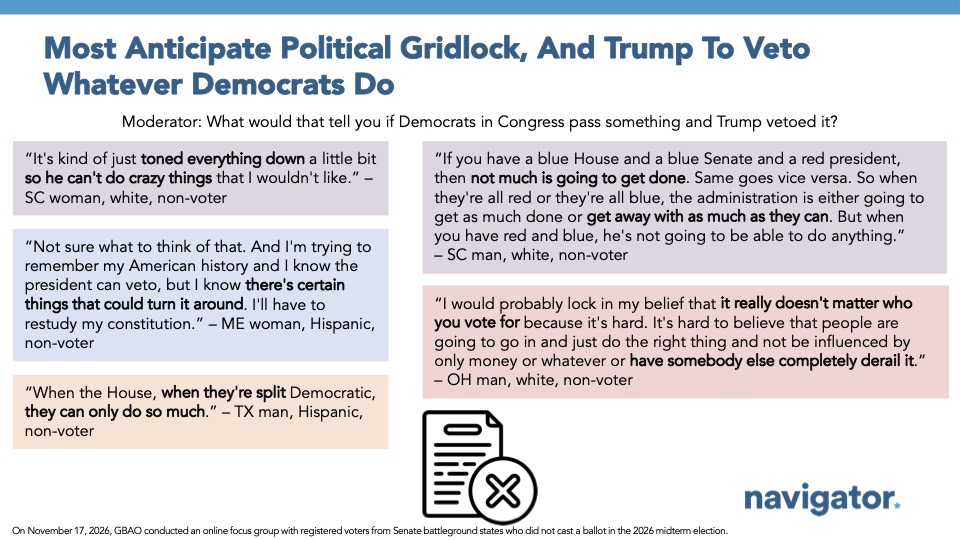
When asked about corruption or actions to hold bad actors accountable, several expressed interest, but they weren’t holding their breath:
- “I support the idea of accountability and clarity. And on that note, I don’t know if an investigation would be unbiased.” – OH man, white, non-voter
- “We need a separate task force to do that.” – ME woman, Hispanic, non-voter
Guaranteed Results and Major Changes Could Drive Non-Voters to the Polls
When asked what could move them to cast a ballot in future elections, many said it would take major changes and guaranteed results.
- “The guarantee that something was gonna happen.” – IA woman, white, non-voter
One participant jokingly said “monetary bribe,” before clarifying that “ease of access” to the polls could help her cast a ballot next time.