
Focus Groups: Affordability
VIEW THE QUALITATIVE SLIDES HERE
This Navigator Research report covers focus groups conducted among working class Americans in Senate battleground states on their personal financial situations, their greatest economic concerns, and perceptions of elected officials tackling affordability.
BIG TAKEAWAYS:
- Participants are struggling mightily to afford the basics – like dog food or energy bills – and see no real sign of the situation improving.
- The wealthy are seen as benefitting from a rigged system, and politicians are seen as not getting it. Many view President Trump as particularly out of touch, with his ballroom project as key evidence.
- Universal health care is seen as a commonsense solution that would ease economic burdens.
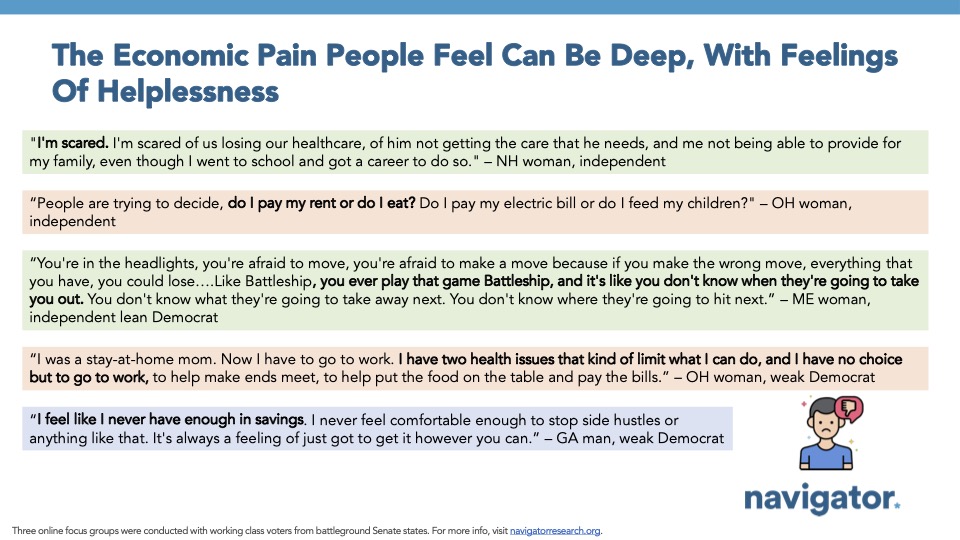
Participants cite feelings of deep economic pain and feelings of helplessness when it comes to their finances, with most seeing the situation as worsening not improving.
- “I’m scared. I’m scared. I’m scared of us losing our healthcare, of him not getting the care that he needs, and me not being able to provide for my family, even though I went to school and got a career to do so.” – NH woman, independent
- “I think the economy’s going to tank because when we all lose healthcare starting in January, or most of us like me, I’m going to lose it in January, what is that going to do to the economy? People can’t afford to buy anything now. It’s going to just kill it.” – NH woman, weak Democrat
- “I find everything is higher priced around here. I find work, but I’m looking for higher paying job and that’s been very discouraging. Unemployment’s up higher than it’s been in four years and I don’t see it getting better.” – MI woman, weak Democrat
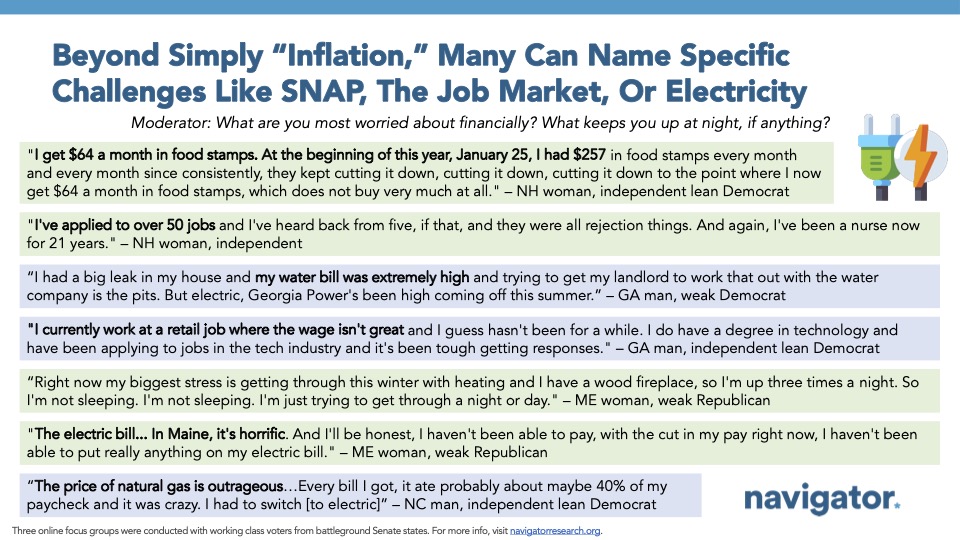
The cost of utilities and electricity is widely cited as an economic pain point, though the job market and changes in SNAP also come up as specific economic challenges.
- “Right now my biggest stress is getting through this winter with heating and I have a wood fireplace, so I’m up three times a night. So I’m not sleeping. I’m not sleeping. I’m just trying to get through a night or day.” – ME woman, weak Republican
- “The price of natural gas is outrageous…Every bill I got, it ate, probably, about maybe 40% of my paycheck and it was crazy. I had to switch [to electric].” – NC man, independent lean Democrat
- “I get $64 a month in food stamps. At the beginning of this year, January 25, I had $257 in food stamps every month and every month since consistently, they kept cutting it down, cutting it down, cutting it down to the point where I now get $64 a month in food stamps, which does not buy very much at all.” – NH woman, independent lean Democrat
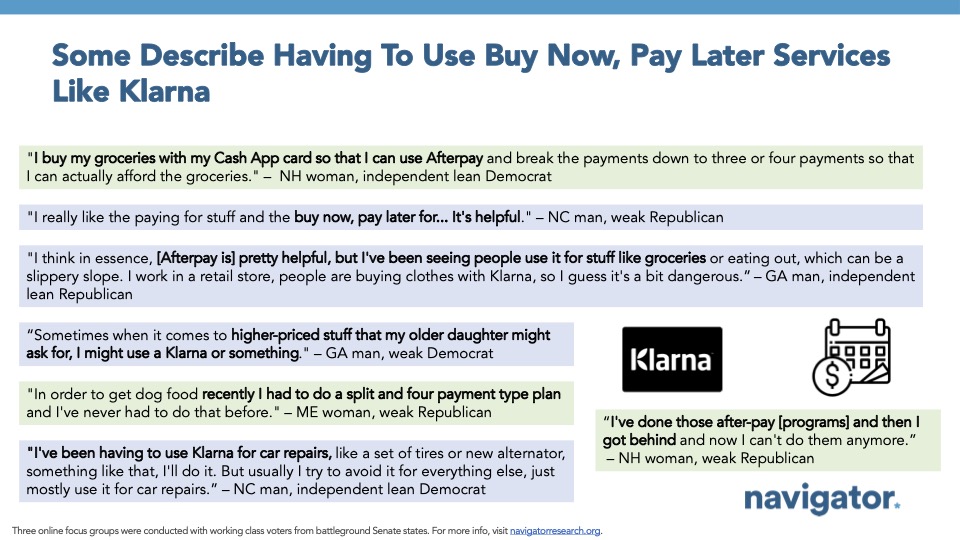
Many participants say they have developed new strategies to get by, including buy now pay later services like Klarna.
- “I buy my groceries with my cash app card so that I can use after pay and break the payments down to three or four payments so that I can actually afford the groceries.” – NH woman, independent lean Democrat
- “In order to get dog food recently I had to do a split and four payment type plan and I’ve never had to do that before.” – ME woman, weak Republican
- “We have cut our grocery bill in half….You just don’t buy as much and just make do with what you have. There’s more chicken and rice and things that are lower costing than the things that you really want.” – OH woman, weak Democrat
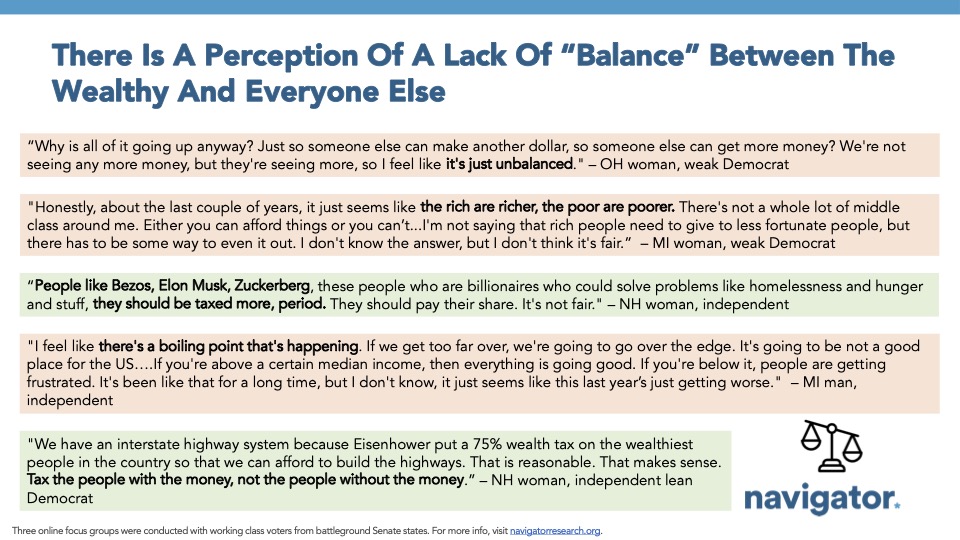
Participants across groups express perceptions of inequity and an economic system that is rigged for the wealthy.
- “Honestly, about the last couple of years, it just seems like the rich are richer, the poor or poorer. There’s not a whole lot of middle class around me. Either you can afford things or you can’t….I’m not saying that rich people need to give to less fortunate people, but there has to be some way to even it out. I don’t know the answer, but I don’t think it’s fair.” – MI woman, weak Democrat
- “People like Bezos, Elon Musk, Zuckerberg, these people who are billionaires who could solve problems like homelessness and hunger and stuff, they should be taxed more, period.. They should pay their share. It’s not fair.” – NH woman, independent
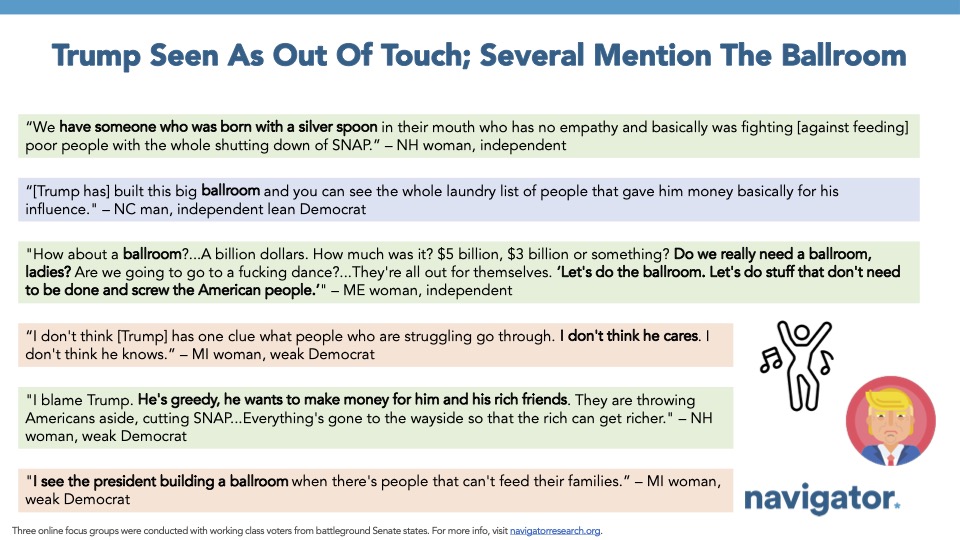
Trump is seen as out of touch with working class people, with several citing his ballroom project as a proofpoint.
- “I blame Trump. He’s greedy, he wants to make money for him and his rich friends. They are throwing Americans aside, cutting, SNAP….Everything’s gone to the wayside so that the rich can get richer.” – NH woman, weak Democrat
- “How about a ballroom?….A billion dollars. How much was it? $5 billion, $3 billion or something? Do we really need a ballroom, ladies? Are we going to go to a fucking dance?…They’re all out for themselves. ‘Let’s do the ballroom. Let’s do stuff that don’t need to be done and screw the American people.’” – ME woman, independent
- “I see the president building a ballroom when there’s people that can’t feed their families.” – MI woman, weak Democrat
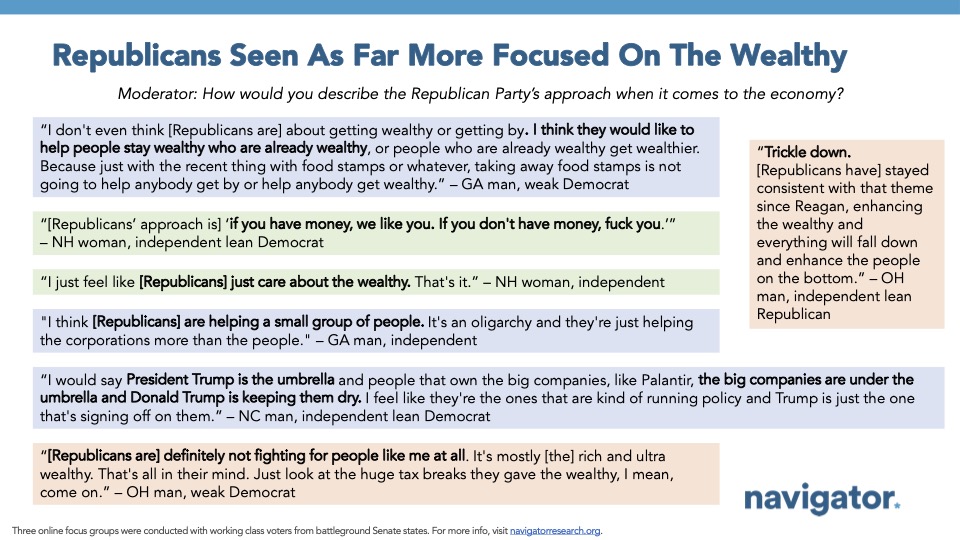
Republican lawmakers as a whole are seen as more focused on the wealthy.
- “[Republicans are] definitely not fighting for people like me at all. It’s mostly they’re rich and ultra wealthy. That’s all in their mind. Just look at the huge tax breaks they gave the wealthy, I mean, come on.” – OH man, weak Democrat
- “[Republicans approach is] if you have money, we like you. If you don’t have money, fuck you.” – NH woman, independent lean Democrat
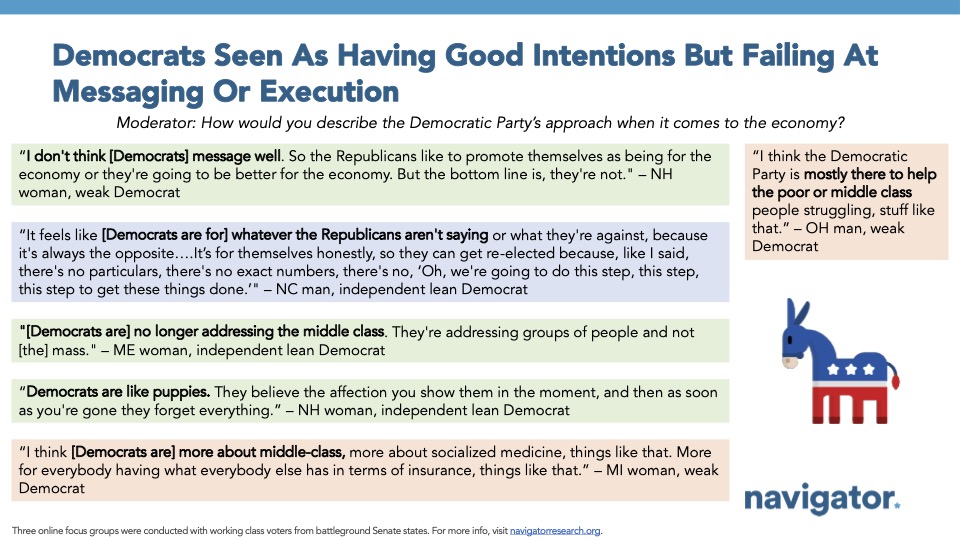
Participants believe Democratic lawmakers are well intentioned but ineffective –due to messaging issues and focus on political games.
- “I don’t think [Democrats] message well. So the Republicans like to promote themselves as being for the economy or they’re going to be better for the economy. But the bottom line is, they’re not.” – NH woman, weak Democrat
- “It feels like [Democrats are for] whatever the Republicans aren’t saying or what they’re against, because it’s always the opposite….It’s for themselves honestly, so they can get re-elected because like I said, there’s no particulars, there’s no exact numbers, there’s no, ‘Oh, we’re going to do this step, this step, this step to get these things done.’” – NC man, independent lean Democrat
- “[Democrats are] no longer addressing the middle class. They’re addressing groups of people and not mass.” – NH woman, independent lean Democrat
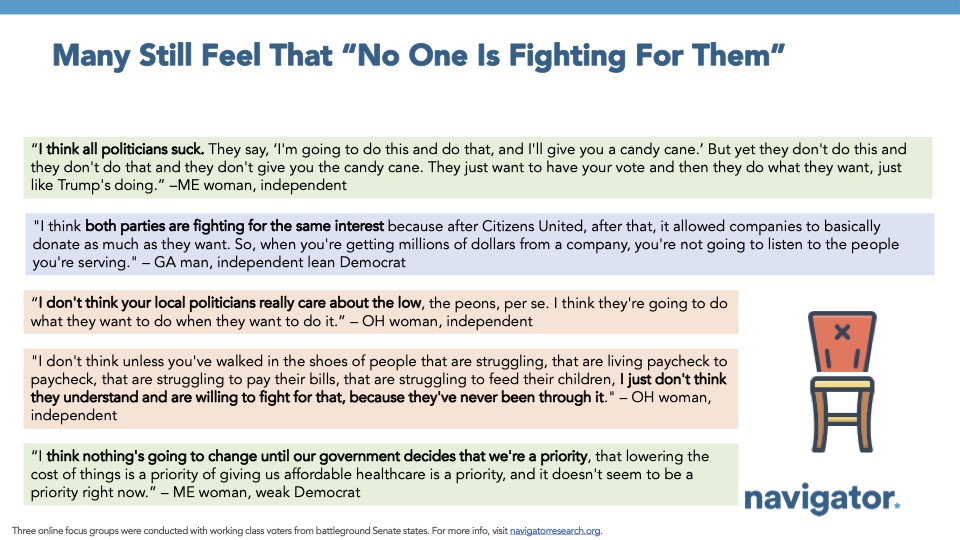
Participants do not see elected officials as fighting for them, or as having the lived experience to really understand the affordability crisis. Bernie Sanders is the one exception across groups.
- “I think nothing’s going to change until our government decides that we’re a priority, that lowering the cost of things is a priority, of giving us affordable health care is a priority, and it doesn’t seem to be a priority right now.” – ME woman, weak Democrat
- “I don’t think unless you’ve walked in the shoes of people that are struggling, that are living paycheck to paycheck, that are struggling to pay their bills, that are struggling to feed their children, I just don’t think they understand and are willing to fight for that, because they’ve never been through it.” – OH woman, independent
- “I think the only person who [understood what I was going through economically] would be Bernie Sanders, I feel like just talking about stuff like how bad student loans are for the youth and how important universal health care is, I feel like those are two things he is always been consistent about.” –GA man, independent lean Democrat
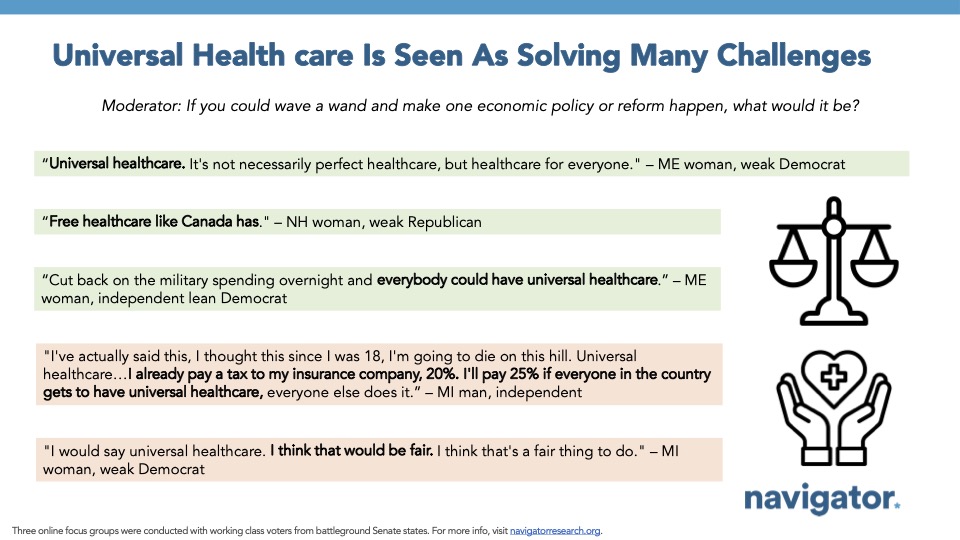
Across groups of participants, universal health care is seen as solving many economic challenges.
- “Cut back on the military spending overnight and everybody could have universal health care.” – NH woman, independent lean Democrat
- “I’ve actually said this, I thought this since I was 18, I’m going to die on this hill. Universal health care…I already pay a tax to my insurance company, 20%. I’ll pay 25% if everyone in the country gets to have universal health care, everyone else does it.” – MI man, independent
- “Universal health care. It’s not necessarily perfect health care, but health care for everyone.” – ME woman, weak Democrat
Read More
How Americans’ Views of the Shutdown Changed
Polling report on the latest views of the government shutdown and its impacts ahead of the Senate’s move to end the shutdown.
Government Shutdown Week 5: A Guide for Advocates
Polling report on awareness of and blame for the government shutdown and message guidance following SNAP’s lapse in funding.

Focus Group Report: Americans and Political Dysfunction
Focus group report on government dysfunction.
About The Study
GBAO conducted three online focus groups with working class swing voters from battleground Senate states (GA, ME, MI, NC, NH, OH)