Focus Groups: Americans and Political Dysfunction
This Navigator Research report covers findings from focus groups conducted on October 23rd among Americans in closely-divided House battleground districts who believe the political system is broken.
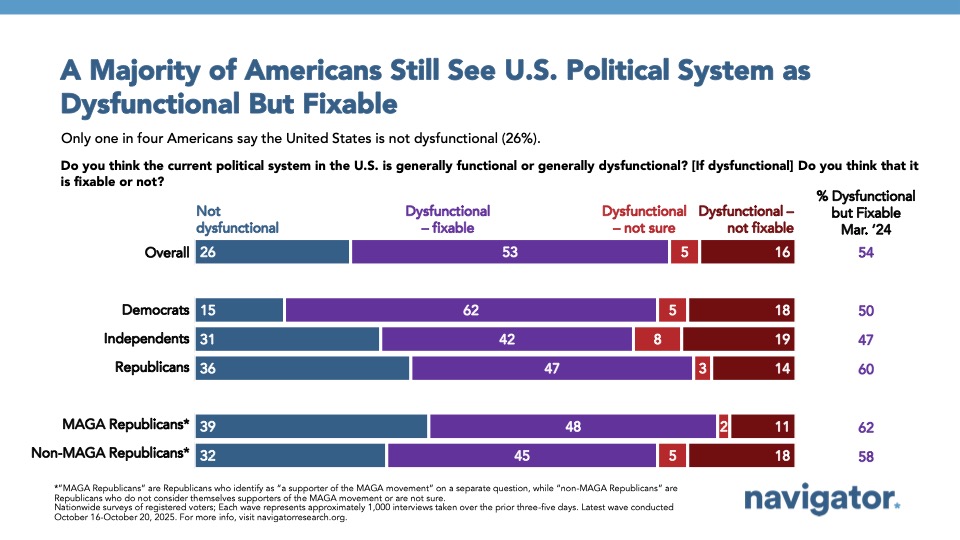
Just over two weeks into the government shutdown, Navigator asked Americans if they believe the U.S. government is generally functional or dysfunctional–and if dysfunctional, if it’s fixable. Overwhelmingly, we found Americans believe the U.S. government is dysfunctional (74 percent) and half say it is fixable (53 percent). An identical share said the government was dysfunctional, but fixable in March of last year, a clear sign that this is not purely shutdown related. We conducted focus groups with Americans who reflect this sentiment to understand what exactly they find dysfunctional and what solutions they believe will fix the brokenness.
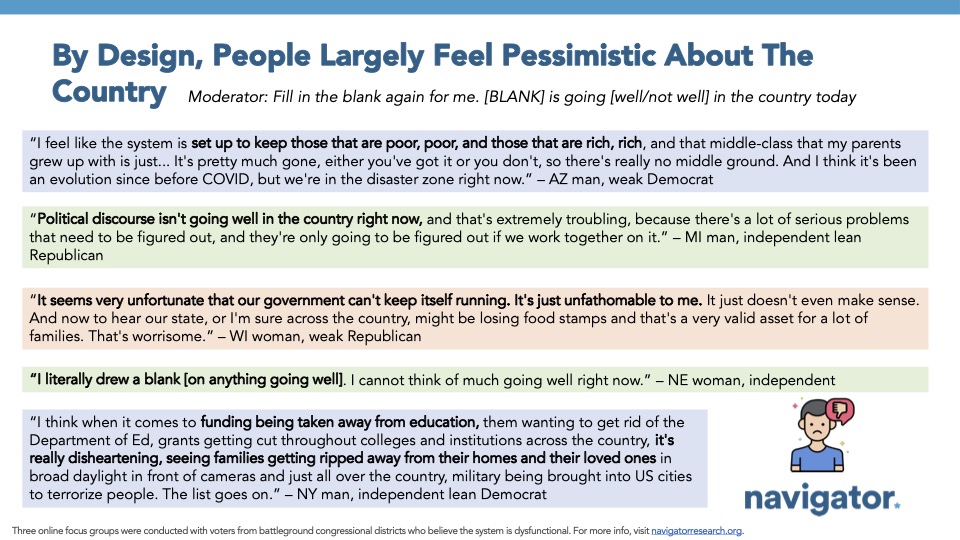
Among participants who believe the political system is dysfunctional, all felt pessimistic about the state of the country today, particularly when it came to issues related to the economy and health care.
“I feel like the system is set up to keep those that are poor, poor, and those that are rich, rich, and that middle-class that my parents grew up with is just… It’s pretty much gone, either you’ve got it or you don’t, so there’s really no middle ground. And I think it’s been an evolution since before COVID, but we’re in the disaster zone right now.”
– AZ man, weak Democrat
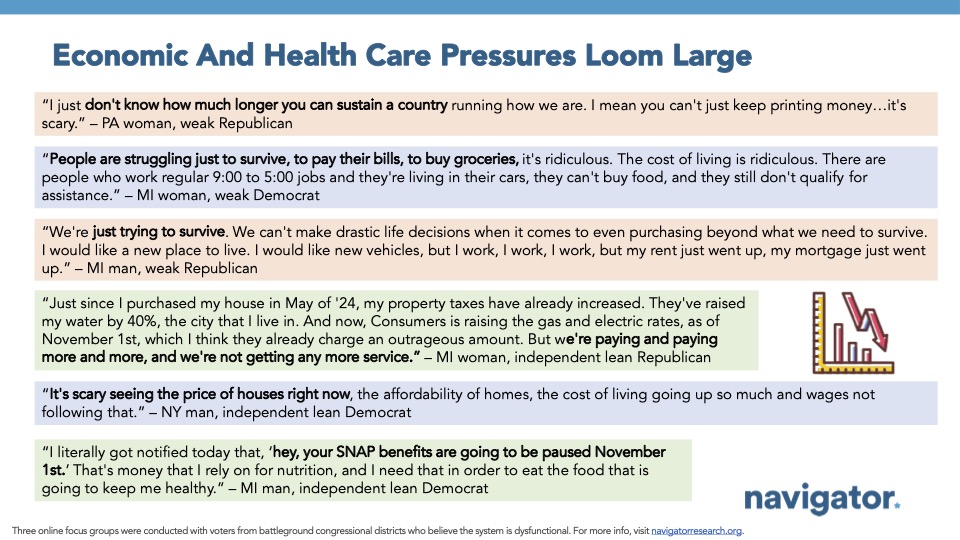
Financial stressors are of top concern.
“People are struggling just to survive, to pay their bills, to buy groceries, it’s ridiculous. The cost of living is ridiculous. There are people who work regular 9:00 to 5:00 jobs and they’re living in their cars, they can’t buy food, and they still don’t qualify for assistance.” – MI women, weak Democrat
“I literally got notified today that, ‘hey, your SNAP benefits are going to be paused November 1st.’ That’s money that I rely on for nutrition, and I need that in order to eat the food that is going to keep me healthy.” – MI man, independent lean Democrat
When prompted, democracy is seen as under threat, with participants citing a range of reasons including President Trump, political division, and government dysfunction.
“Well, first of all, again, we’re in a government shutdown. So how does that look to all the other countries in Europe, Russia, China? United States is weak. They can’t even run their country. They can’t even keep it running. All they’re doing is arguing between both sides. So how does that make us look as a superpower?” – WI woman, weak Republican
“I think we’ve seen a lot of ways that the law system hasn’t been as strong as we might’ve thought it was through Trump’s presidency and the way he’s used executive orders and other things. And I think we found a lot more holes in the system than I thought there were personally. I thought there were more checks and balances than have shown themselves.” – PA man, weak Democrat
“I think unambiguously, democracy is under threat. It’s going to take a while to see the impact of the taxes and the other economic policies. It will definitely get worse, whether it will teeter and fall, can’t say.” – NY man, independent lean Democrat

Democratic-leaning participants blame Trump and Republicans for their pessimism about the country’s future.
“When you see your elected leader villainizing or arresting or pressing charges against political opponents and cleaning house to surround themselves with all yes-men that would never dare to oppose their decisions, it’s scary to see the damage that that can do to a government that’s supposed to represent the people when both sides of the coin aren’t being represented.” – NY man, independent lean Democrat

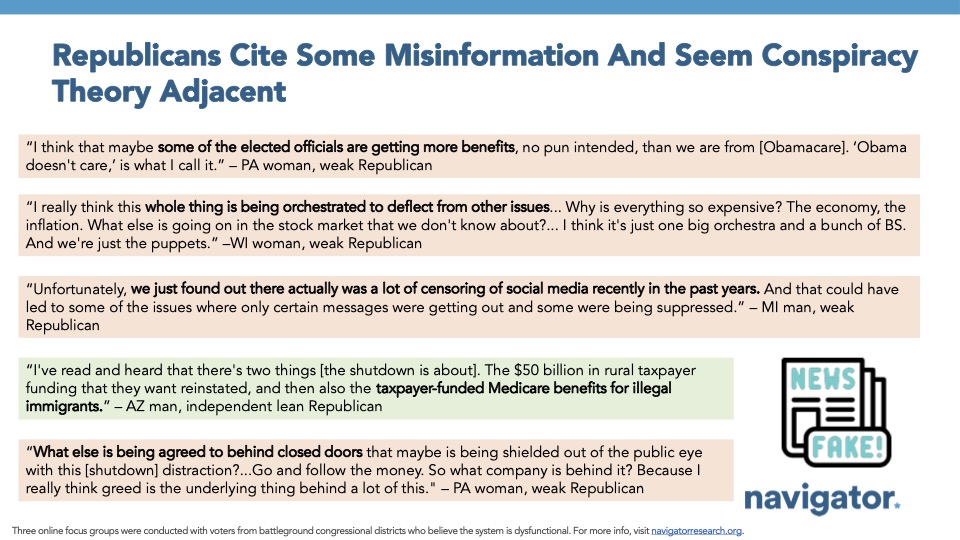
Republican-leaning participants cite some misinformation. Participants across groups express the sentiment that political figures make decisions for personal gain and greed.
“I’ve read and heard that there’s two things [the shutdown is about]. The $50 billion in rural taxpayer funding that they want reinstated, and then also the taxpayer-funded Medicare benefits for illegal immigrants.” – AZ man, independent lean Republican
“What else is being agreed to behind closed doors that maybe is being shielded out of the public eye with this [shutdown] distraction?…Go and follow the money. So what company is behind it? Because I really think greed is the underlying thing behind a lot of this.” – PA woman, weak Republican
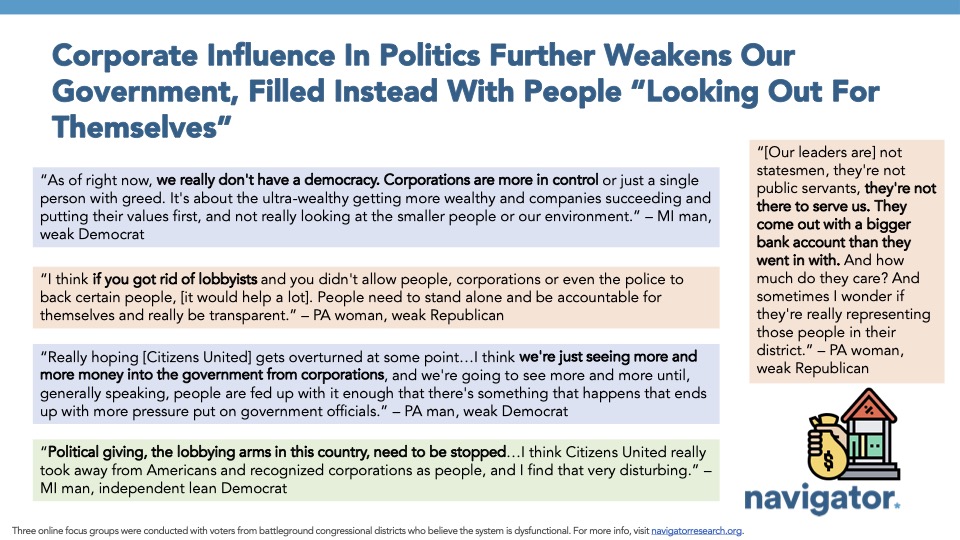
Participants see corporate influence as weakening democracy. Many view corporations and lobbying groups as having more control over the government than everyday Americans–leading many to a feeling of hopelessness.
“As of right now, we really don’t have a democracy. Corporations are more in control or just a single person with greed. It’s about the ultra-wealthy getting more wealthy and companies succeeding and putting their values first, and not really looking at the smaller people or our environment.” – MI man, weak Democrat
“[Our leaders are] not statesmen, they’re not public servants, they’re not there to serve us. They come out with a bigger bank account than they went in with. And how much do they care? And sometimes I wonder if they’re really representing those people in their district.” – PA woman, weak Republican
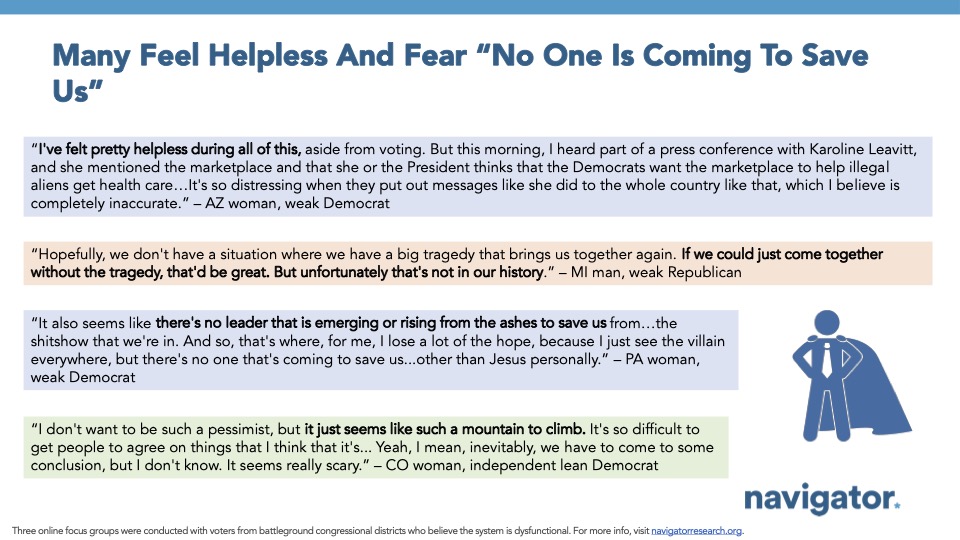
With many participants feeling helpless about the state of the country and democracy, some hope for a political leader who can unite.
“I don’t want to be such a pessimist, but it just seems like such a mountain to climb. It’s so difficult to get people to agree on things that I think that it’s… Yeah, I mean, inevitably, we have to come to some conclusion, but I don’t know. It seems really scary.” – CO woman, independent lean Democrat
“I’ve felt pretty helpless during all of this, aside from voting. But this morning, I heard part of a press conference with Karoline Leavitt, and she mentioned the marketplace and that she or the President thinks that the Democrats want the marketplace to help illegal aliens get healthcare…It’s so distressing when they put out messages like she did to the whole country like that, which I believe is completely inaccurate.” – AZ women, weak Democrat
“I just think a united joint front, instead of these polarizing radicalizing statements. I think our leaders should be demonstrating to people that, ‘hey, I don’t agree with them, but I can be civil and we can have a conversation.’ And it should be a very united front.” – PA woman, weak Republican
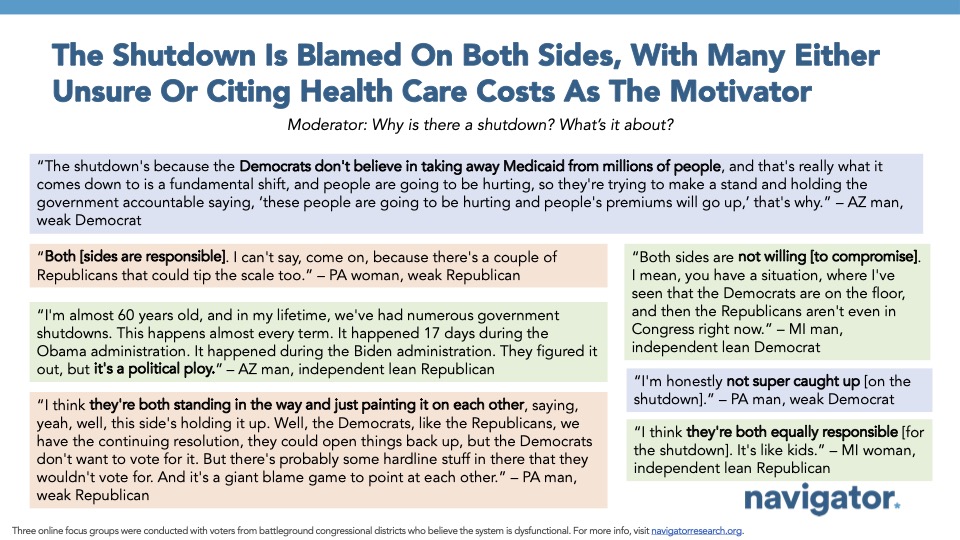
Participants see the government shutdown as another example of political dysfunction and division, though some acknowledge the shutdown fight is about protecting health care.
“The shutdown’s because the Democrats don’t believe in taking away Medicaid from millions of people, and that’s really what it comes down to is a fundamental shift, and people are going to be hurting, so they’re trying to make a stand and holding the government accountable saying, these people are going to be hurting and people’s premiums will go up,’ that’s why.” – AZ man, weak Democrat
“Yeah, I think they’re both standing in the way and just painting it on each other, saying, yeah, well, this side’s holding it up. Well, the Democrats, like the Republicans, we have the continuing resolution, they could open things back up, but the Democrats don’t want to vote for it. But there’s probably some hardline stuff in there that they wouldn’t vote for. And it’s a giant blame game to point at each other.” – PA man, weak Republican
“I think they’re both equally responsible [for the shutdown]. It’s like kids. – MI woman, independent lean Republican