
Mothers are Pessimistic on the Economy and Personal Financial Situations
Mothers in the U.S. are far more anxious about the economy and personal finances than fathers: 76% of mothers rate the economy negatively, compared to 55% of fathers who rate the economy negatively. 64% of mothers feel uneasy about their personal finances, compared to just 41% of fathers who report feeling uneasy.
Additionally, mothers are more likely to say their costs are rising, with 80% saying their costs generally are rising (compared to 74% of fathers), 87% saying the cost of groceries is increasing (compared to 81% of fathers), and 80% saying the cost of utilities is increasing (compared to 69% of fathers). In Navigator’s November focus groups on affordability, one woman with dependents from Maine said: “The electric bill… In Maine, it’s horrific. And I’ll be honest, I haven’t been able to pay, with the cut in my pay right now, I haven’t been able to put really anything on my electric bill.”
Mothers Want the Government to Focus on Costs and Healthcare
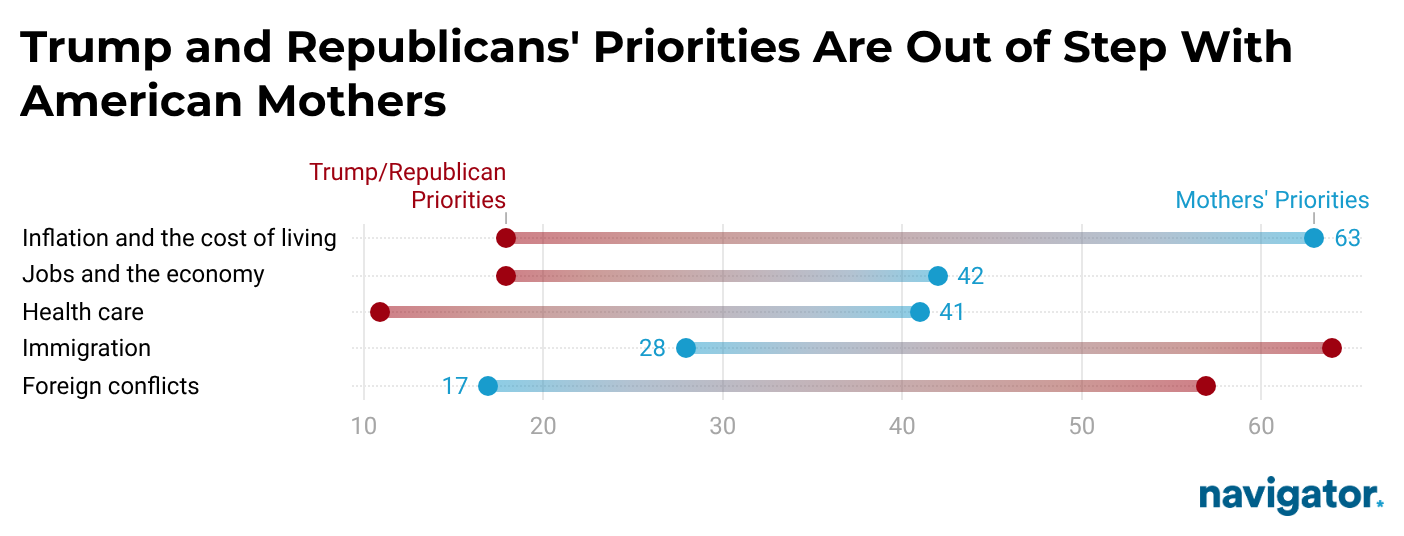
Mothers say they want the president and Congress to focus on the same things as everyone else: inflation and the cost of living (63%), jobs and the economy (42%), and healthcare (41%). Mothers don’t see Trump and Republicans in Congress as sharing their priorities, with a majority seeing them as focused on immigration and foreign conflicts instead (64% and 57%, respectively). Only 18% of mothers believe Trump and Republicans are prioritizing inflation and the cost of living and even fewer believe they’re prioritizing healthcare (11%).
Mothers Are Significantly Less Confident in Ability to Access Healthcare
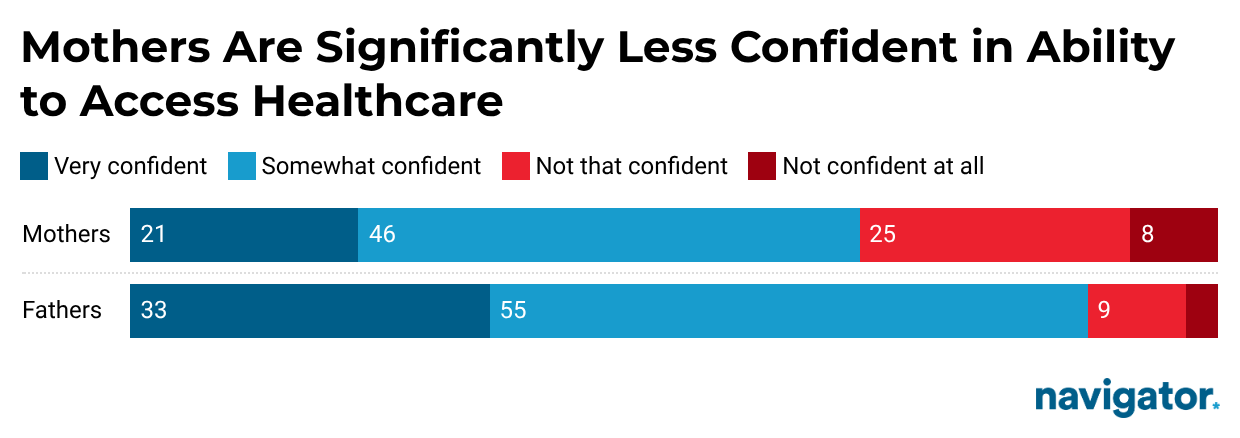
One-in-three mothers are not confident in their ability to access healthcare (34%), compared to only 12% of fathers. Unsurprisingly, when it comes to rating both the quality and availability of healthcare, mothers are also more negative. Mothers are 15 points more likely to rate the quality of healthcare as “not so good” or “poor” than fathers (45% of mothers – 30% fathers). Similarly, by 33 points mothers rate the availability and affordability of healthcare as “not so good” or “poor” (31% excellent/good – 64% not so good/poor). Fathers rate the availability and affordability of healthcare negatively – but by a 5 point margin (47% excellent/good – 52% not so good/poor).
- From focus groups: “I’m a single mom, so for me, if my daughter needs to go, that’s who’s going. She’s going before me. So yeah, I’m going less and reserving the appointments for her if I have to.” – GA woman, ACA marketplace
Plurality Say MAHA Movement Has Had Mixed Impacts
While mothers grow increasingly uneasy with the healthcare system, many turn to alternative healthcare routes – as seen in Navigator’s MAHA focus groups from September, with one mother from Florida saying: “I use a lot of Instagram and TikTok outside of Google. … the people that I follow on Instagram and TikTok are holistic doctors and stuff like that, because I’m also into the trying to heal things naturally, staying away from medication. I don’t even take Tylenol, really.”
MAHA remains largely undefined for mothers (and Americans as a whole), but a plurality of mothers say the impacts of the MAHA movement have been mixed (27% positive – 29% mixed – 25% negative). Though when asked what comes to mind when thinking of “MAHA,” mothers most frequently cite healthier food/nutrition (26%) and healthcare pricing/access (17%).
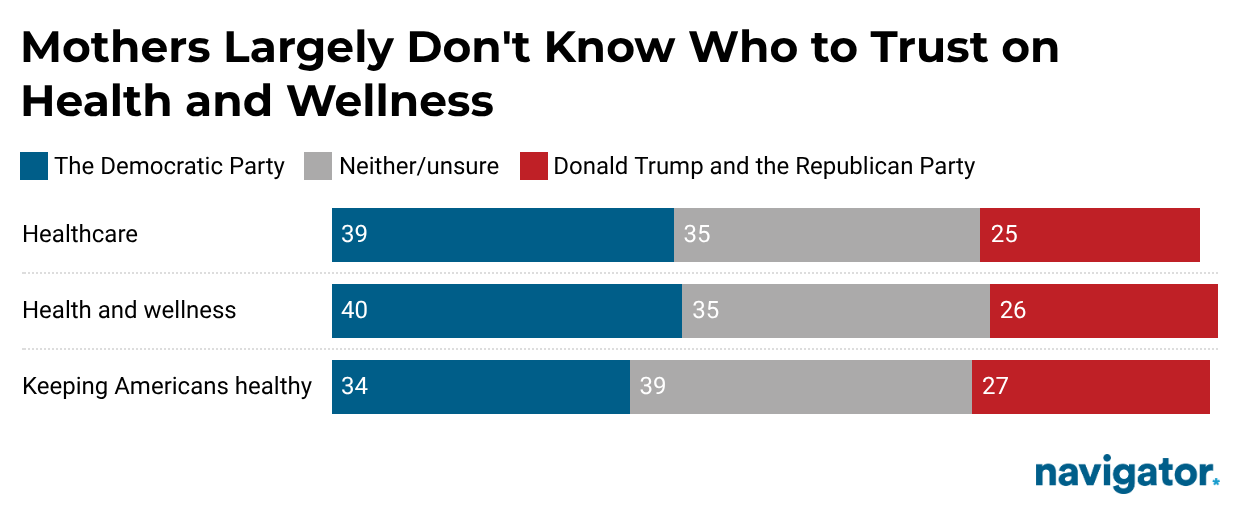
When it comes to who they trust to handle health and wellness, 40% of mothers trust the Democratic Party more and 26% trust Trump and Republicans more – still 37% say they trust neither party or don’t know who to trust.