
Poll: AI and Data Centers
This Navigator Research report covers perceptions of AI and data centers in the country today.
BIG TAKEAWAYS:
- Americans’ perception of AI is varied, with the greatest divide split by gender and age. Half say they are using AI tools once a week or more.
- There is significant support for increased AI regulation—one of the few issues that transcends similar support levels regardless of party.
- When it comes to building more data centers, an approach that protects consumers from both the high costs and environmental consequences is most appealing.
Views toward AI
Americans’ perception of artificial intelligence or AI is varied, with young men viewing it the most positively. 49% of Americans have a favorable view of AI, this jumps to 57% for men overall, and 63% for men under the age of 55. Women on the other hand view AI unfavorably by 7 points (41% favorable – 48% unfavorable). Younger women are nearly even on the issue (net -2), while women over the age of 55 view AI unfavorably by 9 points. Younger Americans and voters of color generally have a more positive view of AI.
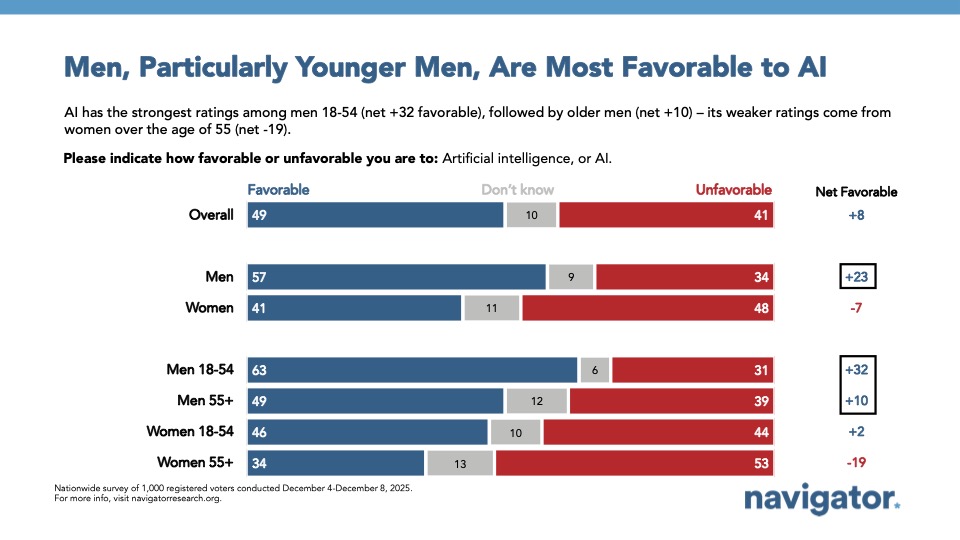
Despite the fact that AI favorability favors younger and men, Republicans view AI more favorably (net +17) than Democrats (net +2) and independents (net -8), the partisan divide is less disparate around AI than most other issues facing the country.
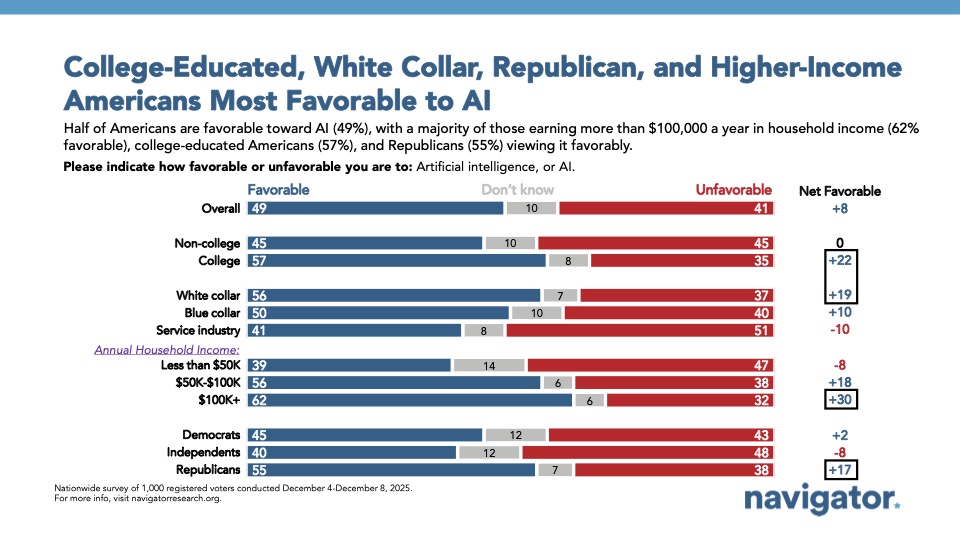
Educational attainment, job type, and income also play a role: Americans with a college degree, those who work white collar jobs, and those living in households that earn more than $100,000 per year all view AI more favorably. Those who use AI frequently, either daily or weekly, are far more favorable towards it than those who don’t.
The groups who report viewing AI most favorably also say they use it the most. While half of Americans say they use AI tools like ChatGPT, Microsoft Copilot, Google Gemini, or DALL-E once a week or more, 15% are using these tools several times a day. 18% of men report using AI tools several times a day, jumping to 23% for men under the age of 55.
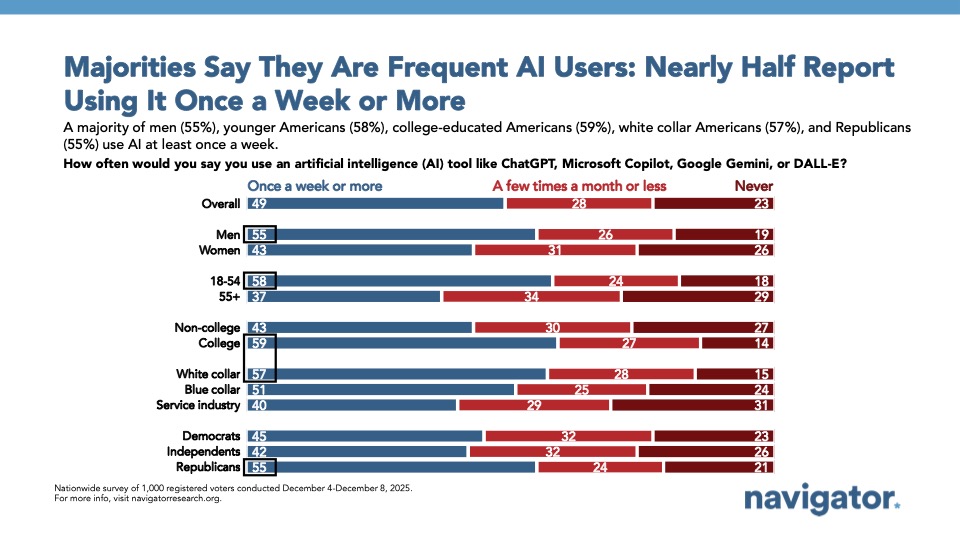
When it comes to AI, while most Americans are generally comfortable with it, most also say either use it with caution or have concerns about it. Regardless of usage, Americans are mixed about whether the way AI is being used right now is good or bad for the country and for “people like you.”

AI as a Political Issue
Americans also don’t see either party as having an advantage on the issue. Just 23% say they trust Democrats to handle AI, while 25% say they trust Republicans more—revealing a large opportunity. A majority either trust neither party or say they don’t know who to trust.
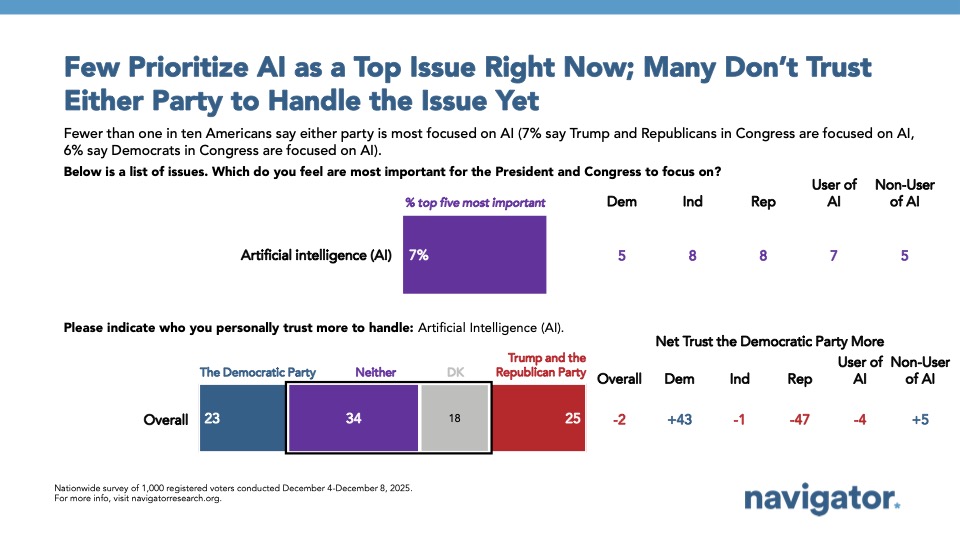
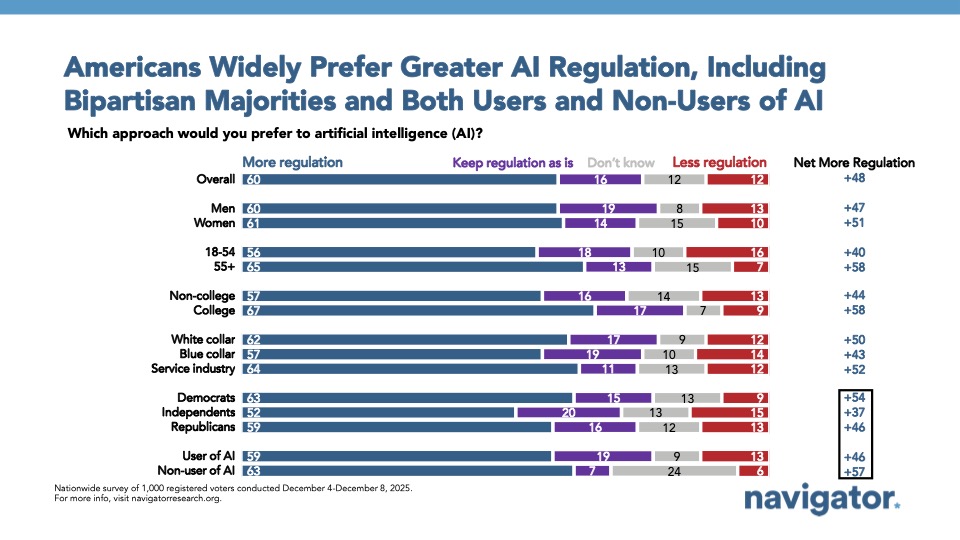
There is bipartisan support for more regulation of AI. When it comes to AI, 60% say there should be more regulation to limit its potential negative impact on society, including 63% of Democrats, 59% of Republicans, and 52% of independents. Even among those who view AI favorably, a majority say there should be more regulation.
Data Centers
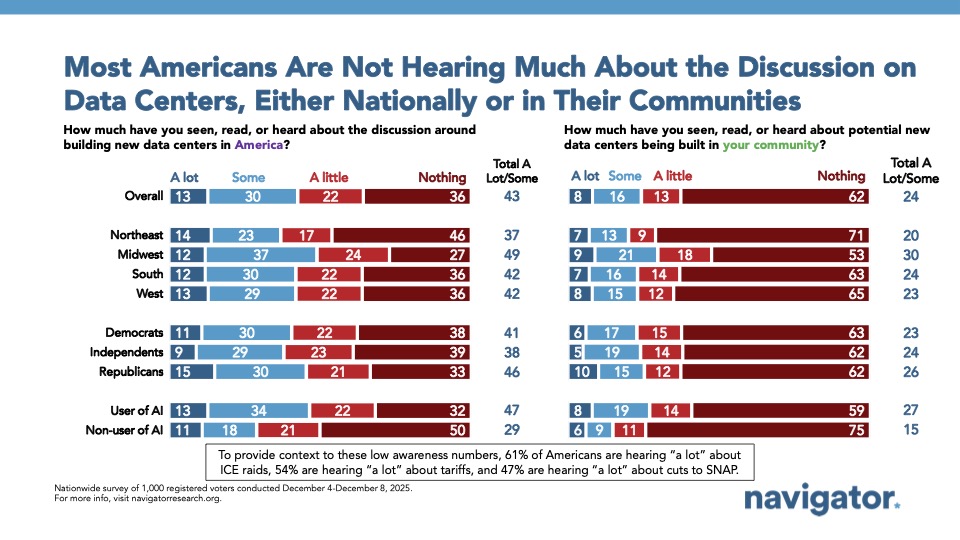
The building of new data centers doesn’t yet evoke strong feelings nationally. A majority say they have heard little or nothing about building new data centers in America, and even fewer have heard about potential data centers being built in their own communities. Americans living in the midwest are hearing more about the building of new data centers both nationally and in their own communities.
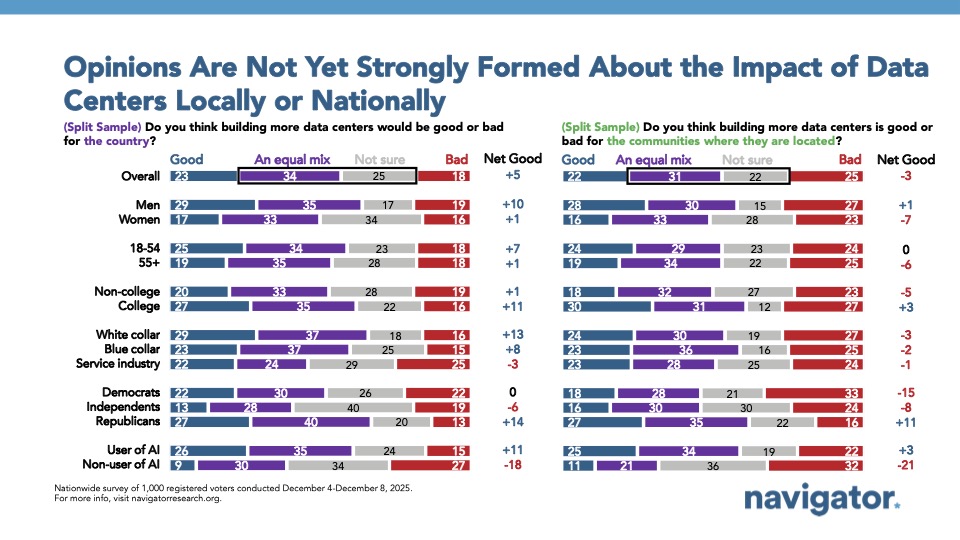
Given the lack of awareness about data centers, Americans don’t have a strong sense that they are good or bad for the country or for the communities where they are located. Most Americans say data centers are either an equal mix of good or bad or that they are not sure, indicating an opportunity to engage on the issue.
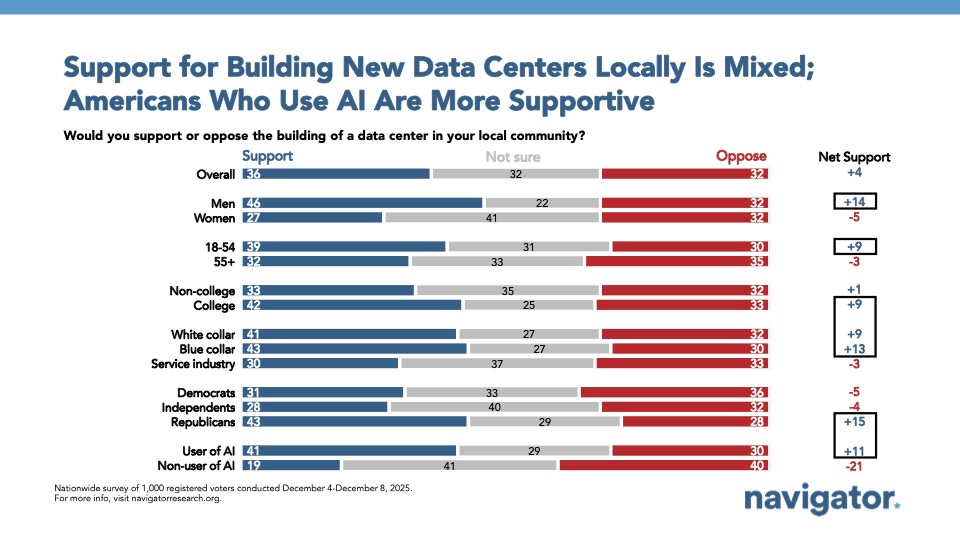
Ultimately, Americans’ are split and unsure of whether they would support the building of a data center in their local community (36% support – 32% oppose – 32% unsure). While Republicans are more supportive (net +15) than Democrats (net -5) and independents (net -4), most Republicans either say they would oppose it or are unsure. Those who view AI favorably are less likely to believe data centers are far more supportive of building new data centers in their own community (52% support – 21% oppose).
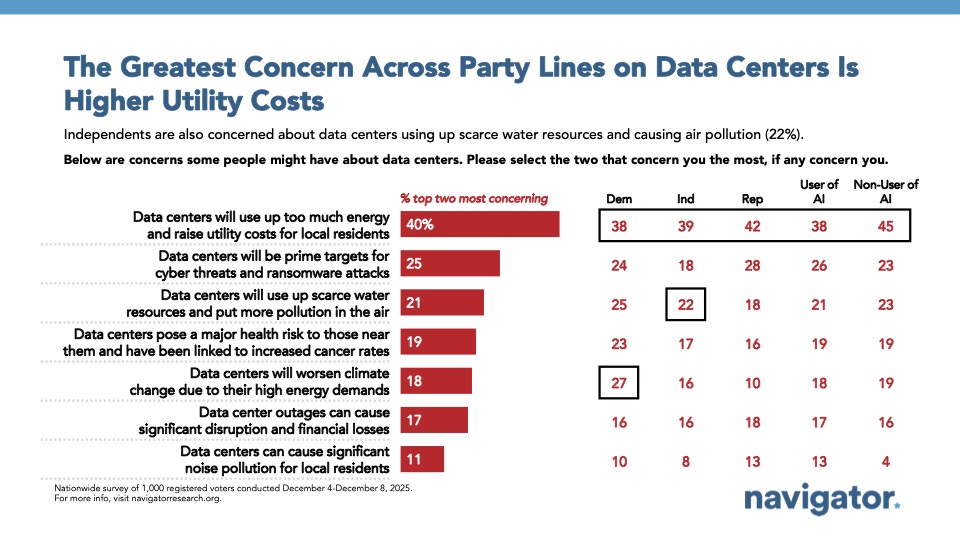
The greatest concern Americans have about data centers focuses on the impact it would have on the community, chiefly that data centers will use up too much energy and raise utility costs for local residents. This is most concerning across partisanship and racial demographics. The most appealing potential benefits are high-paying, union jobs and growth to local economies and tax revenue.
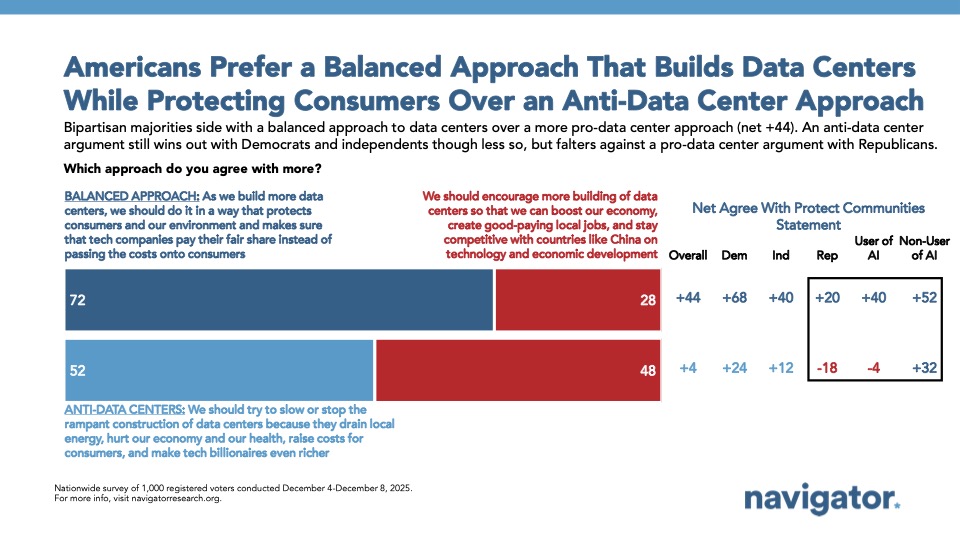
When it comes to building more data centers, an approach that protects consumers from both environmental consequences and higher costs associated with them is more appealing than one that solely aims to slow or stop the construction of data centers.
In response to an argument that “we should encourage more building of data centers so that we can boost our economy, create good-paying local jobs, and stay competitive with countries like China on technology and economic development,” there is a 40 point difference between the rebuttals:
- As we build more data centers, we should do it in a way that protects consumers and our environment and makes sure that tech companies pay their fair share instead of passing the costs onto consumers (net +44)
- We should try to slow or stop the rampant construction of data centers because they drain local energy, hurt our economy and our health, raise costs for consumers, and make tech billionaires even richer (net +4)
Read More

2025 Wrapped: Trump’s Year in Review
Polling report on the latest views of Trump and his administration’s actions over the last year.

In Time for the Holidays, Americans Say Costs Are Going up – on Everything
Polling report on the latest views of the affordability crisis, including specific costs Americans say are increasing and how increased costs are impacting financial habits.

Focus Group Report: Working Class Americans and the Affordability Crisis
Focus group report on working class Americans in Senate battleground states on their personal financial situations, their greatest economic concerns, and perceptions of elected officials tackling affordability.
About The Study
Global Strategy Group conducted a public opinion survey among a sample of 1,000 registered voters from December 4-December 8, 2025. 100 additional interviews were conducted among Hispanic voters. 102 additional interviews were conducted among African American voters. 78 additional interviews were conducted among Asian American and Pacific Islander voters. 102 additional interviews were conducted among independent voters. The survey was conducted online, recruiting respondents from an opt-in online panel vendor. Respondents were verified against a voter file and special care was taken to ensure the demographic composition of our sample matched that of the national registered voter population across a variety of demographic variables. The margin of error for the full sample at the 95 percent level of confidence is +/- 3.1 percentage points. The margin of error for subgroups varies and is higher.