

One Year In: Americans Give Trump a C- Grade

January 20, 2026
Maryann Cousens & Julie Alderman Boudreau

Polling report on the latest views of President Trump’s first year in office, including how Americans think his policies have impacted the country, and how they would rate his performance as President.

BIG TAKEAWAYS

Americans give President Trump and the economy he’s created a C- grade for the first year of his second term.

Political division and cost increases are seen as worsening under Trump.

Americans most associate Trump’s economic policies with tariffs – which they believe are increasing their costs.

Poll: Trump’s First Year in Office

This Navigator Research report covers the latest views of President Trump’s first year in office, including how Americans think his policies have impacted the country, and how they would rate his performance as President.

Americans Give Trump a C- Average

Trump gave his economy an “A+++++,” but Americans do not agree. They give Trump a C- average a year into his second term and give his economy the same grade. When rating Trump’s first year in office, over one-third of people give Trump an “F” (36%), including 37% of independents. Averaging out his grades, Trump scores a 1.78 GPA overall with Americans. Trump’s economy gets a 1.88 GPA, or C- average.
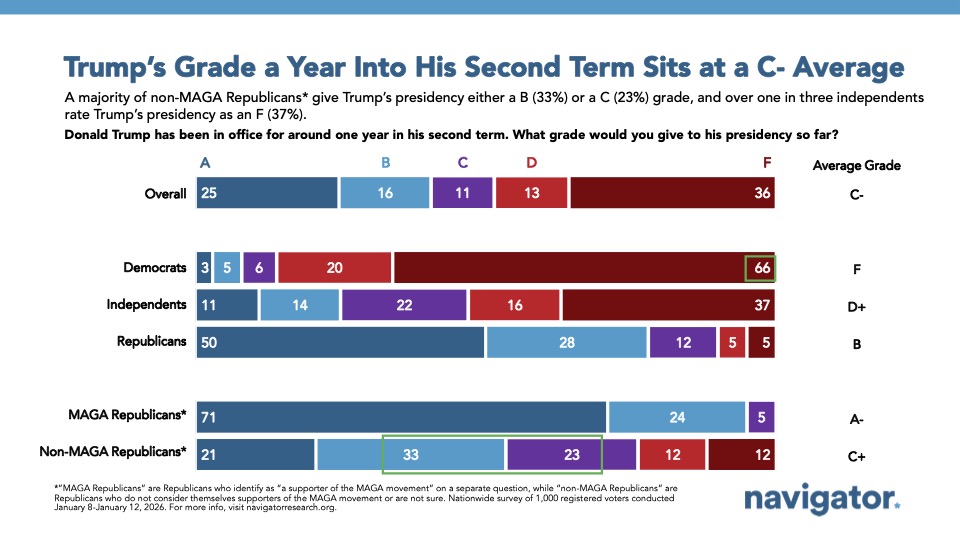
Bar chart from Navigator Research, titled: Trump’s Grade a Year Into His Second Term Sits at a C- Average

Majorities continue to disapprove of how President Trump handles the economy, inflation, and the presidency overall. 56% disapprove of both his handling of the economy and the presidency overall, while 58% disapprove of his handling of inflation and the cost of living. Among those disapproving of his handling of inflation are 44% of non-MAGA Republicans and 66% of independents.

Political Division and Costs Worse Under Trump

Nearly two-thirds believe political division has gotten worse during the first year of President Trump’s second term (65%), including 47% who say it has gotten “a lot” worse. Majorities also say the cost of living and health care costs have gotten worse under Trump (62% and 60%, respectively). When it comes to non-cost related metrics, 56% believe the functioning of our democracy has deteriorated and 54% say the lives of working people have gotten worse, including 50% of middle class Americans.
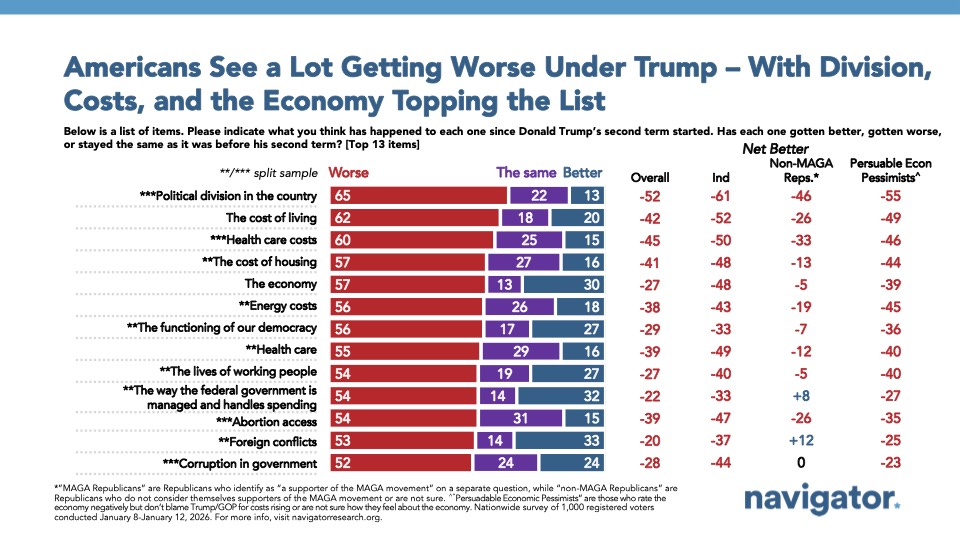
Bar chart from Navigator Research, titled: Americans See a Lot Getting Worse Under Trump – With Division, Costs, and the Economy Topping the List

Majorities Link Cost Increases to Trump Policies

Eight in ten say both their cost of living generally and their grocery costs have increased as a result of Trump’s second term policies (80% and 79%, respectively). Americans are more likely to say their specific costs and costs generally have increased as a result of Trump’s policies rather than seeing cuts to programs as a result of his economic policies. Half believe Medicaid has been cut as a result of Trump’s actions (50%), and 42% believe Social Security and Medicare have been cut.

Utility costs (69%), housing costs (69%), and health care costs (61%), are all seen as increasing as a result of Trump’s policies.
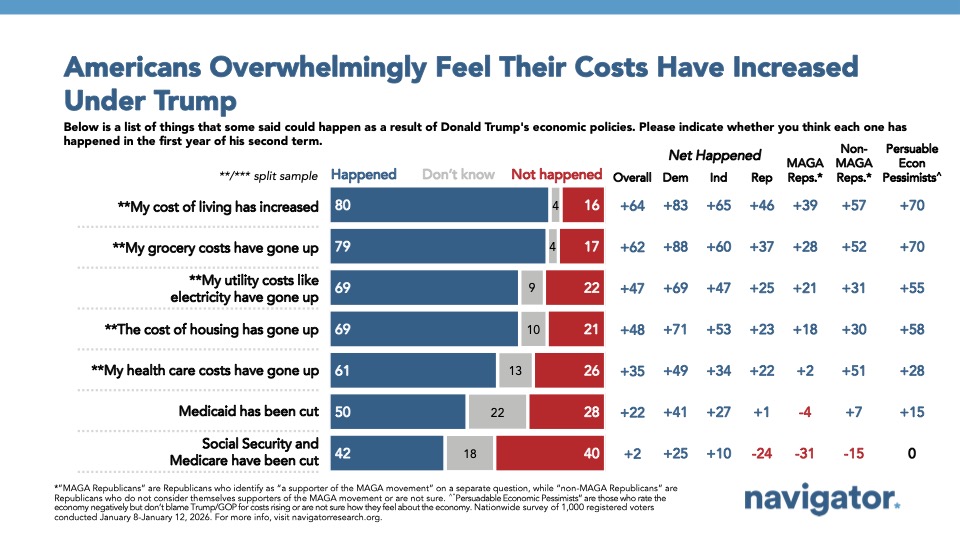
Bar chart from Navigator Research, titled: Americans Overwhelmingly Feel Their Costs Have Increased Under Trump

Trump’s Tariffs to Blame for Costs

Nearly half say Trump’s tariffs are one of the top two policies they associate most with his second term (48%). Two thirds place it in their top three (64%). After tariffs, the policies most associated with Trump’s second term are: cuts to SNAP and Medicaid (38% top two, 54% top three) and cuts to the federal government via DOGE (29% top two, 43% top three).

One-third rank Trump’s tariffs first in terms of policies that have increased costs (33%), and a majority ranked it in their top three (55%). Cuts to Medicaid and SNAP as well as Trump’s ending of ACA subsidies were also ranked as cost increasing culprits –though not as highly as tariffs (Medicaid/SNAP; 40% top three, ACA; 39% top three).
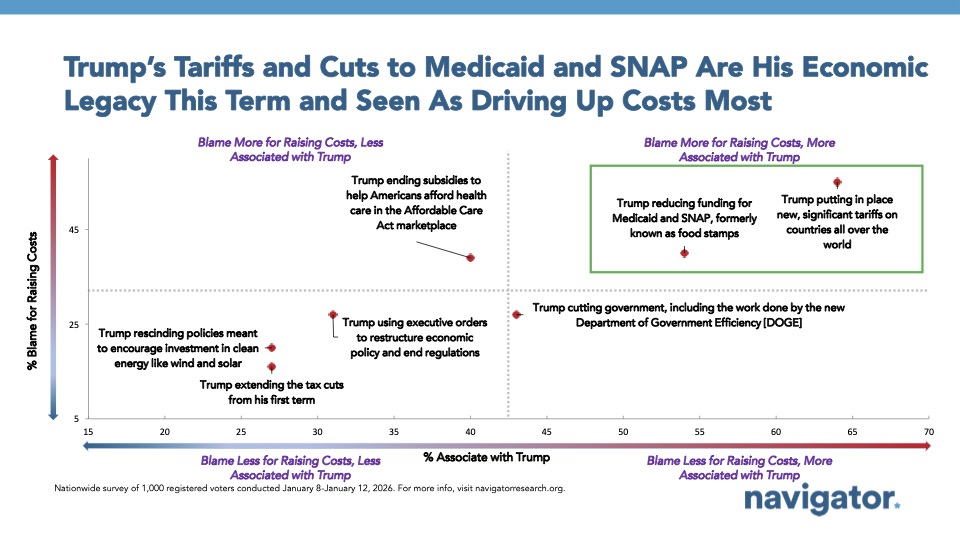
Scatter plot graph from Navigator Research, titled: Trump’s Tariffs and Cuts to Medicaid and SNAP Are His Economic Legacy This Term and Seen As Driving Up Costs Most

Read More

February 5, 2026

All eyes are on ICE

This Navigator Research report covers Trump’s handling of immigration and mass deportations as well as messaging guidance on ICE.

Maryann Cousens
February 4, 2026

Americans Continue To Sour On ICE

Polling report on the most recent perceptions of ICE following the killings of both Renee Good and Alex Pretti, including tracking of ICE’s favorability, the share who believe Secretary Noem should be impeached and Stephen Miller should be fired, and the reforms to ICE that Americans most support.

Julie Alderman Boudreau & Maryann Cousens
January 29, 2026

Meet The Pocketbook Pessimists

This Navigator Research report covers Americans who rate the economy negatively or are unsure but don’t yet blame Trump and Republicans in Congress.

Julie Alderman Boudreau
January 27, 2026

ICE’s Aggression is Fracturing Republicans

Polling report on shifting public sentiment on immigration, Trump’s handling of immigration and deportations, and the deployment of ICE.

Maryann Cousens & Julie Alderman Boudreau
Download
ToplinesGRAPH
Share

About The Study

Global Strategy Group conducted a public opinion survey among a sample of 1,000 registered voters from January 8-January 12, 2026. 100 additional interviews were conducted among Hispanic voters. 100 additional interviews were conducted among African American voters. 75 additional interviews were conducted among Asian American and Pacific Islander voters. 100 additional interviews were conducted among independent voters. The survey was conducted online, recruiting respondents from an opt-in online panel vendor. Respondents were verified against a voter file and special care was taken to ensure the demographic composition of our sample matched that of the national registered voter population across a variety of demographic variables. The margin of error for the full sample at the 95 percent level of confidence is +/- 3.1 percentage points. The margin of error for subgroups varies and is higher.