

Poll: Health Care
This Navigator Research report covers the latest views on health care for Americans in the battleground and beyond, including on rising costs, who they trust to handle those costs, and how much they think Congress can do about it.
Vast Majority Of Americans in the Battleground Are Experiencing Increased Health Care Costs
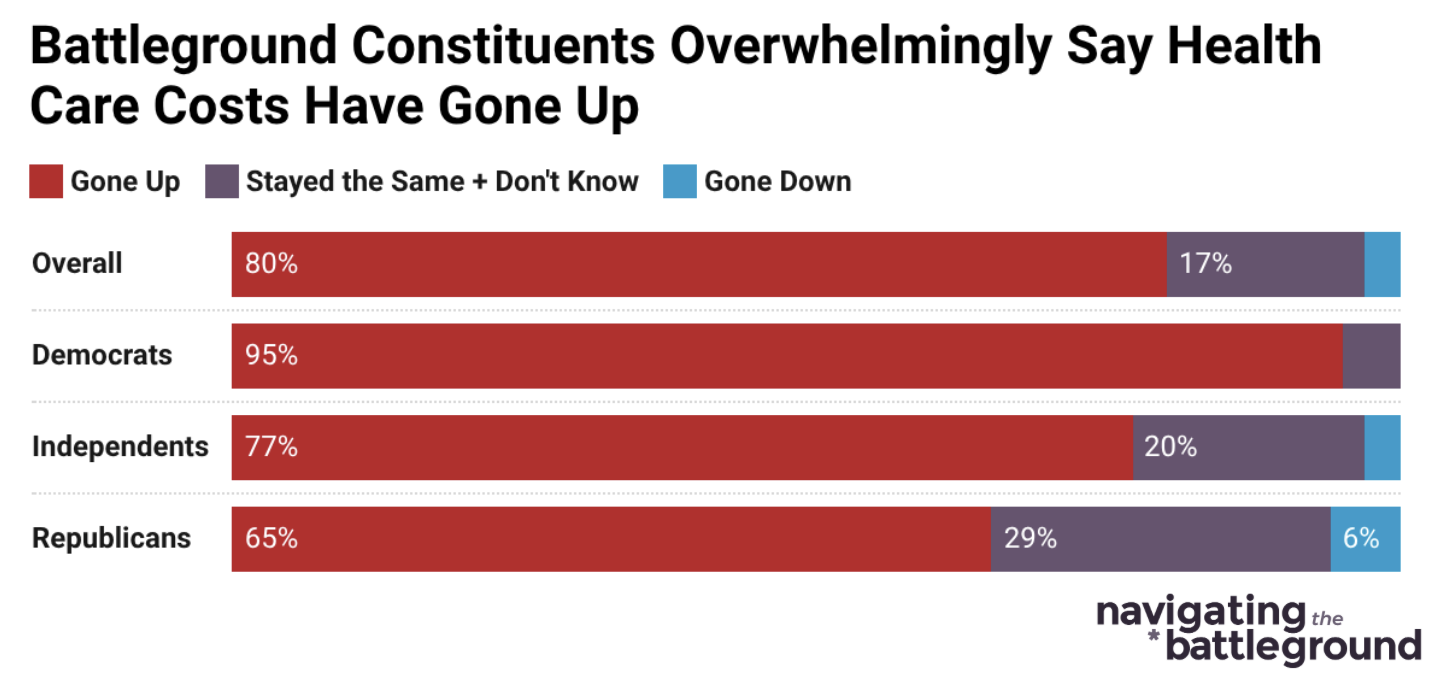
Health care costs are a near-universal concern in battleground districts. Eight-in-10 Americans in battleground districts say their health care costs have gone up (80%) – and most say their costs have gone up “a lot” (57%). Few say their health care costs have stayed the same (12%), and almost no battleground Americans think their health care costs have gone down (3%).
There’s consensus across partisanship that health care costs are going up, including two thirds of battleground Republicans (65%), over nine-in-10 battleground Democrats (95%), and three quarters of battleground independents (77%).
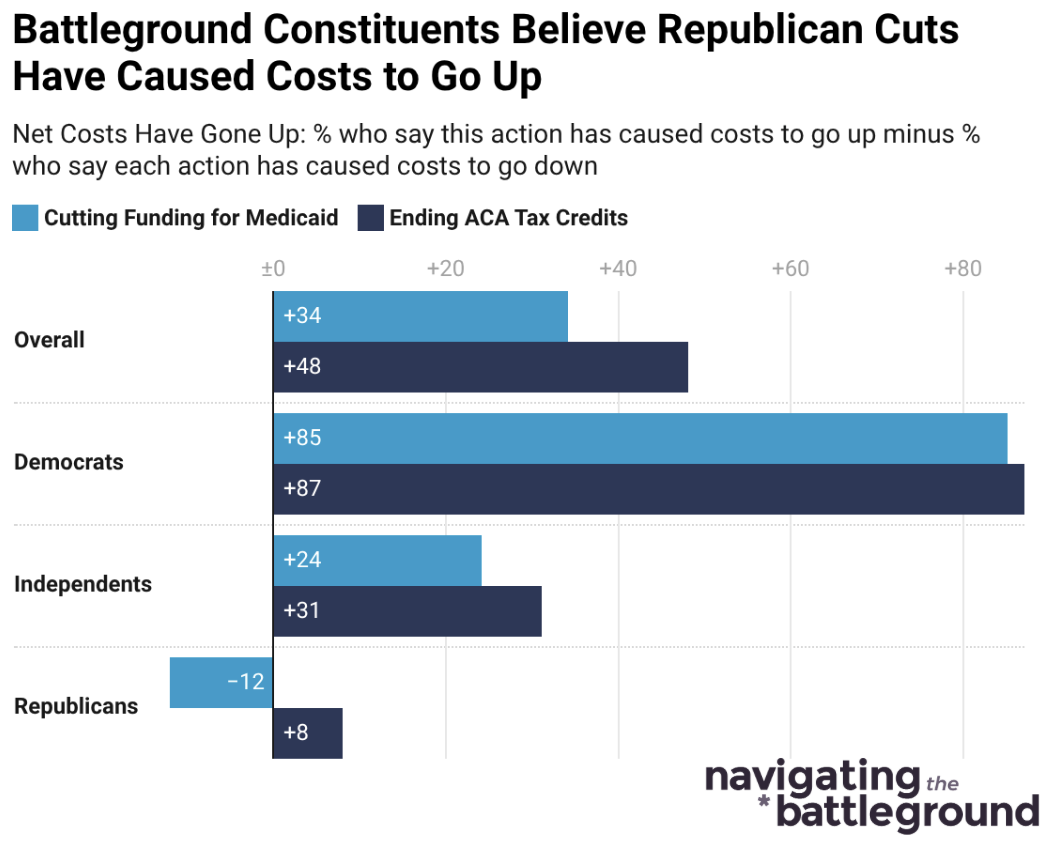
Americans in Battleground Say Republican Health Care Policies Have Raised Costs
Battleground Americans blame Republican health care policies for increased costs. 53% of battleground Americans say Medicaid cuts have caused costs to go up, including four-in-10 who say the cuts have caused costs to go up “a lot” (42%). Likewise, six-in-10 say the end to ACA tax credits has caused costs to go up (60%).
Battleground independents are 24 points more likely to say Medicaid cuts have caused costs to go up than down (46% say this caused costs to go up – 22% say this caused costs to go down), and 31 points more likely to say the same about the ending of ACA tax credits (51% say this caused costs to go up – 20% say this caused costs to go down).
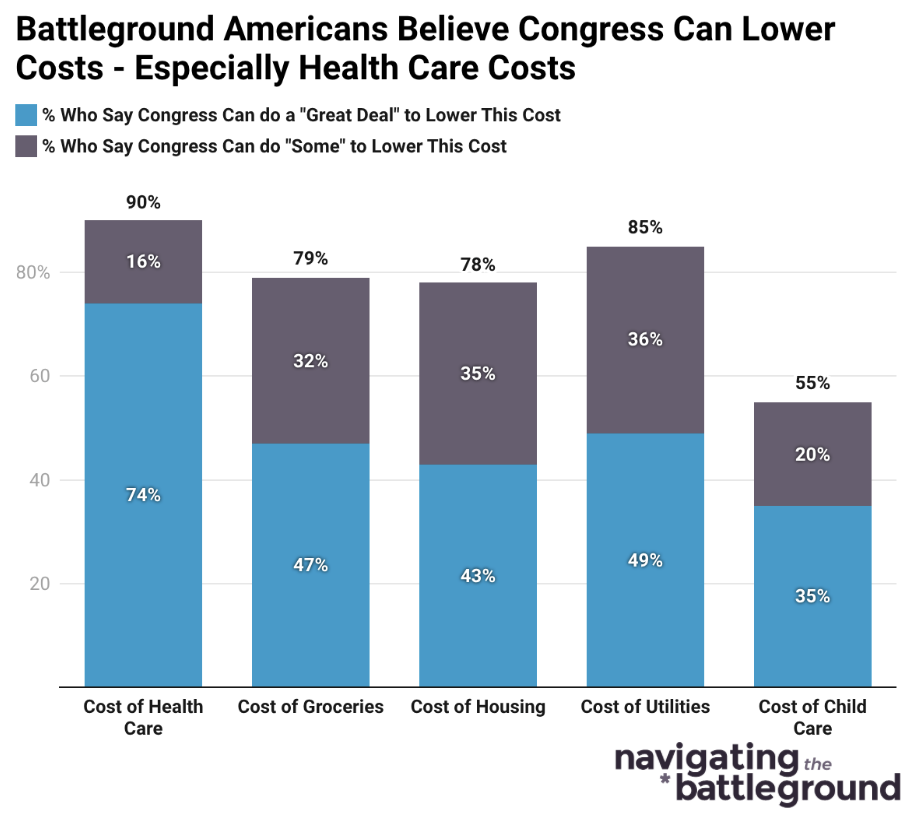
Battleground Americans Believe Congress Can Take Action To Lower Their Health Care Costs
Americans in the battleground overwhelmingly believe that Congress has the power to lower health care costs. Nine-in-10 battleground Americans say Congress can lower health care costs (91%), including nearly three-quarters who say Congress can do a “great deal” to lower these costs (74%). Battleground Americans across partisanships agree that Congress can lower the cost of health care, including 97% of battleground Democrats, 85% of battleground Republicans, and 88% of battleground independents. Of the various cost increases tested, the largest share identify health care as one that Congress can do a “great deal” to lower.
- In addition, a quarter of Americans living in battleground districts say health care is the most important cost for Congress to focus on lowering (23%), while four-in-10 rank it in their top two.
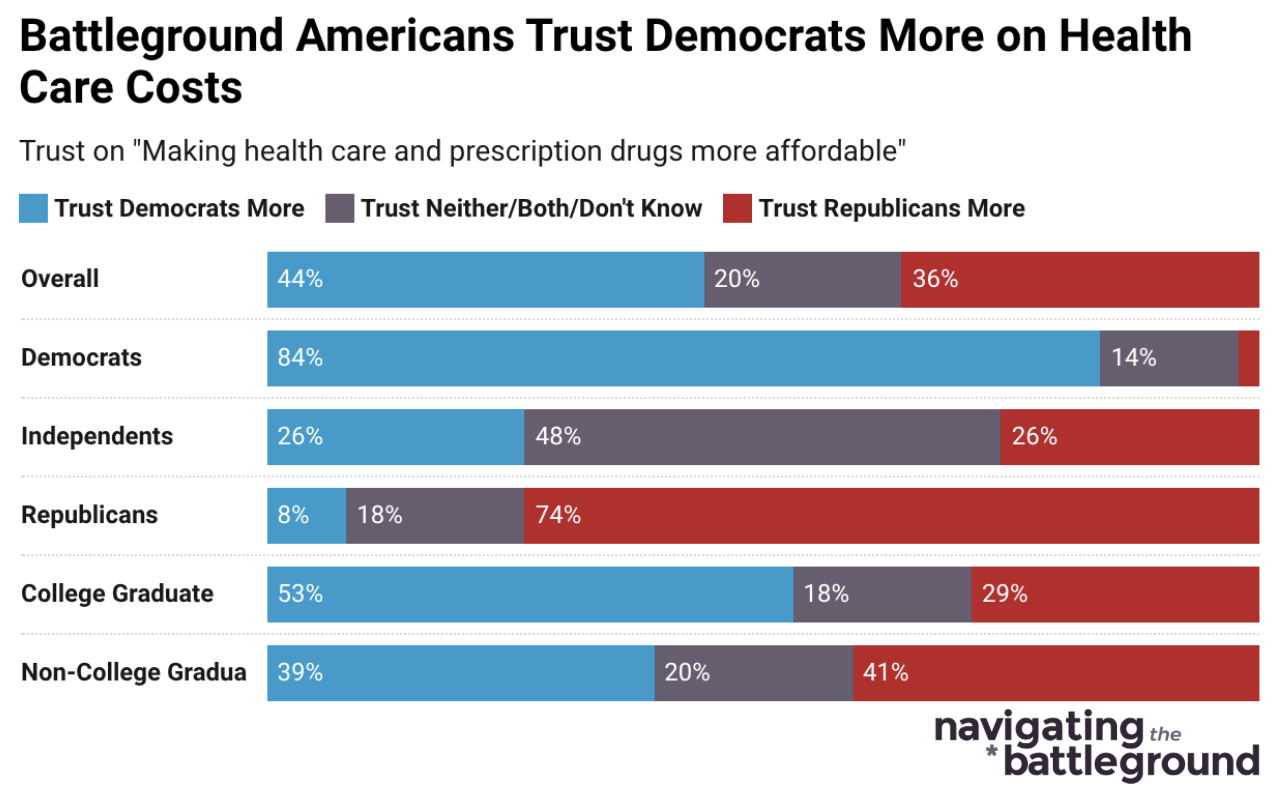
Battleground Americans Trust Congressional Democrats More on Lowering Health Care Costs
People in the battleground are eight points more trusting of Democrats in Congress than Republicans to make health care and prescription drugs more affordable (44% and 36%, respectively). Unsurprisingly, this belief corresponds with partisanship: 84% of battleground Democrats trust Democrats more, while three quarters of battleground Republicans trust Republicans more (74%). Battleground independents are split and pessimistic – while a quarter either trust Democrats or Republicans more (26% each), a plurality say they trust neither party to lower health care costs (41%).
Education level also plays an important role in how battleground Americans view each party on health care. Battleground Americans without a college degree are slightly more trusting of Congressional Republicans than Democrats to lower health care costs (39% trust Democrats more – 41% trust Republicans more), while college-educated Americans in the battleground are 24 points more trusting of Democrats (53% trust Democrats more – 29% trust Republicans more).
Americans Nationally Say They Could Not Support Elected Official Who Makes Cuts to Medicaid and SNAP In Order To Give Tax Breaks To The Wealthy And Corporations
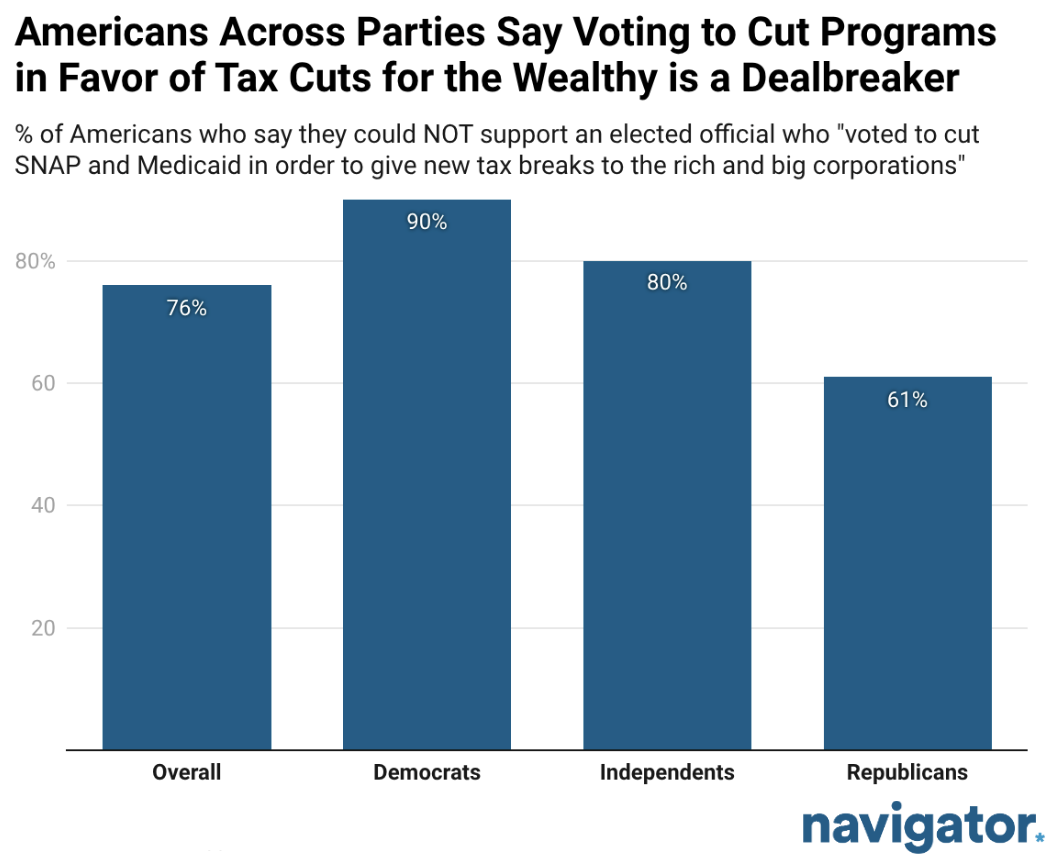
Three-quarters of Americans nationally say they could not support an elected official who voted to cut SNAP and Medicaid to give tax breaks to the rich and big corporations (76%), including 60% who say they could “definitely” not support such an elected official. This belief persists across partisanship, as nine-in-10 Democrats (90%), eight-in-10 independents (80%), and six-in-10 Republicans (61%) all say voting to cut benefits in favor of tax breaks for the wealthy is a dealbreaker.
Likewise, seven-in-10 Americans nationally say they are concerned that “Trump cut programs people depend on, like Medicaid and SNAP, to pay for tax cuts for billionaires and big corporations.” More than half of Americans say they find this “extremely” concerning (56%). Although Republicans are more likely to either say this is not concerning (14%) or that they “don’t believe” this is happening (32%), a plurality four-in-10 Republicans still say they find this concerning (43%). Nine-in-10 Democrats (92%) and eight-in-10 independents (81%) say they are concerned about Trump paying for tax cuts for the wealthy by cutting essential programs.
This contrast message connecting Medicaid and SNAP cuts to tax breaks for billionaires and big corporations was more effective than only highlighting the program cuts (67% said they could not support someone who voted for the largest Medicaid cut in history; 73% said they could not support someone who voted to cut SNAP and Medicaid in order to give new tax breaks to the rich and big corporations).
Read More
About The Study
Global Strategy Group conducted a public opinion survey among a sample of 1,000 registered voters from February 19-February 22, 2026. 101 additional interviews were conducted among Hispanic voters. 99 additional interviews were conducted among African American voters. 75 additional interviews were conducted among Asian American and Pacific Islander voters. 100 additional interviews were conducted among independent voters. The survey was conducted online, recruiting respondents from an opt-in online panel vendor. Respondents were verified against a voter file and special care was taken to ensure the demographic composition of our sample matched that of the national registered voter population across a variety of demographic variables. The margin of error for the full sample at the 95 percent level of confidence is +/- 3.1 percentage points. The margin of error for subgroups varies and is higher.