Poll: SAVE Act
This Navigator Research report covers the latest views of the SAVE Act, including which messages against the SAVE Act and voter identification laws are most effective.
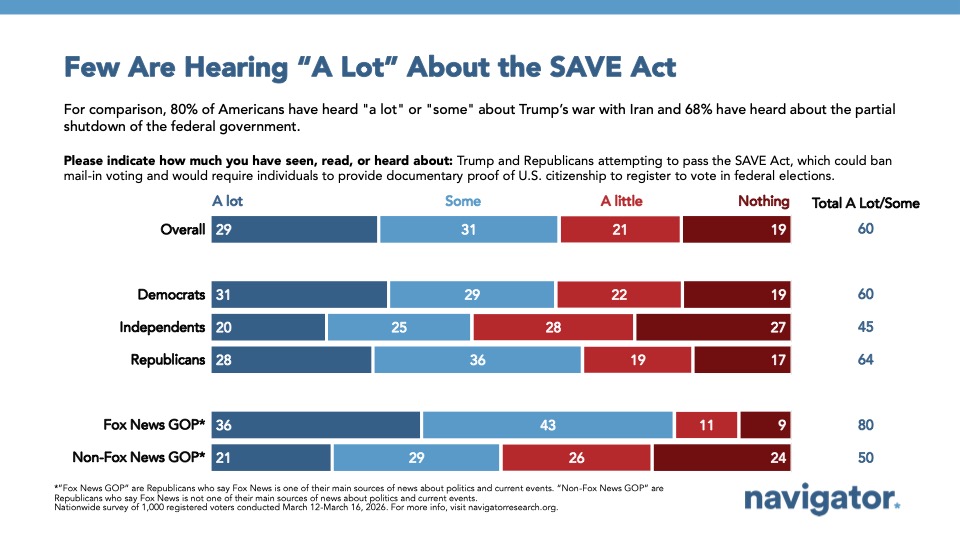
Republicans, Especially Those Who Watch Fox, Are More Likely To Be Aware of the SAVE Act than Democrats and Independents
Six-in-10 Americans are hearing at least some about President Trump and Republicans in Congress attempting to pass the SAVE Act (60%), including 29% who are hearing “a lot.” Republicans are more likely to have heard about the SAVE Act (64%), than Democrats or independents (60% and 45%, respectively). Notably, awareness of Trump and Congressional Republicans’ attempt to pass the SAVE Act is significantly higher among Republicans who say they watch Fox News (80%), compared to Republicans who say they don’t watch Fox News (50%).
Awareness of the SAVE Act is lower among groups that have the potential to be most affected:
- Women are 14 points less likely than men to be aware of the SAVE Act (women: 53%, men: 67%). Women under the age of 55 are even less likely to have heard about the SAVE Act (46%).
- Rural Americans are six points less likely to have heard about the SAVE Act than urban Americans (urban: 62%, suburban: 61%, rural: 56%).
- Americans earning less than $50,000 a year are 16 points less likely to have heard about the SAVE Act compared to Americans earning more than $100,000 ($50k: 52%, $100k+: 68%).
Messages Focused on Misplaced Priorities and Barriers to Voting are Convincing in Increasing Opposition to the SAVE Act
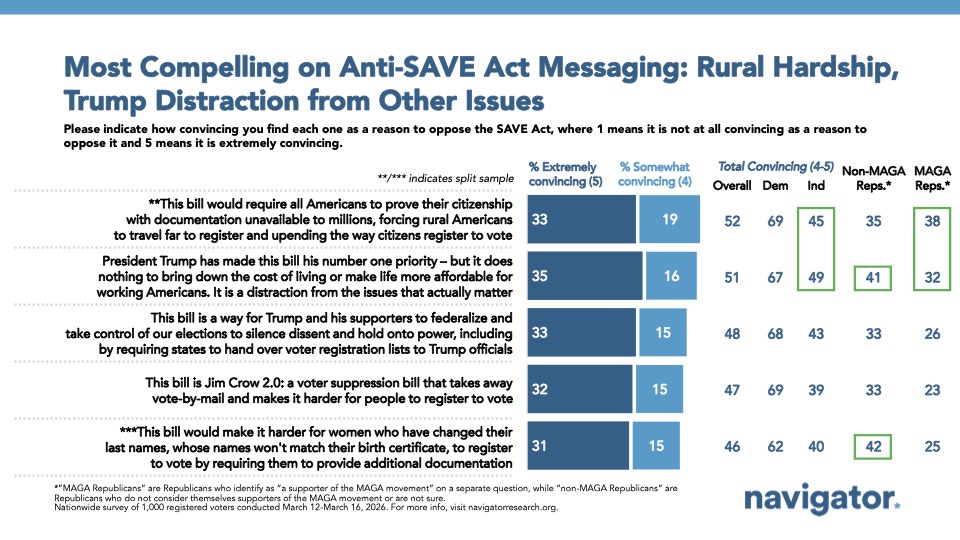
The most effective messages opposing the SAVE Act focus on Trump and Congressional Republicans focusing their efforts on taking away voting access rather than bringing down costs and the additional barriers to voting the act would pose to millions of Americans.
- President Trump has made this bill his number one priority – but it does nothing to bring down the cost of living or make life more affordable for working Americans. It is a distraction from the issues that actually matter. (51% convincing, 35% “extremely” convincing).
- This bill would require all Americans to prove their citizenship with documentation unavailable to millions, forcing rural Americans to travel far to register and upending the way citizens register to vote. (52% convincing, 33% “extremely” convincing).
Support Shift
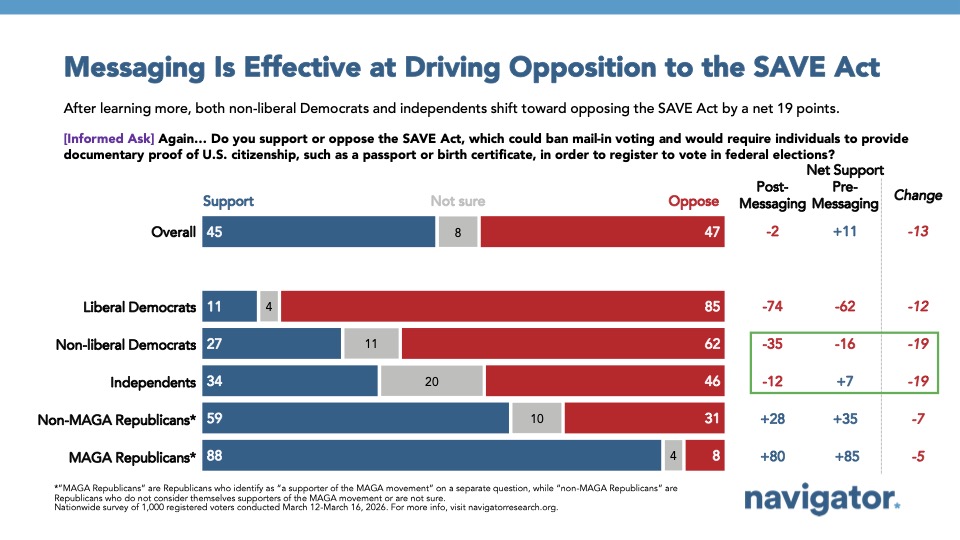
Before reading a series of messages opposing the SAVE Act, Americans support the act by 11 points (50% support – 39% oppose), including independents by seven points (42% support – 35% oppose). After reading a series of messages opposing the SAVE Act, Americans oppose the act by two points (45% support – 47% oppose), underwater among independents by 12 points (34% support – 46% oppose).
SAVE Act Dos and Don’ts