

Healthcare Costs Are Major Stressor
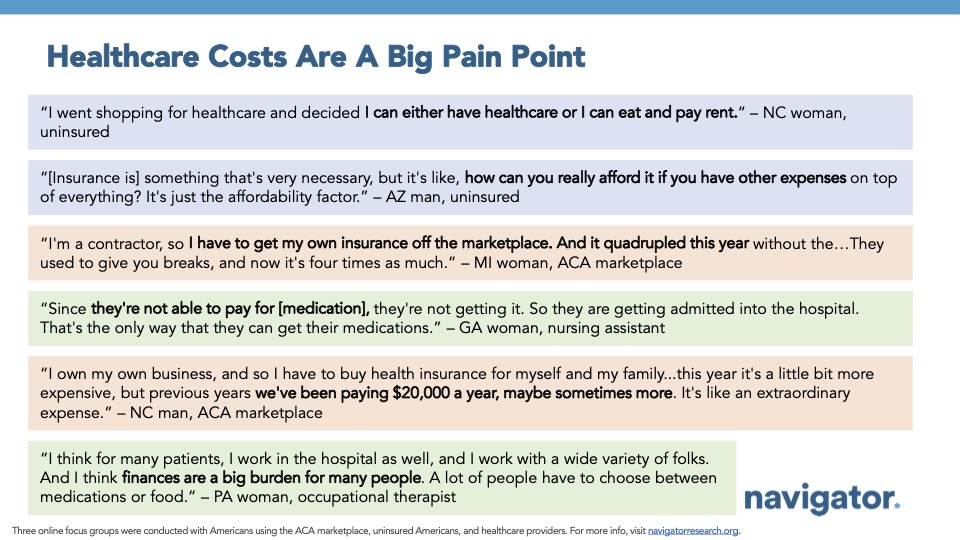
Participants cited healthcare costs as a major financial stressor in their lives, with many saying costs have increased to such an extent they have to choose between healthcare and other necessities.
- “I went shopping for healthcare and decided I can either have healthcare or I can eat and pay rent.” – NC woman, uninsured
- “I’m a contractor, so I have to get my own insurance off the marketplace. And it quadrupled this year…They used to give you breaks, and now it’s four times as much.” – MI woman, ACA marketplace
Many Attribute Increase in Costs to Republican Budget Bill
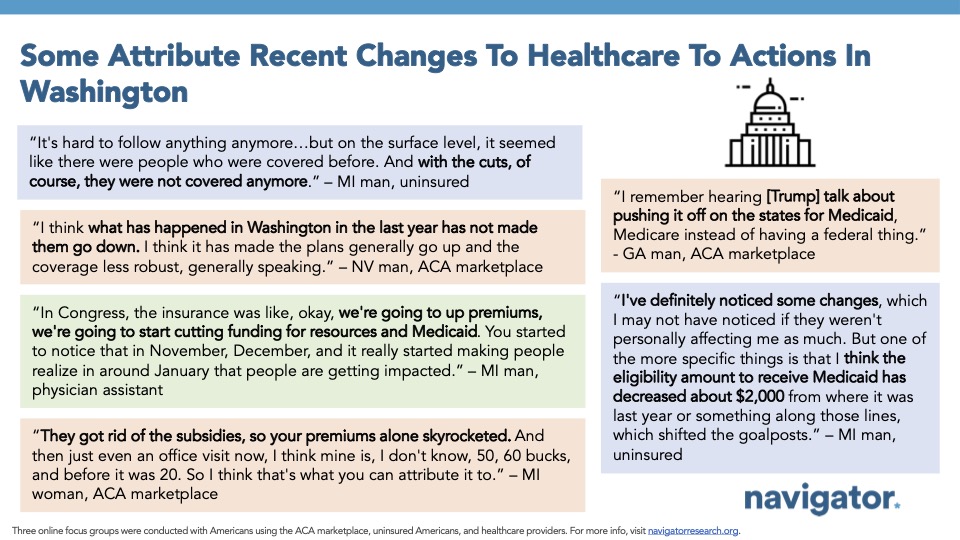
Without priming, some participants organically brought up the Republican tax law, also known as the One Big Beautiful Bill Act, as a culprit for their most recent rise in healthcare costs.
- “They got rid of the subsidies, so your premiums alone skyrocketed. And then just even an office visit now, I think mine is, I don’t know, 50, 60 bucks, and before it was 20. So I think that’s what you can attribute it to.” – MI woman, ACA marketplace
- “I think what has happened in Washington in the last year has not made them go down. I think it has made the plans generally go up and the coverage less robust, generally speaking.” – NV man, ACA marketplace
Most Say they Avoid Going to the Doctor
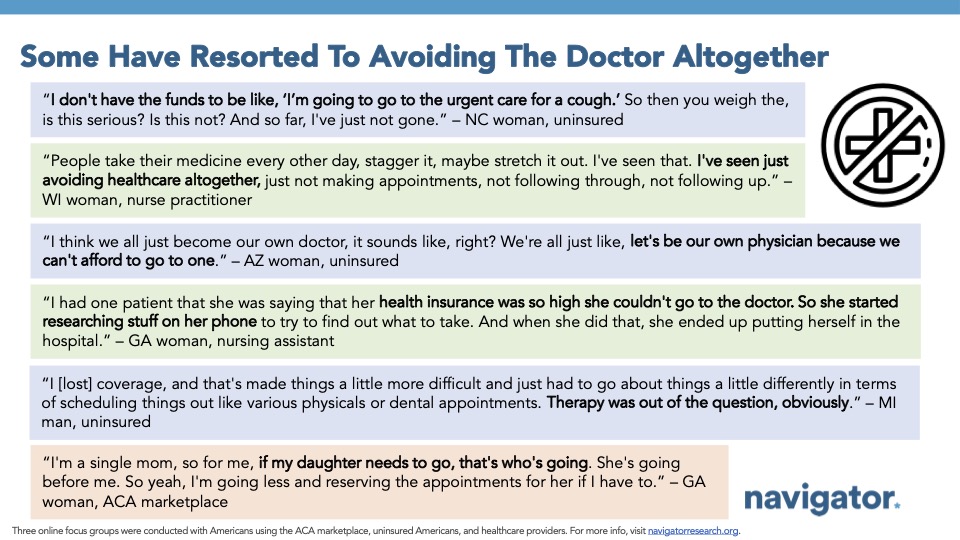
Avoiding doctor visits is a primary strategy for saving on healthcare costs, with many saying something catastrophic would have to occur for them to seek medical care.
- “I’m a single mom, so for me, if my daughter needs to go, that’s who’s going. She’s going before me. So yeah, I’m going less and reserving the appointments for her if I have to.” – GA woman, ACA subsidies
- “I don’t have the funds to be like, ‘I’m going to go to the urgent care for a cough.’ So then you weigh the, is this serious? Is this not? And so far, I’ve just not gone.” – NC woman, uninsured
Participants Cite Range of Strategies for Avoiding Health Care System Altogether
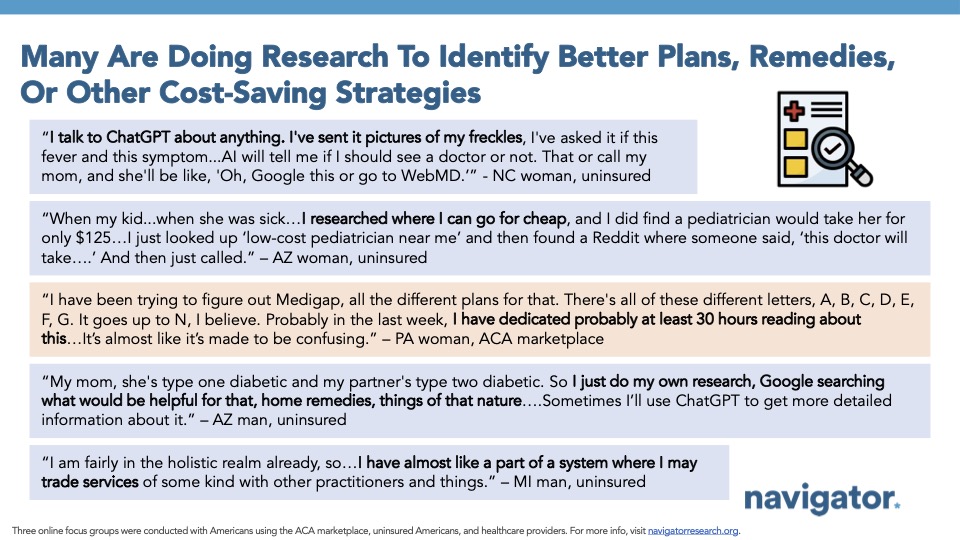
From AI to holistic remedies to spending hours on research, participants have found ways to cope with their lack of access to affordable healthcare options.
- “I talk to ChatGPT about anything. I’ve sent it pictures of my freckles, I’ve asked it if this fever and this symptom…AI will tell me if I should see a doctor or not. That or call my mom, and she’ll be like, ‘Oh, Google this or go to WebMD.'” – NC woman, uninsured
- “I have been trying to figure out Medigap, all the different plans for that. There’s all of these different letters, A, B, C, D, E, F, G. It goes up to N, I believe. Probably in the last week, I have dedicated probably at least 30 hours reading about this…It’s almost like it’s made to be confusing.” – PA woman, ACA marketplace
Insurance Companies Seen as Obvious Villain
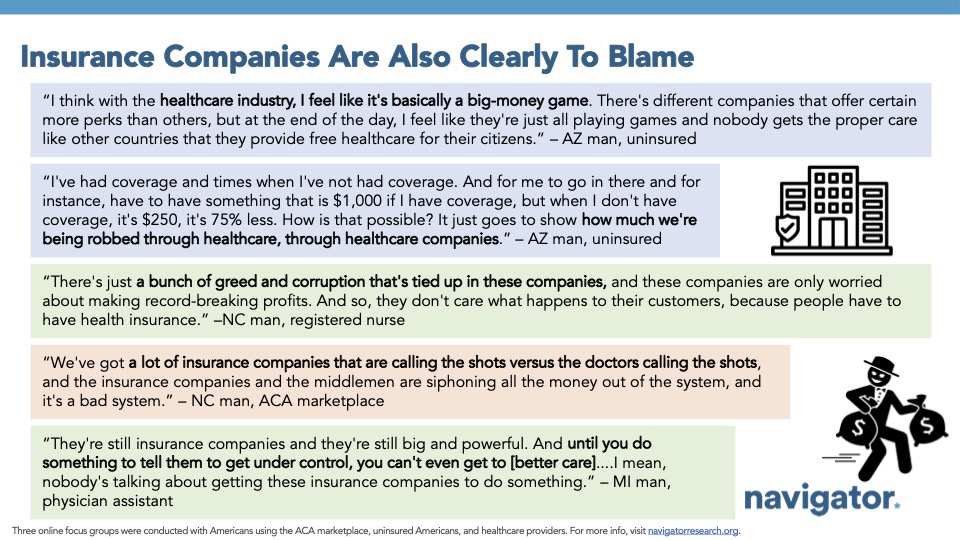
Though the Republican tax law is seen as responsible for recent hikes in healthcare costs, insurance companies are seen as the real villains of a broken healthcare system.
- “I’ve had coverage and times when I’ve not had coverage. And for me to go in there and for instance, have to have something that is $1,000 if I have coverage, but when I don’t have coverage, it’s $250, it’s 75% less. How is that possible? It just goes to show how much we’re being robbed through healthcare, through healthcare companies.” – AZ man, uninsured
- “We’ve got a lot of insurance companies that are calling the shots versus the doctors calling the shots, and the insurance companies and the middlemen are siphoning all the money out of the system, and it’s a bad system.” – NC man, ACA marketplace
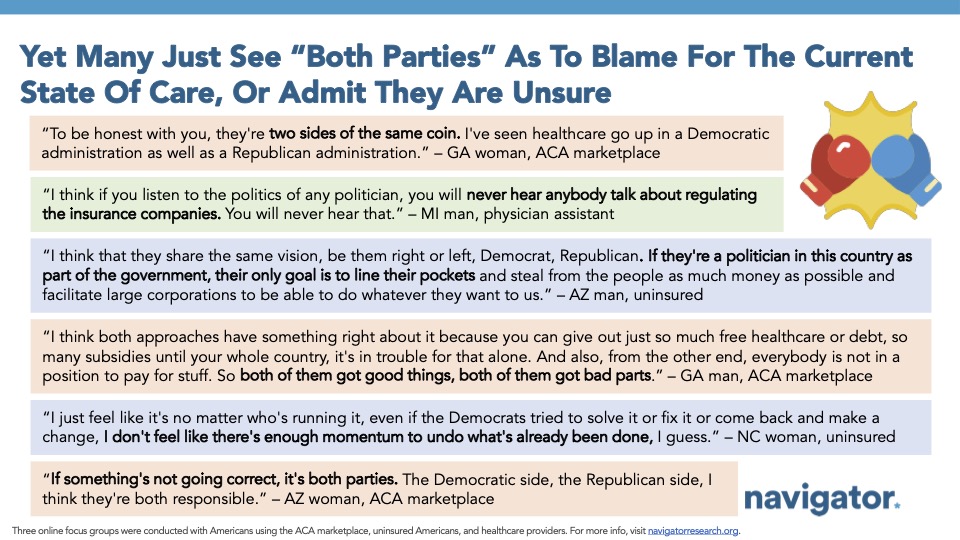
Neither Party Seen as Fighting to Fix Healthcare
Participants expressed feeling like nobody in Washington is fighting for them – no matter the political party. Many felt hopeless that either party could solve the deep-rooted issues within the U.S. healthcare system because many politicians are perceived as beholden to corporate or donor interests instead of helping everyday people.
- “I just feel like it’s no matter who’s running it, even if the Democrats tried to solve it or fix it or come back and make a change, I don’t feel like there’s enough momentum to undo what’s already been done, I guess.” – NC woman, uninsured
- “I think that they share the same vision, be them right or left, Democrat, Republican. If they’re a politician in this country as part of the government, their only goal is to line their pockets and steal from the people as much money as possible and facilitate large corporations to be able to do whatever they want to us.” – AZ man, uninsured
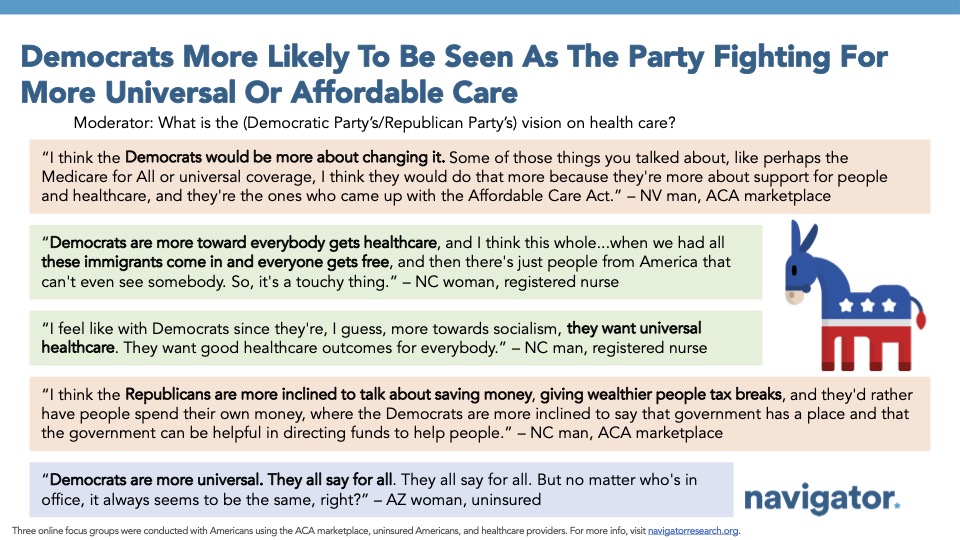
Democrats Seen as More Likely to Fix the Healthcare System
Participants associated affordable and universal healthcare plans with Democrats, saying it’s more aligned with their platform. Skepticism remained on Democrats’ ability to execute healthcare plans.
- “I think the Democrats would be more about changing it. Some of those things you talked about, like perhaps the Medicare for All or universal coverage, I think they would do that more because they’re more about support for people and healthcare, and they’re the ones who came up with the Affordable Care Act.” – NV man, ACA marketplace
- “Democrats are more universal. They all say for all.They all say for all. But no matter who’s in office, it always seems to be the same, right?” – AZ woman, uninsured
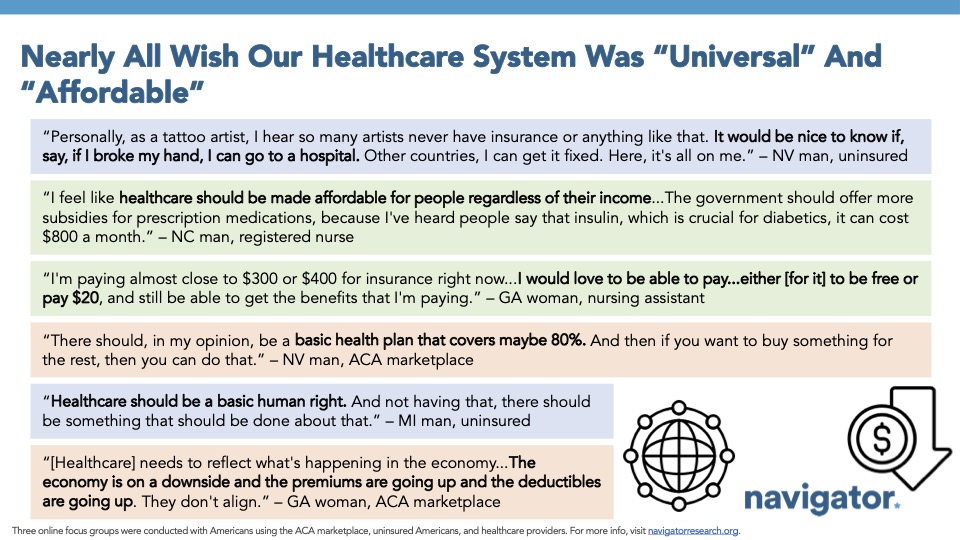
Participants Say Change is Needed, Universal Healthcare Seen as Obvious Solution
Nearly every participant said they wished healthcare was universal – which carried a range of definitions across participants – but boiled down to a basic healthcare plan that all Americans could afford no matter their job or income level.
- “There should, in my opinion, be a basic health plan that covers maybe 80%. And then if you want to buy something for the rest, then you can do that.” – NV man, ACA marketplace
- “Healthcare should be a basic human right. And not having that, there should be something that should be done about that.” – MI man, uninsured
- “Personally, as a tattoo artist, I hear so many artists never have insurance or anything like that. It would be nice to know if, say, if I broke my hand, I can go to a hospital. Other countries, I can get it fixed. Here, it’s all on me.” – NV man, uninsured
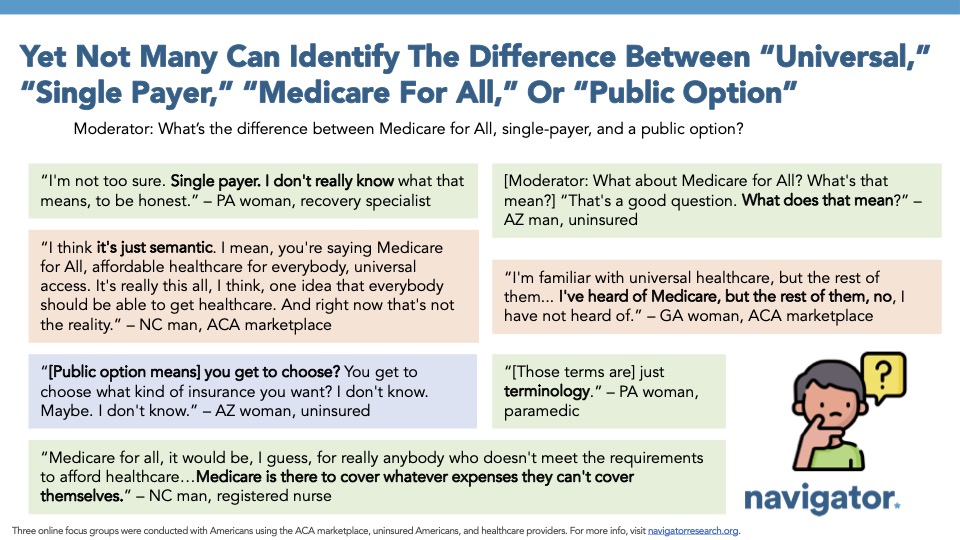
Participants Don’t Know the Difference Between “Universal,” “Single Payer,” “Medicare for All” or “Public Option”
Though some form of universal healthcare was seen as a solution to fixing the healthcare system, few could define “universal,” “single payer,” “Medicare for all,” and “public option.” Communicators need to keep this in mind, while Washington may be debating what is the best branding for this fight, Americans are concerned about access and cost of healthcare.
- “I’m familiar with universal healthcare, but the rest of them…I’ve heard of Medicare, but the rest of them, no, I have not heard of.” – GA woman, ACA marketplace
- [Moderator: What about Medicare for All? What’s that mean?] “That’s a good question. What does that mean?” – AZ man, uninsured
Part 1 of this report covers the first two groups: those insured through the ACA marketplace and those who are uninsured. Part 2 will summarize the findings from our patient-facing healthcare provider group.