

Three-in-Five Americans are Confident in the Security of Voting by Mail
Earlier this week, the Supreme Court lifted one of the two court orders blocking the implementation of key parts of an executive order attempting to restrict mail-in voting. Ahead of this ruling, three-in-five (60%) of Americans remain confident that voting by mail is safe and secure.
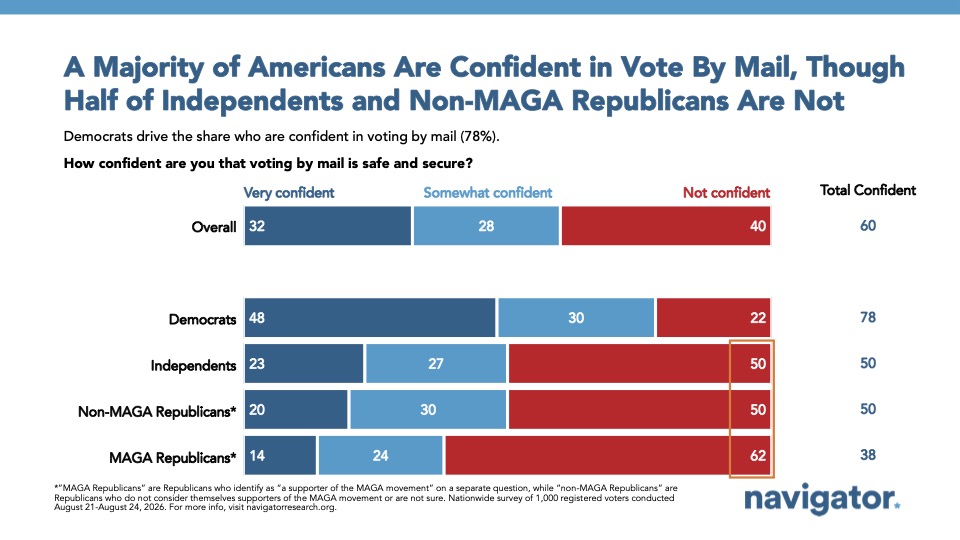
Democrats are especially confident in the security of mail-in voting (78%), while independents and non-MAGA Republicans are evenly split (50%). MAGA Republicans are especially distrustful of voting by mail, with only 38% confident that the process is safe and secure.
Notably, nearly half (48%) of Americans are both not very confident in voting by mail, but also not ideologically entrenched in the MAGA Republican faction – this provides a valuable mail voting audience for messaging, which includes independent women, non-MAGA Republicans, Black, and Gen Z Americans.
Americans Disapprove of the Supreme Court Making Changes That Could Delay or Complicate Mail-In Voting
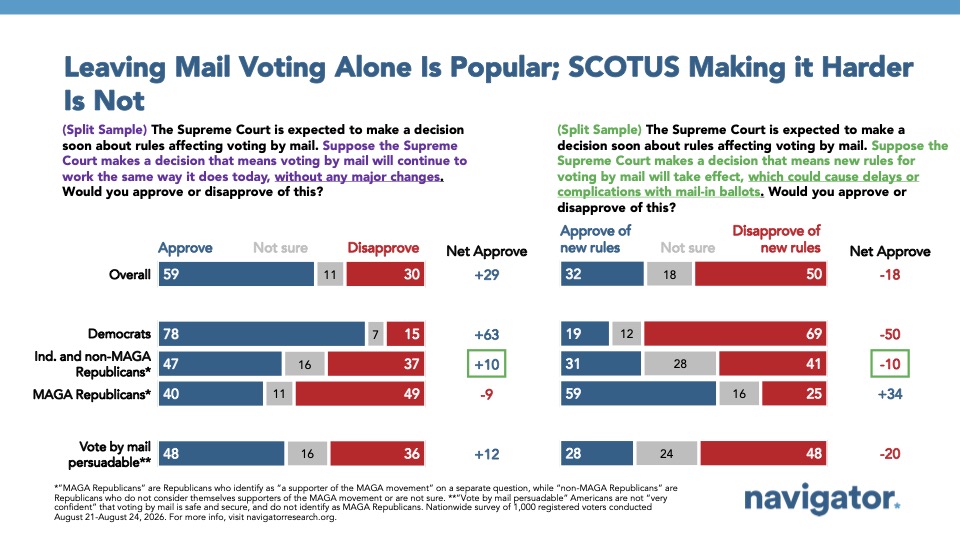
Nearly three-in-five (59%) approve of the vote by mail process continuing as usual without any major changes (including 33% strongly approve), while less than a third (32%) of Americans approve of the Supreme Court making a decision that could cause delays or complications with mail-in ballots. About two-in-five (41%) of independents and non-MAGA Republicans disapprove of the Supreme Court making changes that could complicate mail-in voting. Notably, MAGA Republicans are the only group that would disapprove of the Supreme Court keeping voting by mail as is (40% approve of keeping vote by mail as is, 49% disapprove) and changing the rules (59% approve of new rules that could cause delays or complications, 25% disapprove).
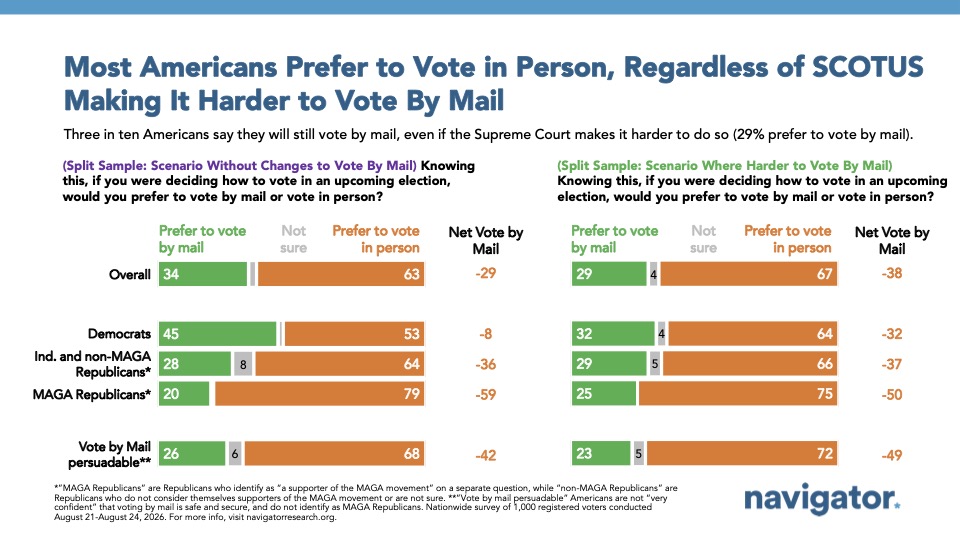
Regardless of changes by the Supreme Court, Americans prefer to vote in person over vote by mail. However, knowing that it may be harder to vote by mail following the SCOTUS decision, Americans are slightly (5 points) less likely to use mail-in ballots (29%) compared to if vote by mail stayed the same (34%). Three-in-10 say they will continue to vote by mail, including nearly two-in-five who strongly prefer to vote by mail, indicating that while the decision may dampen, it will not completely deter mail-in voting.
Most Effective Guidance on Mail-In Voting Centers Importance of Making a Plan and Voting Early
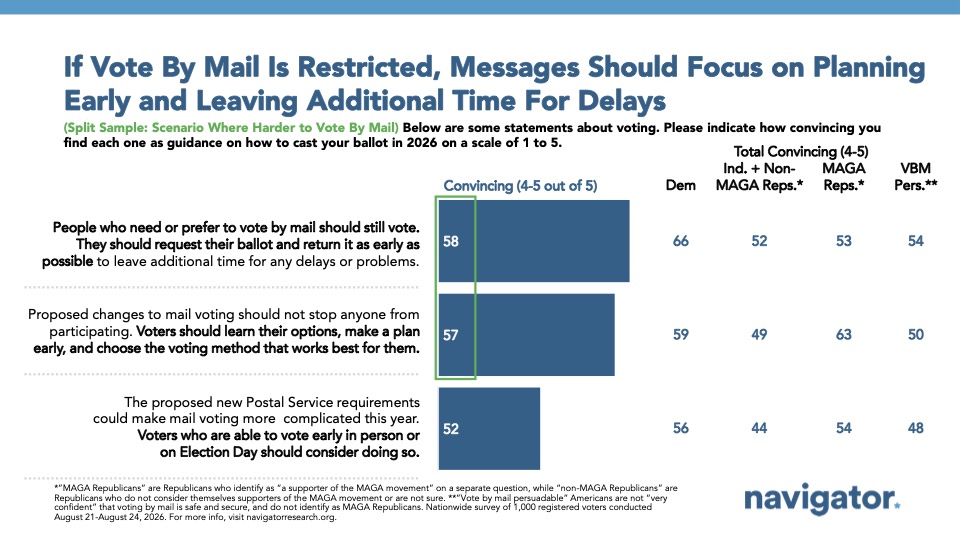
If vote by mail is restricted by the Supreme Court, the most convincing guidance on how to cast a ballot focuses on planning and voting early.
- 57% found a statement on learning about different options to vote and making a plan to be convincing, including half (50%) of vote by mail persuadables, and 59% of Democrats.
- 58% found a statement on how those who need to prefer to vote by mail, should request and return their ballots as early as possible to avoid delays to be convincing, including 54% of vote by mail persuadables and two-in-three (66%) Democrats.
While emphasizing the potential changes in mail-in voting and pivoting to voting in person on Election Day was effective (52%), it trailed behind the more impactful message of planning early and leaving additional time for delays.
Attacking Mail-In Voting is Fundamentally a Mismatch in Priorities for Americans
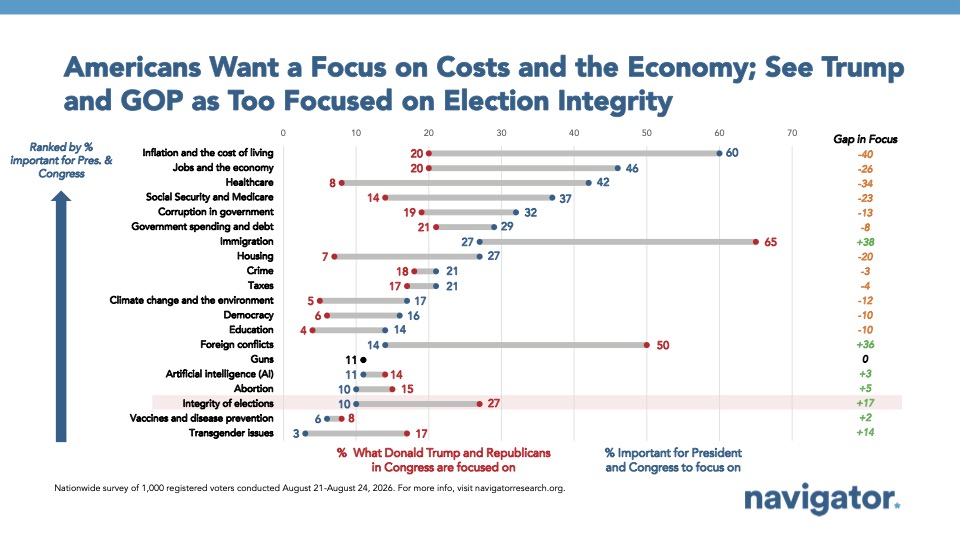
Only 10% of Americans want the President and Congress to focus on issues of election integrity, and the vast majority want to see a focus on inflation and the cost of living (60%). However, Americans view election integrity as the third top issue that President Trump and Republicans in Congress are focused on, demonstrating yet again that this latest attack on vote by mail is another mismatch in priorities away from what the American people want and need.
You can find additional polling from Navigator Research on election security here and here.