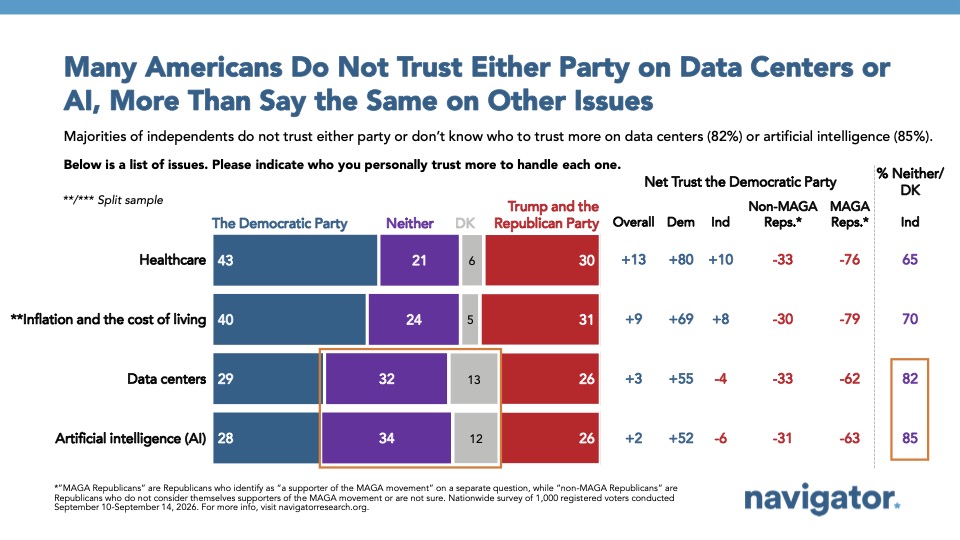

AI Has Grown as a Policy Priority, But Lags Behind Kitchen Table Issues
Less than one-in-five Americans (16%) name artificial intelligence as a policy priority for the president and Congress, up from just 7% in December. While it has increased, AI still lags behind the issues Americans care about most: inflation and the cost of living (60%), jobs and the economy (44%), and healthcare (38%). More Americans (19%) say President Trump and Republicans in Congress are focused on AI, compared to just 13% who say the same about Democrats in Congress.
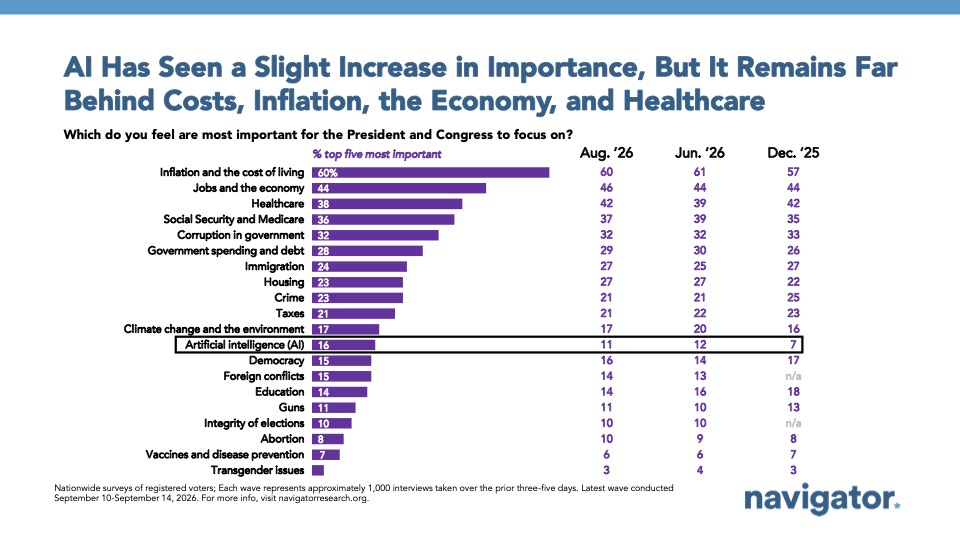
Favorability of AI Has Fallen Since December
Net favorability of AI has fallen 17 points from +8 (49% favorable – 41% unfavorable) in December to -9 today (42% favorable – 51% unfavorable). A slight majority (51%) view AI unfavorably, including 29% who view it very unfavorably. However, 42% view the technology favorably, including 13% who view it very favorably. There are significant divides:
- While a majority of men under 55 view AI favorably (58% favorable – 37% unfavorable), a majority of women under 55 view it unfavorably (36% favorable – 55% unfavorable);
- People under 55 are warmer to AI (47% favorable – 46% unfavorable) than people 55 and up (36% favorable – 56% unfavorable);
- Half of Trump 2024 voters view AI favorably (50% favorable – 44% unfavorable) while a majority of Harris voters view it unfavorably (39% favorable – 59% unfavorable);
- Midwesterners and Southerners (where data center construction is most concentrated) have the most unfavorable view of AI when it comes to regionality (Midwest: 39% favorable – 55% unfavorable, South: 42% favorable – 51% unfavorable);
- Similarly, rural Americans (where data center construction is also occurring at high levels) view AI more unfavorably (37% favorable – 55% unfavorable) than those in urban (47% favorable – 45% unfavorable) and suburban (42% favorable – 51% unfavorable) residents.
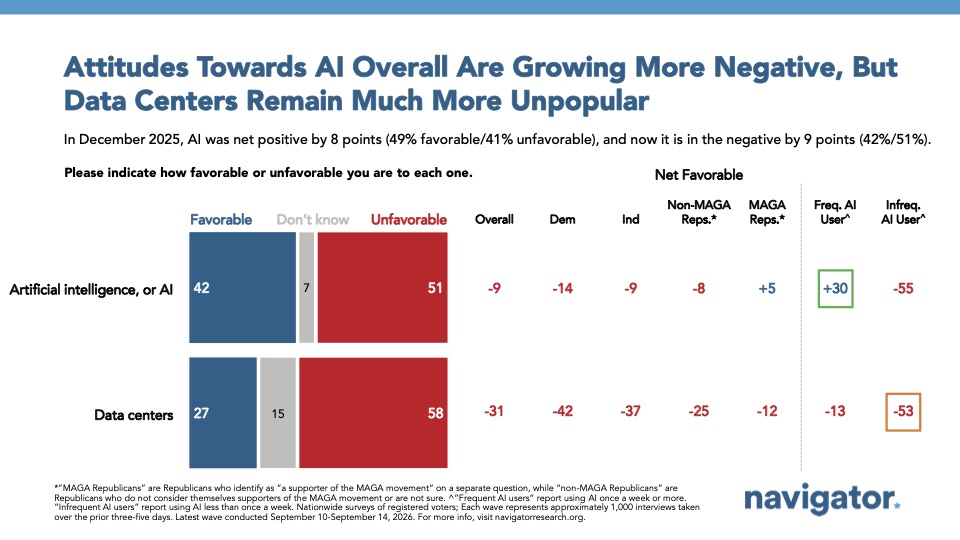
A Majority Use AI Frequently, Especially Younger, Wealthier Americans
A majority of Americans use artificial intelligence (AI) tools at least once a week (55%), including nearly one-in-five (19%) who say they use it several times a day. Among those who report using AI most frequently:
- Americans between 18 and 34 (75% use at least once a week, 23% use several times a day),
- Americans making more than $100,000 annually (67% use at least once a week, 29% use several times a day),
- Black Americans (67% use at least once a week, 28% use several times a day),
- Hispanic Americans (64% use at least once a week, 25% use several times a day), and
- Men with college educations (62% use at least once a week, 29% use several times a day).
Data Centers are Unpopular and Most Oppose Construction of Data Centers in Their Communities, a Large Shift Since December
Data centers are even more unpopular than AI, with three-in-five (58%) viewing them unfavorably, including 38% who view them very unfavorably. Even across party lines, a majority of Republicans (53%) and half of MAGA Republicans (50%) view them unfavorably. Data centers are particularly unpopular among:
- Independents (19% favorable – 56% unfavorable),
- Women (20% favorable – 57% unfavorable),
- Rural Americans (24% favorable – 62% unfavorable), and
- Americans making less than $50,000 annually (22% favorable – 61% unfavorable).
Nearly three-in-five Americans (58%) say they would not support the building of a data center in their local community. This includes a majority of Democrats, independents, and Republicans (63%, 56%, and 53%, respectively). Those most opposed to data center construction include:
- Women (24% support – 60% oppose),
- Americans 55 and up (26% support – 63% oppose),
- Americans in the Midwest (30% support – 62% oppose),
- Americans making less than $50,000 annually (26% support – 60% oppose), and
- Passive news consumers (24% support – 60% oppose).
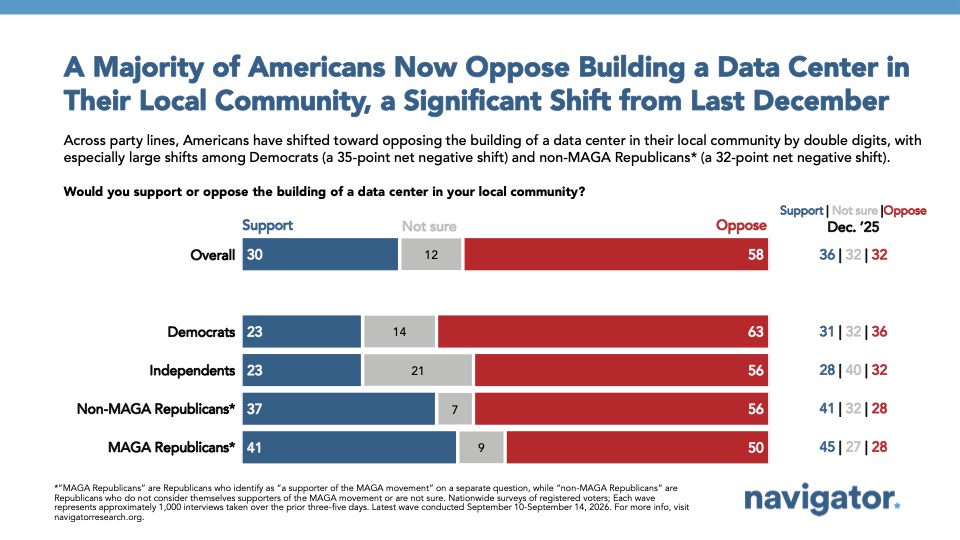
When Navigator asked this in December, less than a third (32%) said they were opposed. The share of those who say they are “strongly opposed” to the construction of a data center in their community has doubled from 17% in December to 36% today.
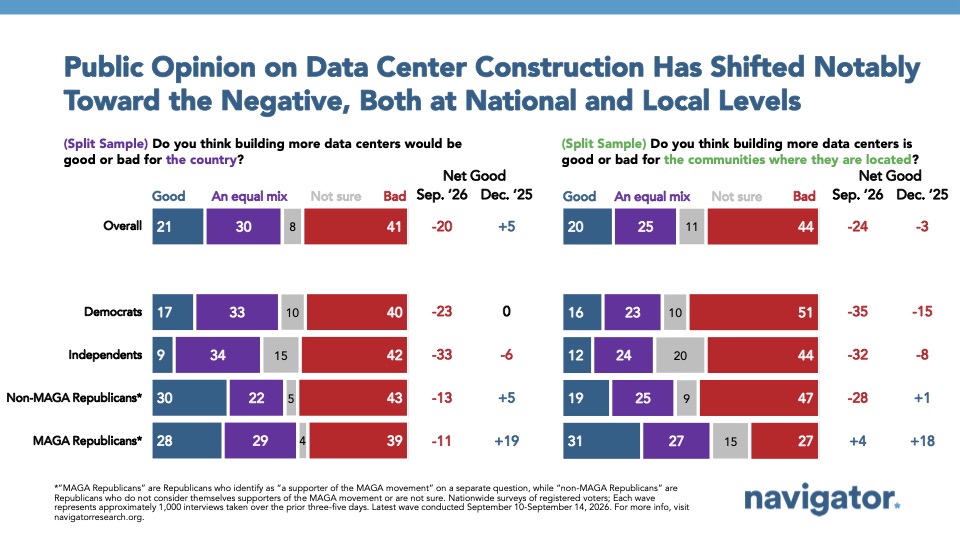
Similarly, the share of those who say data centers are bad for the country has doubled from 18% in December to 41% today. And the share of those who say data centers are bad for the communities they’re established in has grown from 25% in December to 44% today.
Americans Oppose Unfettered Data Center Construction Amid Concerns About The Impact on Energy Costs and Water Usage
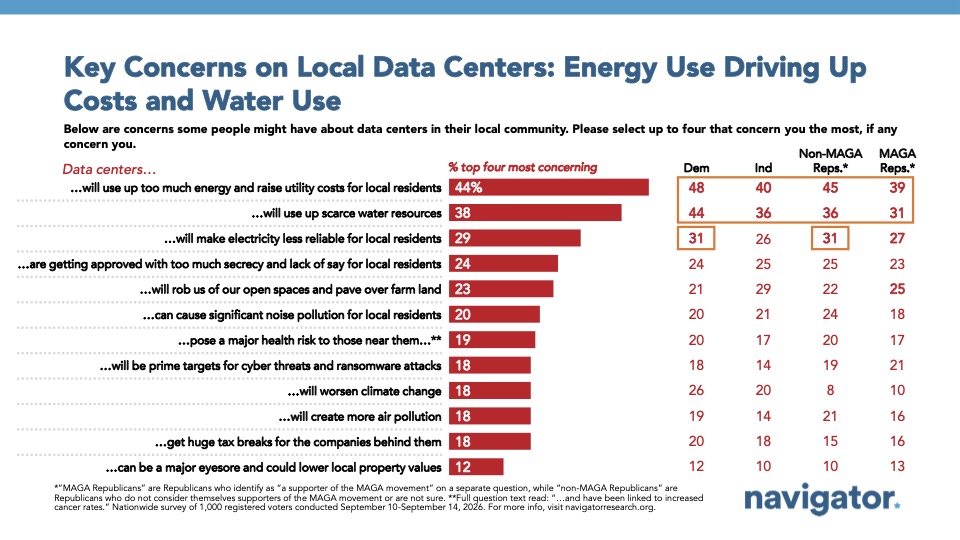
The biggest concern Americans have about data centers is increasing costs: that they will use too much energy and raise utility costs (44%). The other top concern is that data centers will use up scarce water resources (38%). It’s a large gap between those concerns and others about making electricity less reliable (29%) and that they are getting approved with too much secrecy and lack of say for local residents (24%).
Nearly three-in-five independents (29%) are concerned that data centers will rob them of open spaces and farmland. And 20% of Republicans are concerned that data centers may make America more vulnerable to cyber attacks.
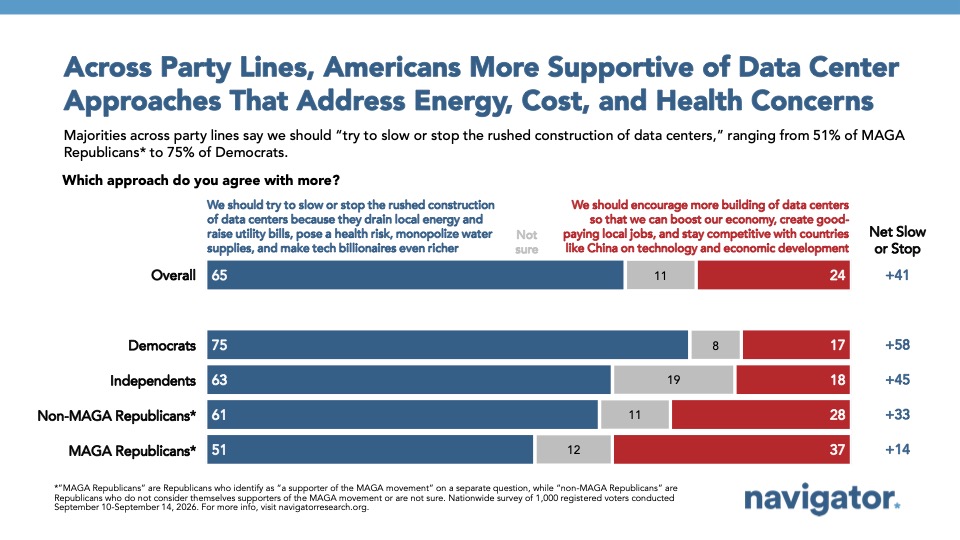
Amid these concerns, Americans have a deep desire to see data centers regulated, if not halted. Nearly two-thirds (65%), including 63% of independents and 56% of Republicans, say that the U.S. should halt or slow the construction of data centers while only 24% say the U.S. should encourage more construction of data centers.
Most Oppose the Way Trump Has Handled Data Centers, But Many Don’t Trust Either Party on AI or Data Centers
54% disapprove of the way President Trump has handled data centers. In recent weeks, Trump has referred to opposition to their construction as a “hoax” and has referred to those pushing back on data center construction as “backwards and poor.”
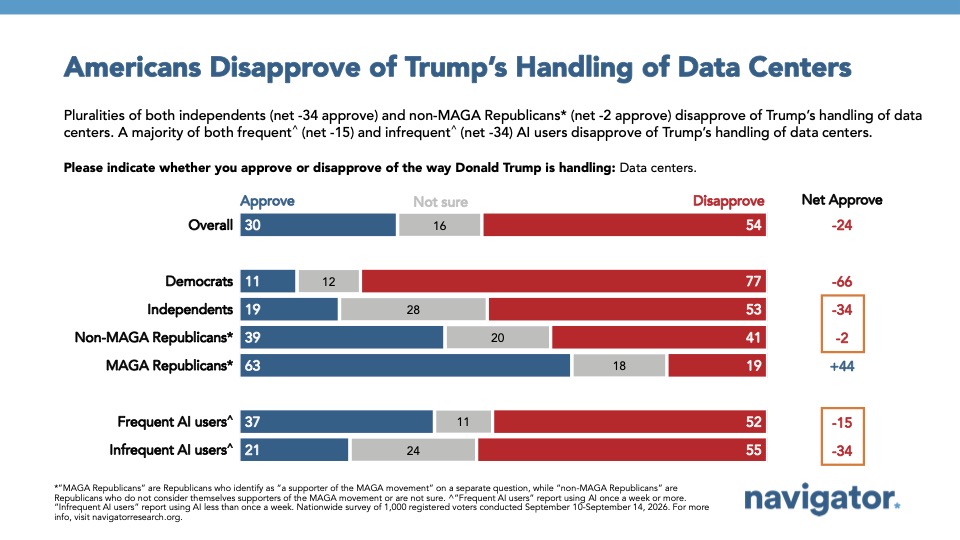
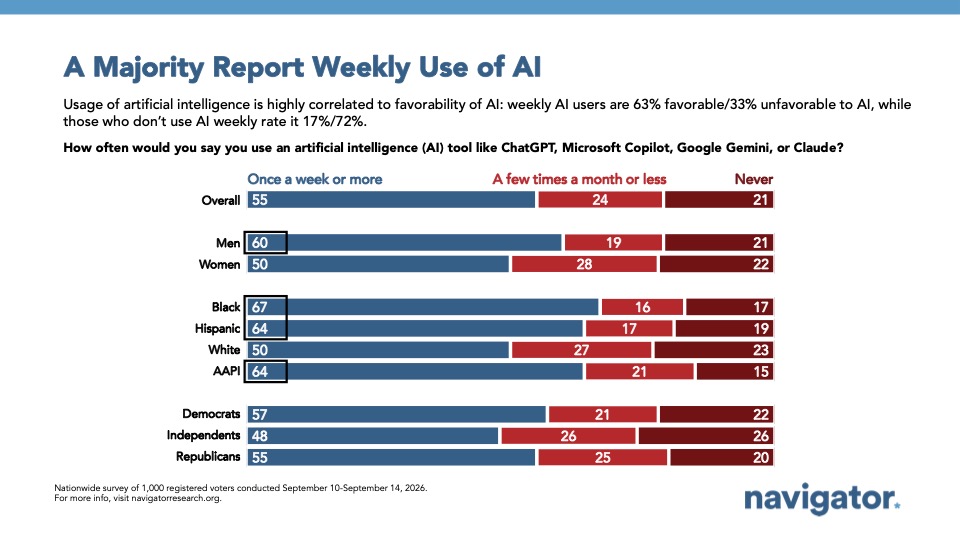
Americans’ distaste for Trump’s handling of data centers doesn’t translate into support for Democrats in Congress on the issue. A plurality (32%) trust neither Democrats nor Republicans on data centers. Similarly, 34% trust neither Democrats nor Republicans on AI.