Americans Have Nuanced Views of Political and Ideological Identity
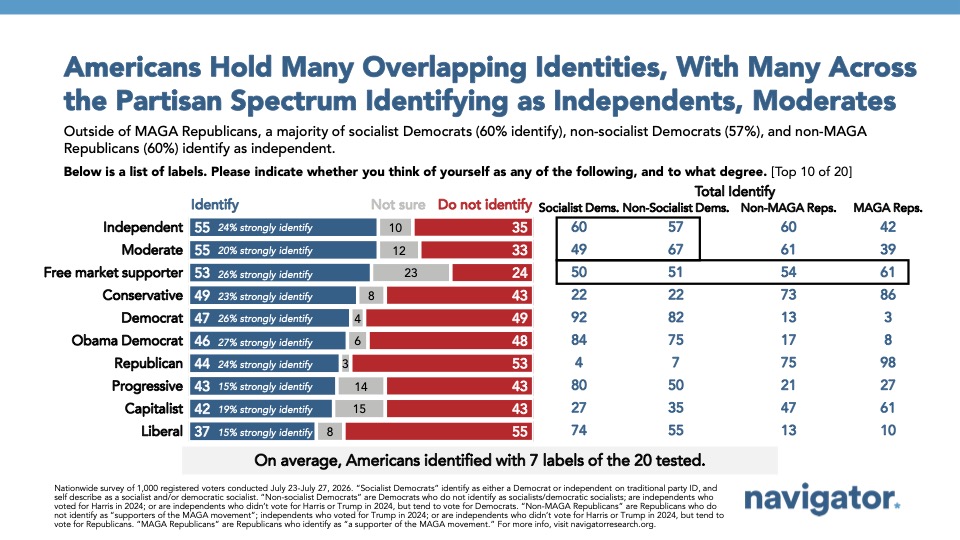
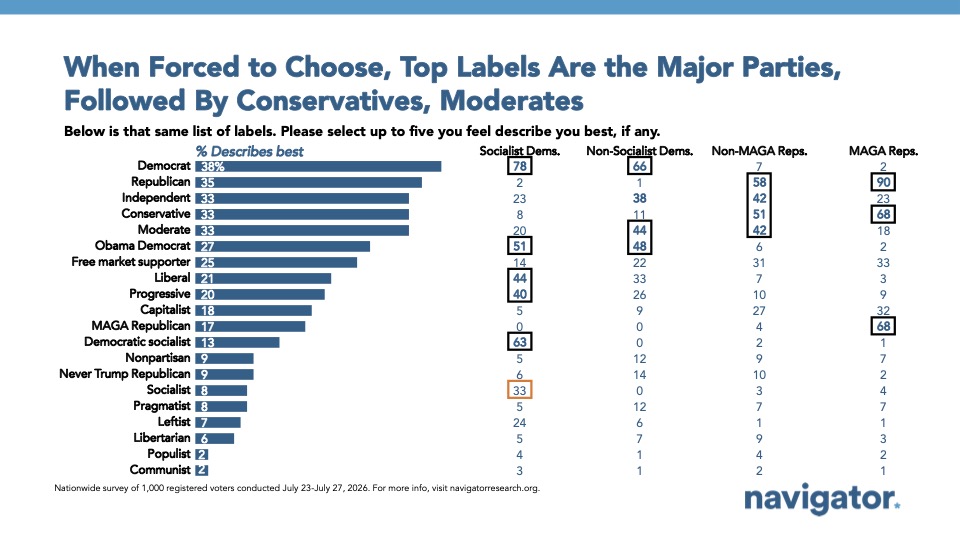
In our latest survey, Americans were asked how strongly – if at all – they identified with each of 20 labels: on average, Americans identified with seven of the 20 labels tested, suggesting a continued heterodoxy among Americans ideologically and politically. More than either political party or any other label tested, many Americans are self-identifying as independent (55%) or moderate (55%).
- 64% of those between the ages of 18 and 34 identify as independent
- 62% of Gen Z Americans identify as independent
- 60% of people with blue-collar jobs identify as independent
- 60% of men under 55 identify as independent
- 55% of those who do not have college degrees identify as independent, as well as 55% of those who hold college degrees
An outsized share of these groups identify as moderate:
- 61% of those 55 and up identify as moderate
- 60% of Black Americans identify as moderate
- 60% of baby boomers and Gen X Americans identify as moderate
- 60% of those with college degrees identify as moderate
Fewer Americans think of themselves as Democrats (47%) or Republicans (44%).
Many Americans Have Overlapping Identities
Republicans who identify as supporters of the MAGA movement (MAGA Republicans) are older, are more likely to have blue-collar jobs, and own their homes, while Democrats or independents who identify as either socialists or Democratic socialists (Socialist Democrats) are largely younger, more likely to have white-collar jobs, and rent their homes.
- Socialist Democrats skew younger, with 57% of them being between the ages of 18 and 44, while 48% of MAGA Republicans are aged 55 and up.
- A plurality of Socialist Democrats have white-collar jobs (36%), while a plurality (34%) of MAGA Republicans have blue-collar jobs.
- Both groups are majority white, however MAGA Republicans more so (86% of MAGA Republicans, 64% of Social Democrats). 26% and 17% of Socialist Democrats are Black and Latino, respectively.
- A majority of MAGA Republicans are homeowners (55%), while a plurality of Social Democrats rent their homes (48%).
Self-identified democratic socialists do not see socialism as being mutually exclusive and continue to identify with other terms on the left, including more mainstream Democratic labels. Of Socialist Democrats, 92% consider themselves to also be Democrats, 84% consider themselves to also be Obama Democrats, and 80% consider themselves to also be progressive.
Factions Within the Party are Less Popular Than the Parties Themselves
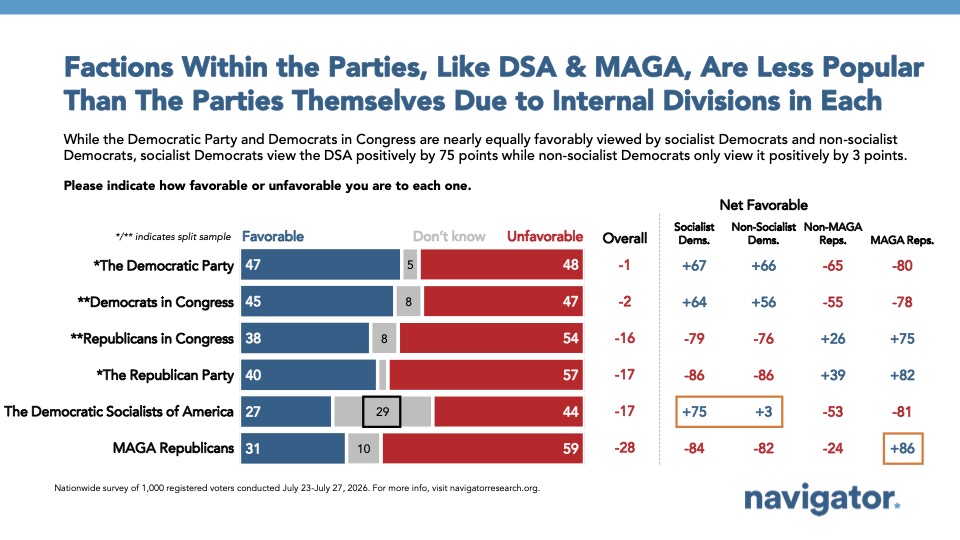
The Democratic Party holds an edge on favorability (net -1 favorable) over the Republican Party (net -17 favorable). The same is true for Democrats in Congress (net -2 favorable) over Republicans in Congress (net -16 favorable). Majorities are unfavorable towards MAGA Republicans (net -28 favorable, 31% favorable – 59% unfavorable), while a plurality view Democratic Socialists of America unfavorably (-17 net favorable, 27% favorable – 44% unfavorable). However, nearly a third (29%) of Americans have yet to make up their minds about the Democratic Socialists of America.
Republicans Are Divided On The Role of President Trump and Direction of the Country
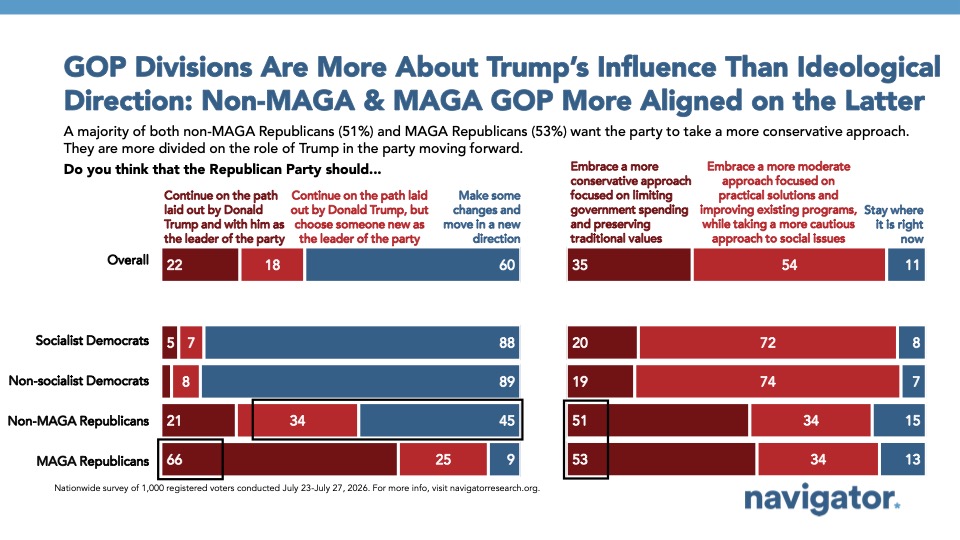
Many in the Republican Party are divided on the role of Trump moving forward. As costs rise and the Iran war continues, Americans’ support for Trump as the face of the Republican Party is declining. Less than a quarter of Americans (22%) want to continue with Trump as the leader of the Republican party, down 6 points from January 2024. And this isn’t just non-Republicans: more than one in three non-MAGA Republicans say they would like to continue on the path laid out by Trump, but with someone new in charge (34%), with another 45% saying they would like to see the party make changes and move in a new direction.
Calls for the Republican Party to move in a different direction come from a majority of Americans (60%), including three-quarters of independents (75%), more than one-third of non-MAGA Republicans (39%) and almost one in every 10 MAGA Republicans (9%). In tandem with growing disapproval of Trump, the MAGA movement’s popularity is suffering too (59% unfavorable), with unfavorable numbers up 10 points since Trump took office in January 2025. Americans’ are unfavorable to MAGA and overwhelmingly agree that MAGA Republicans have an outsized impact on GOP leadership (80% agree).
For Supporters of Socialism Within the Democratic Party, the Main Appeals are Affordable Healthcare and Tackling Corporate Greed
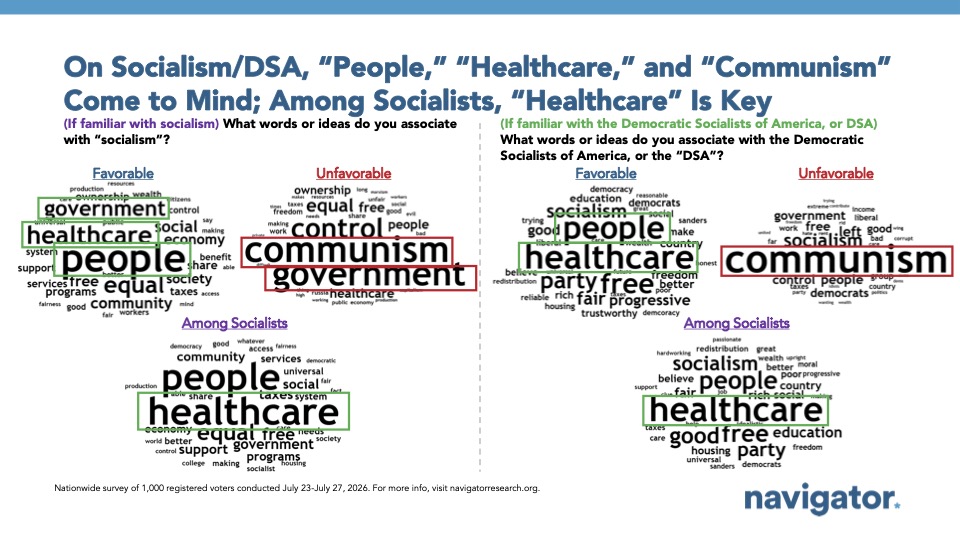
Among those familiar with and favorable to socialism, healthcare is top of mind, while for those unfavorable, communism comes to mind.
The greatest appeals of democratic socialism among those who view the Democratic Socialists of America, socialism, and/or democratic socialists favorably are its calls to take on big corporations (54%), provide comprehensive healthcare (47%), and reform the broken system (44%).
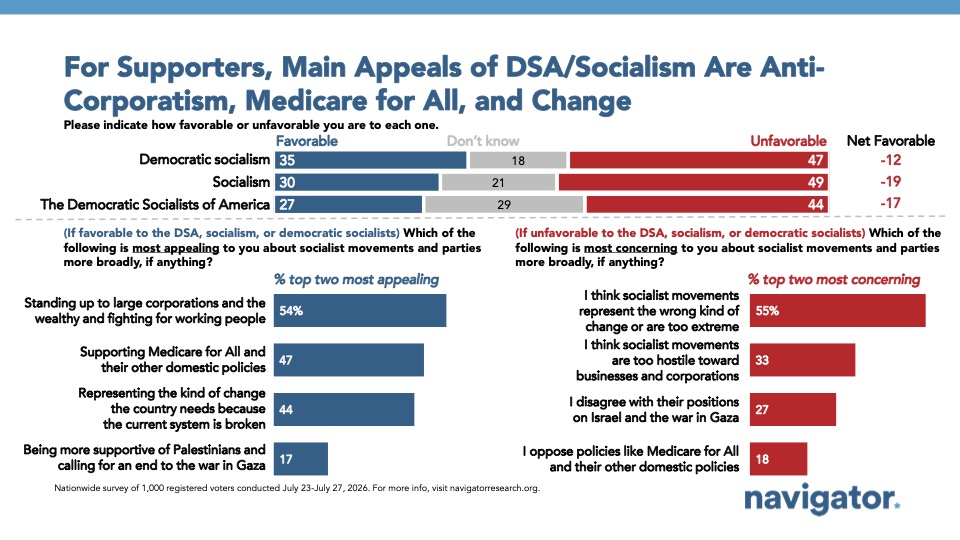
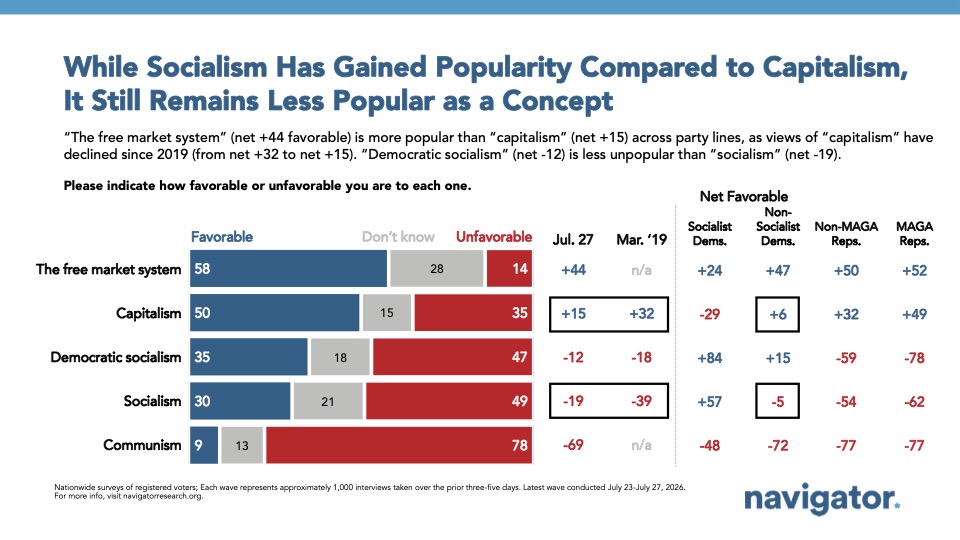
Despite greater shares of Americans self-identifying with more left-leaning labels, almost half of Americans overall view democratic socialism unfavorably (47%). Since 2019, net favorability of socialism has increased by 20 points (-39 in 2019 to -19 today). However, a plurality (49%) still view socialism negatively.