

Americans Don’t Want Regime Change Wars

March 2, 2026
Melissa Toufanian

This Navigator Research report covers Americans’ views on using military force, regime change wars, and military strikes against Iran.

Big Takeaways:

More than three quarters (77%) of Americans, including eight-in-ten independents, say the U.S. should be cautious about using military force abroad, especially when it comes to regime change wars, and instead focus our time and money on priorities at home.

Prior to the recent U.S. military operation, only about one-third of Americans (34%) said they supported a military strike against Iran.

Poll: Foreign Policy

This Navigator Research report covers Americans’ views on using military force, regime change wars, and military strikes against Iran.

Americans Oppose Regime Change Wars

More than three quarters (77%) of Americans, including eight-in-ten independents, say the U.S. should be cautious about using military force abroad, especially when it comes to regime change wars, and instead focus our time and money on priorities at home. 

Only 28% said the U.S. should be willing to use its military power abroad, including to topple dictators when necessary, to strengthen U.S. influence and finances. Opposition to using the U.S. military against foreign countries, especially for regime change wars, is high across partisanship, with 88% of Democrats, 83% of independents, and 64% of Republicans opposed. Even a majority (55%) of MAGA Republicans say they are opposed to regime change wars. 

Overall, opposition has increased since January when we last asked a similar question question. At that time, 72% of Americans favored a cautious approach to using U.S. military force abroad — a five-point shift in just over a month.
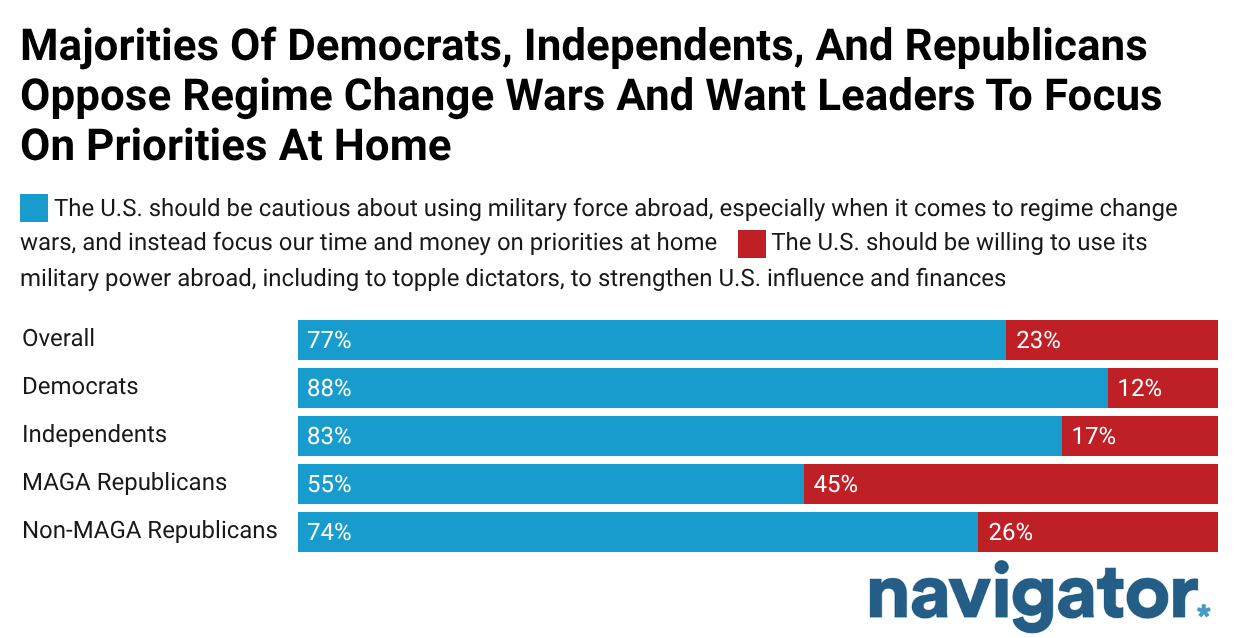
20260302 Majorities Of Democrats, Independents, And Republicans Oppose Regime Change Wars And Want Leaders To Focus On Priorities At Home: A Stacked Line Graph From Navigator Research Titled: Majorities Of Democrats, Independents, And Republicans Oppose Regime Change Wars And Want Leaders To Focus On Priorities At Home

Before Strikes Were Launched, Plurality of Americans Were Opposed 

Nearly half of Americans (48%) said they opposed a U.S. military strike against Iran prior to the Trump administration’s decision to carry out coordinated strikes with Israel that resulted in the death of Iran’s Supreme Leader, Ayatollah Khamenei. When asked, nearly one-in-five Americans (19%) were unsure if they support or oppose a military strike. 
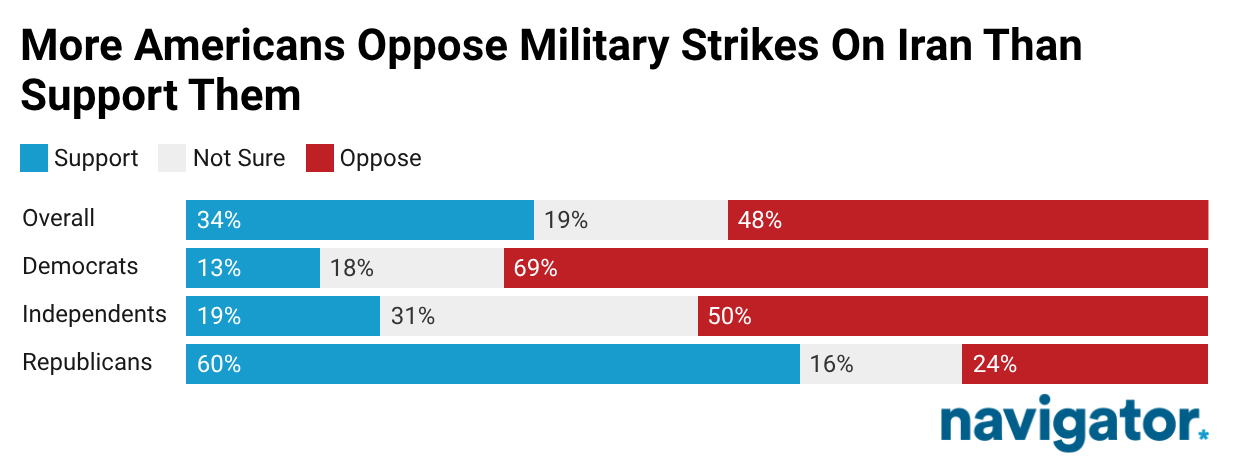
20260302 More Americans Oppose Military Strikes On Iran Than Support Them: A Stacked Line Graph From Navigator Research Titled: More Americans Oppose Military Strikes On Iran Than Support Them

Trump Focused on the Wrong Priorities

Even before the U.S. military strikes against Iran this weekend, an overwhelming majority of Americans said Trump and Republicans in Congress are most focused on immigration (73%) and foreign conflicts (47%) while they want elected leaders to prioritize lowering inflation and the cost of living (63%). Only one-in-four Americans think Trump and Republicans in Congress are focused on inflation and the cost of living, while even fewer (23%) think he’s focused on jobs and the economy — despite nearly half of Americans seeing those issues as top priorities. 
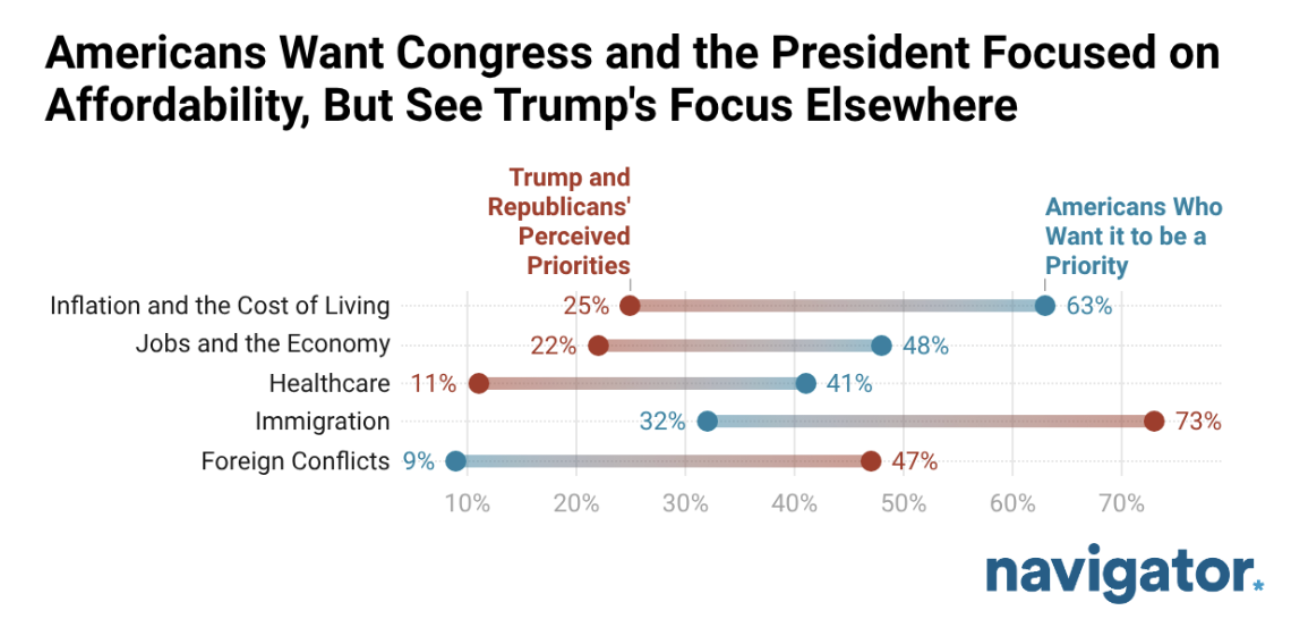
20260302 Americans Want Congress and the President Focused on Affordability, But See Trump's Focus: A Dot Graph From Navigator Research Titled: Americans Want Congress and the President Focused on Affordability, But See Trump's Focus

Read More

February 19, 2026

Americans Do Not See Their Government as a Democracy

This Navigator Research report covers Americans’ views of democracy, authoritarianism, and the federal government.

Aidan Harty and Melissa Toufanian
February 17, 2026

Why Americans Don’t Trust Their Elected Officials – And How to Fix it

This Navigator Research report covers the most recent perceptions of why elected officials are unable to get things done.

Maryann Cousens
Download
Toplines
Share

About The Study

Global Strategy Group conducted a public opinion survey among a sample of 1,000 registered voters from February 19-February 22, 2026. 101 additional interviews were conducted among Hispanic voters. 99 additional interviews were conducted among African American voters. 75 additional interviews were conducted among Asian American and Pacific Islander voters. 100 additional interviews were conducted among independent voters. The survey was conducted online, recruiting respondents from an opt-in online panel vendor. Respondents were verified against a voter file and special care was taken to ensure the demographic composition of our sample matched that of the national registered voter population across a variety of demographic variables. The margin of error for the full sample at the 95 percent level of confidence is +/- 3.1 percentage points. The margin of error for subgroups varies and is higher.