Focus Group Report: Independents and Soft Partisans on the Trump Administration’s Tariff and Tax Policies
This Navigator Research report contains findings from focus groups conducted online on January 29, 2025 among independents and soft-partisans (voters who do not identify strongly with either the Democratic Party or the Republican Party) with varied levels of engagement: Maine voters who report following the news “not too closely,” Michigan voters who report following the news either “somewhat” or “very closely,” and North Carolina voters who report followed the news “very closely.”
Few participants recall past Trump tax policies, but assume they benefit the wealthy and big corporations most.
When asked what participants knew about the Trump tax cuts, many were unsure. A Maine woman said: “I, unfortunately, I have not heard anything about it either. I’m assuming they’re corporate tax cuts though, but I don’t know for sure.” A North Carolina man said: “Is that the small business tax cuts? If so, I was on board with that.” A Michigan man also said: “I remember it when he was first running… I don’t know too much aside from that… it felt like it was for the upper class and that it was going to kind of negatively affect lower and middle class economy and families. So it felt kind of like it was a tax cut for him and his friends type of thing.”
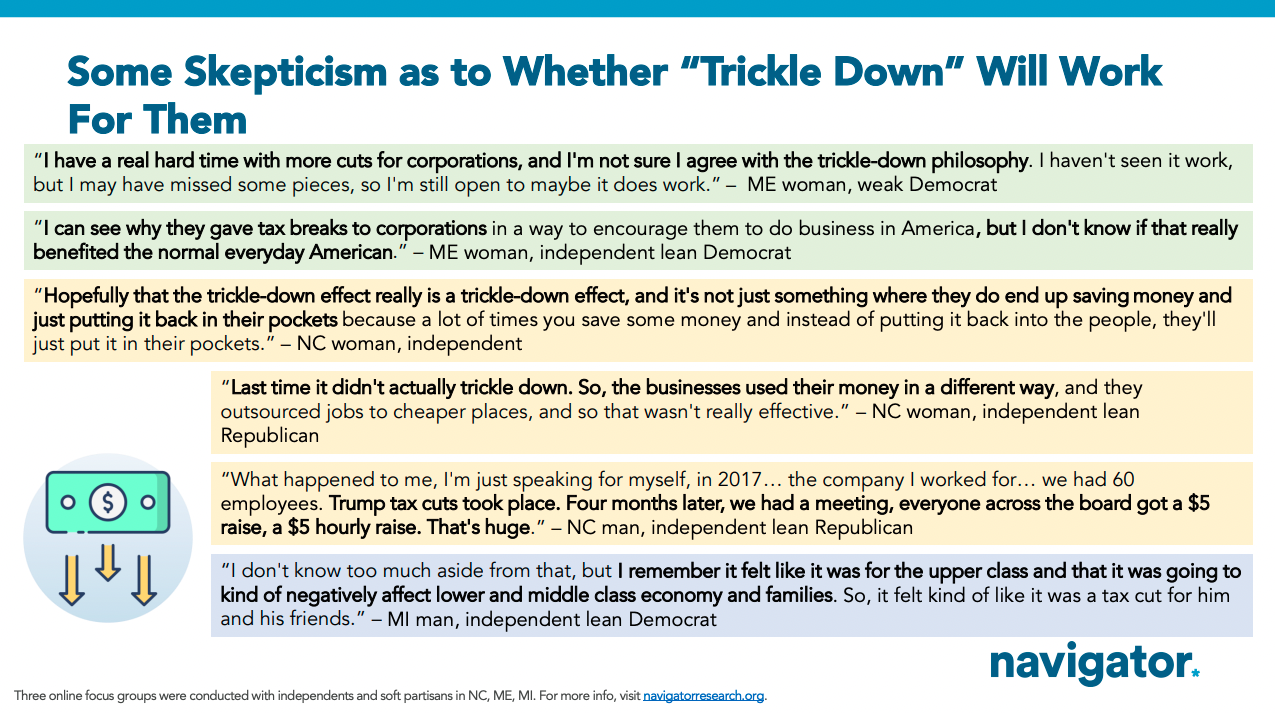
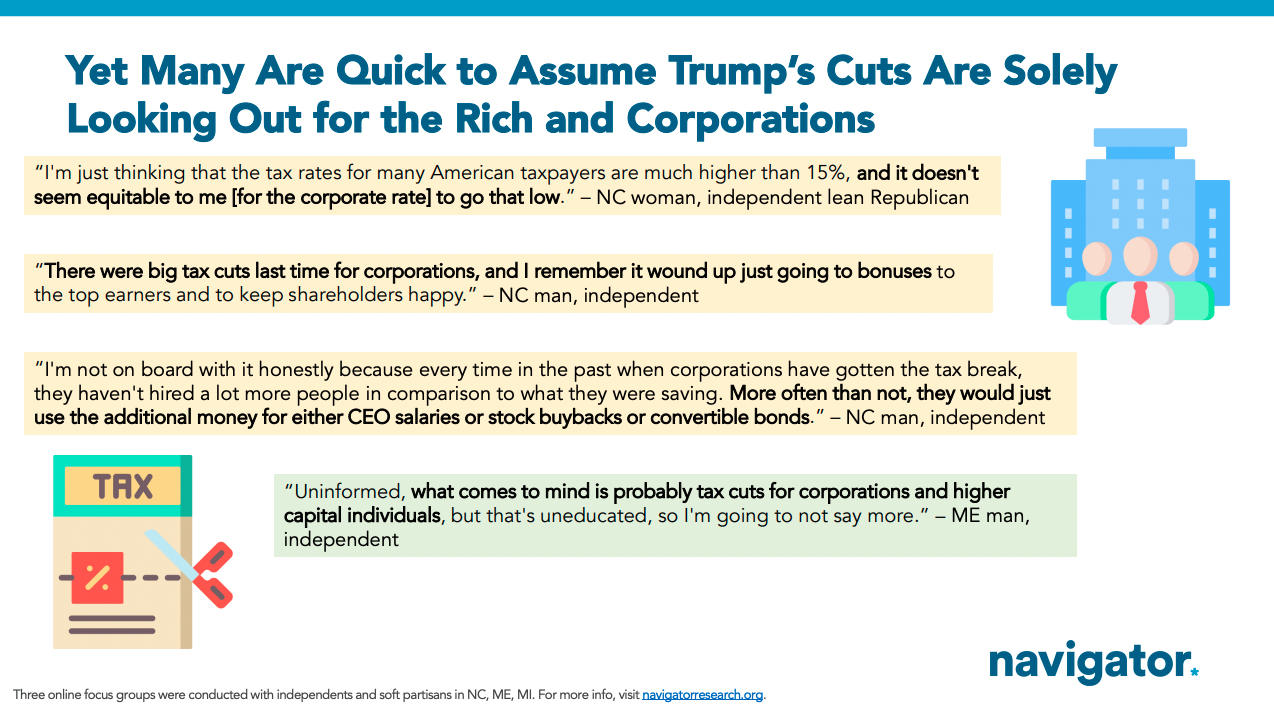
- When presented facts about the Trump tax plans, the idea that corporations and the wealthy will benefit most cements. As a North Carolina woman said: “I’m just thinking that the tax rates for many American taxpayers are much higher than 15%, and it doesn’t seem equitable to me [for the corporate rate] to go that low.” A Michigan man also said: “It just feels like we’re so out of touch with it that it’s like the president’s supposed to be taking care of the majority of the country, and it feels like that’s not the majority and that’s the most well-off minority you could probably stick your neck out for.” A Maine woman responded to the top 0.1 percent receiving a tax cut by saying: “Well, it kind of makes sense since Bezos, Zuckerberg and Musk were all at his inauguration.” Another Maine woman said: “So I can see why they gave tax breaks to corporations in a way to encourage them to do business in America, but I don’t know if that really benefited the normal everyday American.”
- Some debate whether corporate tax cuts could ultimately be good for the economy. For example, one North Carolina woman said: “Well, I think that there is some benefit in possibly a small cut. That was a huge cut and I think that was too much, but also, there were a lot of jobs at that point too that were created and there is a trickle-down effect with things like that.” Others don’t believe the cuts trickled down, as a North Carolina man said: “I do remember that there were big tax cuts last time for corporate, and I remember it wound up just going to bonuses to the top earners and to keep shareholders happy.” A Michigan man similarly said: “It’s going to benefit the CEOs.” Another North Carolina woman said: “...last time it didn’t actually trickle down. So the businesses used their money in a different way and they outsource jobs to cheaper places, and so that wasn’t really effective…the trickle-down never really happened.”
Most assume Trump’s proposed tariffs will raise costs, but diverge on whether it would ultimately be worth it.
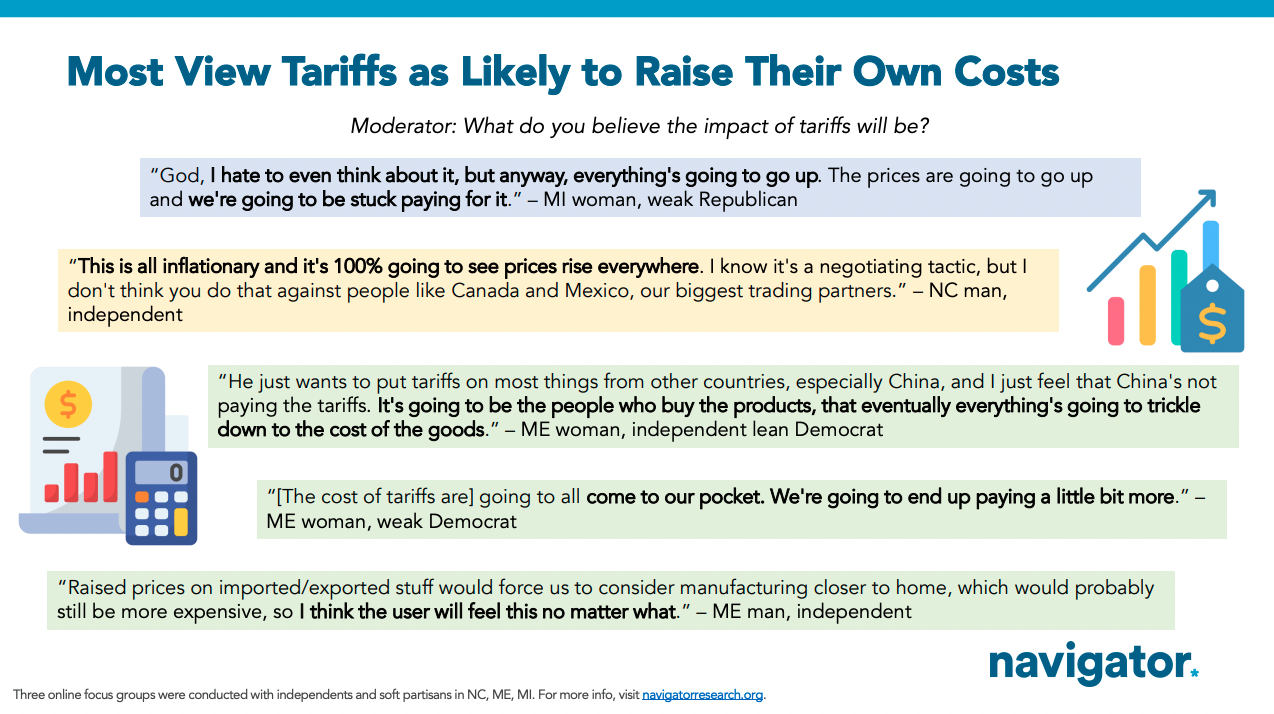
When asked about tariffs, some saw it as a negotiating tactic with implications on the prices they pay. One Maine man said: “Short-term, I think it’d be probably like…price increases. It’s a tax, so I think a lot of his blustering is just negotiating… a negotiating technique.” A North Carolina man said: “This is all inflationary and it’s 100 percent going to see prices rise everywhere. I know it’s a negotiating tactic, but I don’t think you do that against people like Canada and Mexico, our biggest trading partners.” Many believe they will pay the price of tariffs, including a Maine woman who said: “[The cost of tariffs are] going to all come to our pocket. We’re going to end up paying a little bit more.”
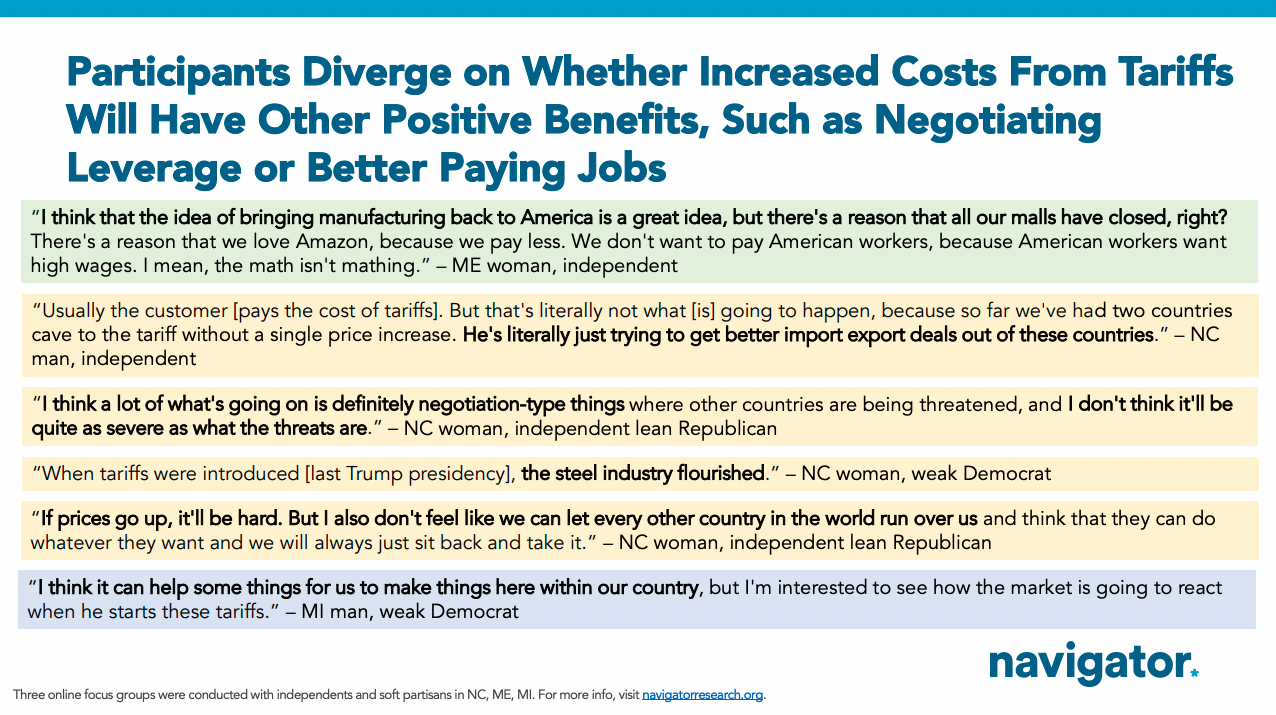
- Some assume tariffs are a tool to bring back American manufacturing, but wonder if it will ultimately be worth it. A North Carolina woman said: “If prices go up, it’ll be hard. But I also don’t feel like we can let every other country in the world run over us and think that they can do whatever they want and we will always just sit back and take it.” A Maine woman espoused a similar sentiment: “I think that the idea of bringing manufacturing back to America is a great idea, but there’s a reason that all our malls have closed, right? There’s a reason that we love Amazon, because we pay less. We don’t want to pay American workers, because American workers want high wages. I mean, the math isn’t mathing.”
- Others assume tariffs could weaken America’s relationships with other countries, including a Michigan man who said: “I think they could easily retaliate and do the same thing and make it harder for us to get foreign and international goods, and that in turn will weaken our relationship with countries that we do benefit from.”