
Poll: MAHA
This Navigator Research report covers the latest perceptions of health and wellness in the United States.
The “Make America Healthy Again” (MAHA) movement espouses ideas that range from common sense to fringe — with the purported aim of tackling America’s chronic disease crisis. As Health and Human Services Secretary Robert F. Kennedy Jr. has begun to reshape the nation’s public health establishment, many of his ideas pull on two simple threads: fear of sickness and frustration with our health care system. And, while there has been a decline in satisfaction and confidence with Americans’ health care coverage, the debate is not simply about health insurance, but more specifically about who and what Americans’ trust to keep them well.
The Establishment
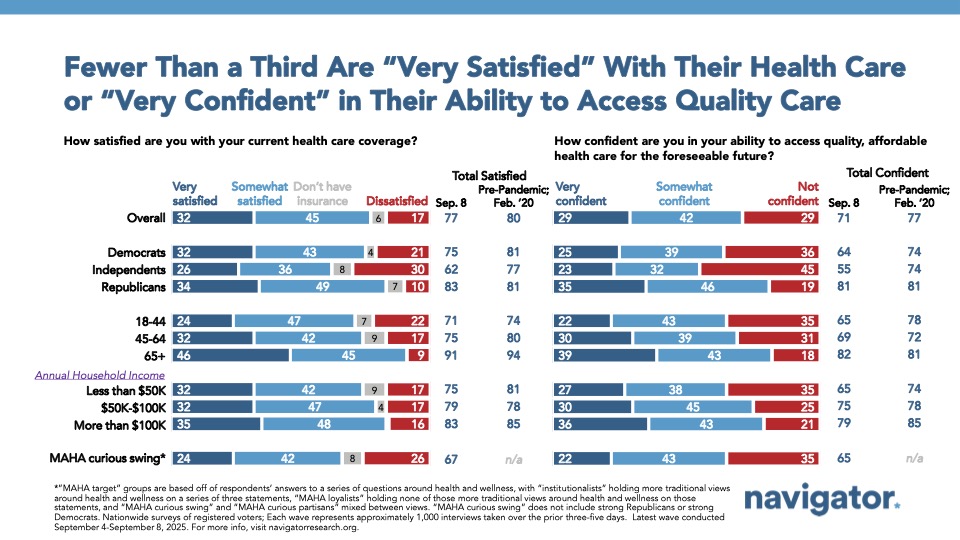
Just 32 percent of Americans overwhelmingly are very satisfied with their own health care coverage and just 29 percent are very confident in their ability to access quality, affordable health care for the foreseeable future.
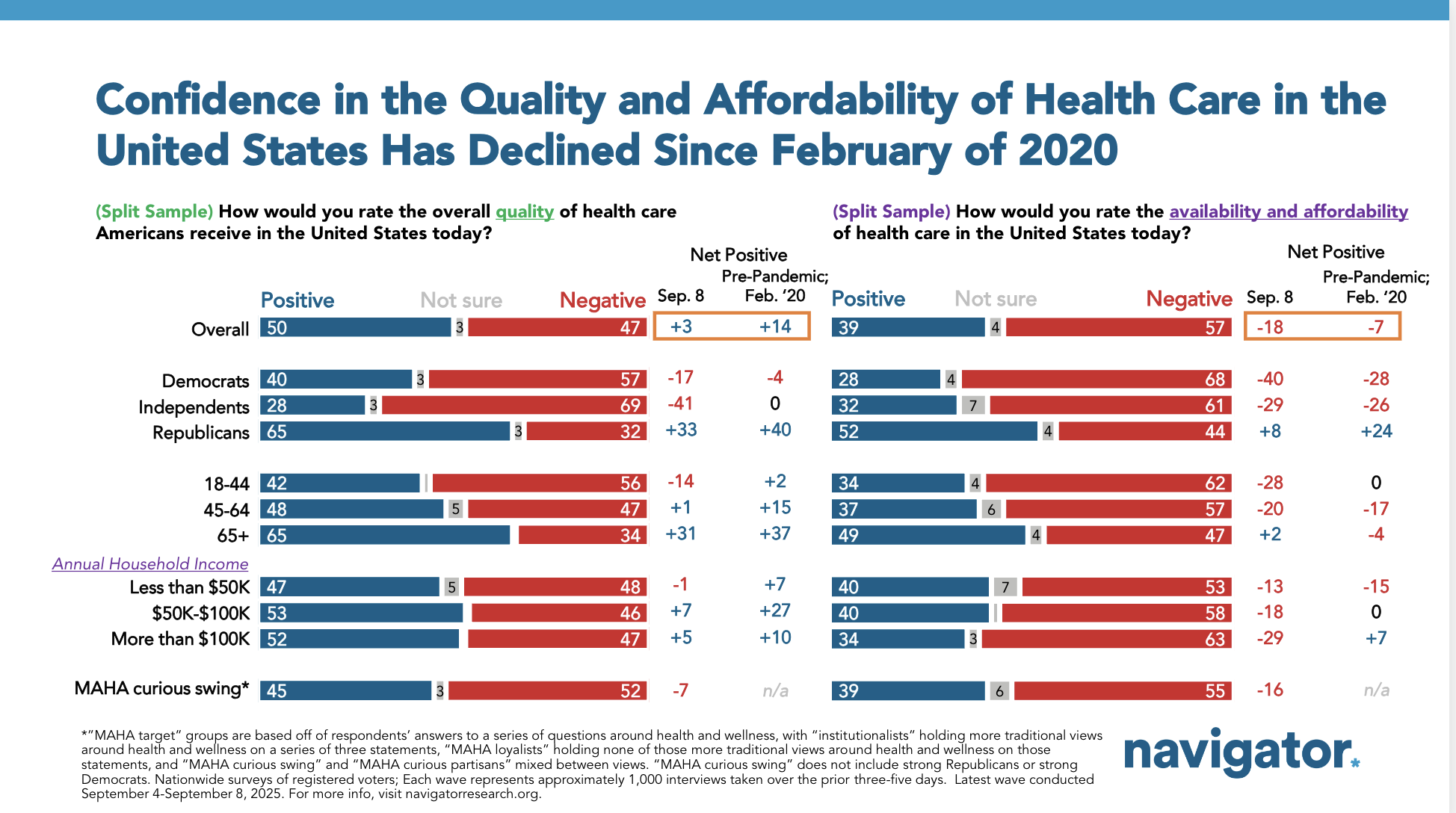
Just half of Americans are positive about the overall quality of health care Americans receive in the country today, a five point drop from February 2020. Just 39 percent give a positive rating to the availability and affordability of health care nationally. Millennials are the least satisfied with their own coverage, confidence in ability to access care, and rating of the overall quality of health care in the country.
Perceptions of the public health establishment are lukewarm, if not positive, but declining: in a January survey, 63 percent rated the Centers for Disease Control and Prevention (CDC) favorably, including a majority of independents. The CDC has taken a partisan hit since the pandemic: in March of 2020 its favorability was +62, it now sits at +38. The National Institutes of Health (NIH) is also favorable to a plurality of Americans.
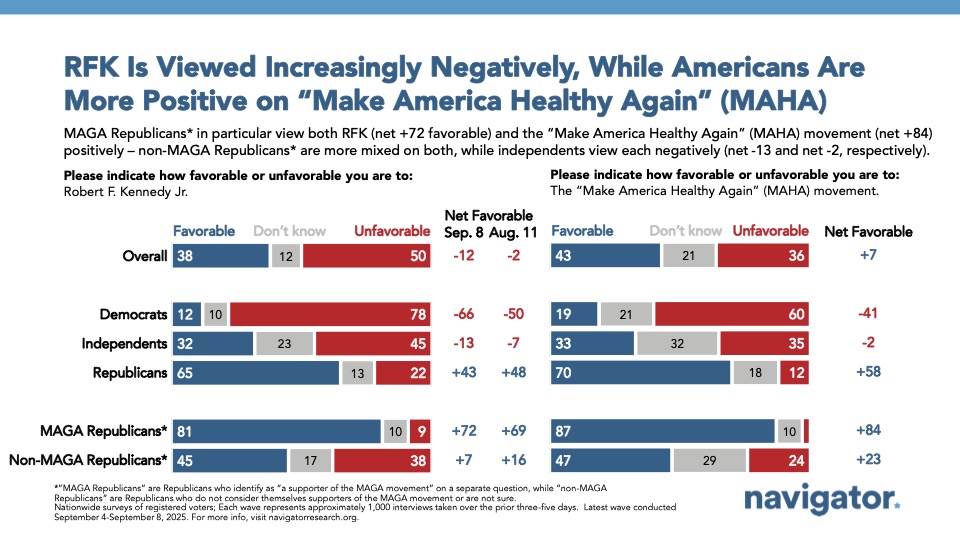
RFK Jr. and the MAHA movement are far more divisive than these institutions. The MAHA movement is favorable to a narrow plurality (+7), and RFK Jr. has seen a precipitous drop since his tense congressional hearing (-12), shifting 10 points in the last month (from -2).
While the cohort that intensely supports RFK Jr. and MAHA make up between 15 to 20 percent of the electorate and are largely conservative, the pathways into MAHA are not purely based on the pundits and vocal MAHA advocates, but more so on the values MAHA claims.
The Values
An overwhelming majority of Americans across partisanship believe basic values about health and wellness:
- It should be easier for every American family to access fresh fruits and vegetables (86 percent);
- We need to hold corporate polluters accountable and keep them from pouring toxic chemicals into the air we breathe and the water we drink (86 percent);
- Good health care is a human right that all American families should have access to (84 percent);
- Maintaining a healthy lifestyle and diet is just as important as regular visits to the doctor (86 percent); and,
- The government should make it more affordable for American families to stay healthy (84 percent).

Where there is slightly more division, but still overwhelming agreement is on trusted sources, vaccines, and the health industry, but seven-in-ten still agree on the following:
- Doctors and scientists should be trusted more than politicians or influencers to share medical advice (79 percent);
- It’s alarming that America has a serious chronic disease problem and worse health outcomes than any other developed nation (72 percent);
- It’s important for children to be vaccinated (71 percent); and,
- Our health system is designed so drug and insurance companies make more money when Americans are sick (71 percent).
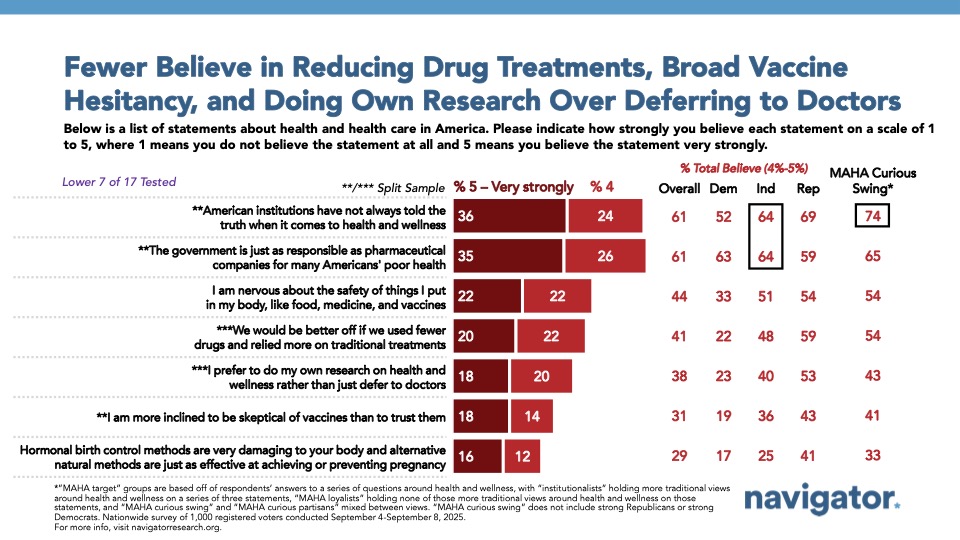
The most divisive beliefs focus on skepticism of hormonal birth control, vaccines, and a preference to “do your own research” over trusting doctors.
Trusted Sources
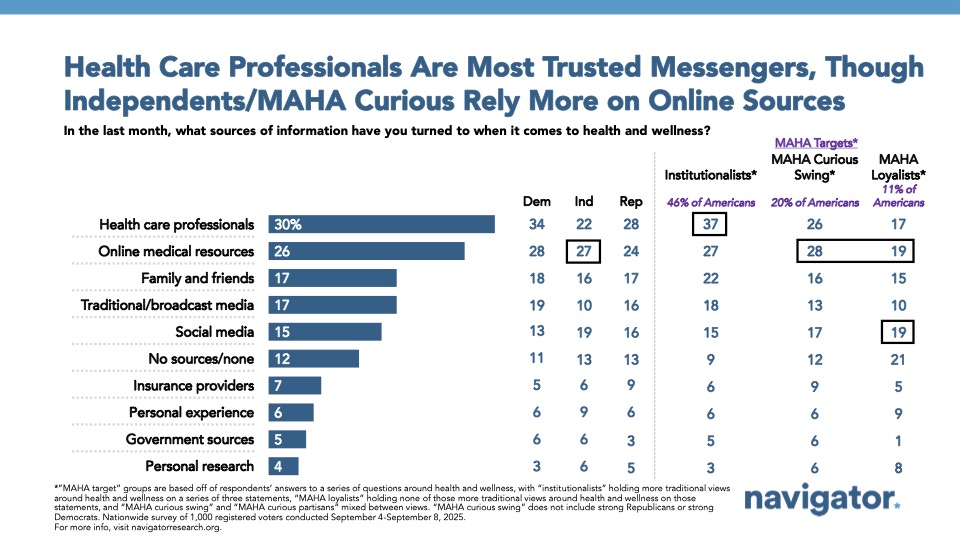
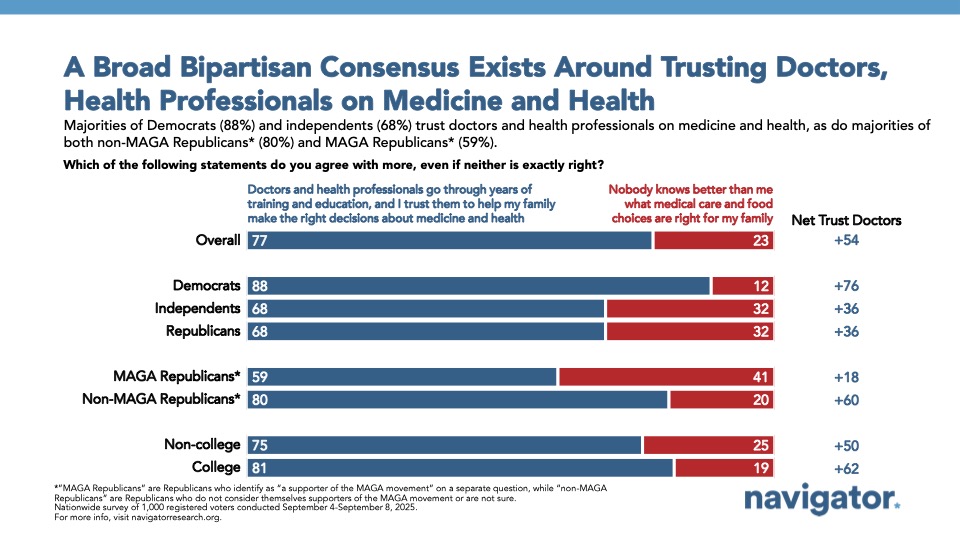
Americans overwhelmingly say they trust doctors and health care professionals to help them make the right decisions about medicine and health (77 percent), though many also say they turn to social media and online sources for information. Many also rely on friends and family, as well as news articles. With the rise of the health and wellness industry in online spaces, it is difficult to quantify what information is deemed as trustworthy or just another piece of content served up by the algorithm.
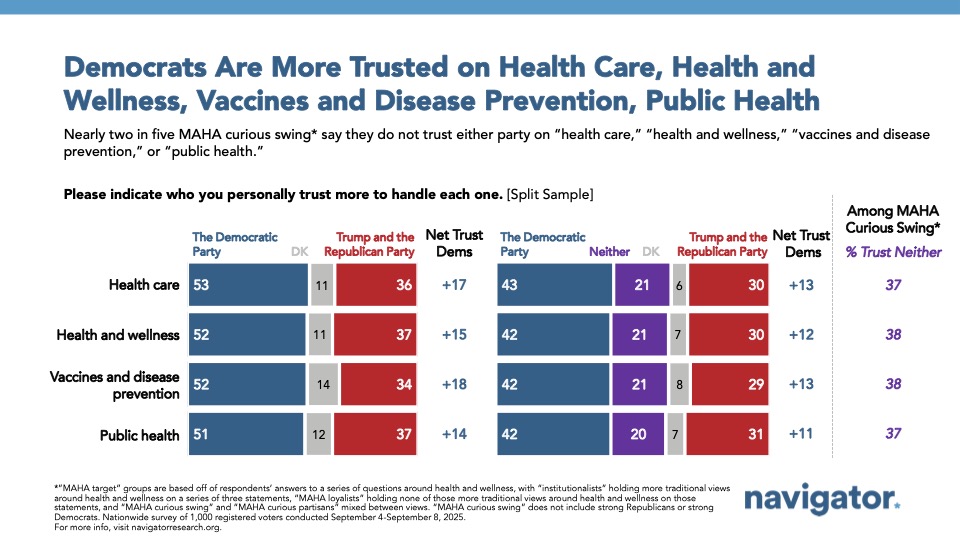
When it comes to political leaders and health, Democrats have a clear advantage over Republicans. Democrats are more trusted on health care broadly (+17), health and wellness (+15), vaccines and disease prevention (+18) and public health (net +14), including among most independents for each. When given the option of “not trusting either Democrats or Republicans” on these issues, a plurality of independents opt for it. In this scenario, Democrats lose ground while Republican trust remains stable when the option for neither is introduced.
MAHA Curious
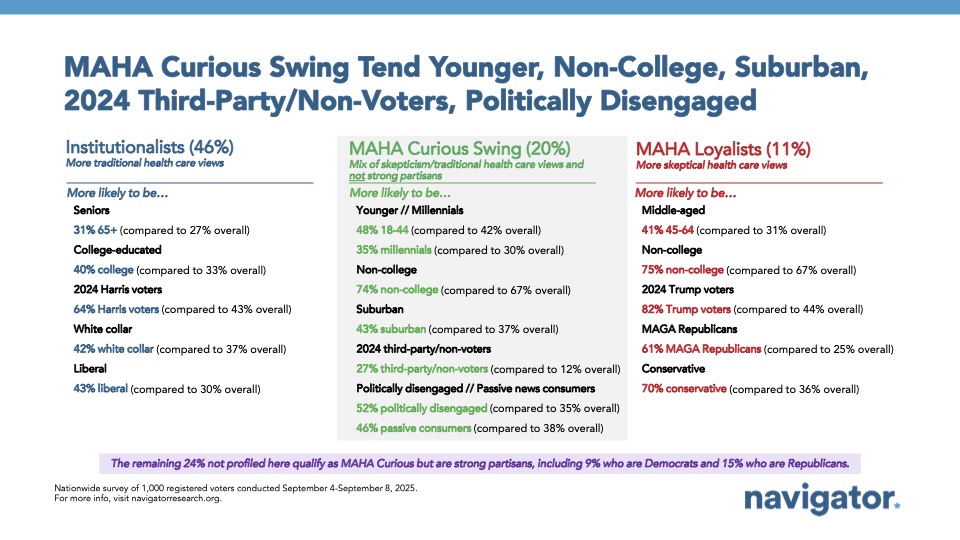
In an effort to understand those who are somewhat skeptical of our health system but not completely against institutions and traditional medicine, we segmented the electorate into three groups: institutionalists (answered solely option A), MAHA-loyalists (answered solely option B), and MAHA-curious (answered a mix of A and B), based on which response they agreed with:
Trusted Sources:
A: Doctors and health professionals go through years of training and education, and I trust them to help my family make the right decisions about medicine and health (77 percent agree)
B: Nobody knows better than me what medical care and food choices are right for my family (23 percent agree)
Medical Reliance:
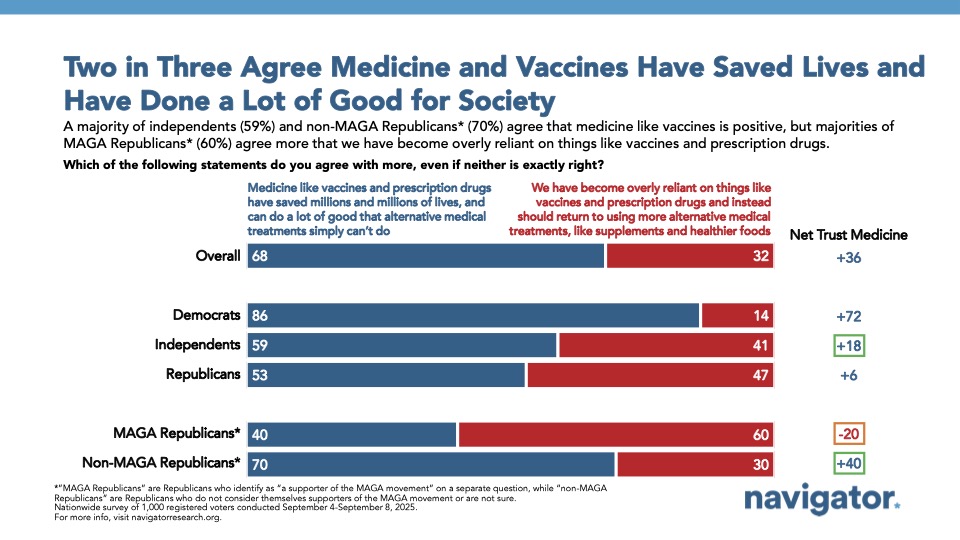
A: Medicine like vaccines and prescription drugs have saved millions and millions of lives, and can do a lot of good that alternative medical treatments simply can’t do (68 percent agree)
B: We have become overly reliant on things like vaccines and prescription drugs and instead should return to using more alternative medical treatments, like supplements and healthier foods (32 percent agree)
Governmental Role:
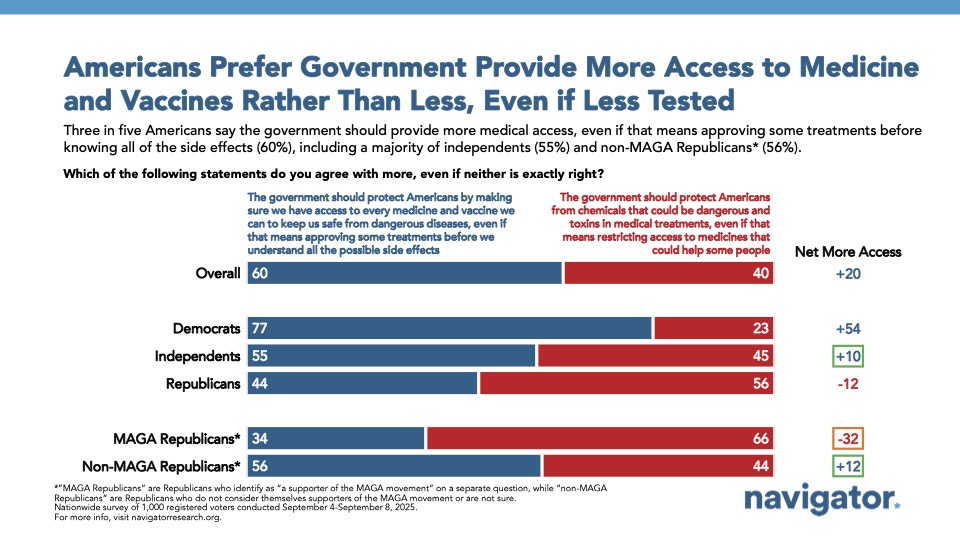
A: The government should protect Americans by making sure we have access to every medicine and vaccine we can to keep us safe from dangerous diseases, even if that means approving some treatments before we understand all the possible side effects (60 percent agree)
B: The government should protect Americans from chemicals that could be dangerous and toxins in medical treatments, even if that means restricting access to medicines that could help some people (40 percent agree)
The MAHA-curious cohort makes up 43 percent of the electorate, but for the purposes of analysis we will focus on those in this bucket who are not strong Democrats or strong Republicans, which make up 20 percent of the electorate.
In part two of our report, we will go through the specific policies and messages that meet these voters where they are on the issue of health and wellness.