
Meet The Pocketbook Pessimists

January 29, 2026
Julie Alderman Boudreau

This Navigator Research report covers Americans who rate the economy negatively or are unsure but don’t yet blame Trump and Republicans in Congress.

Big Takeaways:

Nearly one third (31%) of Americans say they are unsure about or negative on the economy, but they are reluctant to blame Trump.

This group of people who are pessimistic about the economy but uncertain of who to blame – a group we’ll be referring to in this report as “pocketbook pessimists” – give Trump’s handling of the economy a C- / D+ grade, and are especially unfavorable towards his tariffs.

This group is more likely than all Americans to say the costs of groceries, housing, and utilities are rising.

They don’t trust either party on issues like taxes and the cost of living.

Additionally, pocketbook pessimists are evenly split between Passive and Active news consumers. More than half say they use TikTok multiple times a day.

Poll: Pocketbook Pessimists

This Navigator Research report covers Americans who rate the economy negatively or are unsure but don’t yet blame Trump and Republicans in Congress.

Pocketbook Pessimists

In a survey Navigator research conducted earlier this month, a group of nearly one-third of Americans said they are either unsure or pessimistic about the economy (31%), but they do not yet blame President Trump and Republicans in Congress for costs rising.

This group, which Navigator is referring to as “pocketbook pessimists,” leans independent (52% of independents fit into this category) and 37% are between the ages of 18 and 44.
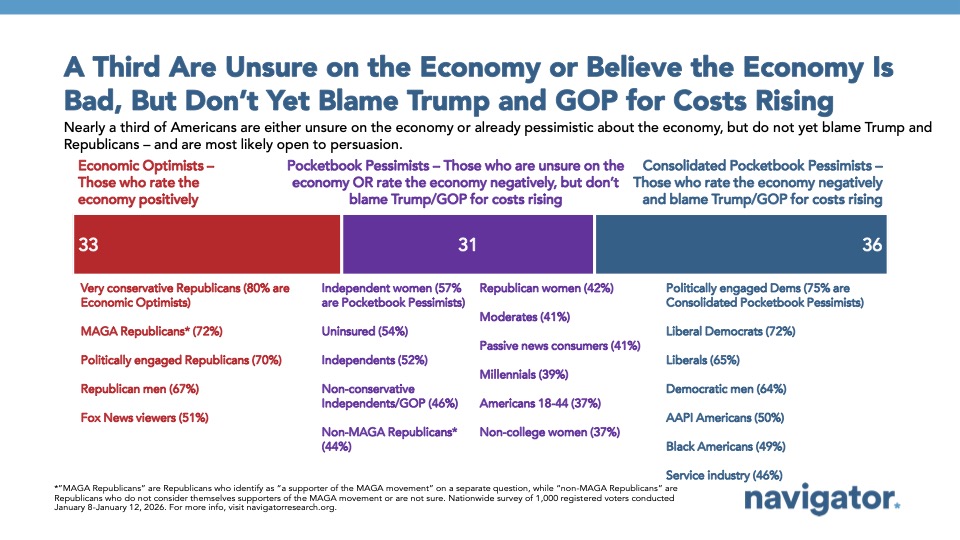
Chart from Navigator Research, titled: A Third Are Unsure on the Economy or Believe the Economy Is Bad, But Don’t Yet Blame Trump and GOP for Costs Rising

This group is less likely to say politics are important to their identity (only 52% said they were, compared to 66% of all voters). Half say they voted for Trump in 2024 (50%), compared with 29% who say they voted for Harris, and 6% who say they voted for somebody else. 17% say they did not vote at all.
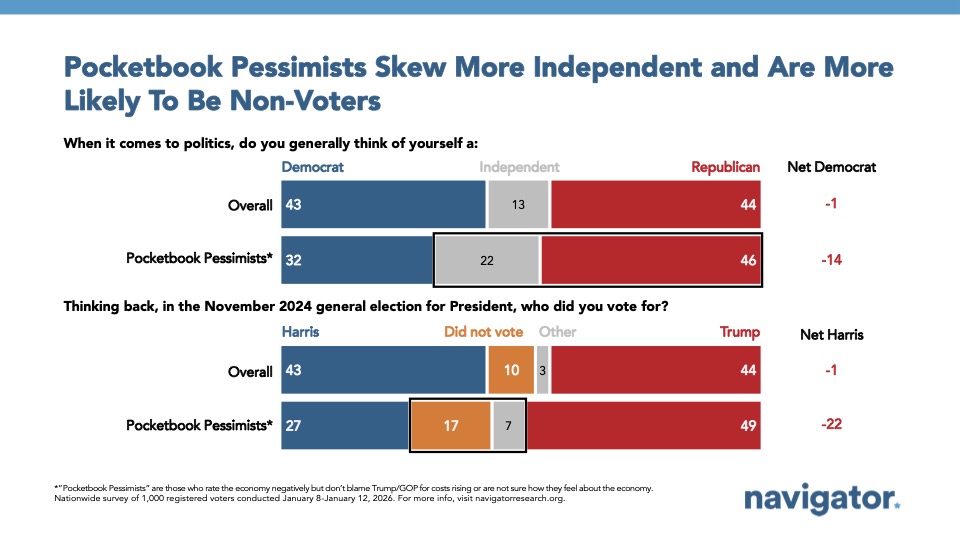
Bar chart from Navigator Research, titled: Pocketbook Pessimists Skew More Independent and Are More Likely To Be Non-Voters

Feelings About Trump, Democrats, And The Economy

While pocketbook pessimists are reluctant to blame Trump for their economic pain, they’re still largely negative on him. Trump has an overall net -8 approval with pocketbook pessimists, slightly better than the net -14 approval he has with Americans overall.

Pocketbook pessimists have a net -14 approval of Trump’s handling of the economy and give him an average grade between a C- and a D+ on the economy, about the same grade he got from all Americans.
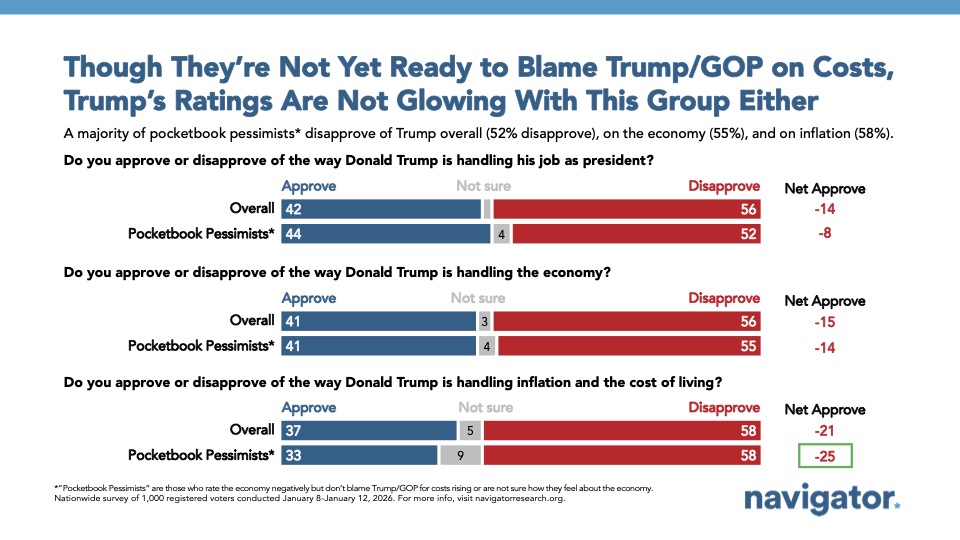
Bar chart from Navigator Research, titled: Though They’re Not Yet Ready to Blame Trump/GOP on Costs, Trump’s Ratings Are Not Glowing With This Group Either

Tariffs have a net -34 favorability rating among this group, while the Affordable Care Act (ACA) has a net +25 rating among them.
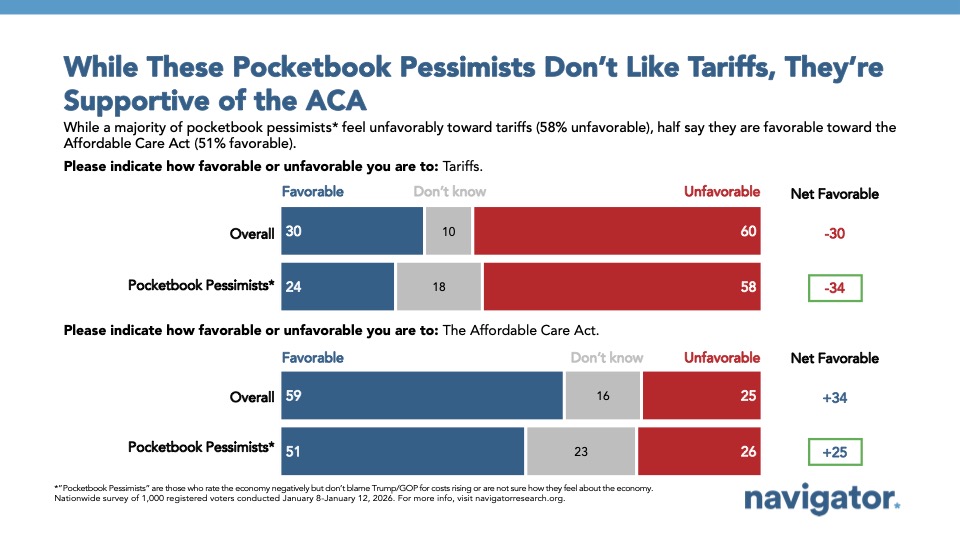
Bar chart from Navigator Research, titled: While These Pocketbook Pessimists Don’t Like Tariffs, They’re Supportive of the ACA

Pocketbook pessimists feel crushed by the economy. 77% say their costs are going up (compared to 72% of Americans overall). Similarly, they are slightly more likely than Americans overall to say the cost of groceries (86% vs. 81%), housing (77% vs. 70%), and utilities (81% vs. 74%) are going up. 70% also say health care costs are rising.
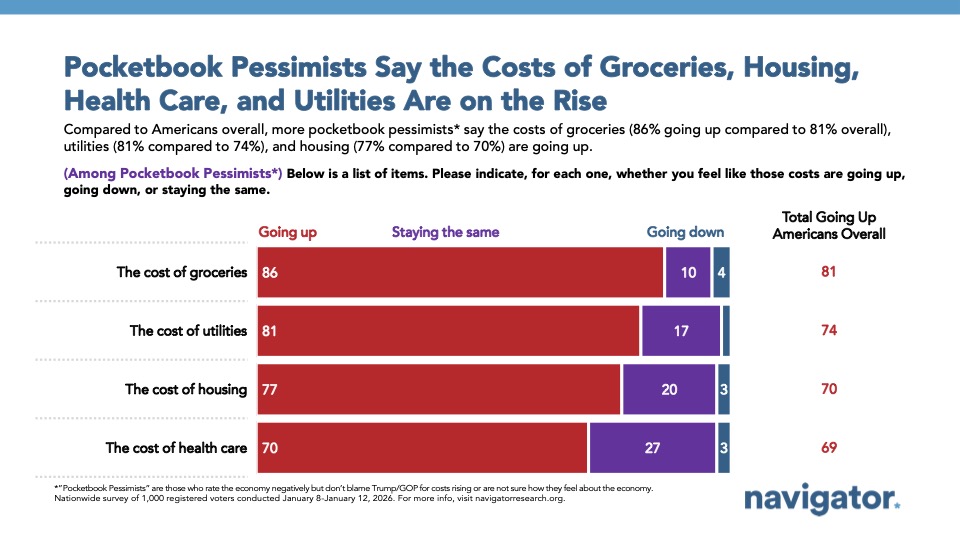
Bar chart from Navigator Research, titled: Pocketbook Pessimists Say the Costs of Groceries, Housing, Health Care, and Utilities Are on the Rise

Pocketbook pessimists blame policies from Trump and Republicans in Congress for rising costs. A majority say they blame Trump’s tariffs for raising their costs (54%), 42% say they blame Republicans’ cuts to SNAP and Medicaid, and 41% say they blame Republicans’ inaction on ACA subsidies for their rising costs.
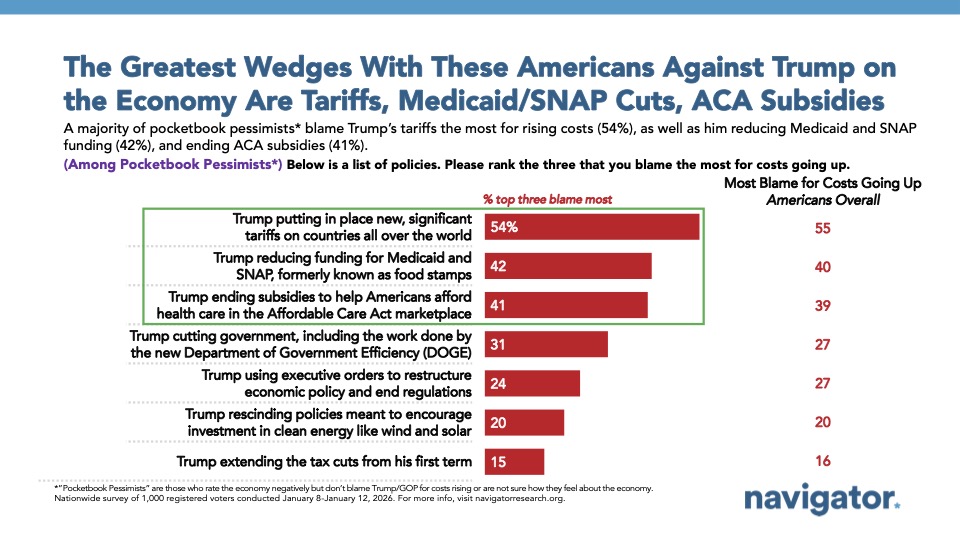
Bar chart from Navigator Research, titled: The Greatest Wedges With These Americans Against Trump on the Economy Are Tariffs, Medicaid/SNAP Cuts, ACA Subsidies

However, this group doesn’t necessarily trust Democrats more. On many issues including taxes (39%) and inflation and the cost of living (36%), a plurality say they trust neither party on the issue.
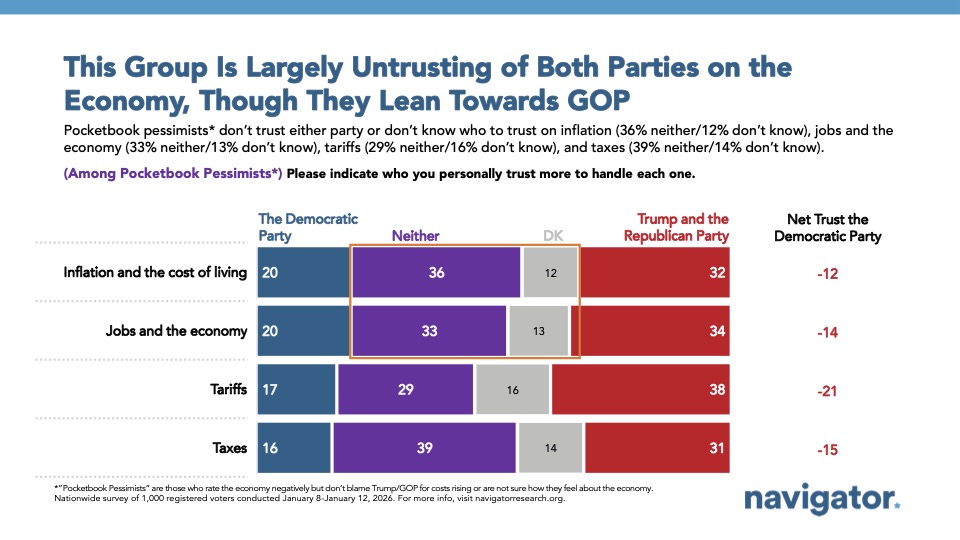
Bar chart from Navigator Research, titled: This Group Is Largely Untrusting of Both Parties on the Economy, Though They Lean Towards GOP

Media Habits

Pocketbook pessimists are evenly split between Passive and Active News Consumers. 45% say they turn to social media for news (compared to 40% of Americans overall). 58% say they use TikTok multiple times a day (compared to 52% of all Americans).
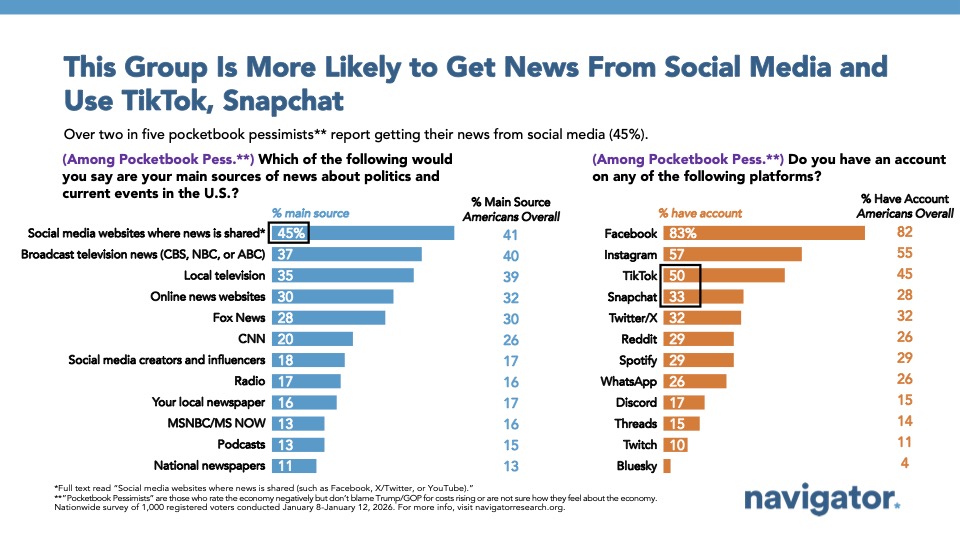
Bar chart from Navigator Research, titled: This Group Is More Likely to Get News From Social Media and Use TikTok, Snapchat

Read More

February 17, 2026

Why Americans Don’t Trust Their Elected Officials – And How to Fix it

This Navigator Research report covers the most recent perceptions of why elected officials are unable to get things done.

Maryann Cousens
February 12, 2026

Trump’s Priorities Still Seen as Out of Whack

This Navigator Research report covers the most recent perceptions of the economy.

Aidan Harty & Maryann Cousens
February 5, 2026

All eyes are on ICE

This Navigator Research report covers Trump’s handling of immigration and mass deportations as well as messaging guidance on ICE.

Maryann Cousens
February 4, 2026

Americans Continue To Sour On ICE

Polling report on the most recent perceptions of ICE following the killings of both Renee Good and Alex Pretti, including tracking of ICE’s favorability, the share who believe Secretary Noem should be impeached and Stephen Miller should be fired, and the reforms to ICE that Americans most support.

Julie Alderman Boudreau & Maryann Cousens
Download
ToplinesGraphs
Share

About The Study

Global Strategy Group conducted a public opinion survey among a sample of 1,000 registered voters from January 8-January 12, 2026. 100 additional interviews were conducted among Hispanic voters. 100 additional interviews were conducted among African American voters. 75 additional interviews were conducted among Asian American and Pacific Islander voters. 100 additional interviews were conducted among independent voters. The survey was conducted online, recruiting respondents from an opt-in online panel vendor. Respondents were verified against a voter file and special care was taken to ensure the demographic composition of our sample matched that of the national registered voter population across a variety of demographic variables. The margin of error for the full sample at the 95 percent level of confidence is +/- 3.1 percentage points. The margin of error for subgroups varies and is higher.