ICYMI: Revisiting Navigator’s Post-Election Survey Findings Ahead of 118th Congress

WASHINGTON, D.C. — Last November, Navigator Research conducted a survey with over 5,000 midterm election voters to understand which issues affected vote choice and turnout. We distilled these findings into eight different categories: which issues mattered mostsupport for the two partiesthe economyabortionyouth votersAAPI votersBlack voters; and Hispanic voters.
As we enter the next two years of a divided Congress, here are our key takeaways from the survey, including what issues drew voters to both parties and what Americans want from their leaders.
 
While Inflation and Abortion Were Top Issues, Social Security and Medicare Played a Significant Role
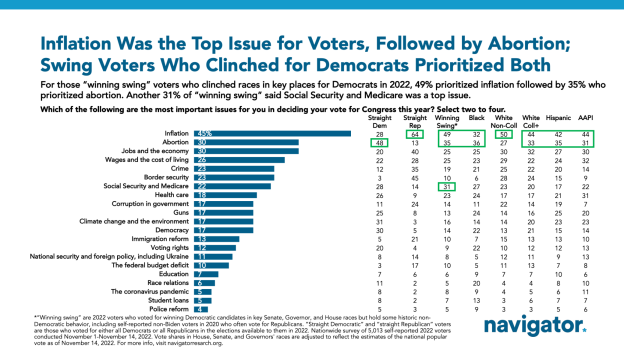
  • Almost half of voters (45 percent) named inflation as one of their top issues, with a third of Americans (30 percent) saying the same of abortion. ‘Winning swing’ voters — those who voted for Democrats who won key races but displayed historic non-Democratic behavior — were even more likely to name inflation and abortion as top priorities (49 percent and 35 percent, respectively). However, a third of these voters (31 percent) named Social Security and Medicare as a top priority, compared to just 22 percent of voters overall.
Image
  • Among voters prioritizing economic issues and not abortion (48 percent of the electorate), Republican congressional candidates won by a 45-point margin (26 percent Democratic candidates – 71 percent Republican candidates). However, among the other 52 percent of voters who prioritized abortion (30 percent) or other issues unrelated to the economy, inflation, or abortion (22 percent), Democratic candidates won by a similarly high 40-point margin (68 percent Democratic candidates – 28 percent Republican candidates).
    • Prioritizing abortion was a particularly significant indicator of Democratic support: those who rated abortion, but not economic issues, as a top priority overwhelmingly supported Democrats (80 percent Democratic candidates – 16 percent Republican candidates); among those who prioritized abortion and economic issues, Democrats beat Republicans by a 27-point margin (62 percent Democratic candidates – 35 percent Republican candidates). An additional 22 percent of voters prioritized neither economic issues nor abortion, and these voters also backed Democratic candidates by a 20-point margin, indicating that their top issues were Social Security and Medicare, health care, and democracy.
  • Midterm voters were overwhelmingly pro-choice (60 percent; 36 percent identified as “pro-life”) and opposed a national abortion ban (67 percent). Both Republican men and women were evenly divided on their support for nationwide abortion bans, while opposition to a ban was particularly strong among AAPI voters (79 percent), Black voters (73 percent), and Hispanic voters (69 percent).
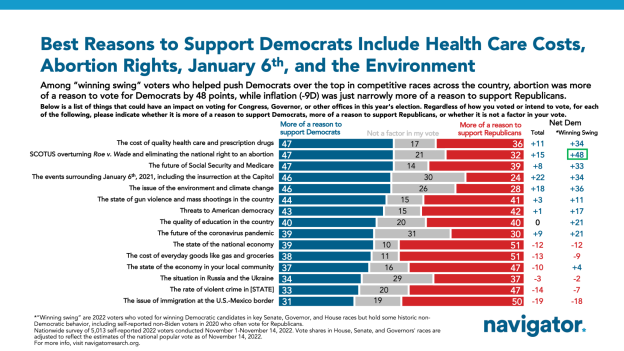
  • Overall, Americans cited health care costs, abortion rights, and the future of Social Security and Medicare as among the top reasons to support Democrats over Republicans. Additionally, over half of Gen Z voters (58 percent) saw student loan debt as a reason to support Democrats over Republicans. While the top reasons to support Democrats varied by racial demographic, no non-white demographic cited any issue as a reason to support Republicans over Democrats:
    • Around three in five AAPI voters said that climate change (64 percent), health care costs (61 percent), the right to abortion (60 percent), and the Jan. 6th insurrection (60 percent) were reasons to prefer Democrats to Republicans.
    • Black voters overwhelmingly supported Democrats on every issue, citing health care costs (78 percent), the Jan. 6th insurrection, gun violence, and the future of Social Security and Medicare (all 76 percent) as the top reasons to support Democrats.
    • Hispanic voters viewed the future of Social Security and Medicare and the right to abortion as the top reasons to support Democrats (both 58 percent), with climate change and health care costs (both 55 percent) also seen as convincing reasons.
Image
  • Older voters were particularly concerned about the future of Social Security and Medicare: a third of Baby Boomers (33 percent) and 40 percent of Silent Generation voters named it as a top priority at the polls. This was also by far the top issue for Black voters over 65, with 56 percent identifying it as a top concern. Since the election, Americans cited cuts to Social Security and Medicare as one of their top concerns with the new Republican Congress.
Biden’s Approval Was Largely Unimportant to Vote Choice, Though Non-White Voters Scored Him Particularly Well
  • President Biden was viewed unfavorably by the majority of midterm voters (56 percent disapprove; 43 percent approve). But Biden’s favorability did not substantially affect vote choice: among voters who ‘somewhat disapproved’ of Biden, 45 percent voted for a Democrat in the House (46 percent voted for a Republican) and 52 percent voted for a Democrat in the Senate (43 percent Republican).
    • Despite the importance of inflation to this election, those who disapproved of Biden’s handling of the economy broke even more favorably for Democrats in both the House (net +36 for Democrats) and the Senate (net +46 for Democrats).
  • Overall, voters narrowly preferred Republicans over Democrats in House races (49 percent to 47 percent) and Democrats over Republicans in Senate races (50 percent to 48 percent). In House races, Democrats won the majority of Black voters (86 percent), AAPI voters (62 percent), and Hispanic voters (62 percent). In Senate races, Democrats won by similarly large shares, garnering 86 percent of the Black vote, 67 percent of the AAPI vote, and 60 percent of the Hispanic vote.
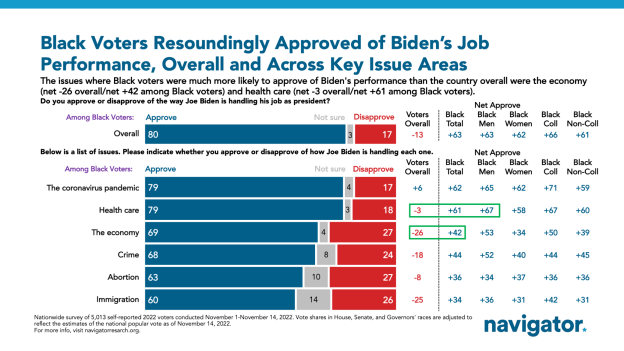
  • Among six key issues (the pandemic, health care, abortion, crime, the economy, and immigration), the only issue where Biden scored favorably was his handling of COVID (51 percent). However, the majority of AAPI and Hispanic voters approved of his handling of the pandemic, abortion, and health care. Black voters resoundingly approved of his handling of each issue, including 69 percent who approved of his handling of the economy.
Image
  • Meanwhile, a majority of Americans disapproved of both Donald Trump (57 percent disapprove; 42 percent approve) and MAGA Republicans (54 percent disapprove; 35 percent approve). ‘Winning swing’ voters were particularly negative on Donald Trump (net -30) and MAGA Republicans (net -43).
Americans Want Congress to Focus on Inflation and Abortion Rights, Not Investigations
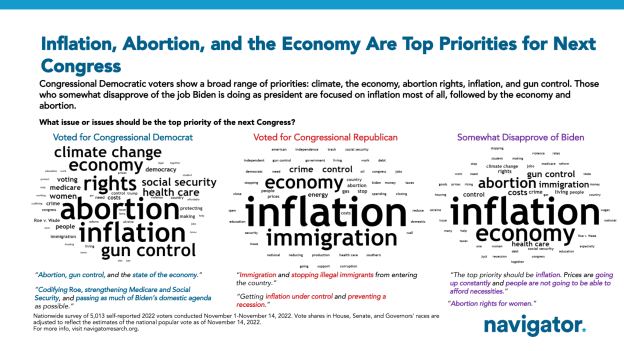
  • In an open-ended question about which issues the next Congress should prioritize, abortion and inflation were the top responses. While Democratic voters narrowly identified abortion as a top priority over inflation, inflation was the top concern for Republican voters and voters who slightly disapproved of Biden. Those who supported Republicans also named immigration as a top priority. Meanwhile, each of these groups said inflation was the most important issue for both parties to work together on.
  • Navigator polling after the election found that three in five Americans want Congress to focus on lowering costs (76 percent), reducing violent crime (74 percent), and addressing the U.S.-Mexico border (74 percent) instead of investigating the Biden administration. Additionally, nearly nine in ten Americans would prefer Americans work on these issues instead of banning abortion nationwide.
Image
Democrats Were Significantly More Likely Than Republicans To Contact Non-White Voters
  • 61 percent of Black voters reported being contacted by Democratic candidates, with 45 percent reporting being contacted multiple times. By contrast, only 36 percent of Black voters were contacted by Republican candidates, with just 22 percent being contacted multiple times.
  • Just over half of Hispanic voters (53 percent) were contacted by Democratic candidates, compared to 40 percent who were contacted by Republican candidates. This gap was driven by Hispanic women (53 percent contacted by Democrats; 37 percent contacted by Republicans) and Hispanic voters ages 18-54 (51 percent contacted by Democrats; 37 percent contacted by Republicans).
  • The majority of AAPI voters were not contacted by candidates from either party, with 52 percent saying they did not hear from Democrats and 68 percent saying the same of Republicans. However, 42 percent of AAPI voters were contacted by Democrats multiple times, compared to just one in four (26 percent) who were contacted by Republicans multiple times.
 
###
NEW POLLING: Pro-Choice Republican Coalition Growing, Progressive Messages Win on Abortion and Court Expansion

WASHINGTON, D.C. — Today, Navigator Research released new research on Texas’ new abortion law, Senate Bill 8. News of this bill broke through nationally, with 76 percent of Americans reporting hearing “a lot” (46 percent) or “some” about the law. Fox News viewers were the least likely to hear about the bill. Americans oppose the legislation by an 18-point margin (54 percent), and labeling the bill “the nation’s most restrictive abortion law” increases net opposition by 8 points (from +18 to +26).

A growing majority of Americans identify as “pro-choice,” which has increased by 5 points in Navigator’s tracking since June 2019, driven largely by a 9-point increase among Republicans (from 29 percent to 38 percent). 

Several aspects of the law were highly concerning across parties, including the lack of exceptions for illness, rape, or incest. Americans especially oppose the civil enforcement mechanism that “deputizes private citizens to sue anyone who performs or assists with an abortion” — 61 percent of Americans, including more than half of Independents (55 percent) and more than two in five Republicans (43 percent) oppose this provision

51 percent of Americans say they would be less favorable toward elected officials who support a law like the Texas abortion ban, including nearly half of Independents (47 percent) and even a quarter of Republicans (26 percent). 

At the same time, progressive arguments did better than a conservative argument supporting abortion restrictions by a nearly two-to-one margin. Two progressive messages tested on abortion’s 50-year legal precedent and the vigilante enforcement mechanisms both beat back the conservative argument that this law puts reasonable limits in place to protect the unborn by 26-point and 24-point margins, respectively.

“Despite the onslaught of anti-abortion legislation, most Americans support women’s rights and freedoms and see this law as a direct attack,” said Bryan Bennett, Director of Polling & Analytics at the Hub Project. “‘As Americans become more supportive of abortion rights, extreme legislation like the Texas law will continue to draw negative attention to Republicans and have real political consequences. It might even push some voters to look for fundamental changes in the way our courts function.” 

For many voters, the Texas law is proof that the Supreme Court has become too conservative. Given the context of SCOTUS’s abortion decision, 56 percent of Americans, including 90 percent of Democrats and 61 percent of Independents, agree more with a statement about court expansion than about the legitimacy of the law. Expanding the Supreme Court is also popular across racial demographics, with more than eight in ten Black Americans (83 percent), 75 percent of Asian Americans and Pacific Islanders, 68 percent of Hispanic Americans, and about half of white Americans (49 percent) agreeing.

View the full report HERE.

###

About Navigator Research

The Navigator Research project is designed to act as a consistent, flexible, responsive tool to inform policy debates. By conducting research and providing reliable guidance to inform allies, elected leaders, and the press, Navigator helps top leaders in Washington and grassroots leaders around the country shape the debate on the issues that matter most. Follow us on Twitter for the latest updates.

About This Survey

This release features findings from a survey conducted September 9-13, 2021 of 995 registered voters. 100 additional interviews were conducted among Hispanic voters. 79 additional interviews were conducted among Asian American and Pacific Islander voters. 100 additional interviews were conducted among African American voters. 100 additional interviews were conducted among independent voters. The survey was conducted online, recruiting respondents from an opt-in online panel vendor. Respondents were verified against a voter file and special care was taken to ensure the demographic composition of our sample matched that of the national registered voter population across a variety of demographic variables.


As the For the People Act Goes to the Senate, Three in Five Voters Support Eliminating the Filibuster

By a 2-to-1 margin, more Americans say that the filibuster will create more gridlock than create more bipartisan compromise.

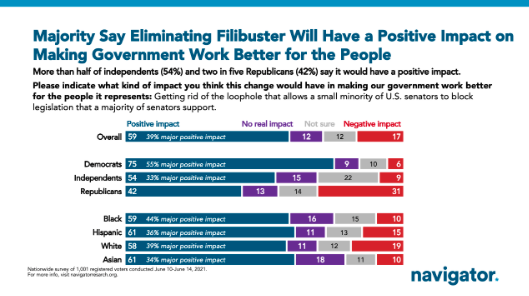
WASHINGTON, D.C. — Today, the Senate is set to vote on a motion to proceed with S.1, the For the People Act, where it is expected to be blocked by a Republican filibuster. Ahead of this crucial vote, Navigator has released new polling that shows the increased popularity of reforming or eliminating the filibuster. Roughly three in five Americans say that eliminating the filibuster would have a positive impact on “making our government work better for the people it represents” (59 percent), and by a 24-point margin, more Americans say that the filibuster does more to “create gridlock” (50 percent) than “create more bipartisan compromise” in Washington, D.C. (26 percent).

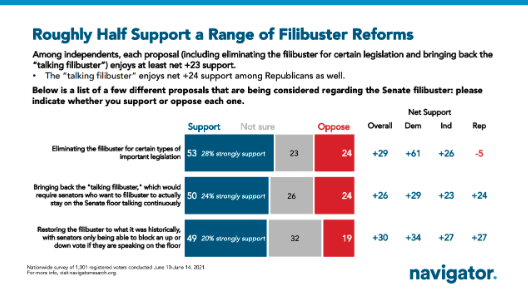
The data also shows the popularity of a variety of filibuster reforms. Eliminating the filibuster for certain types of important legislation earns 53 percent support (with just 24 percent opposed), bringing back the “talking filibuster” has 50 percent support (with just 24 percent opposed), and restoring the filibuster to only allow senators to block an up or down vote if they are speaking on the floor has 49 percent support (with just 19 percent opposed), including 27-point net positive support from Republicans.

“Most Americans want to see changes to the filibuster, while even more still just don’t have a strong opinion about it — they just believe it could stand in the way of good governance,” said Bryan Bennett, Director of Polling & Analytics at The Hub Project. “Most Americans see the filibuster as an impediment to progress, and want their lawmakers to pass popular legislation instead of protecting an antiquated Senate rule.”

###


About Navigator Research

The Navigator Research project is designed to act as a consistent, flexible, responsive tool to inform policy debates. By conducting research and providing reliable guidance to inform allies, elected leaders, and the press, Navigator helps top leaders in Washington and grassroots leaders around the country shape the debate on the issues that matter most. Follow us on Twitter for the latest updates.

About This Survey

This release features findings from a national online survey of 1,001 registered voters conducted June 10-14, 2021. Additional interviews were conducted among 99 Hispanic voters, 102 African American voters, 101 independents without a partisan lean, and 71 Asian American and Pacific Islander voters. The margin of error is +/- 2.8 percentage points. The survey recruited respondents from an opt-in online panel vendor and were verified against a voter file; special care was taken to ensure the demographic composition of our sample matched that of the national registered voter population across a variety of demographic variables.


NEW POLLING: Majorities of Democrats and Independents, and Nearly Half of Republicans, Identify as Pro-Choice

Since the Dobbs Draft Leak, Increasing Number of Americans Support Court Expansion

Washington, D.C. — Navigator Research today released new polling indicating that nearly two-thirds of Americans (63 percent) identify as pro-choice, including majorities across gender and racial demographic groups. Since the leak of the Dobbs v. Jackson draft decision, that number has increased by 5 points, solidifying how unpopular the reversal of Roe would be.

While the vast majority of Democrats continue to identify as pro-choice (81 percent), nearly half of Republicans identify as pro-choice (44 percent), with a narrow majority identifying as pro-life (51 percent). Meanwhile, a majority of Catholics and Protestants (58 percent and 56 percent, respectively), and nearly half of evangelical Christians (44 percent) also identify as pro-choice.

Overall, an overwhelming majority of Americans believe that the decision to have an abortion should be left to a woman and her doctor (78 percent), as opposed to politicians and the government (11 percent). This finding comes as Republican-controlled state legislatures across the country prepare to ban abortion if Roe v. Wade is overturned.

“Reviewing several weeks of tracking data, it is clear that the vast majority of Americans believe abortion should remain legal and deeply oppose proposed Republican abortion bans,” said Rachael Russell, Senior Manager of Polling & Analytics at the Hub Project and Advisor to Navigator Research.“We’ve seen a significant shift in recent weeks in the share of Americans that support expanding the Supreme Court beyond 9 seats — a strong indication that the leaked draft decision has undermined confidence in the Court as an institution.”

Along with broad support for legal abortion, the vast majority of Americans express concern about bans on abortion without exceptions for rape, incest, or when the mother’s life is at risk — including nearly three in five Republicans (57 percent). Additionally, 75 percent of Americans and a majority of Republicans (54 percent) are concerned about the government making decisions that should be between a doctor and their patient.

Since the leak of the draft Dobbs v. Jackson decision, public opinion has shifted considerably on expanding the Supreme Court, increasing by 13 points since late March (net -5 to net +8). In this latest survey, a plurality of respondents support adding more Justices to the Court (46 percent), including 65 percent of Democrats and 64 percent of Black Americans.

### 

About Navigator Research
The Navigator Research project is designed to act as a consistent, flexible, responsive tool to inform policy debates. By conducting research and providing reliable guidance to inform allies, elected leaders, and the press, Navigator helps top leaders in Washington and grassroots leaders around the country shape the debate on the issues that matter most. Follow us on Twitter for the latest updates.

About The Studies
Global Strategy Group conducted public opinion surveys among a sample of 998 registered voters from May 19-May 23, 2022. 102 additional interviews were conducted among Hispanic voters. 62 additional interviews were conducted among Asian American and Pacific Islander voters. 105 additional interviews were conducted among African American voters. 102 additional interviews were conducted among independent voters. The survey was conducted online, recruiting respondents from an opt-in online panel vendor. Respondents were verified against a voter file and special care was taken to ensure the demographic composition of our sample matched that of the national registered voter population across a variety of demographic variables.The margin of error at the 95 percent confidence level is +/- 3.1 percent.

NEW POLLING: Majorities of Americans Say Gun Violence Is a Major Issue and Not Enough Is Being Done To Prevent It

Share of Americans Who Believe Government Has Not Done Enough to Address Gun Violence Has Increased by Double Digits Since Last Summer

Washington, D.C. — Today, Navigator Research released results from a new survey addressing perceptions of gun violence in the United States. The survey was fielded following the racially-motivated mass shooting in Buffalo, New York, but before the shooting on Tuesday at Robb Elementary School in Uvalde, Texas. The survey results make clear that Americans want to see action on the issues of gun violence, mass shootings, and hate crimes.

By a large majority, Americans view gun violence and mass shootings as a crisis or major issue (71 percent and 72 percent, respectively). This finding holds true across race and partisanship, with majorities of Independents and Republicans agreeing. Nearly three in five gun owners believe that gun violence (58 percent) and mass shootings (62 percent) are a crisis or major issue.

That level of concern is reflected in the growing number of Americans who believe that we have not done enough to reform our gun laws. Since July 2021, there has been a net 14-point increase in the share of Americans who believe we need to do more to fix gun laws, with 62 percent now saying that we have not done enough to address the issue compared to just 38 percent who believe too much has been done.

“We’re in national mourning after a number of unspeakable and horrific mass shootings. Gun violence is a uniquely American crisis and the vast majority of Americans agree something needs to change — our government needs to take action,” said Bryan Bennett, Senior Director of Polling & Analytics at the Hub Project and Advisor to Navigator Research. “Our data shows Americans are tired of ‘thoughts and prayers’ followed by inaction. They want progress and meaningful change in preventing future tragedies. With Americans across demographics calling for stronger gun laws, Congress should recognize gun violence prevention reforms are not only politically popular, but morally necessary.”

Consistent with the rising number of Americans who support reforming our gun laws, a majority of respondents (58 percent) support stronger gun laws, with nearly four in five Democrats in support (79 percent). Since July 2021, the greatest swing in favor of stronger gun laws is amongst Republicans (net +9).

Politically, Democrats are most concerned about both gun violence and mass shootings, and are far more likely to support reforming gun laws than Republicans (+70 for Democrats; -22 for Republicans). Reforming gun laws enjoys majority support across all racial demographics, with support highest among Black Americans (80 percent in favor).

When it comes to violent crime generally, Americans are most concerned about mass shootings (54 percent), gun violence (43 percent), and hate crimes (43 percent). While all political groups, as well as white and Hispanic Americans, view mass shootings as their top concern, Black and AAPI Americans are most concerned about hate crimes (63 percent and 55 percent, respectively).

In addition to hate crimes being a top concern for most Americans, Americans across partisanship and race believe that hate crimes are a crisis or major issue. Although a majority of Republicans believe hate crimes are either a crisis or major issue, only 20 percent believe it is a crisis, compared to almost half of Democrats (47 percent) and a majority of Black Americans (59 percent).

###

About Navigator Research

The Navigator Research project is designed to act as a consistent, flexible, responsive tool to inform policy debates. By conducting research and providing reliable guidance to inform allies, elected leaders, and the press, Navigator helps top leaders in Washington and grassroots leaders around the country shape the debate on the issues that matter most. Follow us on Twitter for the latest updates.

About The Studies

Global Strategy Group conducted public opinion surveys among a sample of 998 registered voters from May 19- May 23, 2022. 102 additional interviews were conducted among Hispanic voters. 62 additional interviews were conducted among Asian American and Pacific Islander voters. 105 additional interviews were conducted among African American voters. 102 additional interviews were conducted among independent voters. The survey was conducted online, recruiting respondents from an opt-in online panel vendor. Respondents were verified against a voter file and special care was taken to ensure the demographic composition of our sample matched that of the national registered voter population across a variety of demographic variables.The margin of error at the 95 percent confidence level is +/- 3.1 percent.


NEW POLLING: Outlining GOP Culture War Agenda Causes Loss of Trust Among Some Moderate Voters

More Americans Say Republicans Are Focusing on the “Wrong Things” Following Leaked Roe Decision 

Washington, D.C. — Today, Navigator Research released new polling that shows half of Americans believe Republicans are focused on the wrong things following the leak of a draft Supreme Court decision on Roe v. Wade (a net 11-point shift from earlier this month). This shift was foreshadowed by a survey conducted earlier this month, in which nearly one in six respondents similarly shifted their opinion after reading examples of culture war policies supported by Republicans, including book bans, restricting abortion rights, punishing companies that disagree with their views, and more.

Groups that moved most significantly after reading these example policies were the same groups that shifted following the draft decision leak. In our survey fielded prior to the draft decision leak, a majority of moms (net +20) initially said that Republicans were focused on the right things, but following the leak, their perception moved negatively by a net 23 points. Women under the age of 55 saw an even greater net shift (29 points) toward believing Republicans were focused on the wrong things.

“The cultural and social policies being pushed by many Republicans are deeply unpopular with the majority of Americans — our polling following the Supreme Court leak on Roe punctuates that point,” said Bryan Bennett, Senior Director of Polling & Analytics at the Hub Project and Advisor to Navigator Research. “Republicans are focused on culture war issues like banning books over lowering costs for people struggling to pay the bills. Progressives need to point to that discrepancy and remind the public that the Republican Party is actively blocking a popular economic agenda from President Biden and Democrats in Congress while pushing deeply unfavorable and extreme positions on social issues.”

Among those who shifted their view of the Republican agenda after reading about Republican cultural and social policies, the strongest rebukes stem from statements referencing Republicans’ focus on banning books over bringing down costs for American families (81 percent say concerning) and Republicans controlling people’s choices rather than proposing real policy change (74 percent say concerning).

Although knowledge of Republican social policies shifts public opinion, our survey found that few people are well versed in the cultural and social policies being pushed by the party. Just 24 percent of people said they are hearing “a lot” about Republican attempts to ban books about subjects like racism and the Holocaust, and before the draft decision on Roe was made public, just 29 percent had heard “a lot” about Republicans pushing to overturn it (though in Navigator’s most recent survey, 36 percent have heard a lot about the draft decision).

Another issue impacted by the leaked draft decision is expanding the Supreme Court. Following the leak, support for expanding the Court beyond its current nine seats increased by double digits (net -5 to net +5).

Looking at a range of cultural and social news topics, our survey found that although respondents regard Disney more favorably (net +32) than Governor Ron DeSantis (net -4), the favorability for both is strongly correlated with party affiliation, with Fox News Republicans as both DeSantis’s staunchest supporters (net +76) and Disney’s staunchest opponents (net -20). A plurality oppose DeSantis’s attempts to punish Disney by revoking its special tax status (46 percent oppose – 35 percent support) and a majority (55 percent) are concerned that Republicans are the ones accusing Democrats of being focused on social issues while trying to cancel Disney.

###

About Navigator Research

The Navigator Research project is designed to act as a consistent, flexible, responsive tool to inform policy debates. By conducting research and providing reliable guidance to inform allies, elected leaders, and the press, Navigator helps top leaders in Washington and grassroots leaders around the country shape the debate on the issues that matter most. Follow us on Twitter for the latest updates.

About The Studies

Global Strategy Group conducted public opinion surveys among a sample of 999 registered voters from April 28-May 2, 2022 and May 5-May 9, 2022. 101 additional interviews were conducted among Hispanic voters. Each survey included oversamples of approximately 100 Hispanic voters, 75 Asian American and Pacific Islander voters, 100 African American voters, and 100 independent voters.These surveys were conducted online, recruiting respondents from an opt-in online panel vendor. The margin of error at the 95 percent confidence level is +/- 3.1 percent.