NEW POLLING: If Roe is Overturned, Democrats Would Be More Motivated to Vote in 2022 Than Republicans

Overturning Roe Would Significantly Undermine Confidence in the Supreme Court

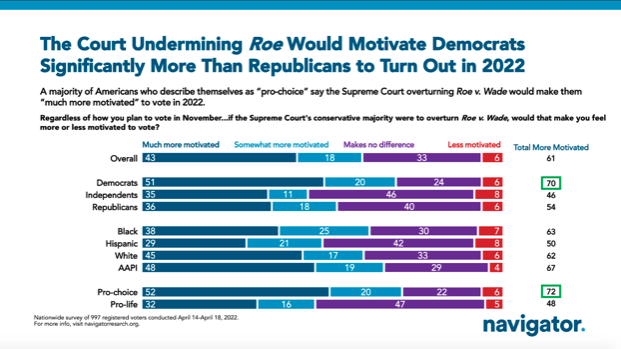
Washington, D.C. — This summer, the Supreme Court will hand down a decision that could overturn Roe vs. Wade and decades of precedent protecting abortion. Today, Navigator Research released new polling on the issue of abortion, finding supermajorities of Democrats (70 percent) and “pro-choice” Americans (72 percent) say the Supreme Court overturning Roe v. Wade would make them more motivated to vote in 2022. By comparison, only 54 percent of Republicans and just 48 percent of “pro-life” Americans report being more motivated to vote in the midterms if the Supreme court overturns Roe. 

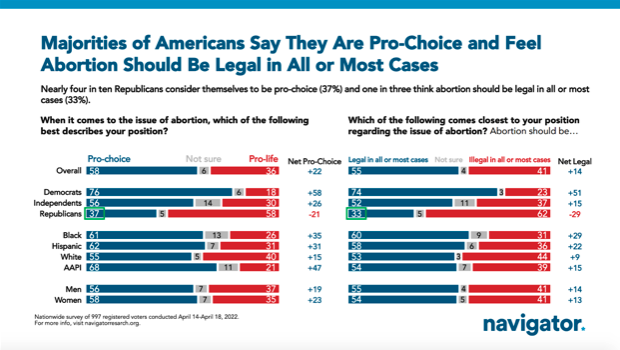
By a 22-point margin, nearly three in five Americans describe themselves as “pro-choice” (58 percent compared to 36 percent who consider themselves “pro-life”), including a majority of Independents (56 percent). 

Additionally, Americans’ trust in the Supreme Court would drop by 15 points (from 60 percent to 45 percent) if the Court overturned Roe vs. Wade. Among Independents, trust in the Court would drop 15 points from 56 percent trust to 41 percent trust if Roe was overturned. 

“Even with an ultra-conservative Supreme Court poised to weaken Roe, a majority of Americans describe themselves as pro-choice and are fearful of losing access to basic bodily autonomy,” said Rachael Russell, Senior Manager at Navigator Research. “These findings show that the pro-choice majority will not sit back and accept a Court decision as fated — they’ll take to the ballot box and use their power.”

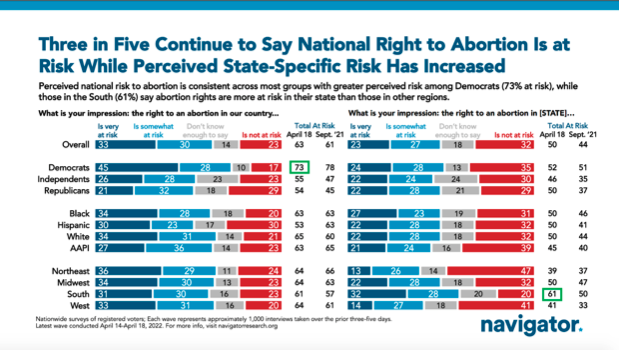
Polling also found 63 percent of Americans believe the right to an abortion in our country is at risk. While a smaller share believed the right to an abortion in their state was at risk (50 percent), this fear was highest among Americans in Southern states (60 percent believed it was at risk).
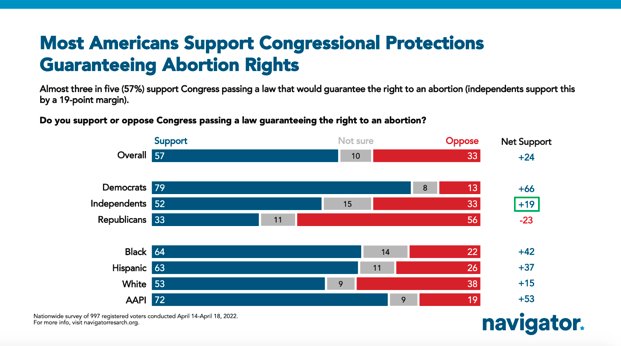
Congressional Democrats have proposed the Women’s Health Protection Act, which would codify the right to an abortion, but it was defeated by the Senate filibuster in February. 57 percent of Americans support Congress passing a law guaranteeing the right to an abortion versus just 33 percent who are opposed; Independents support such legislation by a 19-point margin.

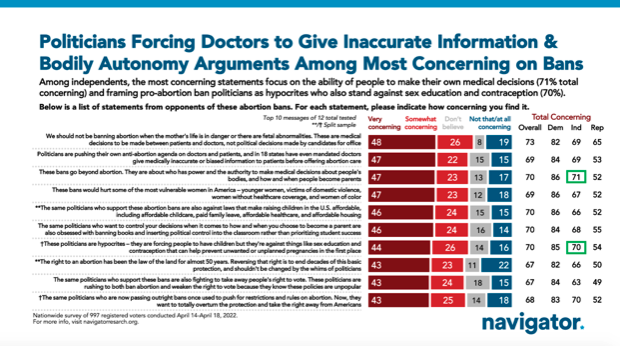
Navigator tested twelve arguments made by opponents of the abortion bans — each was found concerning by at least 66 percent of Americans. The most moving statement argued that abortions are “medical decisions to be made between patients and doctors, not political decisions made by candidates.” This was found concerning across partisanship by 73 percent of respondents overall, including 69 percent of Independents and 65 percent of Republicans. 
###


About Navigator Research

The Navigator Research project is designed to act as a consistent, flexible, responsive tool to inform policy debates. By conducting research and providing reliable guidance to inform allies, elected leaders, and the press, Navigator helps top leaders in Washington and grassroots leaders around the country shape the debate on the issues that matter most. Follow us on Twitter for the latest updates.

About The Study

Global Strategy Group conducted public opinion surveys among a sample of 997 registered voters from April 14-April 18, 2022. 100 additional interviews were conducted among Hispanic voters. 76 additional interviews were conducted among Asian American and Pacific Islander voters. 101 additional interviews were conducted among African American voters. 100 additional interviews were conducted among independent voters. The margin of error at the 95 percent confidence level for each survey is +/- 3.1 percent.


New Focus Groups: Six Months Out from Midterms, Economic Pessimism Remains High Among Independents & Soft Partisans

Washington, D.C. — Today, Navigator Research released new findings from focus groups with Independents and soft partisans in Nevada, North Carolina, and Wisconsin. During the groups, fears of inflation permeated conversations about jobs and the economy, even when participants were shown positive economic indicators. 

New Navigator data supports these qualitative findings, with 92 percent of Americans reporting concerns about the rate of inflation, and more than nine in ten Americans (91 percent) believing the costs of everyday goods like groceries and gas are going up. As one Wisconsin woman put it during the focus groups, “The food prices have gone up…  and they’ve given you less. It used to be 16 ounces. Now it’s 13 and they hope you don’t notice. And sometimes you can go in the store the next day, a price will be 20 cents higher.”

Across partisanship, some participants blamed corporate greed for rising costs. When asked who the economy is working for right now, a Wisconsin woman said “Businesses, corporations. Yes. They’re making record profits. For us, the people, the consumer, there are few people that are making money. But the corporations are making profit. Paying zero taxes.” Navigator’s recent polling also shows this connection — seven in ten Americans believe corporate greed is a reason for rising costs, including two in three Independents. 

Oil companies specifically are blamed for inflation, with one Nevada man saying, “The oil companies ha[ve] been able to get away with it because, as everybody knows, they support political campaigns.” In a forced choice question in a Navigator survey from March, Americans blame gas companies more for rising costs than President Biden and Democrats. 

“In our focus groups, respondents organically cited and trusted an inflation rate of 8.5 percent, but were surprised or distrusting to hear about the millions of new jobs created in the last year — that’s a major messaging problem that progressives have six months to fix,” said Bryan Bennett, Senior Director of Polling and Analytics at The Hub Project and Advisor to Navigator Research. “But the pain of inflation can’t simply be solved by pointing to jobs numbers, despite how historic they are — progressives must show they have a clear road to recovery. Biden’s economic agenda, student loan debt cancellation, and lower drug prices all earn high, bipartisan approval in our polling and could make a real difference in people’s everyday life.” 

Even when shown positive economic indicators, pervasive inflation concerns cloud Americans’ assessments of the economy. During the focus groups, participants were shown several metrics about the current state of the economy from government sources, including: 

  • More than six million jobs were created last year, the largest number of any year on record;
  • Last year the US economy grew 5.7 percent, which was the highest rate of growth in almost 40 years; 
  • The unemployment rate fell from 6.2 percent in the beginning of last year to 3.6 percent in March; 
  • There are fewer jobless claims right now than any time since 1968; and more. 

Participants across groups largely believed these facts, calling the low jobless claims and unemployment rate especially impressive. But some saw them as at odds with their own experiences. One North Carolina woman said, “So you can tell me it’s doing great, but if I’m struggling to buy groceries and gas and will be out of a job for real in two months, that to me is saying, no, it’s not really doing that great.”

In response to the job creation numbers, some voters weren’t sure where the jobs were going; one North Carolina man said, “… As far as going to restaurants… I can’t be seated because there’s not enough people working. I mean, I’ve never experienced that…. I don’t understand it, I guess.”

When asked what economic indicators participants would need to see to feel like the economy is rebounding, one Wisconsin woman said: “Oh, prices going down. Gas prices down.” 

Navigator will release more findings from these focus groups, more quantitative tracking on inflation, and more topics throughout the next few days in our bi-weekly newsletter — sign up here

###

About Navigator Research

The Navigator Research project is designed to act as a consistent, flexible, responsive tool to inform policy debates. By conducting research and providing reliable guidance to inform allies, elected leaders, and the press, Navigator helps top leaders in Washington and grassroots leaders around the country shape the debate on the issues that matter most. Follow us on Twitter for the latest updates.

About The Focus Groups

GBAO conducted three online focus groups on April 13, 2022 with low-motivation voters in three states: North Carolina (Republican), Wisconsin (independent), and Nevada (Democratic). Some quotes have been lightly edited for brevity. Qualitative results are not statistically projectable.


NEW POLLING: Ahead of Inflation Report, Americans Remain Concerned About Rising Costs; Support for Biden’s Economic Agenda Hits Record High

Washington, D.C. — Today, Navigator Research released new polling showing that while Americans remain deeply concerned about inflation and the rising costs of everyday goods, support for Biden’s economic agenda is at an all-time high. These numbers come ahead of this morning’s anticipated release of the March consumer price index report, which is expected to show that inflation remains high.

“Week over week, our polling shows that rising costs remain a critical issue for many Americans as they continue to struggle with soaring costs and tightened budgets,” said Bryan Bennett, Senior Director of Polling and Analytics at The Hub Project and Advisor to Navigator Research. “While concerns around the economy persist, we’re also seeing record high support for Biden’s economic proposals. When the public understands the administration’s plans to lower drug prices, expand Medicare and invest in clean energy, support grows significantly across partisanship. Progressives can and should message their economic proposals more explicitly and urgently to the American people.”

According to this most recent survey, support for President Biden’s economic plan is at the highest level of support in our tracking dating back to last summer. By a 45-point margin, Americans support an economic plan that “will expand Medicare for seniors to include hearing coverage, lower health care costs by allowing Medicare to negotiate lower drug prices, and invest in clean energy like wind and solar power.” Support is strong across partisanship, including among nine in ten Democrats (90 percent), a majority of Independents (53 percent), and even a plurality of Republicans (46 percent).

However, a significant warning sign for President Biden and Democrats in Congress is how little attention this popular economic agenda is getting and how little awareness there is about positive economic news. Just 46 percent of Americans report hearing some about new economic legislation being proposed by Biden and negotiated by Democrats in Congress, including only 15 percent who say they have heard “a lot.” Similarly, only 16 percent of Americans reported hearing “a lot” about the unemployment rate falling to 3.6 percent as the U.S. added 431,000 jobs—compared to 30 percent who have heard a lot about ongoing peace negotiations between Russia and Ukraine, or 67 percent who have heard a lot about Will Smith slapping Chris Rock at the Oscars.

Additionally, Americans don’t think either party is paying enough attention to the economy — and this perception is more acute for the Democratic Party. A majority of Americans say that the Democratic Party is giving too little attention to economic issues (58 percent), while only a third feel the party gives the issue the right amount of attention (33 percent). A plurality similarly say that the Republican Party gives too little attention to economic issues (44 percent), while two in five say they are giving the right amount of attention (41 percent).

Americans also feel negatively about the economy more generally, with seven in ten continuing to rate the economy negatively (71 percent). Inflation also continues to be a major concern across party lines, racial demographics, and income levels, with a majority of Americans reporting being very concerned about the rate of inflation in the coming months (56 percent), and nine in ten reporting being at least somewhat concerned (91 percent). Over nine in ten (93 percent) say that the costs of everyday goods like groceries are going up.

###

Amid Congressional Hearings, Polling Shows Americans Hold Oil Companies Responsible for Rising Gas Prices 

WASHINGTON, D.C. — This week, Congress is holding several hearings to investigate how the actions of corporations are contributing to rising costs of everyday goods, including gasoline. At 10:30a, the House Energy and Commerce Committee will hold a hearing on rising gas prices that will feature testimony from prominent oil and gas executives.

In recent weeks, Navigator has conducted several relevant polls on the link between corporate greed and inflation. Findings include:

  • A majority of Americans (54 percent) specifically hold oil companies accountable for rising gas prices. When asked whom Americans hold more responsible for gas prices increasing, most blame oil and gas companies for rising gas prices over Joe Biden and Democrats (net +8). A majority of Americans also blame Vladimir Putin and Russia more than Biden and Democrats (net +10).

  • A majority of Americans are also supportive of new taxes on oil companies’ profits to offset the high price of gas (58 percent). Three in four Democrats (75 percent), a majority of independents (56 percent), and two in five Republicans are supportive.

  • 73 percent of Americans, including 67 percent of independents, agree that “corporations being greedy and raising prices to make record profits” is a cause of inflation, with 44 percent believing it is a “major cause.”


###

About Navigator Research

Navigator Research project is designed to act as a consistent, flexible, responsive tool to inform policy debates. By conducting research and providing reliable guidance to inform allies, elected leaders, and the press, Navigator helps top leaders in Washington and grassroots leaders around the country shape the debate on the issues that matter most. Follow us on Twitter for the latest updates.

About These Studies

This release features findings from two national online surveys of 1,000 registered voters each, conducted January 20-24, 2022 and March 17-20, 2022. These surveys were conducted online, recruiting respondents from an opt-in online panel vendor. Respondents were verified against a voter file and special care was taken to ensure the demographic composition of our sample matched that of the national registered voter population across a variety of demographic variables. The margin of error at the 95 percent confidence level for each survey is +/- 3.1 percent.

SOTU LIVE DIAL RESULTS: Across Parties, Voters Responded Positively to Biden’s Plans for Ukraine, Unity, and Health Care

Post-Speech Survey Shows Higher Trust in Biden to Handle Ukraine Conflict, Fight for Middle Class, and More 

Denver, CO Yesterday evening, Navigator Research hosted a live dial group with 26 swing voters in Denver, Colorado, providing insight into Americans’ reactions to President Biden’s State of the Union address and his plans to address the conflict in Ukraine, fight inflation, and more. 

See clips of live reactions on Navigator’s Twitter here; to receive full analysis from the dial groups later this morning, sign up here

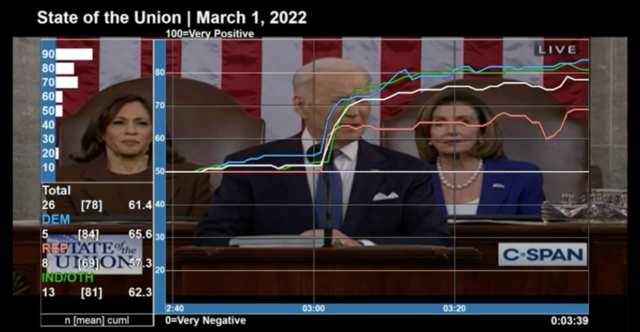
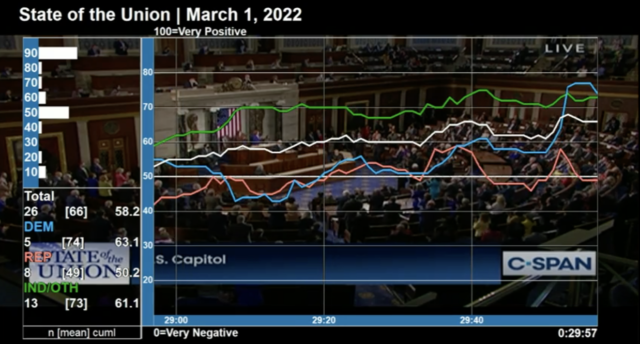
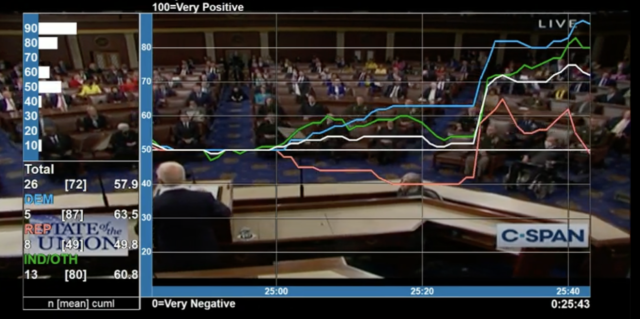
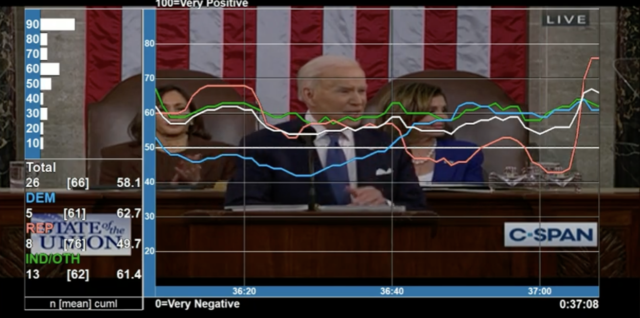
These 26 soft partisans and independents from the Denver-metro area​ adjusted dials on a scale of 0-100 to indicate how favorably they felt about each of the president’s statements (50 being neutral). They also participated in pre- and post-speech surveys grading the president on various metrics, illuminating how their opinions changed after listening to Biden’s speech.

“The results from our dial group demonstrate that Biden was able to effectively meet this moment of conflicting crises, inspiring increased confidence in his ability to handle the situation in Ukraine, a massive uptick in the belief that he is standing up for the middle class, and high levels of support for his Unity Agenda for the Nation Agenda,” said Bryan Bennett, Senior Director of Polling and Analytics at the Hub Project and advisor to Navigator Research. 

Below are some of the key findings from the dial group and pre- and post-speech surveys:

  • Ukraine: 
    1. Across the political spectrum, there was incredibly high support for standing with the Ukrainian people and with NATO, rising over 80 among Democrats and Independents and over 60 among Republicans. 
    2. There was also high support for strong economic sanctions (over 80 among Democrats and 75 among Independents) and closing airspace to Russian planes (over 95 among Democrats, 80 among Independents, and almost 60 among Republicans).

President Biden: That’s why the NATO Alliance was created to secure peace and stability in Europe after World War 2. The United States is a member along with 29 other nations. It matters. American diplomacy matters. American resolve matters. 

  • Economy: 
    1. Biden’s “Buy American” proposals had extraordinarily high support across partisanship, with dials hitting 90+ points among Democrats, near 80 among Independents, and 70 among Republicans.
    2. There was also high support for taxing the wealthy — including cross-partisan support for not raising taxes on those making less than $400,000 a year.

President Biden: Under my plan, nobody earning less than $400,000 a year will pay an additional penny in new taxes. Nobody.


  • Health Care: 
    1. Democrats responded extremely well to Biden’s statements on letting Medicare negotiate lower prescription drugs, rating the statement around 90, with Independents around 75. When Biden declared there should be a cap on the cost of insulin, dials from Democrats and Republicans all rose above 60, and Independents specifically rose to 68. 
    2. This is consistent with Navigator tracking that shows support for “expanding Medicare for seniors to include hearing coverage, lower health care costs by allowing Medicare to negotiate lower drug prices, and invest in clean energy like wind and solar power” is net +44 (66 percent support – 24 percent oppose).

President Biden: My plan to fight inflation will lower your costs and lower the deficit. 17 Nobel Laureates in economics say my plan will ease long-term inflationary pressures. Top business leaders and most Americans support my plan. And here’s the plan: First – cut the cost of prescription drugs.


  • COVID: 
    1. One of the few subjects in which Republicans and Independents reacted more favorably than Democrats was during Biden’s discussion of COVID fatigue and mask wearing. 
    2. On Biden’s strategy around vaccines, tests, antiviral drugs, and opening schools, participants scored Biden’s strategy between 60-70 overall, consistent with ratings of his handling of coronavirus among this group both before and after the speech.

President Biden: We’ve reached a new moment in the fight against COVID-19, with severe cases down to a level not seen since last July. Just a few days ago, the Centers for Disease Control and Prevention—the CDC—issued new mask guidelines. Under these new guidelines, most Americans in most of the country can now be mask free. And based on the projections, more of the country will reach that point across the next couple of weeks.


  • Unity Agenda for the Nation: 
    1. Biden’s plans to address the opioid epidemic and increase investment in mental health care were broadly popular with participants, scoring at 65+ among soft Democrats, Independents, and soft Republicans. Doing more for veterans and Biden’s cancer moonshot program scored even higher (in the 70s and 80s) across participants of all political leanings. 
    2. Throughout the entire discussion of this agenda, which lasted nearly ten minutes of the speech, dial ratings across partisanship remained above 60.
  • Post-Speech Survey Shifts 
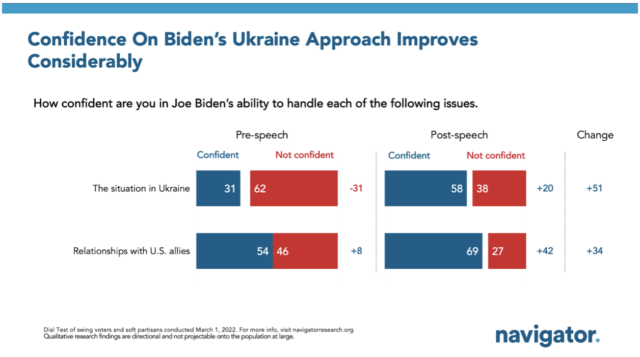
    1. After watching the speech, participants moved from net -32 to net +19 in trusting Biden to handle the crisis in Ukraine. Their trust in him to handle relationships with U.S. allies moved from net +8 to net +42. 
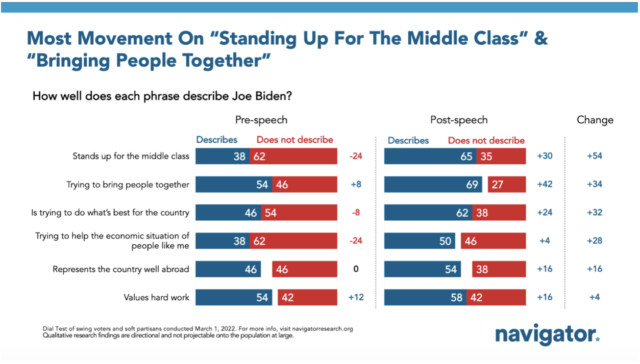
    2. Before the speech, Biden scored net +8 on “trying to bring people together” — after the speech, he scored net +42. 
    3. After the speech, the belief that Biden is fighting for the middle class shot up from net -23 to net +30. The belief that Biden is looking out for small businesses went from net -23 to even. 
    4. The belief that Biden is trying to do what’s best for the country increased significantly post-speech from net -8 to net +24.
    5. Before the speech began, just 4 percent of participants indicated they felt hopeful. By the end of the speech, 19 percent said they were hopeful.
    6. The percentage of people who said they felt angry dropped from 23 percent to 8 percent.


About Navigator Research

The Navigator Research project is designed to act as a consistent, flexible, responsive tool to inform policy debates. By conducting research and providing reliable guidance to inform allies, elected leaders, and the press, Navigator helps top leaders in Washington and grassroots leaders around the country shape the debate on the issues that matter most. Follow us on Twitter for the latest updates.

About the Dial Group

GBAO conducted a live-reaction dial group on behalf of Navigator Research on March 1, 2022 during President Biden’s State of the Union address with 26 participants in the Denver, Colorado metro area. Participants included a roughly equal mix of soft partisans (not strong Democrats, not strong Republicans) and independents without a partisan lean. Participants were also a mix based on gender, race/ethnicity, age, and educational attainment. Qualitative results are not statistically projectable.


NEW POLLING: Fewer Than One in Five Americans Believe the Economy is Creating Jobs Despite Record Job Growth in 2022

WASHINGTON, D.C. — Today, ahead of President Biden’s State of the Union address, in which he is expected to address Americans’ growing economic concerns, Navigator Research released new polling revealing a gap between official metrics of economic health and how people are experiencing the economy. 

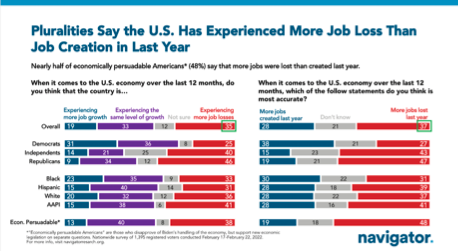
Fewer than one in five Americans believe the economy is experiencing more job growth than usual, despite the fact that the U.S. added more than 6 million jobs to the labor market last year — the biggest one-year gain for job creation in United States history.  

“There is a vast disconnect between what Americans think about job growth and how the labor market grew in 2021, which has significant implications for their overall economic perceptions,” said Bryan Bennett, the Senior Director of Polling and Analytics at the Hub Project and an advisor to Navigator. “Americans see job growth as a telling and credible indicator of the nation’s economic health, and President Biden has an opportunity to lay out some of these economic successes in his State of the Union address to help bridge this enormous divide between perception versus reality.” 

The new polling also found just 19 percent of respondents believe that the U.S. economy is experiencing more job growth than usual, including only 31 percent of Democrats, 14 percent of Independents, and 9 percent of Republicans. Americans are more likely to believe that the economy is experiencing a similar level of growth compared to prior years (33 percent) or even more job losses than compared to prior years (35 percent). This polling comes after the January jobs report found that nearly half a million jobs were added to the labor market in the first month of 2022, and ahead of the release of the February report, which is expected on Friday.

This disconnect around job growth may be contributing to continued negative sentiment about the state of the U.S. economy overall: only 26 percent rate the U.S. economy positively while 71 percent are more negative, with most Americans saying they believe the economy is getting worse (55 percent). Nearly four in five Americans believe the costs of everyday goods like groceries are going up a significant amount (78 percent), and a similar share — 77 percent — believe the price of gas is going up a lot, a high in recent Navigator’s tracking. 

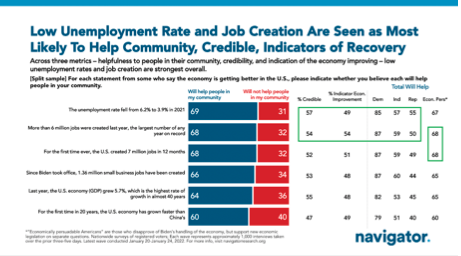
When Americans do hear about job creation and economic growth, however, they find those benchmarks to be credible indicators of economic health. Statements such as “last year, the U.S. economy (GDP) grew 5.7%, which is the highest rate of growth in almost 40 years” and “more than 6 million jobs were created last year, the largest number of any year on record” were considered good indicators of a recovering economy by most Americans (54 percent and 51 percent, respectively). 


###

About Navigator Research

The Navigator Research project is designed to act as a consistent, flexible, responsive tool to inform policy debates. By conducting research and providing reliable guidance to inform allies, elected leaders, and the press, Navigator helps top leaders in Washington and grassroots leaders around the country shape the debate on the issues that matter most. Follow us on Twitter for the latest updates.

About the Study

Global Strategy Group conducted public opinion surveys among a sample of 1,395 registered voters from February 17-February 22, 2022. 100 additional interviews were conducted among Hispanic voters. 75 additional interviews were conducted among Asian American and Pacific Islander voters. 100 additional interviews were conducted among African American voters. 100 additional interviews were conducted among independent voters. The survey was conducted online, recruiting respondents from an opt-in online panel vendor. Respondents were verified against a voter file and special care was taken to ensure the demographic composition of our sample matched that of the national registered voter population across a variety of demographic variables. The margin of error at the 95 percent confidence level is +/- 3.1 percent.