Americans Are Left Grappling With Rising Grocery Costs
Grocery and fuel costs continue to be key pain points for Americans. About three-quarters (74%) say prices are going up across the board, but gas (84%), groceries (83%), and diesel (78%) stand out the most. About half (48%) say that grocery prices are going up a lot.
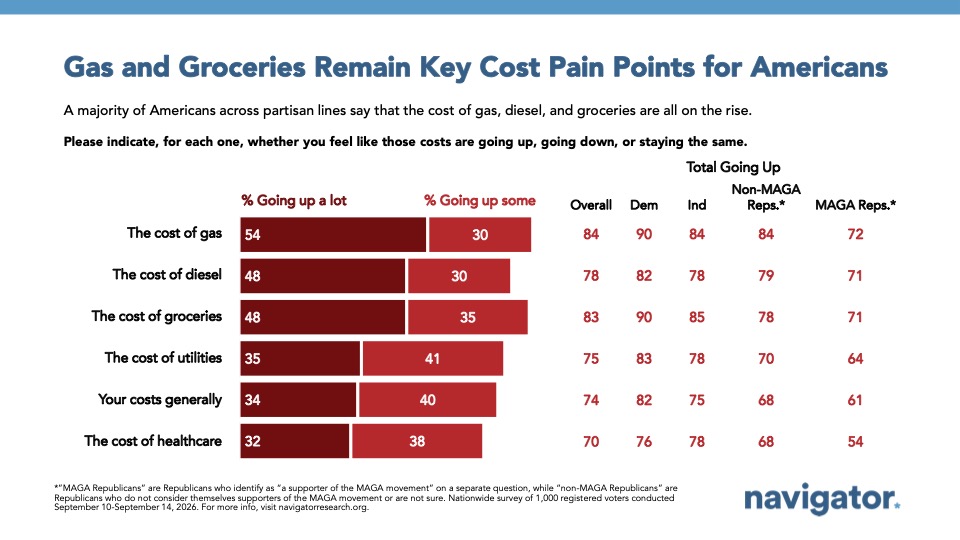
- More so than other generations, baby boomers are intensely feeling the impact of rising grocery prices (90% of baby boomers, 82% of Gen X, 79% of millennials, 77% of Gen Z say grocery prices are going up).
Groceries are squeezing American budgets more than anything else: 78% say food prices are having the greatest impact on their monthly expenses, 20 points higher than the runner-up, gas (58%).
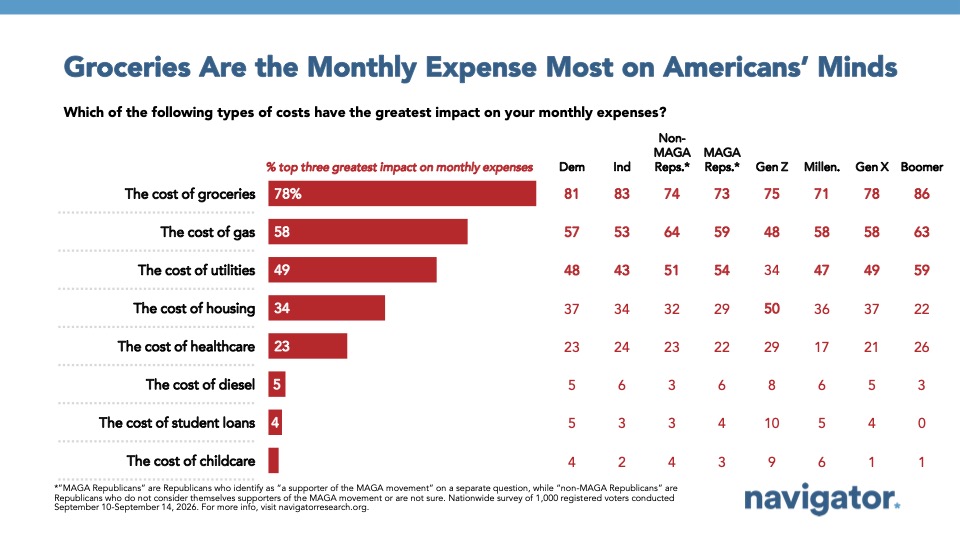
Housing costs are top of mind for younger generations, with 50% of Gen Z citing them as their greatest monthly cost driver, compared to 37% of Gen X, 36% of millennials, and 22% of baby boomers. Renters are particularly affected by housing costs (49%) as opposed to home owners (20%).
The Vast Majority of Americans Have Changed Behaviors Due to Rising Grocery Costs
More than four-in-five Americans have changed their behaviors due to rising grocery prices.
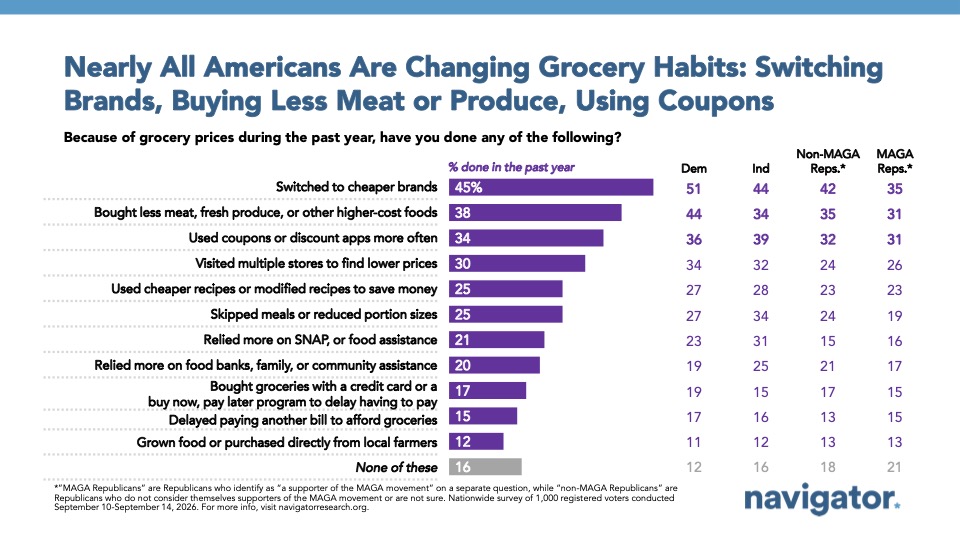
Women are more likely to have made some of these changes than men, including:
- Switching to cheaper brands (48% women – 41% men);
- Buying less meat, fresh produce, or other high-cost items (44% women – 32% men);
- Visiting multiple stores to find lower prices (34% women – 26% men); and
- Skipping meals or reducing portion sizes (29% women – 21% men).
Nearly a third (31%) of 18-44 year olds have skipped meals or reduced portion sizes due to rising costs, compared to 25% of 45-65 year olds and 17% of 65+ year olds.
Americans Want Leaders to Focus on Lowering Costs
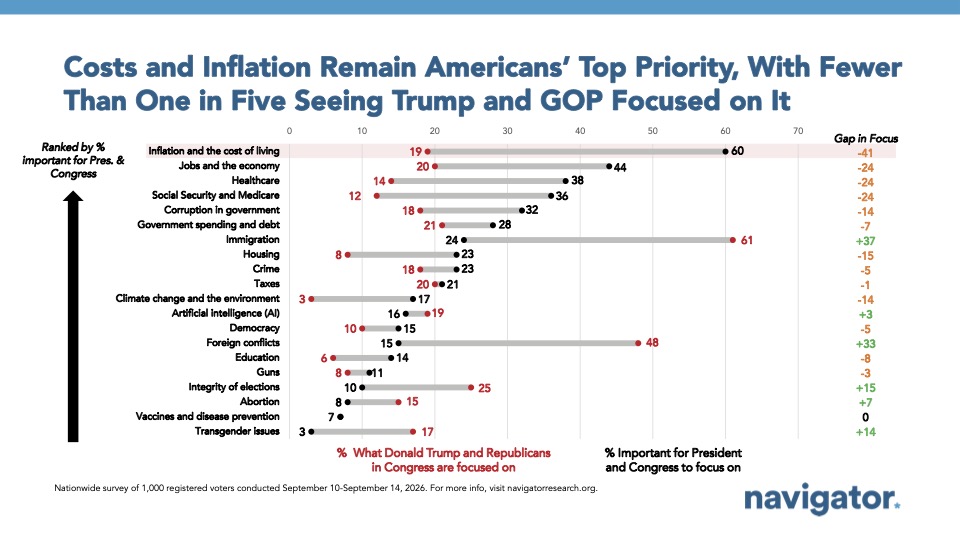
Americans overwhelmingly want their elected leaders to focus on the cost of living. Three-in-five (60%) want President Trump and Congress to focus on inflation and the cost of living. Americans across party lines (61% of Democrats – 63% of independents – 58% of Republicans) view costs as the most pressing issue for lawmakers to focus on.
However, there’s a strong disconnect between what people want the administration to focus on and what it is actually focusing on. Only 19% say Trump and Republicans in Congress are focused on inflation and the cost of living, despite it being a top concern for Americans, while 61% say they’re focused on immigration.
Americans are evenly split on whether Democrats in Congress are focused more or less on cost of living issues now than they were during the 2024 election (34% more focused – 34% less focused – 22% the same). Nearly half say Republicans in Congress are less focused on cost of living issues now than they were two years ago (21% more focused – 49% less focused – 20% the same).
Independents have a more grim view of both parties, with 38% saying Democrats are less focused and 48% saying Republicans are less focused. Just 15% say Democrats are more focused, while 10% say Republicans are more focused.
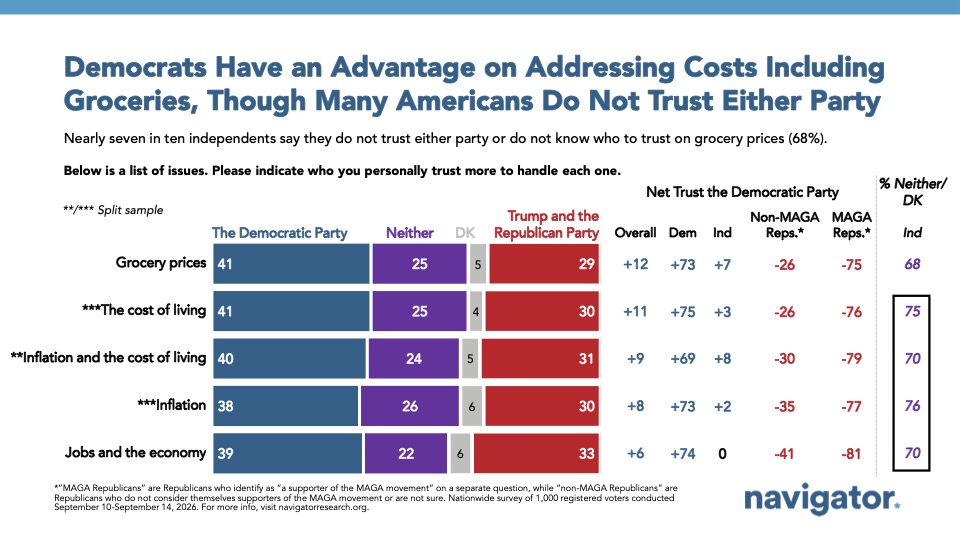
Democrats have a net +12 point trust advantage on handling grocery prices, net +10 point advantage on gas prices, and net +9 point advantage on cost of living. Still, around a third of Americans (32%) don’t trust either party or know enough to say on gas prices; 29% trust neither party or don’t know enough to say on cost of living, and 30% trust neither or don’t know enough to say on grocery prices. Notably, a majority of independents trust neither party or don’t know enough to say on cost of living (75%) or grocery prices (68%).
Providing Free School Meals To Kids in Need and Restoring SNAP Cuts Are Policy Solutions That Resonate
When asked to rank policies to lower grocery prices, Americans identified the following as the most popular:
- Providing free school meals for children in need.
- Restoring nutrition assistance that was cut for families, seniors, and people with disabilities.
- Banning price gouging and surveillance pricing on groceries. Surveillance pricing refers to companies using personal data to charge different customers different prices for the same product.
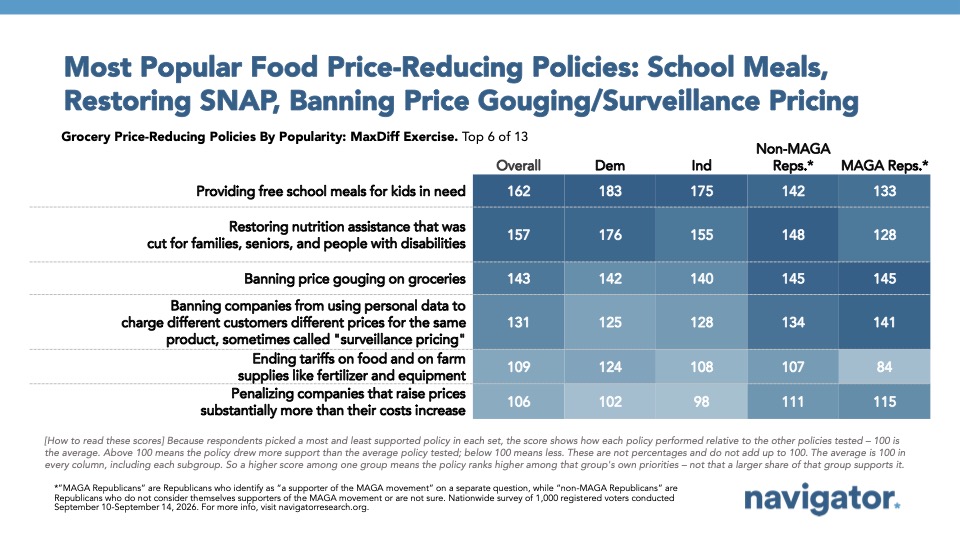
Democrats, independents, and women rank providing free school meals and restoring nutrition assistance highly while Republicans and white Americans rank banning price gouging and surveillance pricing highly.
The least popular cost-lowering policies tested include cutting regulations and permitting requirements that raise food production costs, blocking mergers between large grocery chains, and creating publicly run grocery stores.
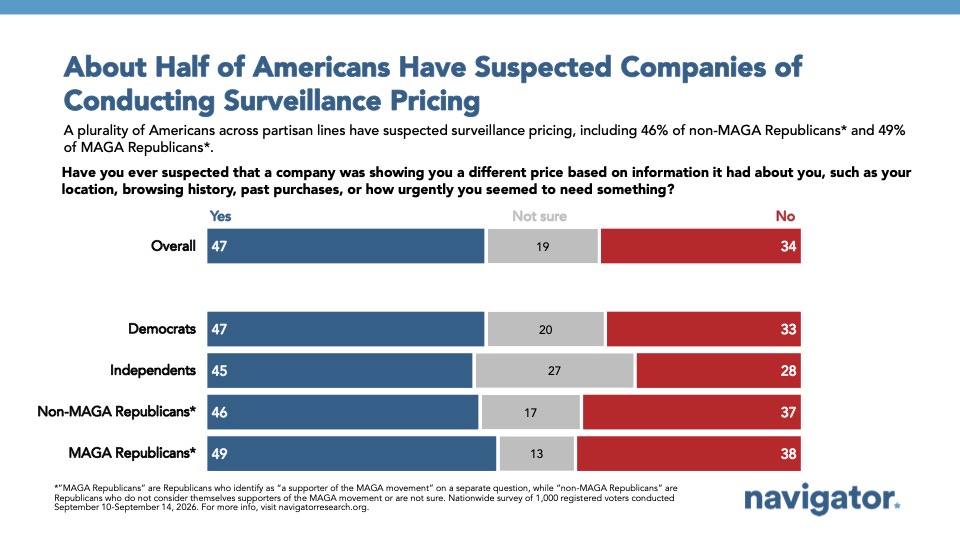
Nearly Half of Americans Are Familiar With Surveillance Pricing And Think It’s Raising Their Costs
Around half (48%) of Americans have heard a lot or some about surveillance pricing. There is higher recognition among 18-44 year olds (56%) compared with 65+ year olds (39%).
Nearly half (47%) of Americans suspect surveillance pricing is being used to raise their prices. A higher percentage of young people 18-44 years old (59%) have suspected surveillance pricing is raising their costs compared to those 65+ (35%).