

Poll: Landscape
This Navigator Research report covers perceptions of government leaders, including which party is more trusted to handle the issues that matter most to Americans in the battleground, and who is seen as having the right priorities.
Leaders Across Both Parties Viewed Negatively
Frustration with both political parties is palpable among battleground constituents. Democrats and Republicans in Congress are both viewed overwhelmingly unfavorably (63% and 61%, respectively), though named Democratic incumbents fare better than Republican incumbents with a narrow but positive favorability rating of net +1. Republican incumbents are struggling more significantly and are underwater by 13 points.
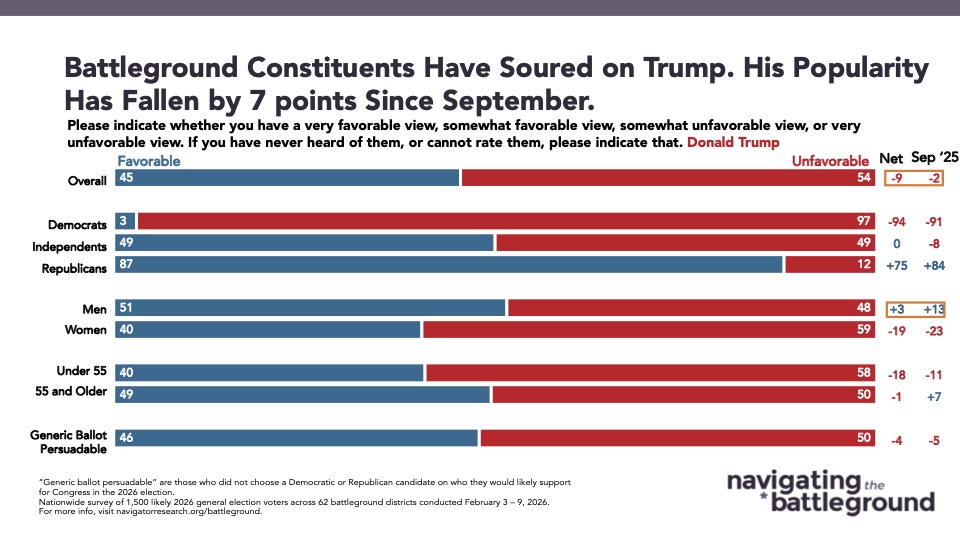
A majority of battleground constituents view President Trump negatively (54%), including a majority of independents who break against him by eight points (43% favorable – 51% unfavorable).This is aligned with findings at the national level with 56% of Americans viewing Trump unfavorably. Independents in the national survey are slightly more unfavorable towards Trump, with 58% viewing him unfavorably and just 32% favorably.
Similarly, 54% of battleground constituents view Vice President Vance negatively and opinions are notably intense, with over half (51%) saying they see him “very” unfavorably.
Economy, Corruption, Threats to Democracy Remain Top Priorities
The cost of living, jobs, and the broader economy dominate the concerns of battleground constituents. More than four-in-ten (42%) of battleground constituents rank economic issues among their top priorities, with inflation and cost of living leading the list (29% inflation and cost of living, 13% jobs and the economy).
Concerns about the health of our democracy and government corruption are also top of mind. One-third list government corruption (36%) and threats to democracy (33%) among their top two priorities, and nearly a quarter (23%) say protecting democracy should be the number one issue Congress is focused on.
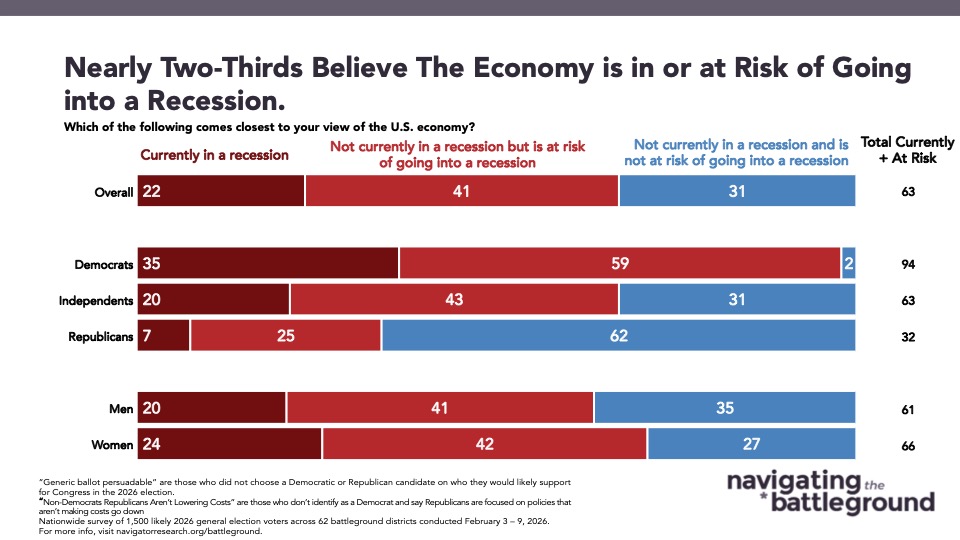
Additionally, nearly two-thirds believe the economy is currently in or at risk of going into a recession. While many battleground constituents want Congress to focus on the economy and lowering the cost of living, a decisive majority believe Republicans in Congress are focused elsewhere. A clear majority (59%) believe Congressional Republicans are instead focused on immigration, followed by 17% who say they are focused on national security. Yet immigration ranks as the top issue for fewer than one in ten battleground voters (9%), and national security barely registers as the most urgent priority (only 4%).
This misalignment of priorities is clear to battleground constituents. By an 18-point margin, they say Donald Trump and Republicans in Congress are focused on the wrong things (39% right things – 57% wrong things). A majority believe they are most focused on non-economic issues (58%), rather than economic issues (39%) even as the latter is a top priority for battleground Americans.
On Top Issues, Battleground Constituents Are Split On Who They Trust
Democrats in Congress hold a slight trust advantage with battleground constituents on several cost of living issues. They’re more trusted on lowering costs for working families (net +8), making health care and prescription drugs more affordable (net +8), and looking out for “people like me” (net +3). These advantages aren’t overwhelming, but they suggest that on day-to-day affordability issues, Democrats have a slight trust advantage over Republicans.
However, Republicans in Congress do hold a small advantage over Democrats on handling the economy (net +3), a longstanding strength for the party that still resonates, even for battleground constituents. This is similar to the net +2 advantage Republicans in Congress hold over their Democratic counterparts on handling jobs and the economy in Navigator’s latest national survey.
Democrats in Congress hold commanding trust advantages on ensuring the wealthy pay their fair share in taxes (net +23) and standing up to corporate special interest (net +9). When it comes to broader issues of corruption and changing the system, Americans in the battleground are essentially split on who they trust. By only 1 point, Democrats in Congress are more trusted to stand up to corruption (with 25% saying they trust neither party), and to bring needed change (24% trust neither party). Congressional Republicans hold a 5-point advantage over Democrats in Congress when it comes to fixing a broken system in Washington – though a plurality trust neither party (36% trust neither – 33% trust Republicans – 28% trust Democrats). This signals a significant share of Americans remain unconvinced that either party can meaningfully deliver for them.
Congressional Democrats and Helping Working People
While Democrats in Congress have a slight trust advantage on lowering costs for working families and looking out for “people like me,” battleground constituents don’t believe “cares about people like me” describes Congressional Democrats well (37% describes well – 60% does not describe well).
Nearly as many aren’t convinced that Democrats “look out for working people” (40% describes well – 59% does not describe well). Slightly more than half say the word “elitist” is a fit description for Democrats in Congress (53%).
That disconnect shows up again when battleground constituents are asked who Democrats are helping. Congressional Democrats are seen as more likely to be focused on helping “other people than people like me” (55%) rather than helping “people like me” (30%). Even so, a plurality say the economic policies of Democrats in Congress most favor the middle and working class (38% middle/working class – 30% wealthy/corporations – 18% the poor).