
Poll: The Epstein Files
This Navigator Research report covers what Americans are hearing when it comes to the Trump administration and the Epstein files.
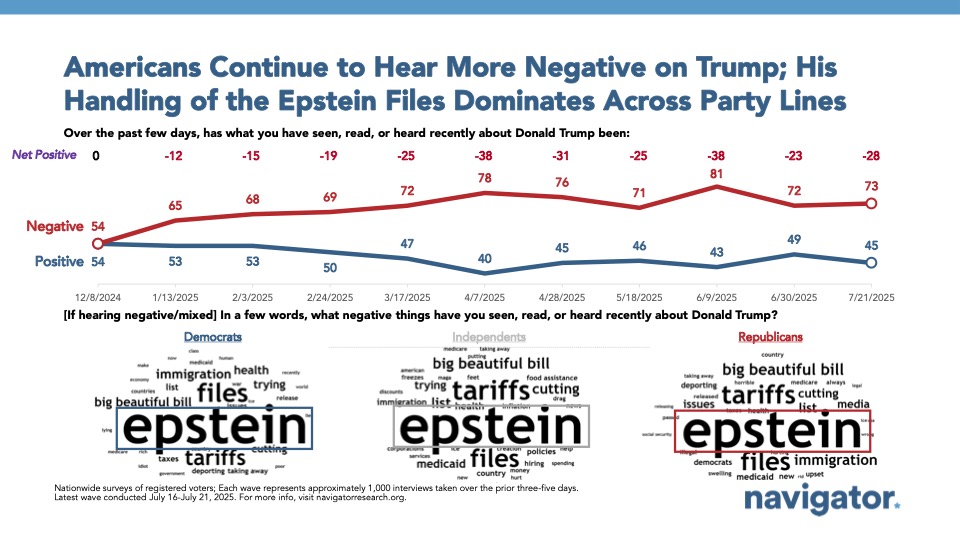
Among those who say they have seen, read, or heard negative news about President Trump over the last few days, the Epstein files clearly dominate.
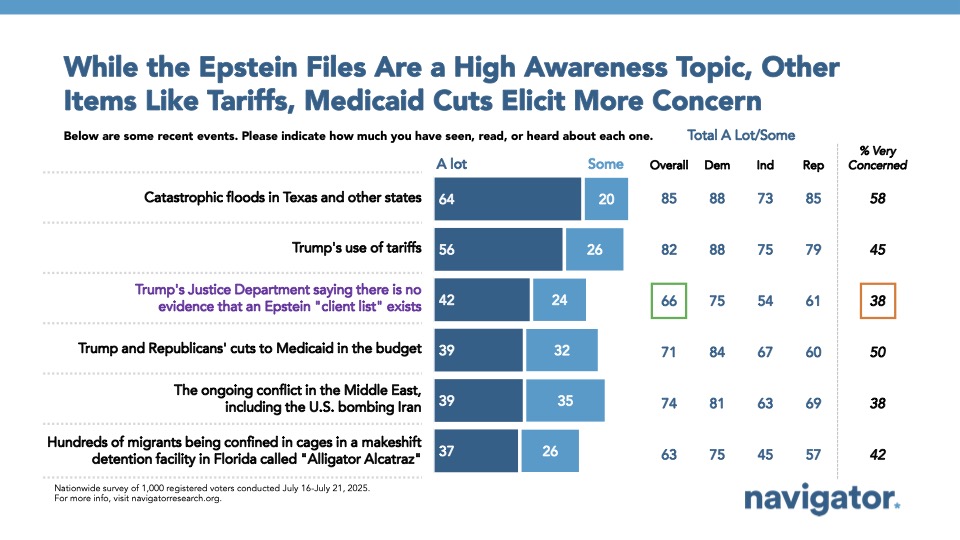
Overall, 42 percent say they have seen, read, or heard a lot about the Justice Department’s handling of the Epstein files, with 66 percent saying they have heard at least some.
Majorities of Democrats, independents, and Republicans have read at least some about this issue. But it has broken through more acutely on the partisan edges, with liberal Democrats and conservative Republicans most likely to report hearing news about the Epstein files.
While Americans who get their news from Fox, MSNBC, and Twitter are hearing the most about this issue, news has broken through across platforms. Half (53 percent) of passive news consumers have heard at least some about this. Among those who say they are less engaged with politics, 58 percent are hearing at least some about this issue.
The Epstein files have dominated the negative news for President Trump. Nevertheless, more Americans report hearing news about the floods in Texas (85 percent) and Trump’s use of tariffs (82 percent).
A Cover-up
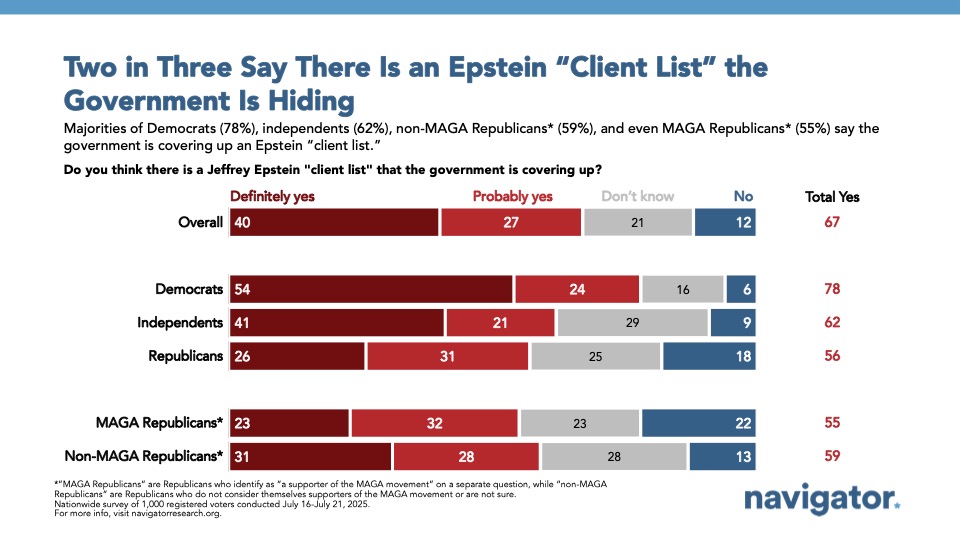
Strikingly, two-thirds of Americans say they believe there is an Epstein client list the government is covering up, including majorities of Democrats, independents, and Republicans. Four in ten Americans believe there is definitely a list, including a quarter of Republicans.
While this has been a heated issue in the conservative media landscape, Democrats (78 percent) and independents (62 percent) are more likely than Republicans (56 percent) to believe there is a list.
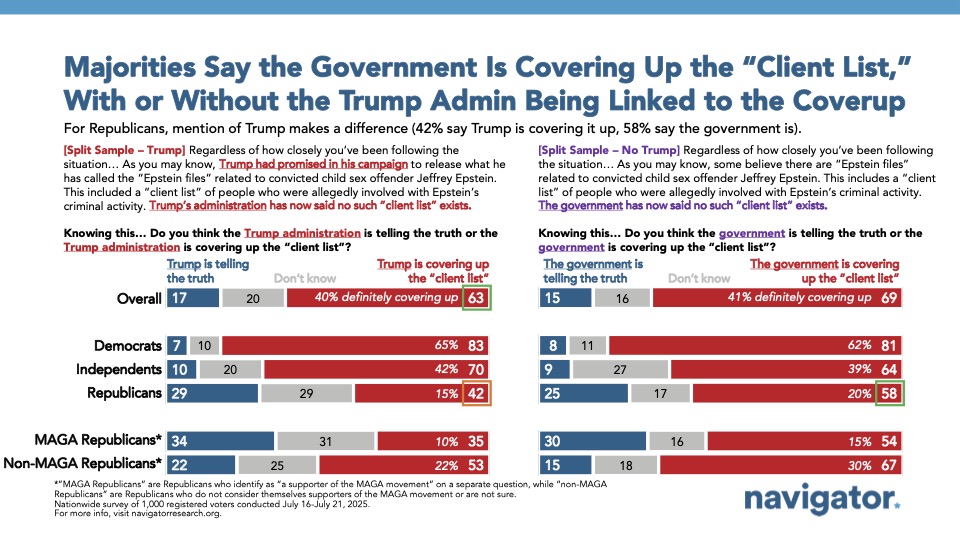
Majorities say the government is covering up the Epstein “client list.” When the question does not mention President Trump, majorities of Democrats, independents, and Republicans believe there is a government cover-up.
When Trump is included in the question, however, we observe a 16-point drop (from 58 percent to 42 percent) in Republicans who believe there is a government cover-up of the Epstein client list.
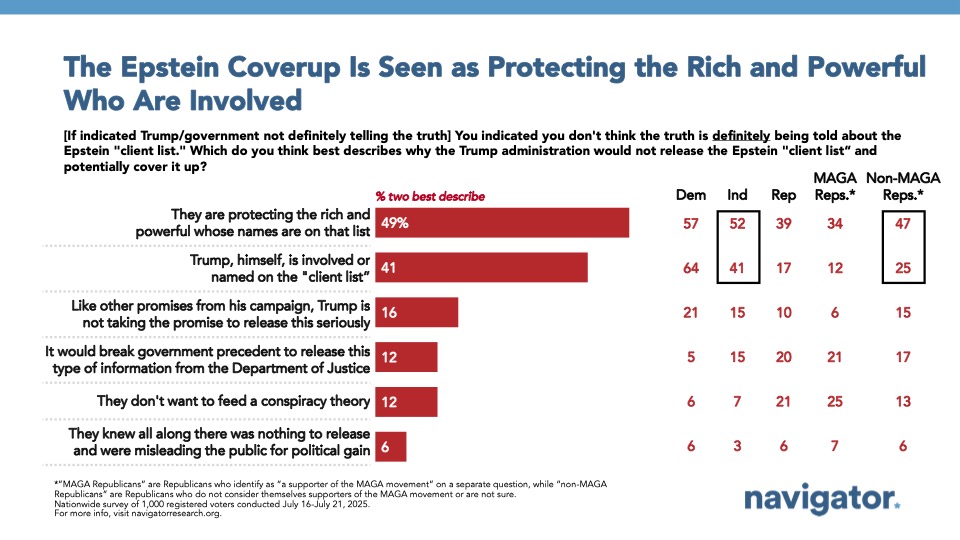
Among those who believe the government is not telling the truth, the top reasons are:
- Protecting the rich and powerful names on the list
- Trump is named or at least implicated.
Independents and Republicans are more likely to say the government is covering it up to protect the rich and powerful. Half (47 percent) of non-MAGA Republicans believe the government is not telling the truth in order to protect those with means and influence.
By contrast, Democrats are most likely to believe it’s because Trump is either involved or named on the list. It is notable that 17 percent of Republicans overall, 25 percent of non-MAGA Republicans, and 41 percent of independents believe that Trump is implicated on the Epstein client list.
Nonetheless, protecting the rich and powerful is a stronger frame than one that suggests Trump himself is implicated. This frame has more reach than one that speaks primarily just to Democrats.
Not Just Another Conspiracy Theory
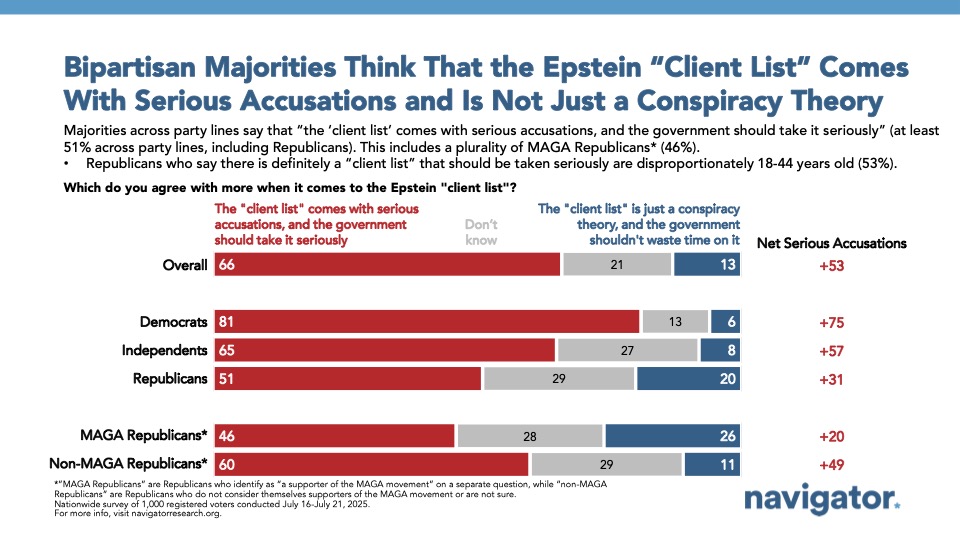
Just 13 percent say this is just a conspiracy theory and the government shouldn’t waste its time on it. Instead, two-thirds of Americans say the Epstein client list comes with serious accusations, and the government should take it seriously. This includes majorities of Democrats, independents, and Republicans.
While there is majority agreement across parties, there is a 30-point gap between the 81 percent of Democrats who believe it’s serious and the 51 percent of Republicans who say the same.
Concerning, but not the most
Four in ten Americans say they are very concerned about the Trump Justice Department’s handling of the Epstein files, and 57 percent are at least somewhat concerned. Concern is driven by Democrats, three-quarters of whom are concerned about this. Among independents (45 percent) and Republicans (43 percent), concern is much lower.
While Americans are concerned about the Justice Department’s handling of the Epstein files, the issue is eclipsed by other issues of more immediate and personal concern to Americans: floods in Texas (84 percent), cuts to Medicaid (69 percent), cuts to FEMA (66 percent), and the ongoing conflict in the Middle East (71 percent).