
Poll: Corruption
This Navigator Research report covers the most recent perceptions of why elected officials are unable to get things done, including who Americans believe are more likely to be beholden to special interests, and how elected officials can show they can be trusted.
Why Elected Officials Can’t Get Things Done
Eight-in-10 Americans believe elected officials’ focus on enriching themselves and their donors stops them from getting things done, including 86% of Democrats, 78% of independents, and 74% of Republicans. Other top barriers to progress include: an unwillingness to reach across the aisle (77%), being out of touch and not understanding the struggles everyone else faces (77%), unwillingness to stand up to the most extreme members of their party (78%), and working for corporations instead of people (76%).
- Among both independents and rural Americans, the perceived greatest barrier to elected officials getting things done is that they don’t understand the struggles everyone else faces (80%).
- Among non-MAGA Republicans, the perceived greatest barrier is only doing what party leaders tell them to do (73%).
Republicans Seen as More Likely to Be Working for Corporations Instead of the People
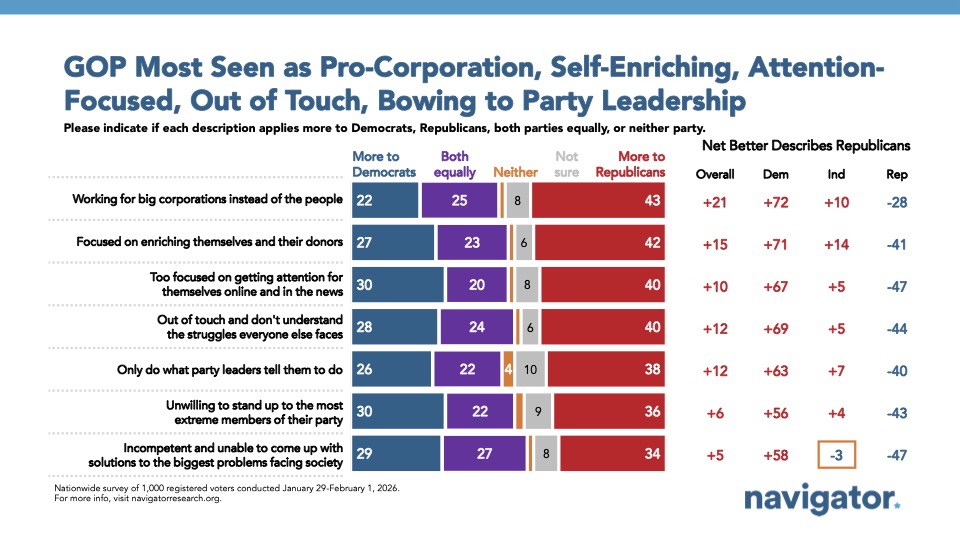
By 21 points, Americans believe Republicans are better described as “working for big corporations instead of the people” than Democrats (43% Republicans – 22% Democrats). By similar margins, Republicans are more viewed as:
- Focused on enriching themselves and their donors (net +15)
- Out of touch and don’t understand the struggles everyone else faces (net +12)
- Too focused on getting attention for themselves online and in the news (net +10)
Both Parties Viewed as Swayed by Special Interests
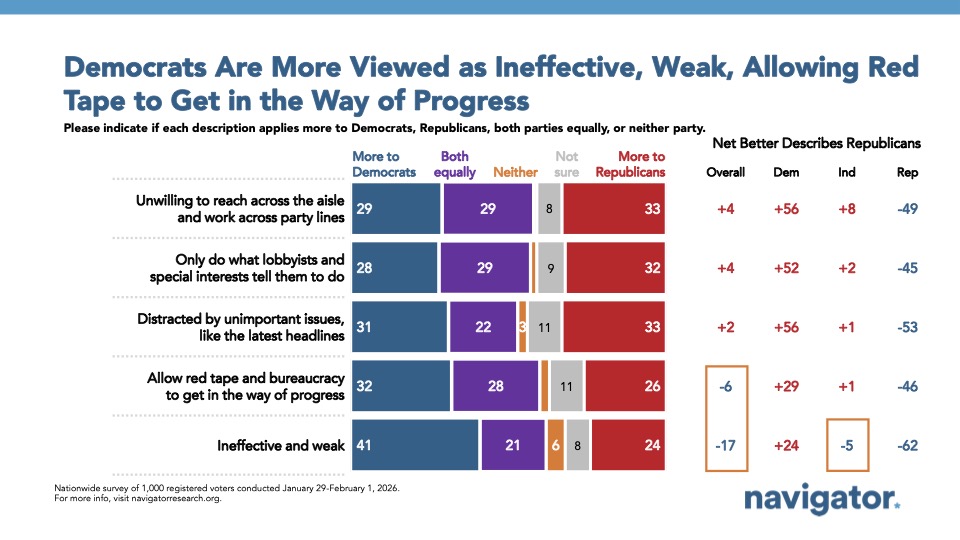
Americans are split on which party is better described as “incompetent and unable to come up with solutions to the biggest problems” (29% Democrats – 34% Republicans – 27% both equally), “only do what lobbyists and special interests tell them to do,” (28% Democrats – 32% Republicans – 29% both equally) and “distracted by unimportant issues” (31% Democrats – 33% Republicans – 29% both equally). For each of these descriptors, nearly half of independents believe they describe both parties equally.
Democrats Seen as More Ineffective and Weak
By 17 points, Americans believe “ineffective and weak” better describes Democrats than Republicans, though a plurality of independents believe it best describes both parties equally (40%). By a six-point margin, Americans also believe “allow red tape and bureaucracy to get in the way of progress” better describes Democrats than Republicans.
How Elected Officials Can Build Trust with Americans
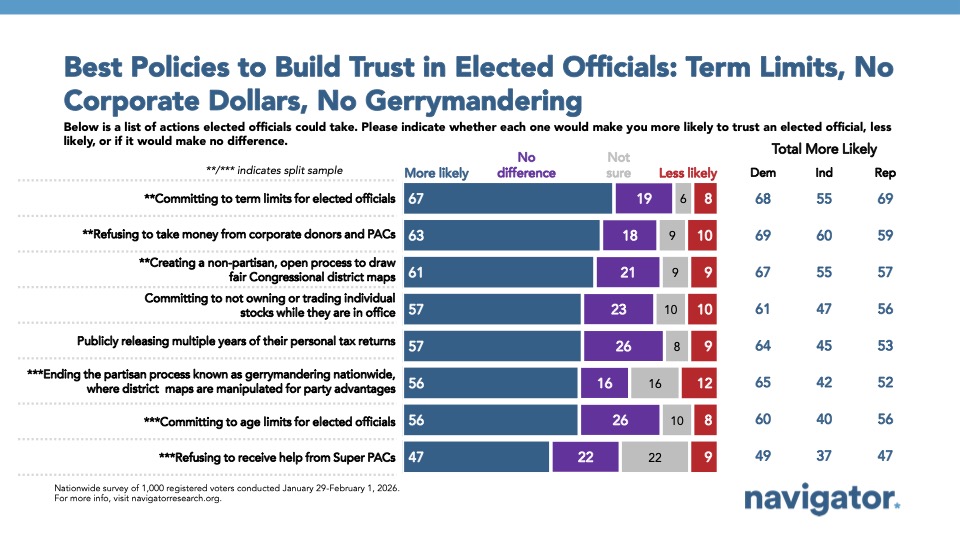
Across partisanship, majorities are more likely to trust an elected official who commits to term limits (67%), including 68% of Democrats, 55% of independents, and 69% of Republicans. Similarly, an elected official who refuses to take money from corporate donors and PACs would be viewed as more trustworthy (63%), including by 42% who say they would be “much” more likely to trust that elected official. Other popular reforms include:
- Creating a non-partisan, open process to draw fair Congressional district maps (more likely to trust among 67% of Democrats, 55% of independents, 57% of Republicans)
- Committing to not owning or trading individual stocks while in office (more likely to trust among 61% of Democrats, 47% of independents, 56% of Republicans).
- Publicly releasing multiple years of their personal tax returns (more likely to trust among 64% of Democrats, 45% of independents, 53% of Republicans).
Read more from Navigator: An early 2025 survey found that 74% believe the American political and economic system needs major changes. Within that three-quarters majority, 12% are so discontented that they believe the system needs to be torn down completely. Remarkably, this cuts fairly evenly across party lines. Our October 2025 focus groups on political dysfunction further underscored frustrations with the status quo and despair with the state of American politics.