Poll: Government Shutdown
This Navigator Research report covers perceptions of a potential government shutdown, including who Americans would blame most.
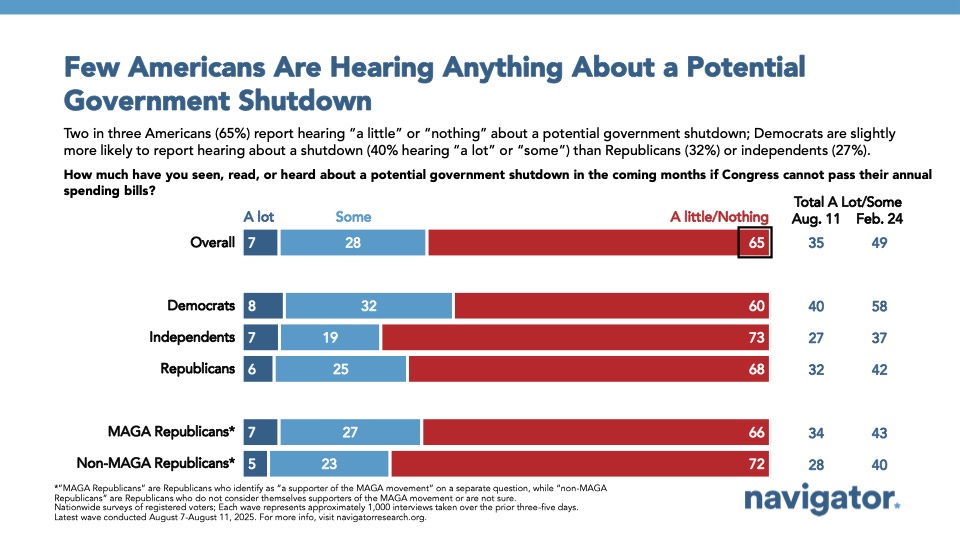
Just one-third of Americans are hearing news about a potential government shutdown in the coming months if Congress cannot pass their annual spending bills (35 percent), a decrease from this past February when Congress previously faced a shutdown (49 percent).
Americans who actively seek out news are nearly 20 points more likely to be hearing about a government shutdown than those who passively consume news (42 percent active news consumers – 24 percent passive news consumers).
The Blame Game
Though awareness remains low, a plurality of Americans say President Trump and Republicans in Congress would be to blame if the government were to shut down in the coming months (net +22; 48 percent Trump and Republicans in Congress – 26 percent Democrats in Congress), including independents by a 25-point margin. This past February when Congress was previously on the brink of a shutdown, a similar share said Trump and Republicans would be to blame (net +20).
Americans say they would blame Trump and Republicans more than Congressional Democrats regardless of whether they are active news consumers (net +20; 49 percent Trump and Republicans in Congress – 29 percent Democrats in Congress) or passive news consumers (net +26; 46 percent Trump and Republicans in Congress – 20 percent Democrats in Congress).

Positioning Progressives
Support is higher for Democrats framing the funding debate as supporting bills as long as they meet certain conditions, rather than opposing them unless they meet certain conditions. We tested two arguments against the following: “Democrats who say that without the majority there’s not much they can do to stop Trump, and so they should at least keep the government working.” The best testing message positioned progressives as fighting for Americans’ best interests, rather than purely against Trump and Republicans:
- Democrats who say they should be willing to support the spending bills, as long as they meet conditions: that they don’t cut funding for public schools, take away health care that people depend on, or defund research into lifesaving cures (net +18, including net +34 among independents); and,
- Democrats who say they need to oppose the spending bills and threaten to shut down the government, unless they are able to stop Trump’s power grab and Republicans’ outrageous budget cuts (net +2; including net -4 among independents).

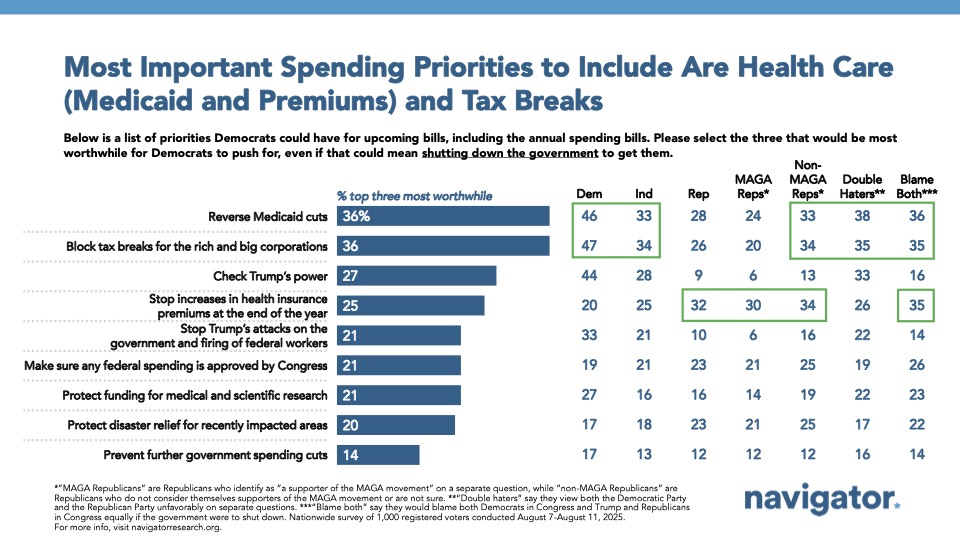
While most agree Democrats in Congress should support spending bills if their policy priorities are met, some priorities are seen as more worth fighting for if it means shutting the government down. When selecting three policy priorities that would be worth Democrats in Congress pushing for even if it means shutting the government down, 36 percent say reversing Medicaid cuts would be worthwhile, including 46 percent of Democrats, 33 percent of independents, and 28 percent of Republicans. Similarly, 36 percent say blocking tax breaks for the rich and powerful would be worth Democrats in Congress pushing for. Among Republicans, the greatest policy priority worth pushing for – even if it meant shutting the government down – is stopping increases in health insurance premiums (32 percent).