Poll: Greenland, ICE and Venezuela
This Navigator Research report covers the latest views of President Trump’s priorities while in office, including views of his recent actions in Venezuela, perceptions of ICE and the shooting of Renee Good, and what Americans believe the President should be focused on.
Americans’ Priorities vs Trump’s Priorities
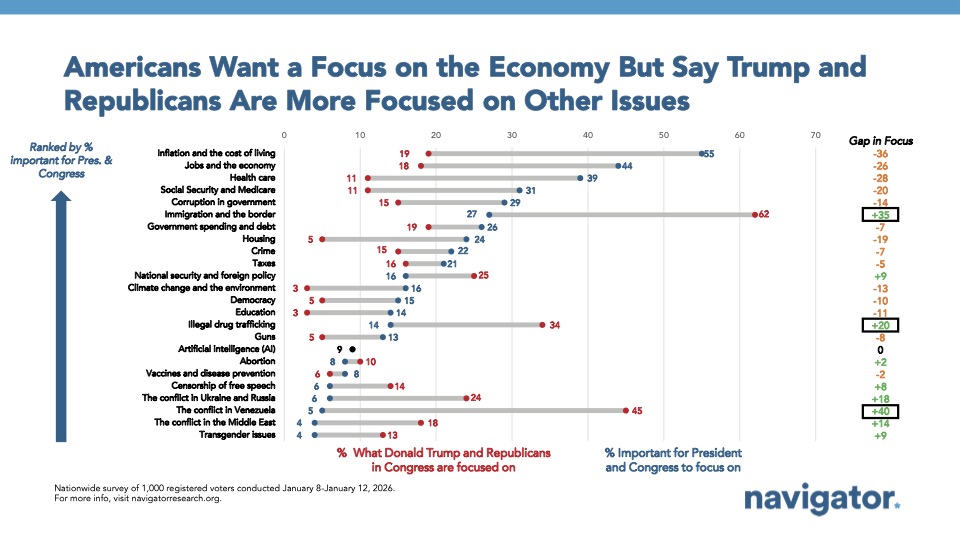
Majorities of Americans across partisanship want the President and Congress to be focused on inflation and the cost of living (56% of Democrats, 54% of independents, and 54% of Republicans). After inflation and the cost of living, Americans cite jobs and the economy (44%), health care (39%), Social Security and Medicare (31%), and corruption in government (29%) as the issues they want the President and Congress to focus on.
Though when it comes to the issues Americans want the government to focus on versus what they believe Trump and Republicans in Congress are most focused on, priorities are not aligned. Nearly two thirds say Trump and Republicans in Congress are focused on immigration and the border (62%) – while only a quarter say this should be a priority (27%). Nearly half believe Trump and Congressional Republicans are focused on the conflict in Venezuela (45%), a priority for only 5% of Americans.
Foreign Intervention and Venezuela
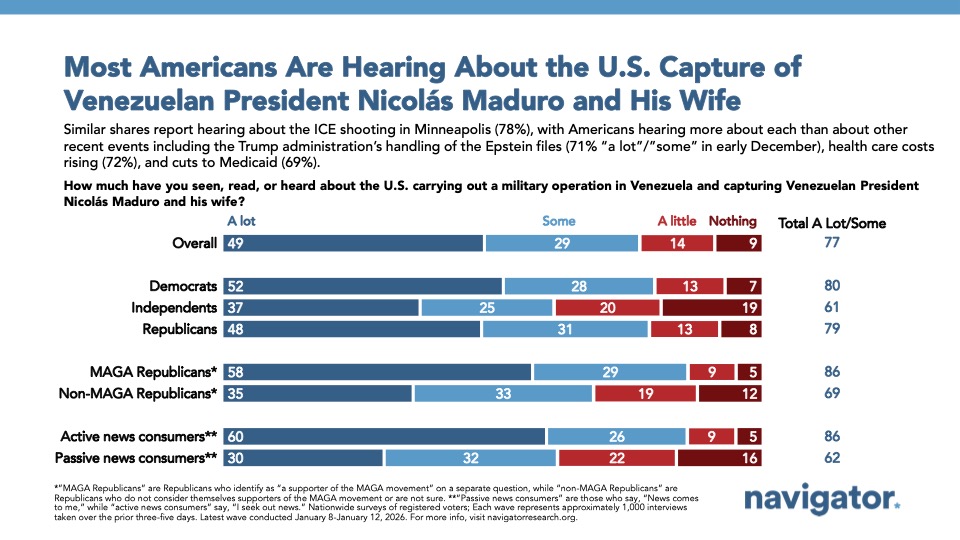
News of the U.S. carrying out a military operation in Venezuela and capturing President Nicolás Maduro has broken through to 77% of Americans, including 62% of passive news consumers – who say news comes to them (rather than seeking out news).
Support for this military operation is split and heavily influenced by partisanship (43% support – 43% oppose), though majorities agree the U.S. should not take control of Venezuela and run the country (37% support – 53% oppose), including a plurality of non-MAGA Republicans by a 2-point margin (43% support – 45% oppose).
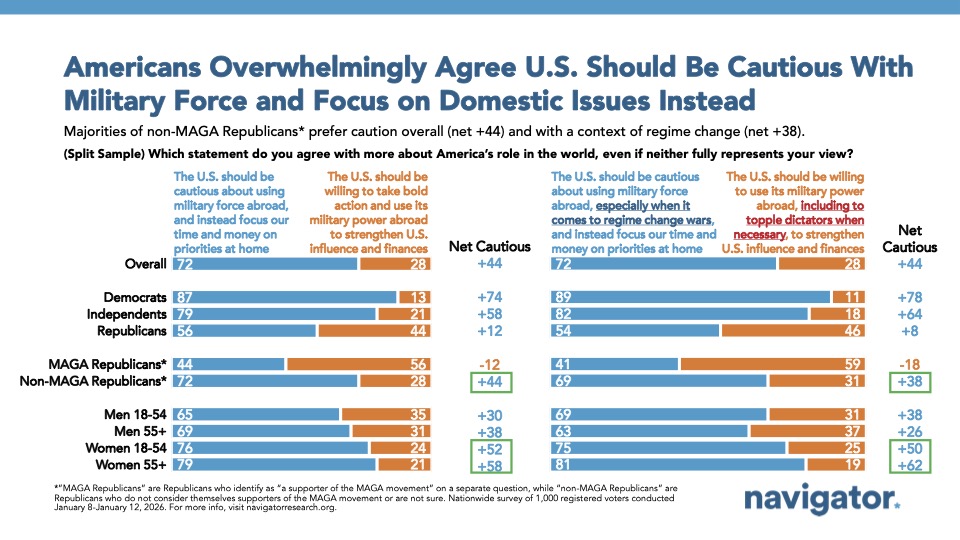
Nearly three quarters of Americans believe the US should be cautious about using military force abroad and instead focus priorities at home (72%), while only 28% believe the U.S. should be taking bold actions to strengthen influences and finances. This margin stays the same even after adding the context of toppling a dictator:
“The U.S. should be willing to use its military power abroad, including to topple dictators when necessary, to strengthen U.S. influence and finances”
While 72% agree with the opposing message:
“The U.S. should be cautious about using military force abroad, especially when it comes to regime change wars, and instead focus our time and money on priorities at home.”
Greenland
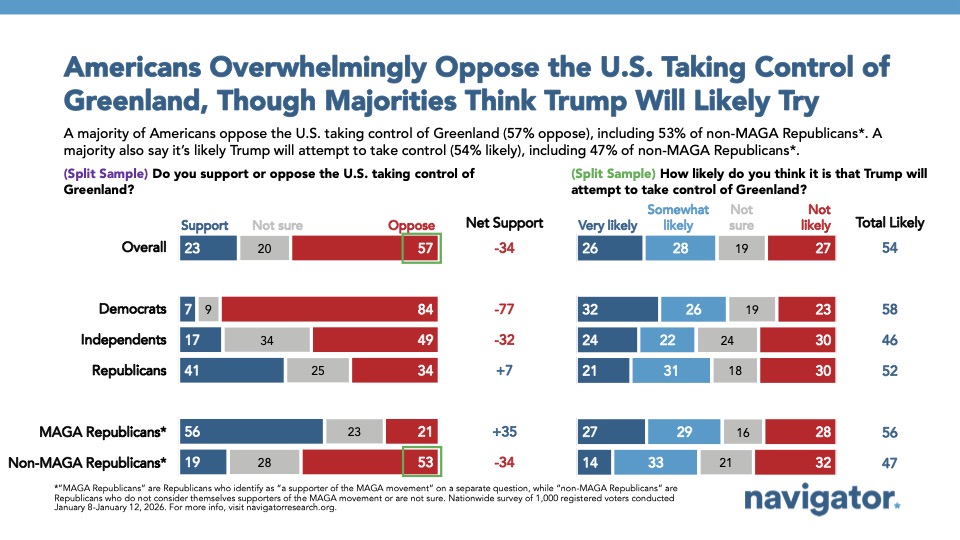
By a 34-point margin, a majority oppose the U.S. taking control of Greenland (23% support – 57% oppose). Republicans as a whole narrowly support the U.S. taking control of Greenland (net +7), though non-MAGA Republicans oppose the move by 34-points (19% support – 53% oppose). A majority of Americans believe it is likely that President Trump will attempt to take control of Greenland (54% likely – 27% unlikely), including 58% of Democrats, 52% of Republicans, and 46% of independents.
ICE
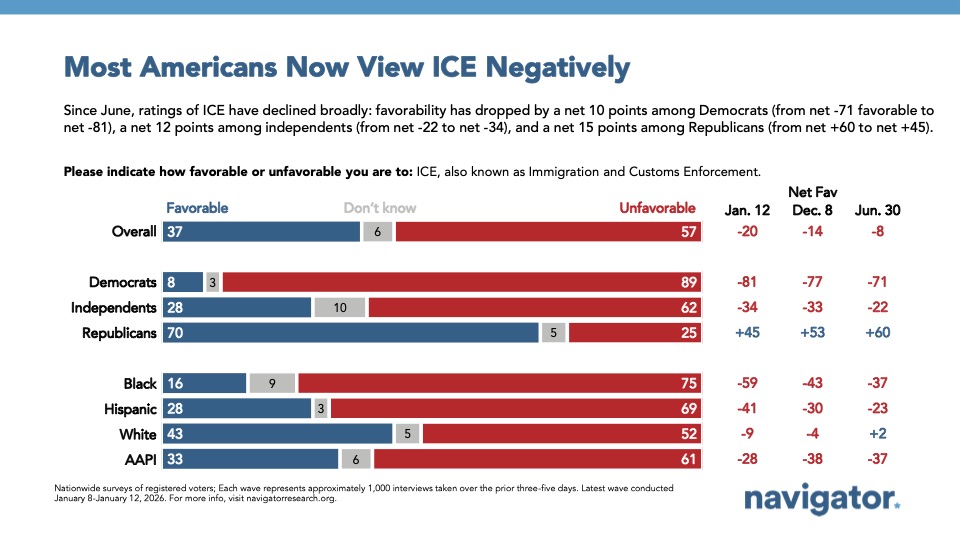
ICE’s favorability has dropped significantly in the past year, including in the wake of the shooting of Renee Good in Minnesota. In June 2025, ICE’s net favorability was -8 with 42% seeing the agency positively and 50% negative. The latest polling, which was fielded the day after an ICE officer shot Good, found ICE had a net -20 favorability, with only 37% favorable and 57% unfavorable. ICE is also one of the most prominent negative news stories regarding the President in qualitative data.
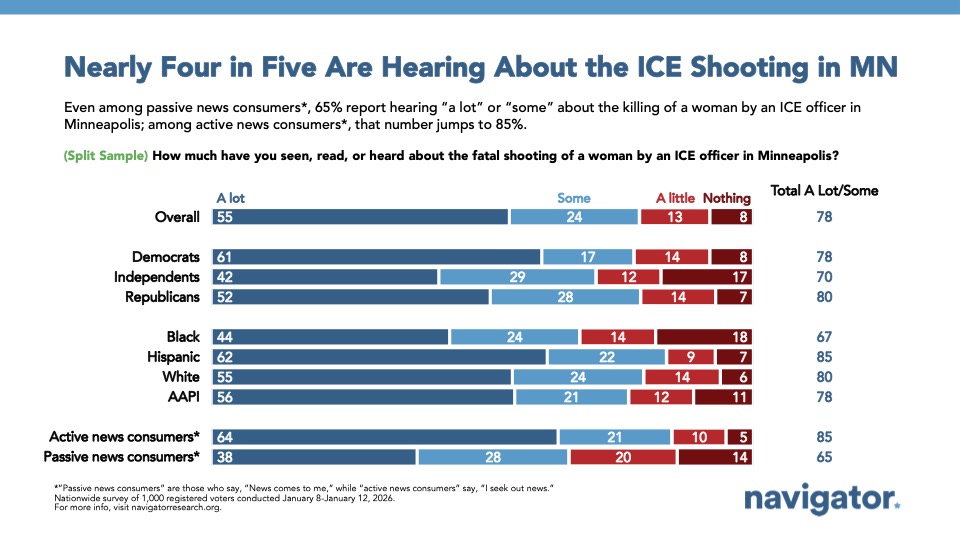
More than three-in-four (78%) say they have seen at least some news about the ICE officer in Minneapolis shooting Renee Good with 55% saying they have seen, heard, or read “a lot” about it. This includes nearly two-thirds of passive news consumers (65%).
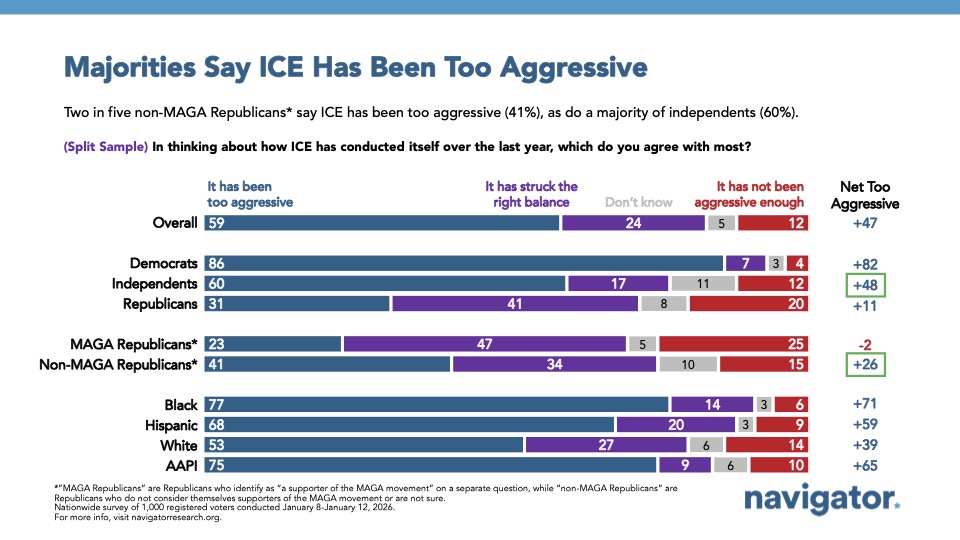
Nearly six-in-10 say that ICE has been too aggressive in its approach (59%), including 41% of non-MAGA Republicans. In Navigator’s June 2025 survey, only 52% said the administration has been too aggressive in their approach to deportations.