

Americans are Mostly Unfamiliar With Prediction Markets
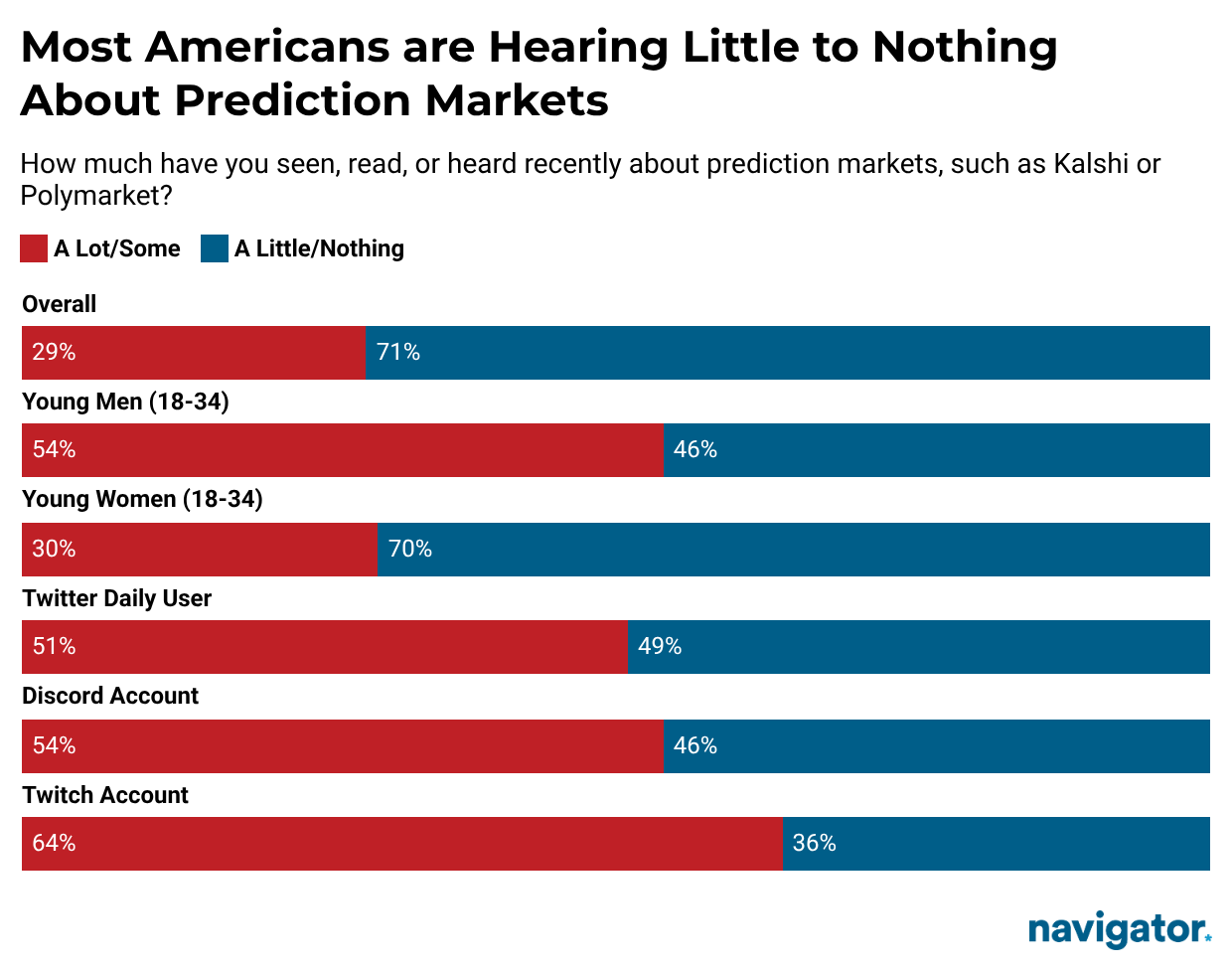
Despite their prevalence in the news and the attention on Capitol Hill, most Americans are hearing little to nothing about prediction markets. Over seven-in-10 say they have recently heard “a little” or “nothing” about prediction markets like Kalshi and Polymarket (71%).
Even among Americans who say they “frequently” or “sometimes” engage in online gambling, only 47% say they have recently heard “a lot” or “some” about prediction markets – and over one-third say they’ve heard nothing at all (36%).
Young men are more aware of prediction markets. Over half of men ages 18-34 say they have recently heard “a lot” or “some” about prediction markets (54%). Conversely, seven-in-10 women ages 18-34 report recently hearing “a little” or “nothing” about prediction markets (70%).
While familiarity with prediction markets is relatively similar across traditional media sources, such as local TV (28%) and radio (36%), users of a select few social media platforms have more awareness:
- 51% of daily Twitter users say they are hearing “a lot” or “some.”
- 54% of those with a Discord account report hearing “a lot” or “some.”
- 64% of those with a Twitch account report hearing “a lot” or “some.”
Younger Men are Gambling or Using Prediction Markets the Most; Virtually No Baby Boomers Use Prediction Markets
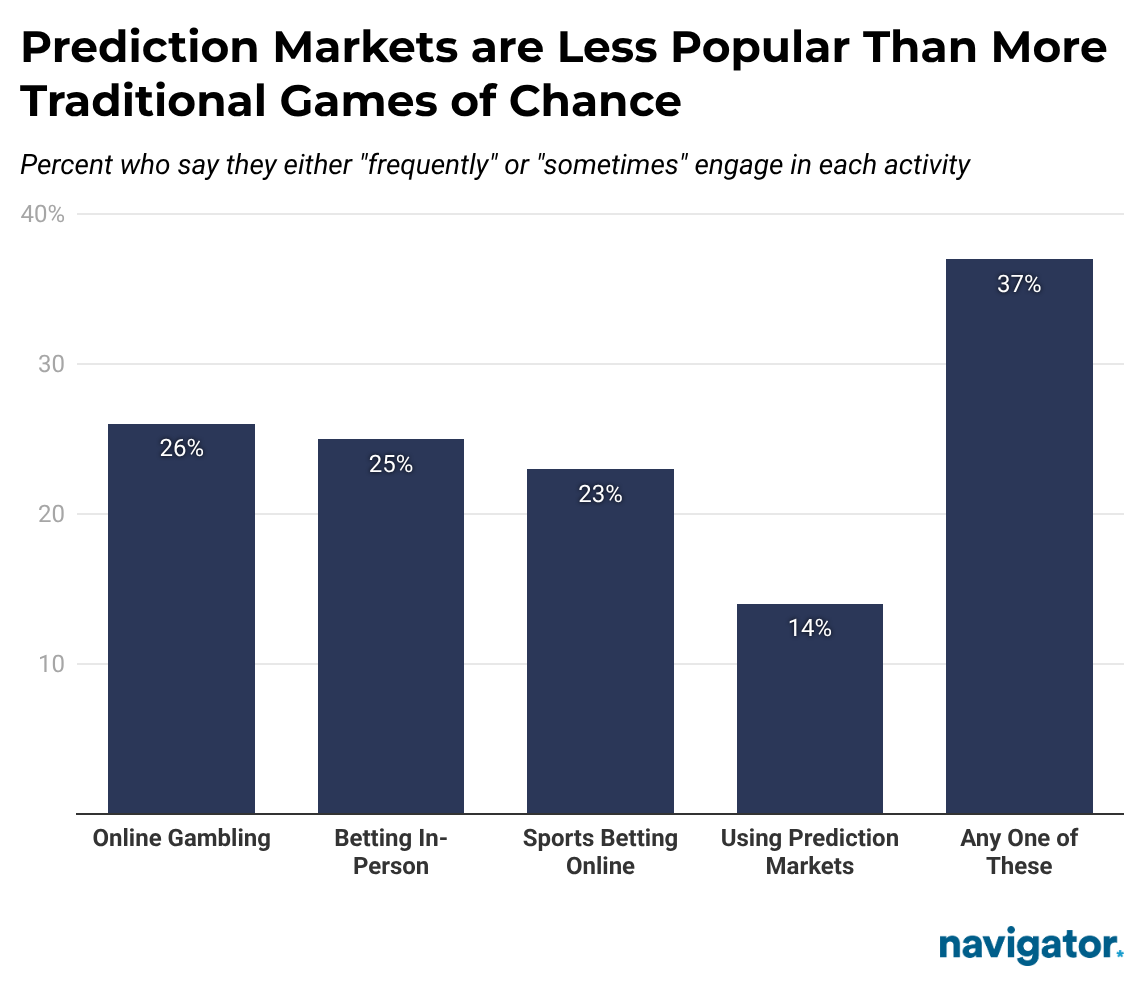
Overall, 37% of Americans are “frequently” or “sometimes” engaging in at least one of the four listed forms of gambling or prediction markets. About a quarter of Americans say they at least “sometimes” engage in online gambling, including casino games, or place bets in person (26% and 25%, respectively), while 23% report at least “sometimes” betting on sports online.
- Fewer Americans are using prediction markets. Only 14% report “sometimes” or “frequently” placing bets on prediction markets.
Younger Americans gamble more. Around four-in-10 Gen Z or Millennial Americans “frequently” or “sometimes” participate in online gambling (42% and 40%, respectively), while just a quarter of Gen X (25%) and 8% of Baby Boomers say the same.
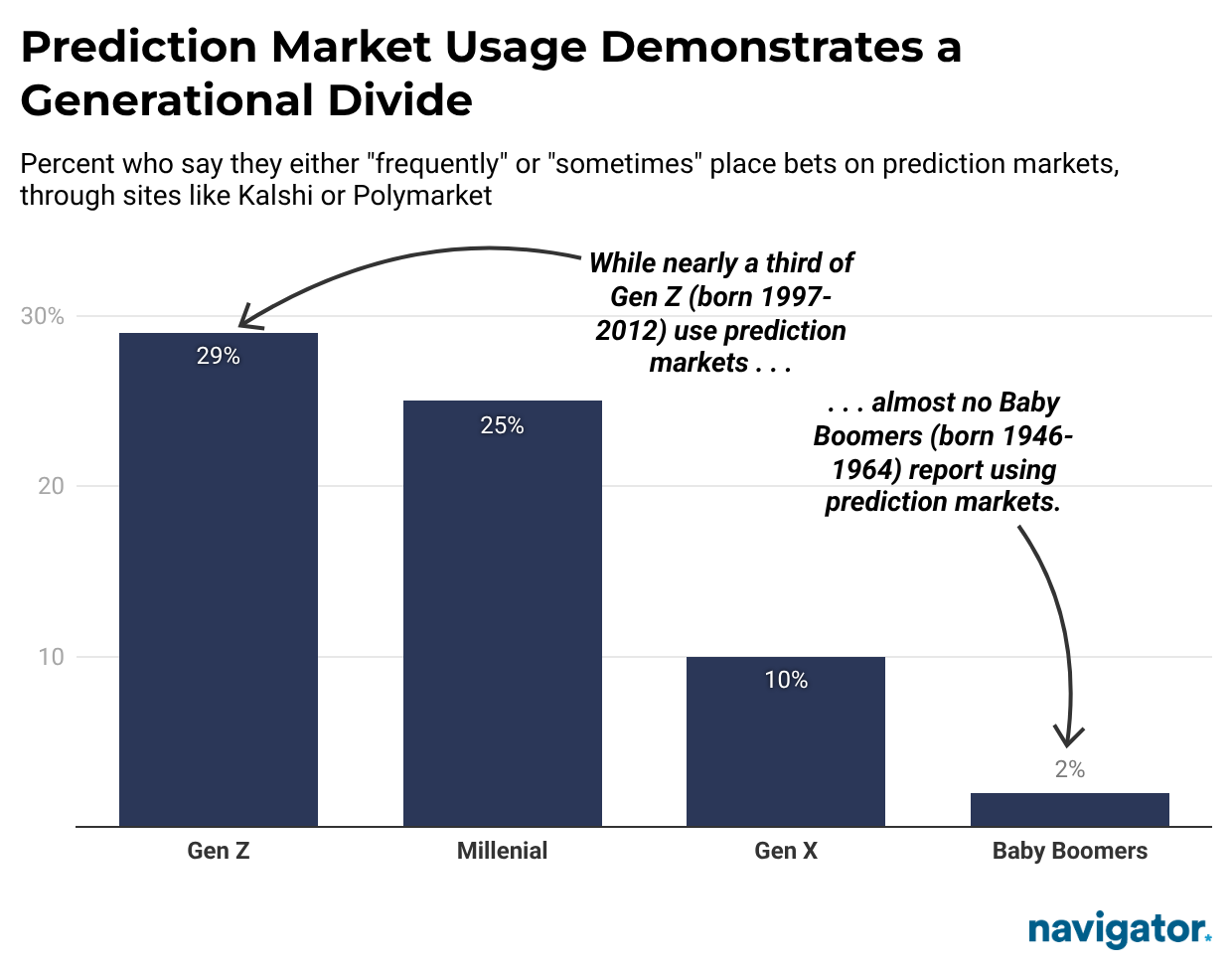
This is also true of prediction markets: 29% of Gen Z report using prediction markets, compared with just 2% of Baby Boomers.
Young men are especially likely to gamble or engage in prediction markets. Over half of men ages 18-34 report betting on sports online (53%), compared to 38% of women ages 18-34. Young men were also more likely to use prediction markets:
- 39% of young men (18-34) are using prediction markets.
- 23% of young women (18-34) are using prediction markets.
A Majority Feel Prediction Markets Should be Legal in Some Form, With Specific Regulations Receiving Broad Support
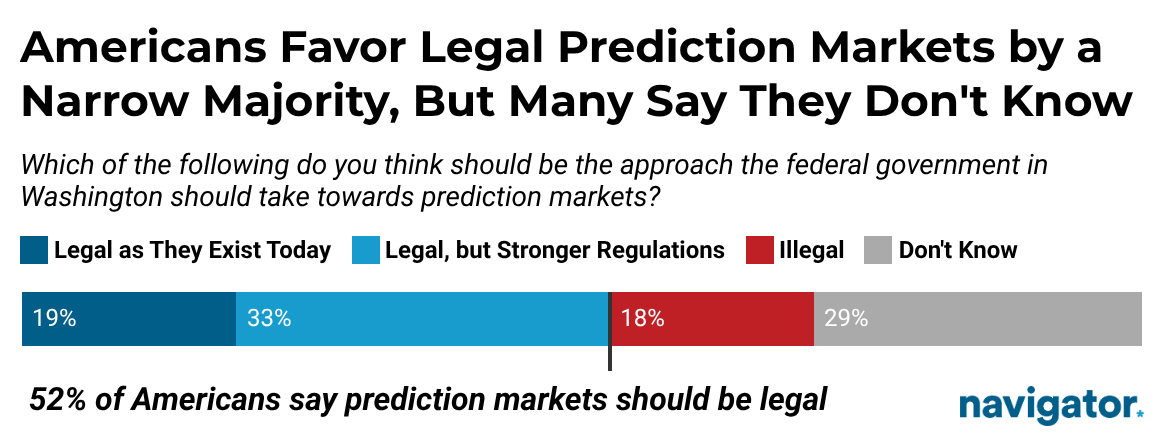
Overall, 52% of Americans say prediction markets should be legal in some capacity – with more preferring additional regulations over the status quo. A plurality of Americans say prediction markets should be legal but with stronger regulation and oversight (33%), while nearly one-in-five say prediction markets should be legal as they exist today (19%); a similar number say prediction markets should be illegal entirely (18%). Notably, almost a third of Americans say they “don’t know” how the federal government should approach prediction markets (29%).
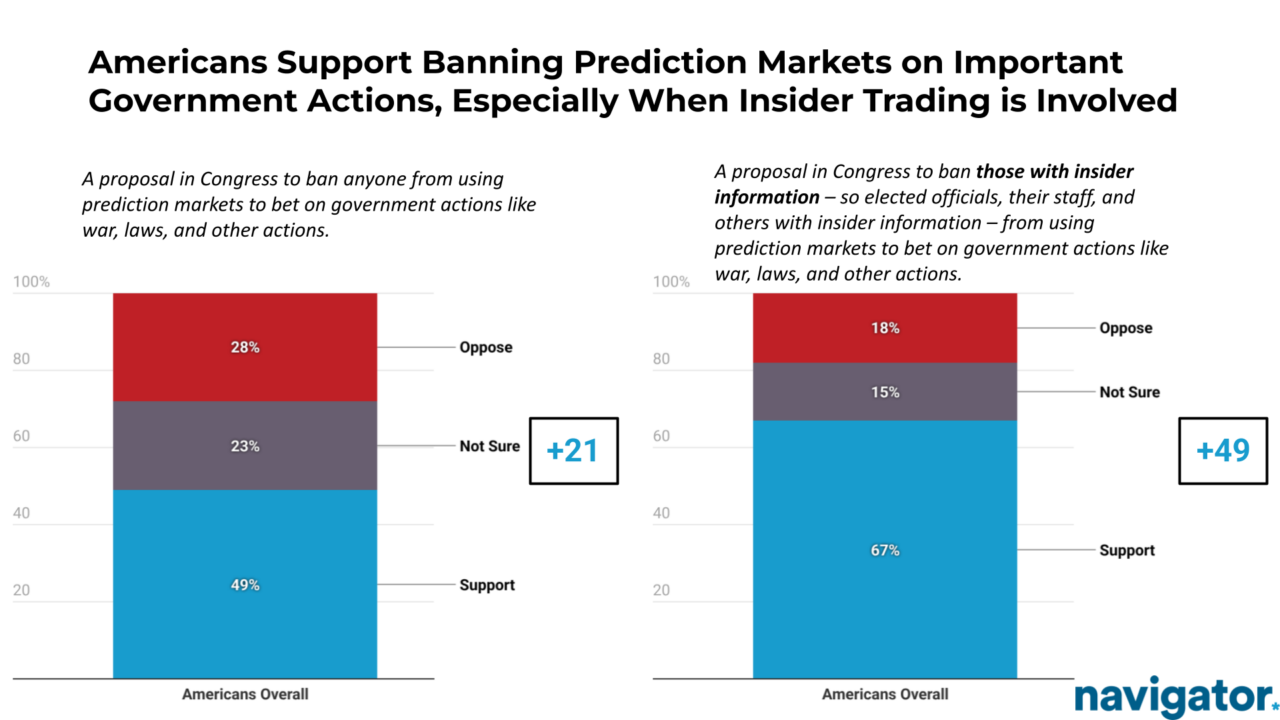
While many Americans support some form of legal prediction markets, banning those with insider information from engaging in markets on government actions is strongly supported.
- Americans support Congress banning anyone from using prediction markets to bet on government actions like war, laws, and other actions by net 21 points (49% support – 28% oppose). Nearly a quarter of Americans say they are “unsure” if they would support such a policy (23%).
Americans support Congress banning anyone with insider information – so elected officials, their staff, and others with insider information – from using prediction markets to bet on government actions like war, laws, and other actions by net 49 points (67% support – 18% oppose).
Although men are more supportive than women of keeping prediction markets legal in general (61% of men say legal – 45% of women say legal), they are also more supportive of a policy limiting those with insider information from using prediction markets. Men support banning individuals with insider information from using prediction markets by net 61 points (76% support – 15% oppose), while women support the same by 39 points (59% support – 20% oppose).