Majorities Are Hearing About Flock Cameras and are Both Concerned and Opposed to Their Use
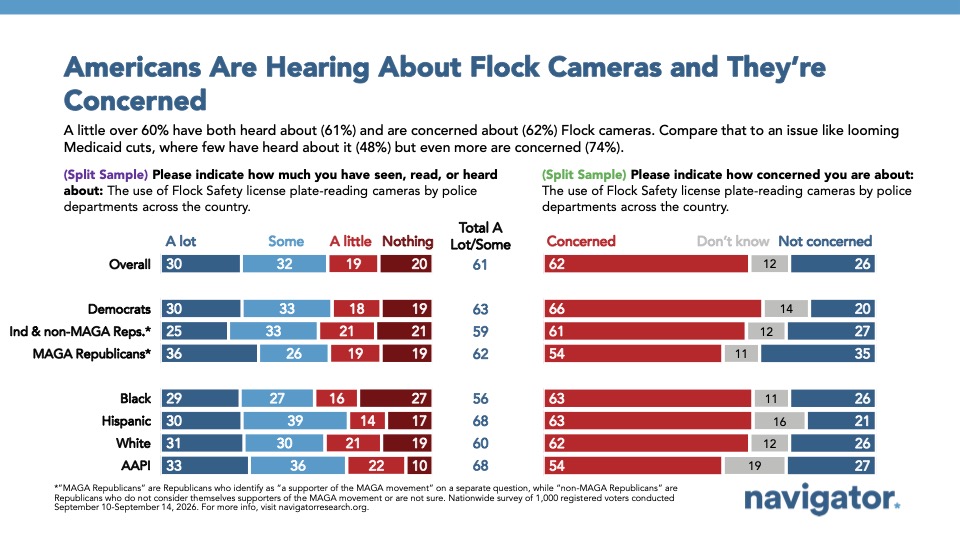
Flock cameras have caught the attention of a majority (61%) of Americans after recent stories in the media about Flock being used improperly by law enforcement and to search for women traveling to obtain abortion care. By a 13-point margin, more Americans have heard about the use of Flock cameras than have heard about Medicaid cuts set to go into effect next year (48%).
Americans aren’t just hearing about Flock cameras, they’re concerned. 62% are concerned by the use of Flock cameras, including majorities across party lines; majorities of independents (70%), Democrats (66%) and Republicans (55%) are concerned about Flock camera use.
- Men are especially concerned about the use of Flock cameras (67% men – 56% women). At twice the rate as men (8%), women (16%) say they don’t know enough to say.
- Midwesterners are most concerned about Flock camera usage (66%) compared to those from the South (63%), Northeast (58%), and West (57%).
- Nearly seven-in-10 Gen Z Americans are concerned about Flock camera use (69%), compared to 56% of baby boomers.
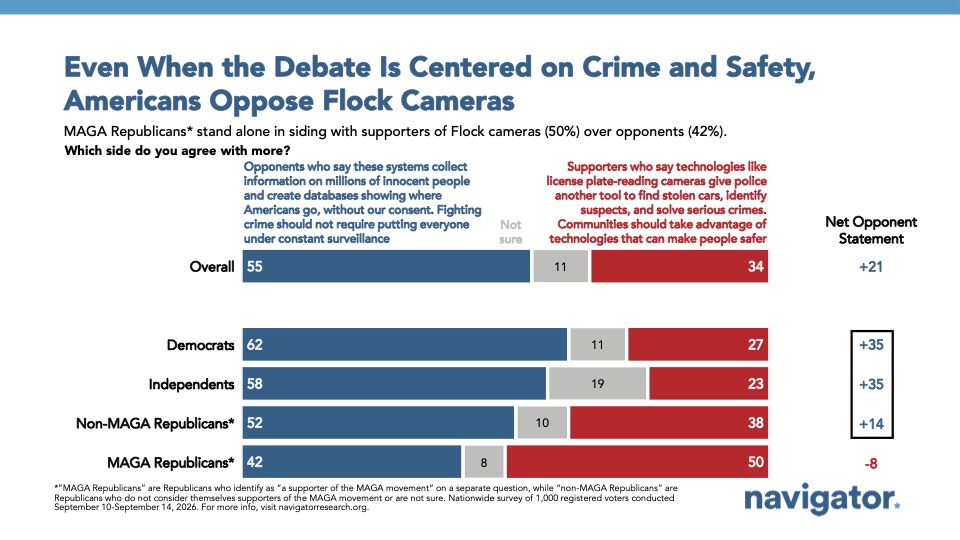
By a 23-point margin, Americans are opposed to Flock camera usage by police departments; however, nearly one-in-five (17%) are unsure. MAGA Republicans are the only partisan group where a plurality supports Flock cameras (46% support – 40% oppose).
- Younger Americans ages 18-34 are especially opposed to Flock camera use by police departments (57% of 18-34 year olds, 50% of those 55+).
- Midwesterners are particularly opposed (60%) to Flock camera use by police departments, compared to those from the South (53%), Northeast (52%) and West (47%).
Americans’ Primary Unease With Flock Cameras Revolves Around Surveillance
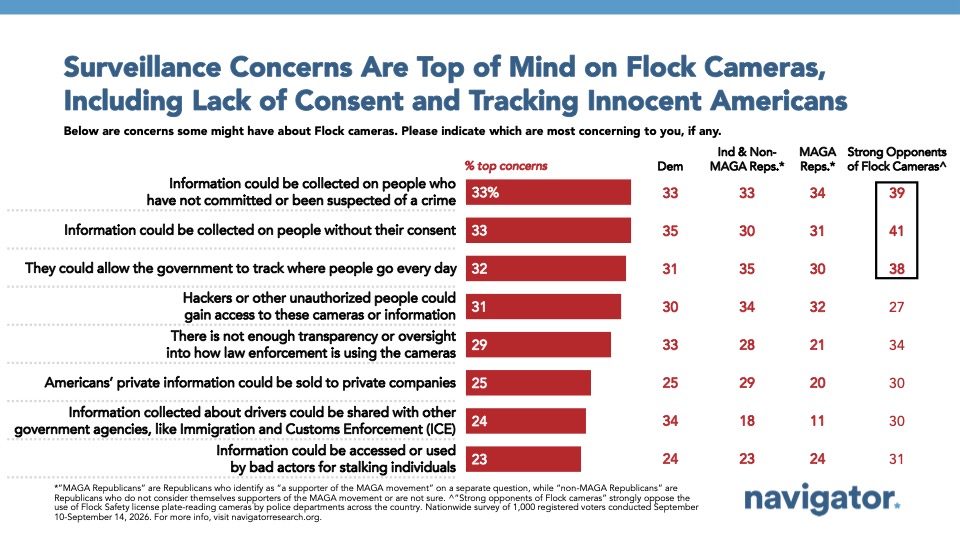
Americans’ top concerns with Flock cameras revolve around surveillance. When asked to choose the top three from a list of eight, a third worry information could be collected on people who have not committed or been suspected of a crime (33%) or without their consent (33%), and that Flock cameras could allow the government to track where people go every day (32%).
There are some demographic differences regarding unease with Flock cameras, including:
- White Americans are most concerned about information being collected on people without their consent (34%) and the government being allowed to track where people go every day (34%).
- Black Americans (38%) and Hispanic Americans (38%) are most concerned about hackers or other unauthorized people gaining access to these cameras or information. Black Americans’ second greatest concern is information collected on people who have not committed or been suspected of a crime (34%), while for Hispanic Americans, it is information being collected without consent (34%).
- A sizable share (29%) of Hispanic Americans worry that information collected about drivers could be shared with other government agencies, like Immigration and Customs Enforcement.
- While Flock cameras have gained traction in the news due to police misconduct and concerns about their use to enforce stringent abortion bans, surprisingly, about an even share of women (24%) and men (23%) worry about information being accessed by bad actors for stalking individuals.
A Majority of Americans Say Putting Everyone Under Surveillance in the Name of Fighting Crime is Going Too Far
When pitted against a safety argument, a majority of Americans (55% agree) say that fighting crime should not require putting everyone under constant surveillance and collecting information on millions of innocent Americans. This sentiment resonates especially with younger Americans (60%).