
As the United States marks its 250th anniversary, Americans find themselves and our country at a political tipping point. Political divisions run deep, frustration with Washington is widespread, and patriotism has hit historic lows.
Against this backdrop, the administration’s “Freedom 250” celebration reflects a particular vision of America rooted in a white Christian identity and nostalgia for a pre-civil rights history. But when Americans are asked what patriotism means to them, a far more nuanced picture emerges.
This report, and our forthcoming series, explores that gap between the way America is being celebrated and portrayed by this administration, and the America people believe in.
Being American Is Deeply Tied To Personal Identity, And Many Express Pride at Progress Made
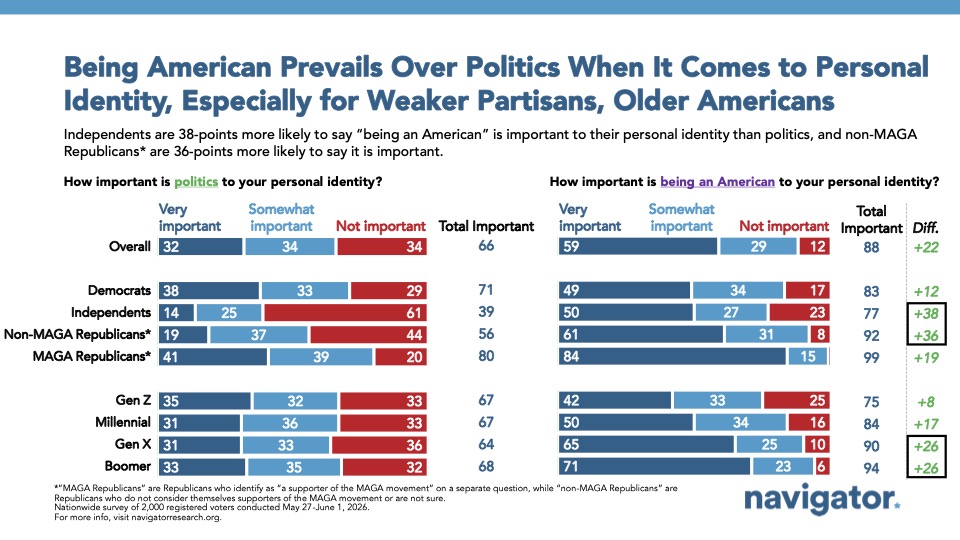
Nearly nine-in-10 (88%) say being American is very or somewhat important to their personal identity, compared to just 66% of Americans who say politics is important to their personal identity.
- 85% of immigrants say being American is important to their personal identity, including 51% who feel it’s very important.
- 94% of baby boomers feel being American is important to their personal identity, compared to 84% of millennials and 75% of Gen Z.
- 83% of Democrats say being American is important to their personal identity, compared to 77% of independents and 95% of Republicans.
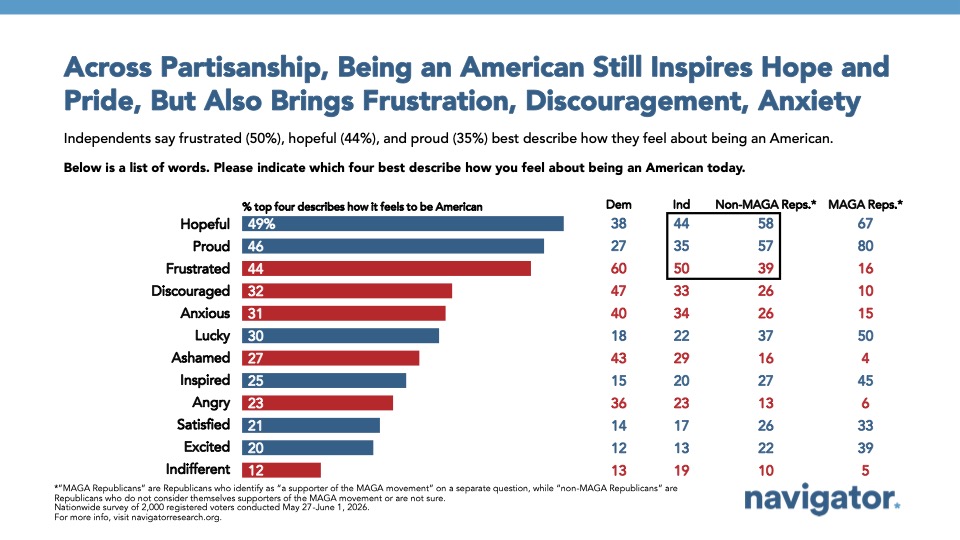
People feel hopeful (49%) and proud (46%) about being an American today, though many also feel frustrated (44%), discouraged (32%), or anxious (31%).
- Independents and non-MAGA Republicans are especially primed to feel hopeful, proud, though frustrated about being an American today.
When we asked focus group participants if they think America is the greatest country on earth, reactions were mixed, but many believe that status is at risk of being taken away.
“As a retired military member, I’m flushed with patriotism. So when I hear being American, it’s almost like I’m a part of the winning team. I’m on the right side. I’m on the good side. I’m the good guys. To me, it’s the greatest country in the world and I am so grateful to be a part of it.” – TX man, white veteran strong Democrat
“I think America still is the greatest country, but…it’s definitely declining, especially from an economic perspective….Starting off on your own, getting a house, starting a family, it’s extremely hard nowadays.” – PA man, 2nd generation soft Republican
“I have faith and high hopes that America will be great again. I think we have to hit rock bottom, pick ourselves up and get better. And I have hopes that better days are coming.” – MS woman, white Christian soft Democrat
Americans Are Divided on the Direction of Our Country
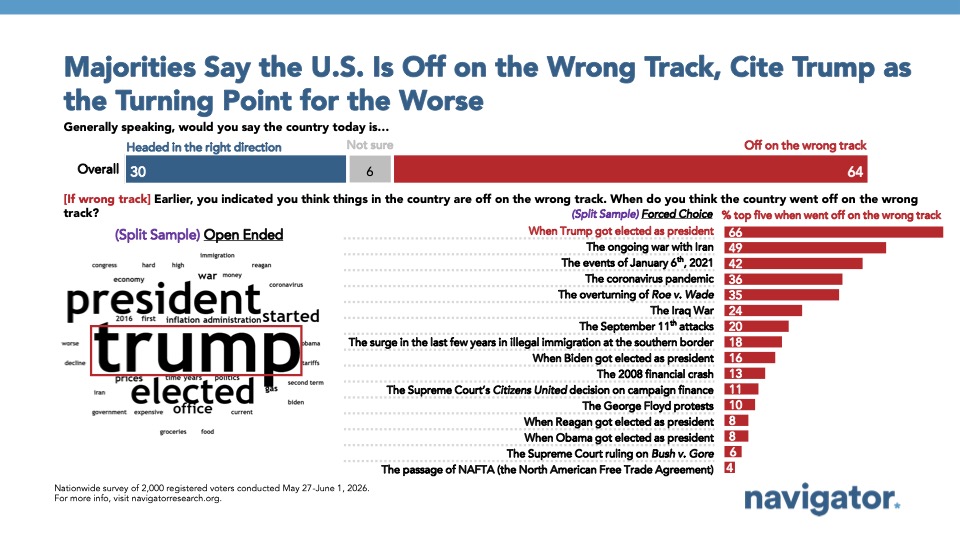
Nearly two-thirds (64%) of Americans say the country is on the wrong track, and 16% doubt the United States will exist at all in 250 years. Only one-third (30%) of Americans believe the country is headed in the right direction, with modest optimism about the longer-term future: 37% expect the country to be better off in 20 years and 33% in 250 years. Among those who see the country headed in the wrong direction, the most commonly cited concerns shared in their own words were Trump, war, inflation, and prices.
Of those who feel the country is off on the wrong track:
- 66% cite Trump’s election as the turning point.
- 49% cite the war with Iran.
- 42% cite the events of January 6, 2021.
When asking if they feel America’s best days are ahead of us, behind us, or happening now, responses remain mixed, but almost no one feels America’s best days are happening now.
“I truly believe that because we’re so young, again, we’re babies in this world, in the United States, that we’re judging things on a very small scale. Countries have had thousands of years of history. We have a long way to go, but again, I think we’re trending in the right direction.” – PA man, Black veteran, strong Democrat
“I think the best days of America were back then. It’s hard to live the American dream—home, car, family. It just seems impossible these days.” – TX man, 2nd generation, independent lean Democrat
“I’m a huge optimist….I think we’re making some progress and I think we’re all working towards that more perfect union and that shining city on the hill.” – PA man, white veteran strong Republican
Americans Are Proud Of Our Founding and the Progress that Followed
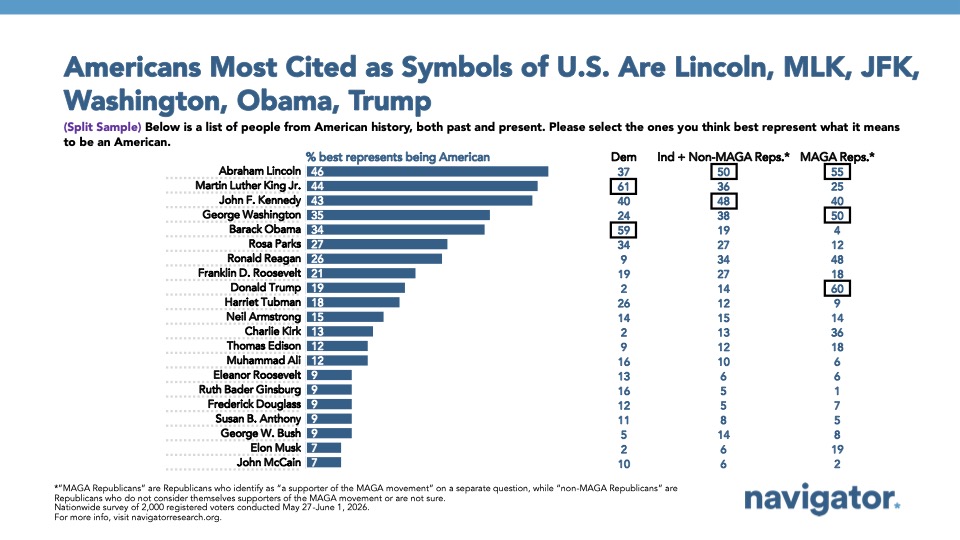
Both in their own words and selecting from a list of current and historical figures, Abraham Lincoln (46%), Martin Luther King Jr. (44%), John F. Kennedy (43%), George Washington (35%), and Barack Obama (34%) stand out as the figures who most represent what it means to be American.
- While Democrats heavily favored Martin Luther King Jr. (61%) and Barack Obama (59%), independents and non-MAGA Republicans favored Abraham Lincoln (50%) and John F. Kennedy (48%).
- MAGA Republicans stand alone in favoring Donald Trump (60%) and Ronald Reagan (48%).
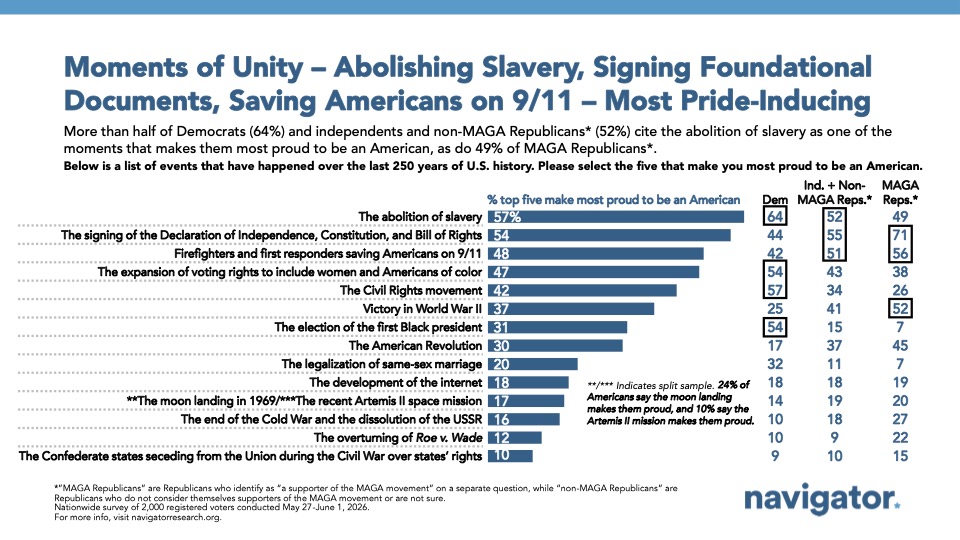
On events over the last 250 years, the abolition of slavery (57%) and the signing of our founding documents (54%) made people feel most proud to be an American. The abolition of slavery was a top choice for both Democrats (64%), independents, and non-MAGA Republicans (52%). The signing of our founding documents was the clear top choice for MAGA Republicans (71%).
On a personal level, holidays and milestones bring out a deep sense of pride for many Americans. From stories of celebrating with family to a participant’s naturalization ceremony, Americans find moments of pride and joy in their country.
Moderator: Tell me about times or a time you celebrated being American, or feel or felt most American.
“Martin Luther King Day just because I just found out a couple of years ago that Martin Luther King Day, you’re supposed to volunteer on that day. So to me, when I found out like, ‘oh, I should definitely do that.’ So now I drag my son and we do stuff to volunteer.” – PA man, white Christian soft Democrat
“When I hear ‘Taps,’ it still brings me to tears because it means so much to those that gave their lives in combat to protect what we have today. That’s what makes me feel American because I know people are willing to give their lives and fight for what we believe.” – OH man, white Christian independent
“When I was able to marry…..I felt that we were being seen as a person and not as a sin anymore. And so yeah, being given the right to marry made me celebrate being American.” – TX man, Hispanic strong Democrat
“When I first saw the Statue of Liberty in person. That was kind of like, ‘okay, I have arrived’ kind of thing. So that was really the most American I felt, and it was really an overwhelming feeling of pride, of happiness, as well as, I don’t know, a connection.” – MI woman, 1st generation independent lean Republican
Americans Are Strongly Aligned On Shared Values Of Freedom, Helping Each Other
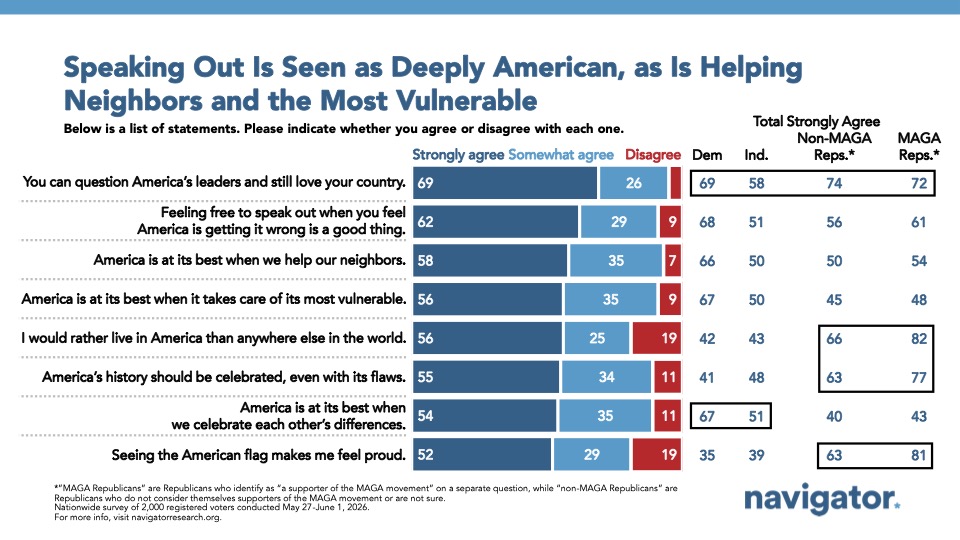
Americans across demographics strongly agree with values centered on protecting freedoms and helping each other.
- 69% strongly agree that you can question America’s leaders and still love your country.
- 62% strongly agree that feeling free to speak out when you feel America is getting it wrong is a good thing.
- 58% agree that America is at its best when we help our neighbors.
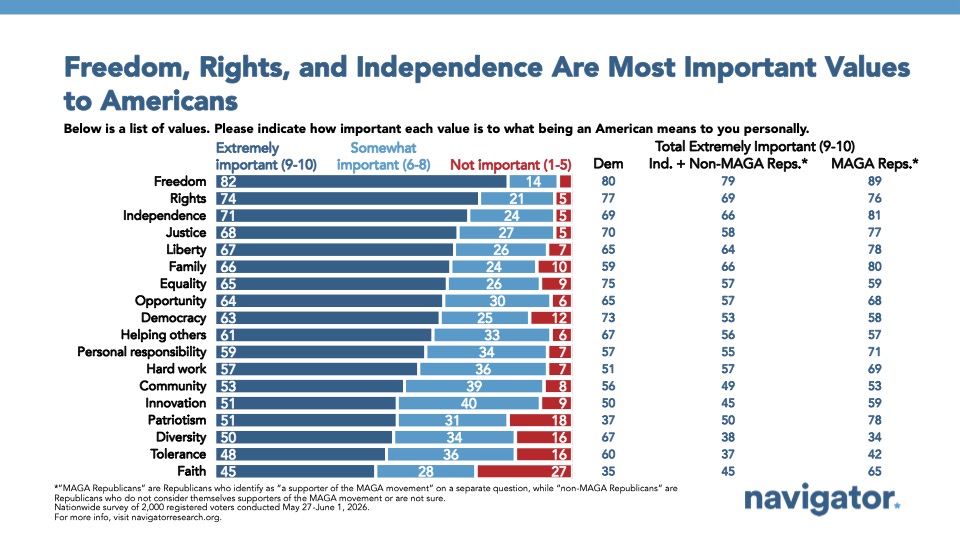
Freedom (82%), rights (74%), and independence (71%) rank as the most important values to Americans’ personal sense of what it means to be American. While Americans associate rights more closely with the Democratic Party, Democrats hold only a narrow advantage, or in some cases are at a slight disadvantage, on freedom and independence.
Freedom of speech (65%), the right to vote (53%), and freedom of religion (44%) are the rights and freedoms that Americans think are most important. Independents and non-MAGA Republicans especially value freedom of speech (69%) above all others. Freedom of speech (51%) is also the right that Americans feel are most under threat right now, including from Democrats (51%), independents and non-MAGA Republicans (47%), and MAGA Republicans (55%).
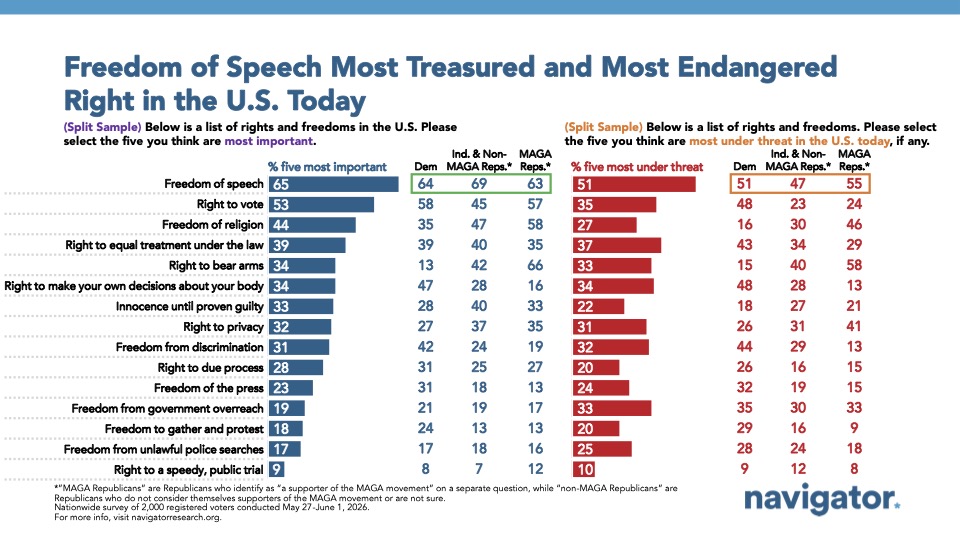
The value of freedom of speech is deeply aligned across the political spectrum. In a focus group, a strong Democrat and strong Republican shared similar sentiments on the importance of freedom and acceptance.
“Being in America, everybody has a right to do what they want and say what they want as long as it’s not infringing upon anybody else. It would be boring if we were all the same, but one thing we need to do and we must do is respect each other’s opinion.” – PA man, Black veteran strong Democrat
“The shared values would be the freedom to express, whether it’s religion, your speech, anything of that sort….And also I would say the diversity. It’s a country that is based on accepting people.” – TX woman, Hispanic strong Republican
The Symbols and Values That Most Evoke Pride in Americans
Images of our founding documents (93%) or a veteran returning home (94%) evoke deep feelings of patriotism for people across demographics. And many Americans (41%) say they display the American flag.
“I still got a lot of warm feelings towards the flag….For me, the flag is tied up in what we want to be. And I think that Americans want to be kind. We want to be generous. We want to be neighborly. We want to get along with each other and we want a fair shake at providing for ourselves and our families….To me, the flag represents the dream.” – MI man, white veteran strong Democrat
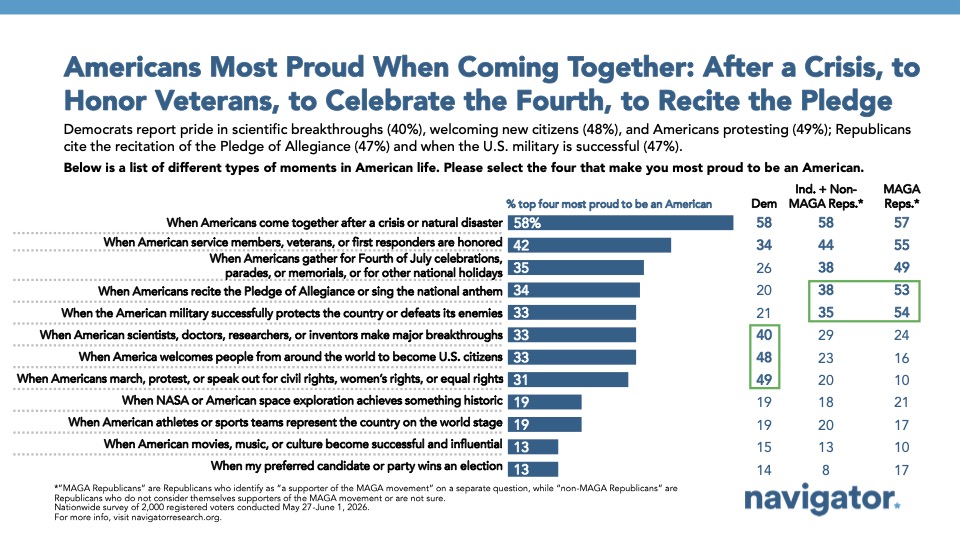
Americans are also most proud in moments of unity, when people come together after a crisis (58%) or when service members, veterans, and first responders are honored (42%).
- 43% of Black Americans are proud when people march, protest, or speak out for civil and equal rights, but almost one-in-10 (9%) are not proud of any of the options given.
- 48% of AAPI Americans are proud of America’s scientific innovation.
- While only a small minority of Democrats (4%) and Republicans (3%) don’t feel proud of any of the options given, 13% of independents are more pessimistic in sharing this sentiment.
The American Dream Is Achievable, But Harder Today Than It Has Ever Been
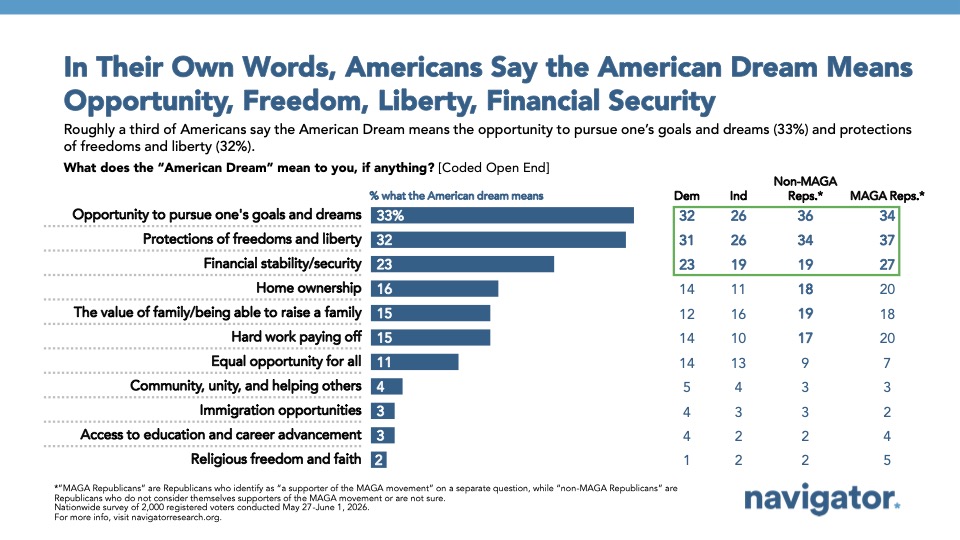
To Americans, the American dream is about opportunity, freedom, and financial security.
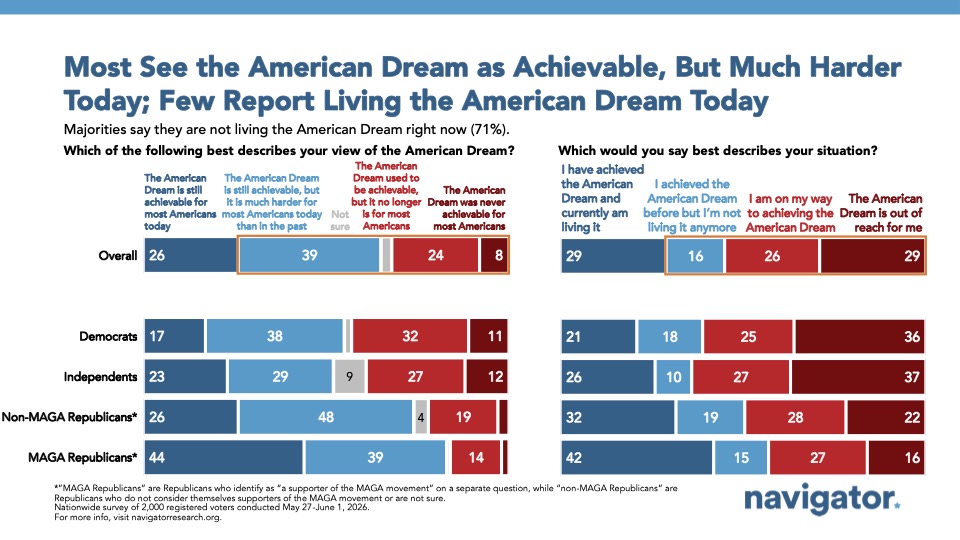
However, only about a quarter (26%) feel that the American dream is still achievable, while 39% feel it is much harder for most Americans today to achieve and 24% feel it is no longer achievable for most today.
“I think my parents are the epitome of the American dream. My dad and mom came with a suitcase and a couple hundred bucks, and then not even 10 years later, they owned their own house, they had me, both got stable jobs, just working hard. And I feel like nowadays I don’t think you can do that anymore.” – PA man, 2nd generation, Republican
- Hispanic Americans (32%) especially feel the American dream used to be achievable but is no longer achievable today.
- Second generation Americans (34%) also feel the American dream used to be achievable but is no longer achievable today compared to just 22% of first generation immigrants.
- Baby boomers are 10 points more than Americans overall to feel the American dream is still achievable, though harder today.
- Nearly one-in-three Americans (29%) feel that the American dream is out of reach for them.
America at 250, A Work in Progress
Two and a half centuries in, Americans are neither naive nor defeated. They see the cracks, and they still bet on the future. The country’s defining trait isn’t agreement, it’s a refusal to stop striving for a better tomorrow.
And when Navigator asked what would you put in a time capsule for future generations to find, one veteran shared:
“The Constitution….’Boys and girls, just in case you forgot, this is where we came from and this is where we’re supposed to stay with.’” – TX man, white veteran strong Democrat