
The Values That Define America
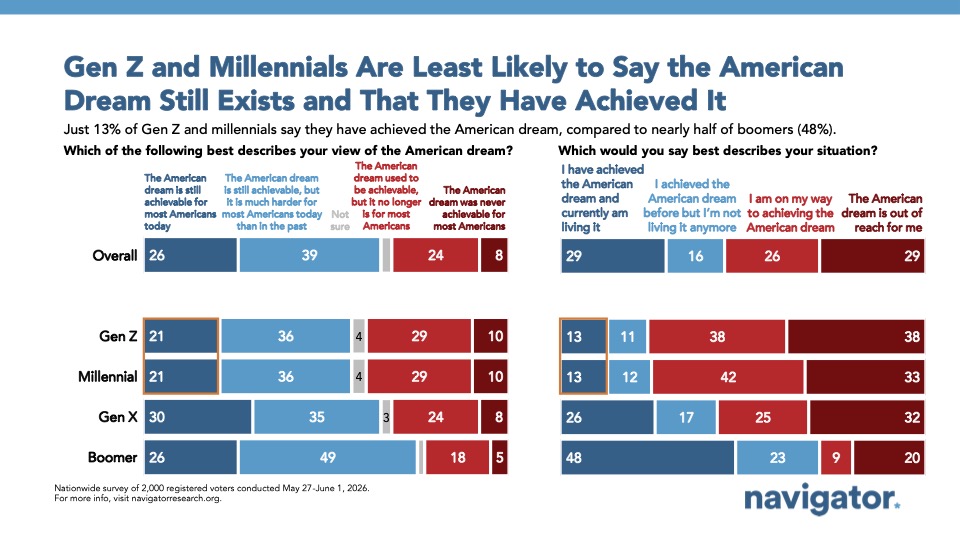
Nearly all Americans agree that freedom is the most important value to being an American, including eight-in-10 who say it is extremely important.
- Older Americans especially place value on freedom (Gen X 83%, Baby Boomer 89%), independence (Gen X 70%, Baby Boomer 83%), family (Gen X 69%, Baby Boomer 75%), and faith (Gen X 47%, Baby Boomer 54%).
- Younger generations place value on freedom (Gen Z 70%, millennial 78%), equality (Gen Z 70%, millennial 63%), and diversity (Gen Z 52%, millennial 53%).
The People That Define America
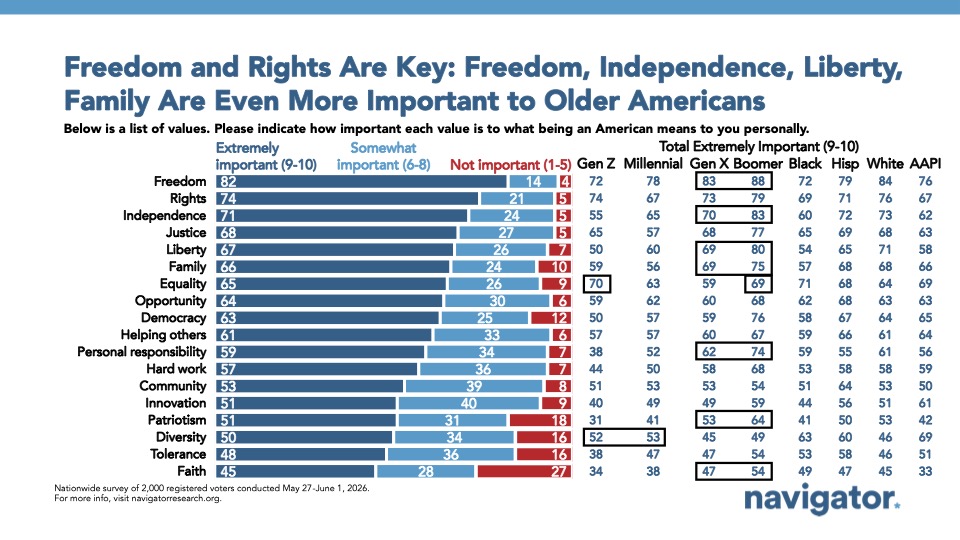
When asked who best represents what it means to be American, people drew inspiration both from the country’s founding and the progress we have made towards equality.
- Abraham Lincoln (46%), Martin Luther King Jr. (44%), John F. Kennedy (43%), George Washington (35%), and Barack Obama (34%) stand out as the figures who most represent what it means to be American.
- Gen X and Baby Boomers are more likely to point to past presidents like Abraham Lincoln, John F. Kennedy, and George Washington.
- Gen Z are more likely to point to civil rights leaders like Martin Luther King Jr. or Rosa Parks.
The Images That Define America
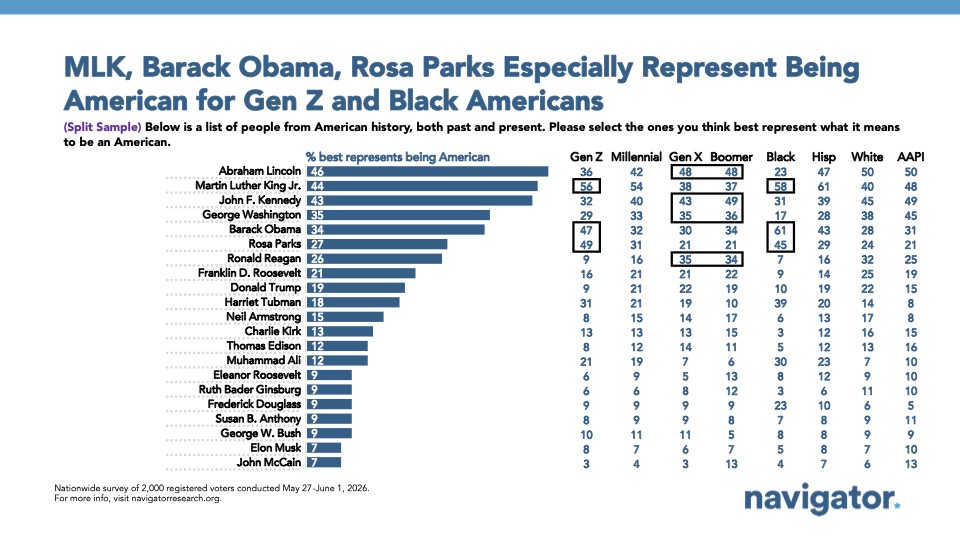
Images of our founding documents (72%) or a veteran returning home (71%) evoke deep feelings of patriotism for Americans, while other images evoke stark ideological divides.
- Democrats and independents see protest as patriotic, 64% and 41% respectively.
- Republicans see the Bible and flag as more patriotic, including 63% and 56% of non-MAGA Republicans respectively.
- Older Americans are more likely to identify with images of the flag, Bible, or veterans, whereas younger generations more identify with images of protest.
Defining Personal Identity
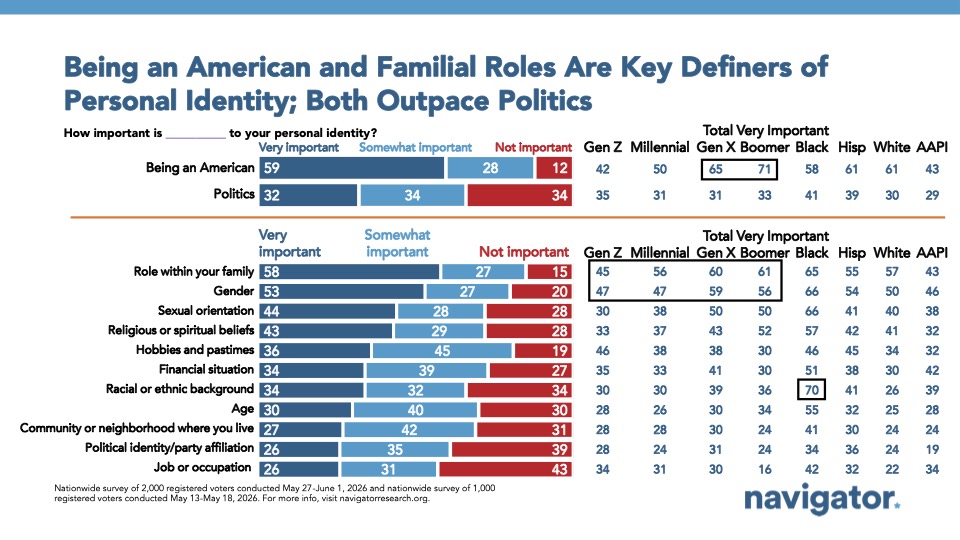
Over half (59%) say being American is very important to their personal identity, compared to just 32% of Americans who say politics is very important to their personal identity.
- 71% of Baby Boomers and 65% of Gen X feel being American is very important to their personal identity, compared to 50% of millennials and 75% of Gen Z.
Familial roles, gender, and hobbies and pastimes are also core parts of American identity.
- 60% of Gen X and 61% of Baby Boomers feel their role within their family is very important to their personal identity, compared to 45% of Gen Z and 56% of millennials.
- 46% of Gen Z feel their hobbies and pastimes are very important to their personal identity, compared to just 30% of Baby Boomers.
Participating In Civic Life
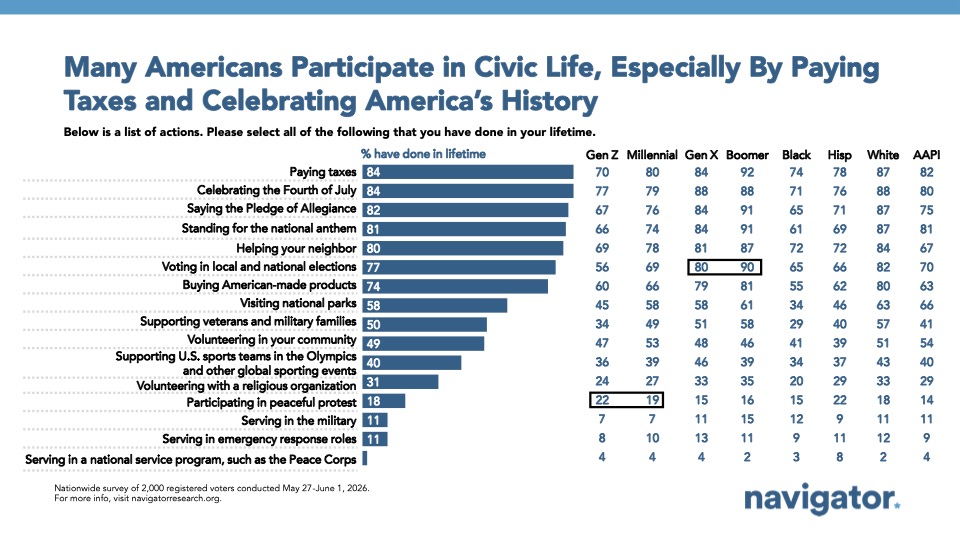
Americans engage in civic life through many different facets—from paying taxes (84%) to celebrating the 4th of July (84%) to standing for the national anthem (81%) to helping our neighbors (80%).
- White and older Americans are more likely to have participated in actions that are more traditionally defined as patriotic, like saying the Pledge of Allegiance or standing for the national anthem.
- Younger Americans are more likely to have participated in peaceful protest (22% Gen Z, 19% millennials – 15% Gen X, 16% Baby Boomer).
- While 80% of Gen X and 90% of Baby Boomers have voted in local and national elections, only 69% of millennials and 56% of Gen Z report doing the same.
The American Dream
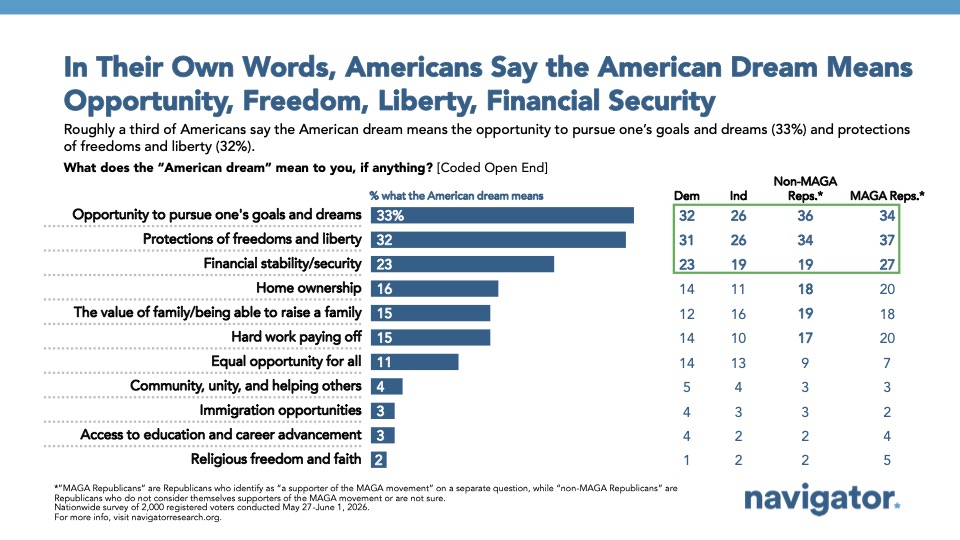
To Americans, in their own words, the American dream is about opportunity, freedom, and financial security.
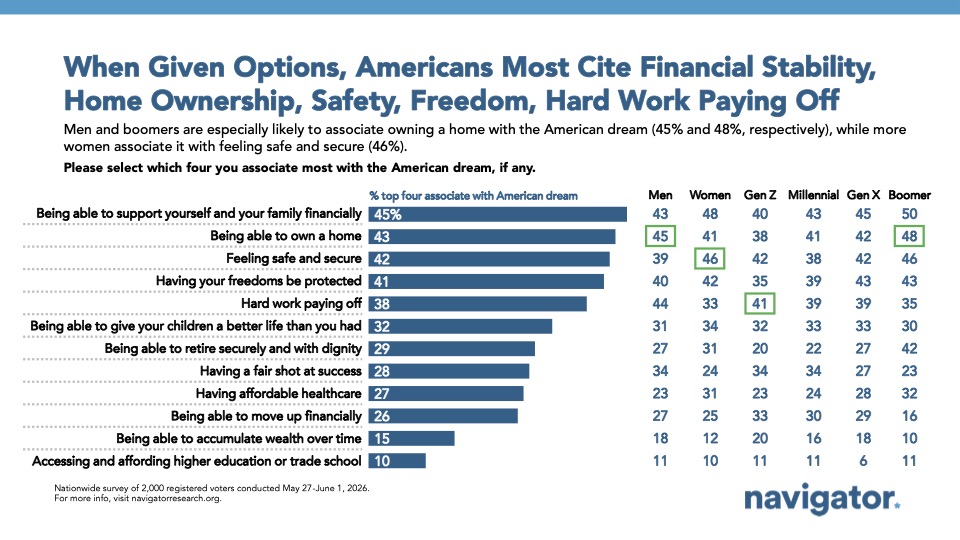
When given options, Americans most associate the American dream with financial security and protection of freedoms.
- Being able to support yourself and your family financially (45%), owning a home (43%), feeling safe and secure (42%), and protecting freedoms (41%) are most associated with the American dream for Americans overall.
- Older men are more likely to identify home ownership with the American dream, while women identify more with safety and security.
- Gen Z are more likely to view the American dream as when hard work pays off.
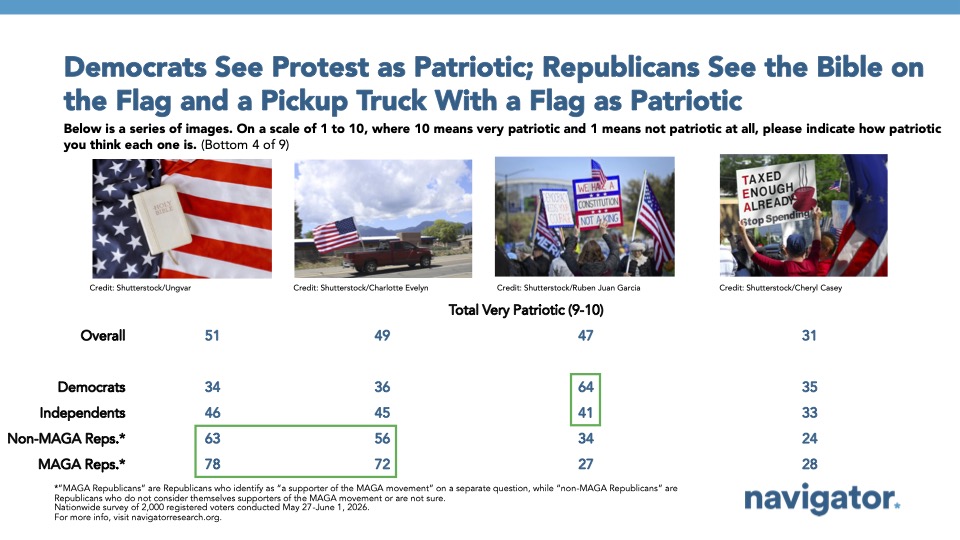
Yet optimism about actually achieving the American dream is limited. Only a quarter (26%) feel that the American dream is still achievable, while two-thirds (39%) feel it is much harder for most Americans today to achieve and 24% feel it is no longer achievable for most today.
Less than a third (29%) of Americans feel that they have achieved the American dream and are currently living it, while the same number (29%) feel the American dream is out of reach. About a quarter (26%) of Americans feel that they are on their way to achieving the American dream. About one-in-six (16%) feel that they have achieved it at one point but are no longer living it.
- Younger Americans are the most pessimistic: Gen Z and millennials are least likely to feel that the American dream is achievable and that they have personally achieved the American dream.
- Even older Americans, including nearly half (49%) of Baby Boomers, recognize the American dream may be achievable but is much harder today than it has been in the past.